
In mechanical transmission systems, spur gears are widely used due to their simplicity and efficiency. However, under operational conditions, factors such as machining errors, assembly misalignments, shaft deformations, and torsional effects can lead to uneven load distribution along the tooth width, resulting in edge contact and stress concentration—a phenomenon known as deflected load. This significantly impacts the contact and bending strength of spur gears, potentially causing premature failure like pitting or tooth breakage. To mitigate these issues, tooth modifications, such as drum-shaped profiling, are often applied. This study investigates the effects of drum-shaped modification and deflected load on the stress distribution and strength of spur gears using finite element analysis. The goal is to understand how these factors interact and optimize gear design for enhanced durability and performance. Throughout this analysis, the focus remains on spur gears, as they represent a fundamental gear type in many applications.
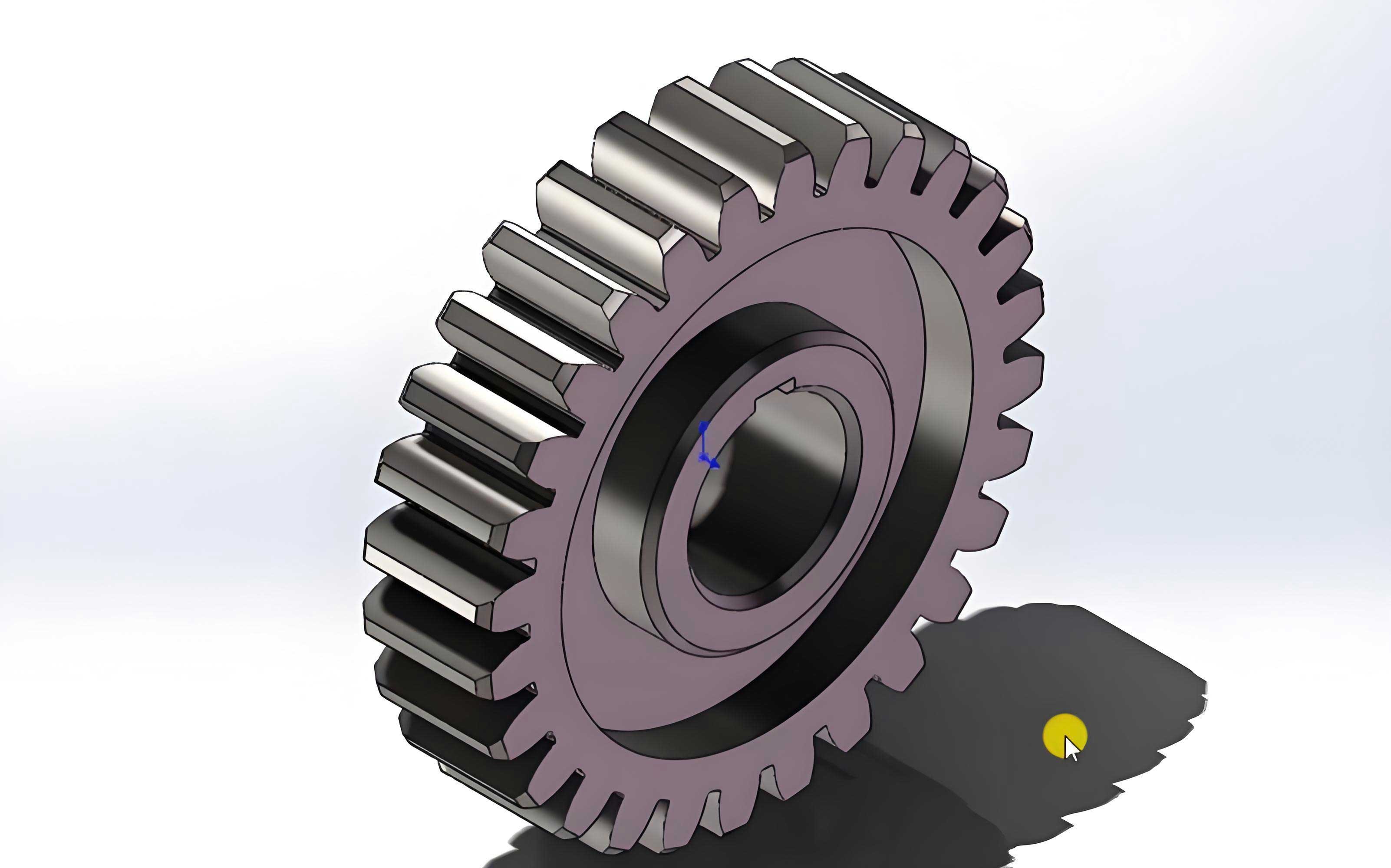
To begin, a three-dimensional model of a spur gear pair was developed based on standard geometric parameters. The gears are designed with involute tooth profiles, and their key specifications are summarized in Table 1. These parameters are typical for industrial spur gears, ensuring realistic simulation conditions. The material properties, including elastic modulus and Poisson’s ratio, are assigned to model steel gears commonly used in power transmission.
| Parameter | Value |
|---|---|
| Number of teeth (pinion) | 35 |
| Number of teeth (gear) | 37 |
| Module (mm) | 2 |
| Pressure angle (°) | 20 |
| Addendum coefficient | 0.8 |
| Dedendum coefficient | 0.3 |
| Face width of gear (mm) | 9.3 |
| Face width of pinion (mm) | 19.5 |
| Elastic modulus (MPa) | 206,000 |
| Poisson’s ratio | 0.29 |
The finite element model was constructed using Abaqus software. The gears were meshed with refined elements in the contact regions to ensure accuracy in stress calculations. Boundary conditions were applied to simulate real operating conditions: a rotational displacement of 0.85 rad was imposed on the gear’s central node, while a torque of 100 N·m was applied to the pinion’s central node. This setup allows the spur gears to engage under load, replicating typical transmission scenarios. The analysis focuses on the gear (larger wheel) as it experiences higher stress concentrations due to its smaller face width relative to the pinion.
The initial analysis without any modification or deflected load revealed significant edge contact stress on the spur gears. The contact stress distribution showed peak values at the highest point of single tooth engagement, with elevated stresses near the tooth edges. Similarly, bending stress at the tooth root was maximum at the mid-width region. This baseline behavior highlights the inherent susceptibility of spur gears to edge loading under ideal conditions. The stress distributions can be represented mathematically. For contact stress, the Hertzian contact theory provides a foundation, but finite element analysis offers more precise results for complex geometries like spur gears. The bending stress can be approximated using the Lewis formula, though it neglects stress concentrations. In this study, stresses are computed directly from the finite element model.
The contact stress \(\sigma_c\) and bending stress \(\sigma_b\) are critical metrics for spur gear strength. They can be expressed in terms of load and geometry. For instance, the nominal contact stress for spur gears is given by:
$$ \sigma_c = \sqrt{\frac{F_t}{b \cdot d_1} \cdot \frac{u \pm 1}{u} \cdot \frac{E}{\pi \cdot (1 – \nu^2)} \cdot \frac{1}{\cos \alpha \cdot \sin \alpha}} $$
where \(F_t\) is the tangential load, \(b\) is the face width, \(d_1\) is the pinion pitch diameter, \(u\) is the gear ratio, \(E\) is the elastic modulus, \(\nu\) is Poisson’s ratio, and \(\alpha\) is the pressure angle. However, this formula assumes uniform load distribution, which is not the case in practice due to deviations like deflected load. Similarly, bending stress is often calculated as:
$$ \sigma_b = \frac{F_t}{b \cdot m} \cdot Y_F \cdot Y_S $$
where \(m\) is the module, \(Y_F\) is the form factor, and \(Y_S\) is the stress correction factor. These equations underscore the importance of load distribution along the tooth width for spur gears.
To quantify the initial stress state, Table 2 presents the maximum contact and bending stresses from the finite element analysis for the unmodified spur gears under no deflected load. These values serve as a reference for subsequent comparisons.
| Stress Type | Maximum Value (MPa) | Location |
|---|---|---|
| Contact Stress | 1460 | Tooth edge at highest engagement point |
| Bending Stress | 348.4 | Tooth root at mid-width |
Drum-shaped modification involves crowning the tooth surface along the face width to reduce edge contact. This is typically achieved by removing material from the tooth edges, creating a slight convex profile. The modification amount \(\Delta\) is defined as the maximum material removal at the tooth center relative to the edges. In this study, two modification levels are considered: \(\Delta = 20 \mu m\) and \(\Delta = 50 \mu m\). The modified spur gear models were analyzed under the same boundary conditions to assess the impact on stress distribution.
The results show that drum-shaped modification effectively reduces edge stress concentration in spur gears. For \(\Delta = 20 \mu m\), the contact stress at the edges decreases, but some concentration remains. For \(\Delta = 50 \mu m\), the contact stress becomes more uniformly distributed, with the peak shifting toward the tooth center. This shift enhances the load-bearing capacity by minimizing localized high stresses. The bending stress, however, increases slightly due to the reduced contact area, but this increase is marginal compared to the contact stress reduction. The stress changes can be summarized using a modification factor. Let \(\sigma_{c0}\) be the initial contact stress and \(\sigma_{c\Delta}\) be the contact stress after modification. The reduction ratio \(R_c\) is:
$$ R_c = \frac{\sigma_{c0} – \sigma_{c\Delta}}{\sigma_{c0}} \times 100\% $$
Similarly, for bending stress \(\sigma_b\), the increase ratio \(R_b\) is:
$$ R_b = \frac{\sigma_{b\Delta} – \sigma_{b0}}{\sigma_{b0}} \times 100\% $$
Table 3 provides the calculated values for the spur gears with different modification amounts. It is evident that drum-shaped modification benefits contact strength at the expense of a minor bending stress increase. For spur gears where contact fatigue is a concern, such modifications are highly advantageous.
| Modification Amount \(\Delta\) (\(\mu m\)) | Maximum Contact Stress (MPa) | Reduction \(R_c\) (%) | Maximum Bending Stress (MPa) | Increase \(R_b\) (%) |
|---|---|---|---|---|
| 0 | 1460 | 0 | 348.4 | 0 |
| 20 | 1245 | 14.7 | 354.3 | 1.7 |
| 50 | 1297 | 11.2 | 363.2 | 4.2 |
Deflected load is introduced by applying angular misalignments to the pinion. Two misalignment angles are considered: \(\theta_x = 0.1°\) and \(\theta_x = 0.2°\) about the X-axis, and \(\theta_y = 0.1°\) and \(\theta_y = 0.2°\) about the Y-axis. These angles simulate typical assembly errors or shaft deflections in spur gear systems. The analysis examines how such misalignments exacerbate edge contact and stress levels.
Under deflected load, the spur gears experience severe edge contact, with stress concentrations amplifying significantly. The contact stress increases proportionally with the misalignment angle, as the load becomes unevenly distributed. For instance, at \(\theta_x = 0.2°\), the contact stress rises by nearly 30% compared to the no-load case. Bending stress also increases, and its maximum point shifts along the tooth width toward the direction of misalignment. This shift, denoted as offset distance \(d_{offset}\), is critical for understanding fatigue initiation sites. The relationship between misalignment angle and stress increase can be modeled linearly for small angles. Let \(\theta\) be the misalignment angle, then the stress increase factor \(K_\theta\) for contact stress is:
$$ K_\theta = 1 + k_c \cdot \theta $$
where \(k_c\) is a proportionality constant derived from finite element results. Similarly, for bending stress:
$$ \sigma_b(\theta) = \sigma_{b0} \cdot (1 + k_b \cdot \theta) $$
where \(k_b\) is another constant. Table 4 summarizes the stress values and offset distances for various deflected load conditions on unmodified spur gears. The data underscores the detrimental impact of misalignment on spur gear performance.
| Deflected Load Angle (°) | Maximum Contact Stress (MPa) | Increase (%) | Maximum Bending Stress (MPa) | Increase (%) | Offset Distance \(d_{offset}\) (mm) |
|---|---|---|---|---|---|
| \(\theta = 0\) | 1460 | 0 | 348.4 | 0 | 0 |
| \(\theta_x = 0.1\) | 1558 | 6.7 | 358.8 | 3.0 | 1.983 |
| \(\theta_x = 0.2\) | 1896 | 29.9 | 378.0 | 8.5 | 2.745 |
| \(\theta_y = 0.1\) | 1863 | 27.6 | 380.5 | 9.2 | 2.745 |
| \(\theta_y = 0.2\) | 1987 | 36.1 | 426.7 | 22.5 | 3.126 |
The interaction between drum-shaped modification and deflected load is crucial for designing robust spur gear systems. By applying modifications to gears subjected to misalignments, the edge contact can be mitigated. Analysis was performed for modified spur gears with \(\Delta = 20 \mu m\) and \(\Delta = 50 \mu m\) under the same deflected load angles. The results indicate that drum-shaped modification enhances the anti-deflection capability of spur gears. For \(\Delta = 50 \mu m\), even at \(\theta_x = 0.2°\), the edge contact is substantially reduced, and stress concentrations are less severe compared to unmodified gears. The modification effectively redistributes the load toward the tooth center, counteracting the misalignment effects.
To quantify this, a combined modification-deflection factor can be introduced. Let \(\sigma_{c,\theta,\Delta}\) be the contact stress under deflected load \(\theta\) and modification \(\Delta\). The improvement factor \(I_c\) relative to the unmodified case is:
$$ I_c(\theta, \Delta) = \frac{\sigma_{c,\theta,0} – \sigma_{c,\theta,\Delta}}{\sigma_{c,\theta,0}} \times 100\% $$
This factor measures how much modification reduces stress under misalignment. Similarly, for bending stress, the offset distance reduction \(I_d\) is important:
$$ I_d(\theta, \Delta) = \frac{d_{offset,\theta,0} – d_{offset,\theta,\Delta}}{d_{offset,\theta,0}} \times 100\% $$
Table 5 presents the stress data for modified spur gears under deflected load. It shows that higher modification amounts provide better resistance to misalignment, though excessive modification may increase contact stress slightly under small misalignments due to reduced contact area. Therefore, optimal modification depends on the expected deflected load range. For spur gears in applications with potential misalignments, a balanced approach is necessary.
| Modification \(\Delta\) (\(\mu m\)) | Deflected Load \(\theta\) (°) | Maximum Contact Stress (MPa) | Maximum Bending Stress (MPa) | Offset Distance \(d_{offset}\) (mm) | Improvement \(I_c\) (%) | Offset Reduction \(I_d\) (%) |
|---|---|---|---|---|---|---|
| 20 | \(\theta = 0\) | 1245 | 354.3 | 0 | N/A | N/A |
| \(\theta_x = 0.1\) | 1355 | 360.9 | 1.412 | 13.0 | 28.8 | |
| \(\theta_x = 0.2\) | 1690 | 376.7 | 2.364 | 10.9 | 13.9 | |
| \(\theta_y = 0.1\) | 1663 | 379.8 | 2.364 | 10.7 | 13.9 | |
| \(\theta_y = 0.2\) | 1827 | 422.0 | 3.126 | 8.1 | 0 | |
| 50 | \(\theta = 0\) | 1297 | 363.2 | 0 | N/A | N/A |
| \(\theta_x = 0.1\) | 1302 | 364.1 | 0.840 | 16.4 | 57.6 | |
| \(\theta_x = 0.2\) | 1348 | 377.4 | 1.792 | 28.9 | 34.7 | |
| \(\theta_y = 0.1\) | 1356 | 380.5 | 1.792 | 27.2 | 34.7 | |
| \(\theta_y = 0.2\) | 1724 | 417.5 | 2.745 | 13.2 | 12.2 |
The stress distributions can further be analyzed using mathematical models. For spur gears under combined modification and deflected load, the effective face width \(b_{eff}\) that carries the load may be reduced due to modification. This can be expressed as:
$$ b_{eff} = b – 2 \cdot \delta(\Delta, \theta) $$
where \(\delta\) is a function representing the ineffective edge region due to modification and misalignment. The contact stress then becomes:
$$ \sigma_c = \sqrt{\frac{F_t}{b_{eff} \cdot d_1} \cdot \frac{u \pm 1}{u} \cdot \frac{E}{\pi \cdot (1 – \nu^2)} \cdot \frac{1}{\cos \alpha \cdot \sin \alpha}} $$
This equation highlights how modification and misalignment affect the load-bearing width, thereby influencing stress. For bending stress, the modified tooth geometry alters the form factor \(Y_F\). A revised form factor \(Y_{F,\Delta}\) can be introduced to account for drum-shaped modification:
$$ Y_{F,\Delta} = Y_F \cdot (1 + \eta \cdot \Delta) $$
where \(\eta\) is a modification sensitivity coefficient. Then, bending stress is:
$$ \sigma_b = \frac{F_t}{b \cdot m} \cdot Y_{F,\Delta} \cdot Y_S $$
These formulas, while simplified, provide insight into the mechanical behavior of spur gears under varying conditions.
In practical applications, spur gears often operate in environments where both modification and misalignment are present. Therefore, designers must consider these factors jointly. The finite element results demonstrate that for small misalignments (e.g., \(\theta \leq 0.1°\)), a moderate modification of \(\Delta = 20 \mu m\) is sufficient to improve contact stress without significantly compromising bending strength. For larger misalignments, higher modification amounts like \(\Delta = 50 \mu m\) are more effective in controlling edge contact. However, it is essential to balance this with manufacturing constraints and overall gear geometry.
Moreover, the dynamic effects on spur gears, such as vibration and noise, are also influenced by modification and deflected load. While this study focuses on static stress analysis, future work could extend to dynamic simulations to assess fatigue life and transmission error. The principles established here for spur gears can be applied to other gear types, but the specific outcomes may vary due to differences in tooth geometry and loading patterns.
To summarize, drum-shaped modification and deflected load have profound effects on the strength of spur gears. Modification reduces edge contact stress and enhances anti-deflection capability, while deflected load increases both contact and bending stresses, potentially leading to failure. The interaction between these factors can be optimized through careful design. For spur gears in critical applications, it is recommended to implement drum-shaped modification tailored to the expected misalignment levels. This approach ensures improved durability and performance, contributing to more reliable mechanical transmission systems.
In conclusion, this comprehensive analysis underscores the importance of considering tooth modifications and alignment errors in the design and analysis of spur gears. By leveraging finite element methods and theoretical models, engineers can better predict stress distributions and make informed decisions to enhance gear longevity. The insights gained here are valuable for advancing spur gear technology across various industries, from automotive to industrial machinery. As spur gears continue to be a cornerstone of power transmission, ongoing research in this area will further refine their design and application.