
The machining of high-precision inverted taper spline spur gears presents a significant challenge in gear manufacturing. Traditionally, achieving the required geometric accuracy for the tapered spline section, which functions primarily as a guide during engagement with an internal spline on a co-axial gear in transmission systems, often necessitated separating the gear from its cluster for individual processing. This paper explores, from a first-person analytical perspective, three distinct design methodologies for specialized shaper cutters intended to machine these inverted taper spline spur gears as an integrated component. The choice among these methods hinges critically on the available machine tool functionality, the workpiece material, and the stipulated accuracy requirements for the final gear tooth profile.
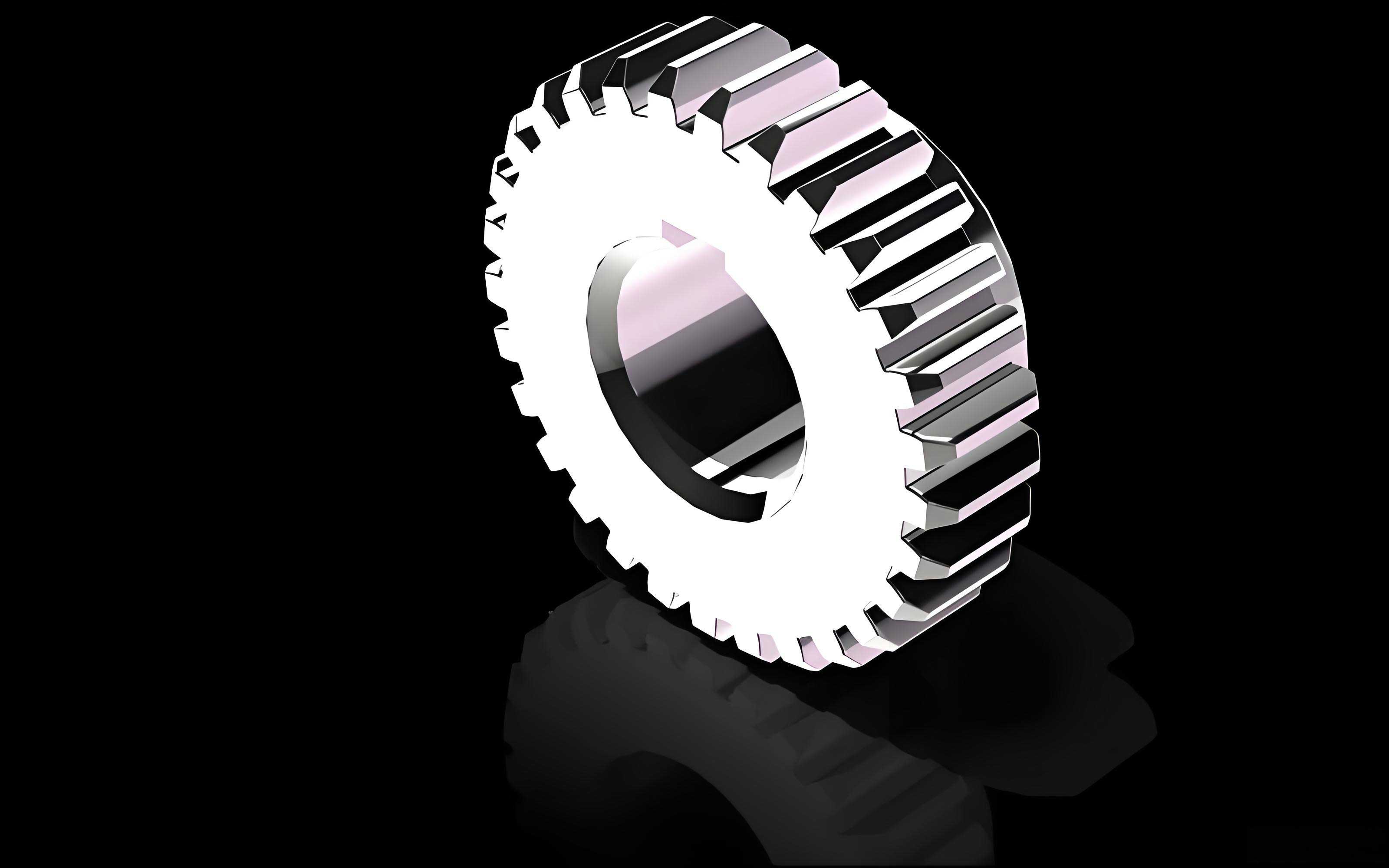
An inverted taper spline spur gear is characterized by its unique geometry where the spline teeth are not parallel to the axis but feature a deliberate side relief or back angle (β_f). All primary geometric parameters, such as module (m), pressure angle (α_f), and pitch diameter (d_f), are defined on the larger end face of the gear. The fundamental principle governing its form is that any cross-section along the gear’s width (B) contains an involute profile generated from the same base circle (d_b), but with a varying effective tooth thickness. This variation in tooth thickness across the width, combined with the specified side relief angle on the pitch cylinder, creates the essential inverted taper form crucial for smooth meshing and guiding action in assemblies like automotive transmission synchro-hubs.
1. Fundamental Design Principles and Methodologies
The core task in designing a shaper cutter for this specific spur gear variant lies in accurately replicating its spatially varying involute flank. The three design philosophies diverge in their foundational geometric assumptions and the resulting cutter kinematics.
1.1 Method 1: Planar Meshing Principle at the Major End Face (With Integrated Cutter Relief)
This approach treats the gear’s major end face as the definitive reference plane for standard planar meshing calculations, identical to designing a cutter for a conventional straight spur gear. The critical difference is the acknowledgment that the cutter must also generate the tapered profile along the gear’s axis. This requirement translates into the cutter needing both axial (parallel to gear axis) and radial feed motions during generation. The design procedure first calculates the cutter geometry based on the gear’s major end parameters, then determines the necessary tilt or relief angle (ψ) for the cutter itself by considering the engagement conditions at the gear’s minor end.
The design sequence is as follows, starting with the standard spur gear parameters at the major end:
Involute function: $$inv(\alpha_f) = \tan(\alpha_f) – \alpha_f$$
Pitch diameter: $$d_f = Z \cdot m$$
Base circle diameter: $$d_b = d_f \cdot \cos(\alpha_f) = Z \cdot m \cdot \cos(\alpha_f)$$
Profile shift coefficient (at major end): $$\xi = \frac{S_f – 0.5\pi m}{2m \tan(\alpha_f)}$$ where \(S_f\) is the circular tooth thickness at the pitch diameter on the major end.
With the cutter’s basic parameters—number of teeth \(Z_0\) and its profile shift coefficient \(\xi_0\)—the engagement angle for the major end mesh is calculated:
$$inv(\alpha_{o1}) = \frac{2 \tan(\alpha_f) (\xi + \xi_0)}{Z + Z_0} + inv(\alpha_f)$$
The corresponding center distance and cutter tip diameter are:
$$A_{o1} = \frac{m \cos(\alpha_f) (Z + Z_0)}{2 \cos(\alpha_{o1})}$$
$$d_{eo} = 2A_{o1} – d_i$$ where \(d_i\) is the gear’s root diameter at the major end.
Next, parameters at the gear’s minor end are derived. The tooth thickness at the minor end pitch diameter is reduced due to the side relief:
$$S_{f\_xiao} = S_f – 2B \tan(\beta_f)$$
Its corresponding profile shift and the mesh parameters with the same cutter are found:
$$\xi_{xiao} = \frac{S_{f\_xiao} – 0.5\pi m}{2m \tan(\alpha_f)}$$
$$inv(\alpha_{xiao}) = \frac{2 \tan(\alpha_f) (\xi_{xiao} + \xi_0)}{Z + Z_0} + inv(\alpha_f)$$
$$A_{xiao} = \frac{m \cos(\alpha_f) (Z + Z_0)}{2 \cos(\alpha_{xiao})}$$
The root diameter at the minor end becomes: $$d_{i\_xiao} = 2A_{xiao} – d_{eo}$$
Finally, the required integrated relief angle ψ for the cutter body to generate the taper is determined geometrically:
$$\psi = \arctan\left(\frac{d_i – d_{i\_xiao}}{2B}\right)$$
The cutter’s final clearance angle \(\alpha_e\) is then the sum of this generation angle ψ and a standard relief (e.g., 6°). This large effective relief angle inherently weakens the cutter’s tooth tip, rendering this method suitable primarily for machining softer materials like plastics or non-ferrous alloys, but less ideal for steel components.
1.2 Method 2: Planar Meshing at Major End Face (With Machine Table Tilt)
This method also initiates design from the major end face’s planar mesh. However, instead of building the taper into the cutter’s relief, the cutter is designed with a standard clearance angle (e.g., \(\alpha_e = 6°\)). The taper generation is achieved by tilting the entire workpiece or the cutter’s stroke direction by the angle ψ relative to the gear axis during the machining process. This ψ angle is essentially the same as calculated in Method 1 from the difference in root diameters. The shaper cutter itself is geometrically identical to one designed for a standard straight spur gear with the major end parameters. While this approach yields a cutter with robust tooth strength, the kinematic approximation involved in tilting the stroke can introduce deviations in the generated tooth form along the flank, making it more applicable for inverted taper spline spur gears where high precision is not the paramount concern.
1.3 Method 3: Virtual Plane (V-V) Meshing Principle Using Equivalent Spur Gear Parameters
This is the most sophisticated and accurate approach. It conceptualizes the generation of the inverted taper spline spur gear not in a plane perpendicular to its axis, but in an oblique plane (V-V) that is normal to the tooth flank at the pitch line on the major end. This principle borrows from the concept of the “equivalent spur gear” used in bevel gear theory. The gear’s major end parameters are transformed into a set of equivalent parameters within this V-V plane. The cutter is then designed to mesh correctly with this equivalent spur gear, ensuring theoretically exact generation of the desired spatial flank geometry.
The transformation to the V-V plane is crucial. The key equivalent parameters are derived as follows, where ψ is the generation angle (akin to the tilt angle from Method 1 & 2):
Equivalent module and number of teeth:
$$m_v = m$$
$$Z_v = \frac{Z}{\cos(\psi)}$$
Equivalent pitch diameter logically follows: $$d_{fv} = m_v Z_v = \frac{mZ}{\cos(\psi)}$$
Equivalent tip and root diameters in the V-V plane account for the axial shift:
$$d_{ev} = \frac{d_e}{\cos(\psi)} + [2B – (d_e – d_i)\tan(\psi)]\sin(\psi)$$
$$d_{iv} = \frac{d_i}{\cos(\psi)}$$
The most critical transformation is for the pressure angle. Analyzing the geometry in the V-V plane yields the equivalent pressure angle (α_{fv}):
$$\tan(\alpha_{fv}) = \sin(\psi)\tan(\beta_f) + \cos(\psi)\tan(\alpha_f)$$
The equivalent base circle diameter is: $$d_{bv} = d_{fv} \cos(\alpha_{fv}) = m Z_v \cos(\alpha_{fv})$$
Determining the equivalent circular tooth thickness at the equivalent pitch diameter (S_{fv}) is more complex and requires a spatial coordinate transformation from the major end definition to the V-V plane, often solved via iterative numerical methods like Newton-Raphson to find the diameter corresponding to a specific chordal measurement projected onto the V-V plane.
Once \(S_{fv}\) is found, the equivalent profile shift coefficient \(\xi_v\) can be calculated. The shaper cutter design then proceeds using standard planar meshing formulas but with the equivalent gear parameters (\(Z_v, \alpha_{fv}, \xi_v\)) and the cutter’s basic parameters (\(Z_0, \xi_0, \gamma, \alpha_e\)).
Equivalent mesh angle:
$$inv(\alpha_{o1v}) = \frac{2 \tan(\alpha_{fv}) (\xi_v + \xi_0)}{Z_v + Z_0} + inv(\alpha_{fv})$$
Equivalent center distance and final cutter dimensions:
$$A_{o1v} = \frac{m \cos(\alpha_{fv}) (Z_v + Z_0)}{2 \cos(\alpha_{o1v})}$$
$$d_{eo} = 2A_{o1v} – d_{iv}$$
$$d_{io} = 2A_{o1v} – d_{ev}$$
The cutter’s nominal pressure angle is adjusted for its own rake (γ) and clearance (α_e) angles:
$$\alpha_{fo} = \arctan\left(\frac{\tan(\alpha_{fv})}{1 – \tan(\gamma)\tan(\alpha_e)}\right)$$
And its base circle diameter is: $$d_{bo} = Z_0 m \cos(\alpha_{fo})$$
This method, though computationally intensive, ensures that the cutter edge tangency condition is maintained correctly in space relative to the desired spur gear flank, promising the highest potential accuracy for demanding applications, especially when machining steel.
2. Design Example and Comparative Analysis
To illustrate the application and outcomes of these methods, consider designing a shaper cutter for the following inverted taper spline spur gear: Module \(m = 1.8\) mm, Pressure Angle \(\alpha_f = 20^\circ\), Number of Teeth \(Z = 39\), Side Relief Angle \(\beta_f = 4^\circ\), Tip Diameter \(d_e = 73.45\) mm, Root Diameter \(d_i = 67.0\) mm, Width \(B = 5\) mm. The shaper cutter basics are: Teeth \(Z_0 = 56\), Rake Angle \(\gamma = 5^\circ\), Clearance Angle \(\alpha_e = 6^\circ\), Tooth Thickness \(S_{fo} = 2.696\) mm.
Key Calculated Parameters for Each Method:
First, common parameters are calculated. The involute function \(inv(20^\circ) \approx 0.01490438\) rad. The circular tooth thickness at the major end \(S_f \approx 2.81099\) mm, leading to a profile shift \(\xi \approx -0.01255\). The cutter’s profile shift is \(\xi_0 \approx -0.1\).
For Method 1 & 2 (ψ calculation):
The mesh at the major end yields \(\alpha_{o1} \approx 19.62^\circ\), \(A_{o1} \approx 85.2955\) mm, and \(d_{eo} \approx 103.5911\) mm.
At the minor end, \(S_{f\_xiao} \approx 1.90194\) mm (\(\xi_{xiao} \approx -0.70633\)). The minor end mesh gives \(\alpha_{xiao} \approx 16.82^\circ\), \(A_{xiao} \approx 83.9322\) mm, and \(d_{i\_xiao} \approx 64.2733\) mm.
Therefore, the generation/tilt angle is:
$$\psi = \arctan\left(\frac{67.0 – 64.2733}{2 \times 5}\right) \approx \arctan(0.27267) \approx 0.266 \text{ rad} \approx 15.25^\circ$$
In Method 1, the cutter clearance would be \(\alpha_e + \psi \approx 21.25^\circ\). In Method 2, the machine table is tilted by ~15.25°.
For Method 3 (Equivalent Spur Gear in V-V Plane):
Using \(\psi \approx 15.25^\circ\):
\(Z_v = 39 / \cos(15.25^\circ) \approx 40.43\)
\(\alpha_{fv} = \arctan(\sin(15.25^\circ)\tan(4^\circ) + \cos(15.25^\circ)\tan(20^\circ)) \approx 20.49^\circ\)
\(d_{fv} = 1.8 \times 40.43 \approx 72.774\) mm
\(d_{ev} \approx 75.785\) mm, \(d_{iv} \approx 69.448\) mm (calculated per formulas in 1.3).
Through spatial projection and iteration, the equivalent tooth thickness \(S_{fv}\) is found, leading to \(\xi_v \approx -0.078\).
The equivalent mesh with the cutter then gives \(\alpha_{o1v} \approx 19.35^\circ\), \(A_{o1v} \approx 86.112\) mm.
Finally, the cutter dimensions are: \(d_{eo} \approx 102.776\) mm, \(d_{io} \approx 96.439\) mm, and the cutter’s pressure angle \(\alpha_{fo} \approx 20.81^\circ\).
| Design Method | Fundamental Principle | Cutter Geometry & Strength | Machine Requirement | Expected Gear Accuracy | Typical Application |
|---|---|---|---|---|---|
| Method 1 (Integrated Relief) |
Planar mesh at major end; taper via cutter body relief. | Large effective relief angle (ψ+6°). Weaker tooth tip. | Standard shaper with axial & radial feed. No tilt needed. | Moderate. Potential for tip wear in hard materials. | Soft materials (plastics, aluminum, brass). |
| Method 2 (Table Tilt) |
Planar mesh at major end; taper via tilted stroke. | Standard relief angle (e.g., 6°). Good tooth strength. | Shaper capable of workpiece or cutter head tilt by angle ψ. | Lower. Kinematic approximation introduces form error. | Non-critical inverted taper spur gears, roughing. |
| Method 3 (Equivalent Spur Gear) |
Spatial mesh in V-V plane; exact generation via equivalent parameters. | Standard relief angle. Good tooth strength. | Shaper capable of workpiece tilt by angle ψ. Precise setup. | High. Theoretically exact generation of flank geometry. | High-precision steel components, finishing operations. |
3. Conclusion
The design of shaper cutters for inverted taper spline spur gears necessitates moving beyond standard spur gear cutter design principles due to the axial variation in the tooth form. Three distinct methodologies have been presented, each with its own merits and limitations. Method 1, which incorporates the taper into the cutter relief, produces a fragile tool suited for soft materials. Method 2, employing a tilted machining setup, offers a stronger cutter but sacrifices some accuracy due to kinematic approximation. Method 3, based on the virtual plane (V-V) meshing principle and the concept of an equivalent spur gear, provides the most rigorous and accurate solution, making it the preferred choice for manufacturing high-precision inverted taper spline spur gears from hardened steels. The selection must be a reasoned compromise based on the specific machine tool capabilities, the workpiece material properties, and the ultimate functional requirements of the spur gear assembly.