
In the field of precision manufacturing, cold extrusion forming has emerged as a pivotal technology due to its high material utilization, ease of automation, and superior product quality. My research focuses on applying this technology to the forming of spur gears, which are fundamental components in various mechanical systems. The primary objective is to investigate how different process parameters affect the forming accuracy of spur gears through finite element numerical simulation. This study aims to optimize the cold extrusion process for spur gear production, ensuring high dimensional precision and mechanical properties.
Cold extrusion involves shaping metal at room temperature under high pressure, which enhances the material’s strength and surface finish. For spur gears, this process can significantly reduce material waste compared to traditional machining methods. However, achieving precise tooth profile filling remains a challenge due to complex metal flow behavior. Therefore, I employed a systematic approach using orthogonal experiments to analyze key factors. The following sections detail my methodology, simulation setup, results, and conclusions.
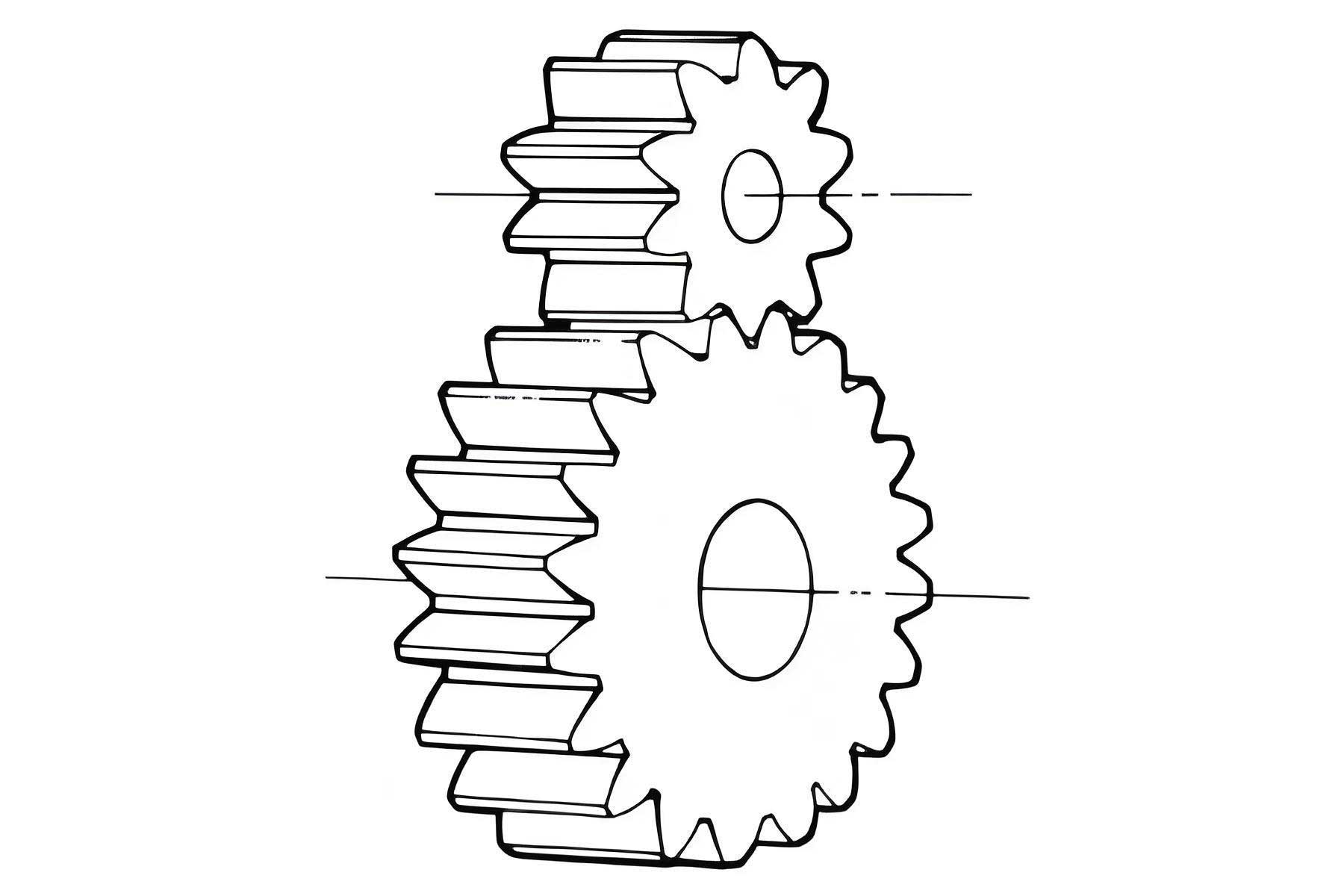
To begin, I designed a finite element model using DEFORM-3D software, which is widely recognized for simulating metal forming processes. The geometry of the spur gear, including the punch, die, and billet, was created in SolidWorks and imported as an *.STL file. The model leveraged symmetry to reduce computational cost, focusing on a wedge-shaped section corresponding to one tooth of the spur gear. This approach allowed for detailed analysis of tooth profile formation. The billet material was set as AISI-1015 steel, commonly used in cold extrusion, with an initial temperature of 20 °C. The mesh consisted of 100,000 tetrahedral elements, with local refinement in the tooth-forming region to capture intricate details. Volume compensation was applied to account for mesh distortions during simulation.
The critical process parameters influencing spur gear forming accuracy were identified as: fillet radius coefficient (Kg), number of teeth (z), module (m), die entrance angle (α), billet diameter coefficient (k), and extrusion speed (v). I conducted an orthogonal experiment with six factors and five levels, totaling 25 simulations. This design enabled efficient exploration of parameter interactions. The parameters were determined based on practical constraints, such as equipment capabilities and material properties. For instance, the fillet radius coefficient Kg was limited to a maximum of 0.45 to avoid stress concentrations, as per gear design standards. The billet diameter was calculated using the formula: $$d = k \cdot m \cdot z$$ where d is the billet diameter, k is the coefficient, m is the module, and z is the number of teeth. Similarly, the fillet radius Rg was derived from: $$R_g = K_g \cdot m$$ These formulas ensured consistency across simulations.
The table below summarizes the parameter levels used in the orthogonal experiment. Each row represents a unique combination for simulation.
| Kg | Number of Teeth (z) | Module (m) | Die Entrance Angle (°) | Billet Diameter Coefficient (k) | Extrusion Speed (mm/s) |
|---|---|---|---|---|---|
| 0.1 | 13 | 0.8 | 60 | 1.25 | 10 |
| 0.1 | 17 | 1.5 | 80 | 1.3 | 20 |
| 0.1 | 21 | 2.5 | 100 | 1.35 | 133 |
| 0.1 | 25 | 3.5 | 120 | 1.4 | 266 |
| 0.1 | 29 | 4.5 | 140 | 1.45 | 6000 |
| 0.2 | 13 | 1.5 | 100 | 1.4 | 6000 |
| 0.2 | 17 | 2.5 | 120 | 1.45 | 10 |
| 0.2 | 21 | 3.5 | 140 | 1.25 | 20 |
| 0.2 | 25 | 4.5 | 60 | 1.3 | 133 |
| 0.2 | 29 | 0.8 | 80 | 1.35 | 266 |
| 0.3 | 13 | 2.5 | 140 | 1.3 | 266 |
| 0.3 | 17 | 3.5 | 60 | 1.35 | 6000 |
| 0.3 | 21 | 4.5 | 80 | 1.4 | 10 |
| 0.3 | 25 | 0.8 | 100 | 1.45 | 20 |
| 0.3 | 29 | 1.5 | 120 | 1.25 | 133 |
| 0.4 | 13 | 3.5 | 80 | 1.45 | 133 |
| 0.4 | 17 | 4.5 | 100 | 1.25 | 266 |
| 0.4 | 21 | 0.8 | 120 | 1.3 | 6000 |
| 0.4 | 25 | 1.5 | 140 | 1.35 | 10 |
| 0.4 | 29 | 2.5 | 60 | 1.4 | 20 |
| 0.45 | 13 | 4.5 | 120 | 1.35 | 20 |
| 0.45 | 17 | 0.8 | 140 | 1.4 | 133 |
| 0.45 | 21 | 1.5 | 60 | 1.45 | 266 |
| 0.45 | 25 | 2.5 | 80 | 1.25 | 6000 |
| 0.45 | 29 | 3.5 | 100 | 1.3 | 10 |
During simulation, I monitored the forming process, including metal flow, stress distribution, and load requirements. The Lagrangian incremental method was employed, suitable for cold extrusion, with step size based on mesh dimensions. The total steps were calculated as extrusion stroke divided by step length. Friction between the billet and die was considered using a shear factor model, which influenced metal flow and final spur gear accuracy. The forming accuracy was quantified by comparing the cross-sectional area of the simulated tooth profile to the designed tooth profile area, expressed as: $$P = \frac{S_{\text{simulated}}}{S_{\text{designed}}} \times 100\%$$ where P is the forming accuracy percentage, S_simulated is the area from simulation, and S_designed is the theoretical area. This metric reflects how well the spur gear tooth is filled during extrusion.
The simulation results revealed detailed insights into the cold extrusion of spur gears. For instance, the final formed spur gear exhibited a smooth and full tooth profile, with minimal defects. However, due to friction effects, a slight collapse angle was observed at the gear front, which is typically removed in post-processing. The filling effectiveness was high across most trials, with accuracy values ranging from 93.6% to 100%. The table below presents the forming accuracy results for all 25 orthogonal experiments.
| Experiment No. | Kg | Number of Teeth (z) | Module (m) | Die Entrance Angle (°) | Billet Diameter Coefficient (k) | Extrusion Speed (mm/s) | Forming Accuracy P (%) |
|---|---|---|---|---|---|---|---|
| 1 | 0.1 | 13 | 0.8 | 60 | 1.25 | 10 | 96.2 |
| 2 | 0.1 | 17 | 1.5 | 80 | 1.3 | 20 | 95.1 |
| 3 | 0.1 | 21 | 2.5 | 100 | 1.35 | 133 | 98.6 |
| 4 | 0.1 | 25 | 3.5 | 120 | 1.4 | 266 | 99.1 |
| 5 | 0.1 | 29 | 4.5 | 140 | 1.45 | 6000 | 99.9 |
| 6 | 0.2 | 13 | 1.5 | 100 | 1.4 | 6000 | 98.4 |
| 7 | 0.2 | 17 | 2.5 | 120 | 1.45 | 10 | 99.9 |
| 8 | 0.2 | 21 | 3.5 | 140 | 1.25 | 20 | 100.0 |
| 9 | 0.2 | 25 | 4.5 | 60 | 1.3 | 133 | 94.1 |
| 10 | 0.2 | 29 | 0.8 | 80 | 1.35 | 266 | 98.4 |
| 11 | 0.3 | 13 | 2.5 | 140 | 1.3 | 266 | 97.1 |
| 12 | 0.3 | 17 | 3.5 | 60 | 1.35 | 6000 | 93.6 |
| 13 | 0.3 | 21 | 4.5 | 80 | 1.4 | 10 | 95.3 |
| 14 | 0.3 | 25 | 0.8 | 100 | 1.45 | 20 | 99.9 |
| 15 | 0.3 | 29 | 1.5 | 120 | 1.25 | 133 | 100.0 |
| 16 | 0.4 | 13 | 3.5 | 80 | 1.45 | 133 | 97.5 |
| 17 | 0.4 | 17 | 4.5 | 100 | 1.25 | 266 | 99.3 |
| 18 | 0.4 | 21 | 0.8 | 120 | 1.3 | 6000 | 100.0 |
| 19 | 0.4 | 25 | 1.5 | 140 | 1.35 | 10 | 99.4 |
| 20 | 0.4 | 29 | 2.5 | 60 | 1.4 | 20 | 96.2 |
| 21 | 0.45 | 13 | 4.5 | 120 | 1.35 | 20 | 100.0 |
| 22 | 0.45 | 17 | 0.8 | 140 | 1.4 | 133 | 100.0 |
| 23 | 0.45 | 21 | 1.5 | 60 | 1.45 | 266 | 95.6 |
| 24 | 0.45 | 25 | 2.5 | 80 | 1.25 | 6000 | 97.3 |
| 25 | 0.45 | 29 | 3.5 | 100 | 1.3 | 10 | 98.7 |
To further analyze the impact of tooth tip fillet radius on spur gear accuracy, I examined a specific case (Experiment 8) where the forming accuracy reached 100%. By varying the fillet radius r, I derived a relationship between r and accuracy P, as shown in the table below. This relationship highlights that smaller fillet radii generally correspond to higher accuracy, but practical limits exist due to stress concerns.
| Fillet Radius r (mm) | Forming Accuracy P (%) |
|---|---|
| 0 | 100.00 |
| 0.5 | 99.99 |
| 1.0 | 99.95 |
| 1.5 | 99.88 |
| 2.0 | 99.77 |
| 2.5 | 99.62 |
| 3.0 | 99.41 |
| 3.5 | 99.15 |
The data can be modeled using a polynomial equation. For instance, a quadratic fit yields: $$P(r) = 100 – a \cdot r^2$$ where a is a constant derived from regression analysis. This formula aids in predicting spur gear accuracy for different fillet designs.
Next, I performed an intuitive analysis of the orthogonal experiment results by calculating the mean forming accuracy for each parameter level. The table below summarizes these means and the range (difference between maximum and minimum mean), which indicates the influence magnitude of each factor on spur gear forming accuracy.
| Parameter | Level 1 Mean P (%) | Level 2 Mean P (%) | Level 3 Mean P (%) | Level 4 Mean P (%) | Level 5 Mean P (%) | Range |
|---|---|---|---|---|---|---|
| Kg | 97.78 | 98.16 | 97.18 | 98.48 | 98.32 | 1.30 |
| Number of Teeth (z) | 97.84 | 97.58 | 97.90 | 97.96 | 98.64 | 1.06 |
| Module (m) | 98.90 | 97.70 | 97.82 | 97.78 | 97.72 | 1.20 |
| Die Entrance Angle (°) | 95.14 | 96.72 | 98.98 | 99.80 | 99.28 | 4.66 |
| Billet Diameter Coefficient (k) | 98.56 | 97.00 | 98.00 | 97.80 | 98.56 | 1.56 |
| Extrusion Speed (mm/s) | 97.90 | 98.75 | 97.73 | 97.90 | 97.84 | 1.02 |
The range analysis clearly shows that the die entrance angle has the largest range (4.66%), making it the most influential factor on spur gear forming accuracy. The billet diameter coefficient follows with a range of 1.56%. Other parameters, such as fillet radius coefficient and number of teeth, have smaller impacts. This suggests that optimizing the die design and billet size is crucial for high-precision spur gear production via cold extrusion.
Based on the analysis, I identified an optimal parameter combination for maximizing spur gear accuracy: Kg = 0.4, number of teeth = 29, module = 0.8, die entrance angle = 120°, billet diameter coefficient k = 1.25, and extrusion speed = 20 mm/s. A validation simulation using these parameters confirmed a forming accuracy of 100%, aligning with the orthogonal experiment predictions. This optimal set balances metal flow and stress distribution, ensuring complete tooth filling without defects.
In conclusion, my study demonstrates that cold extrusion is a viable method for producing high-accuracy spur gears. The die entrance angle and billet diameter are the two most critical factors affecting forming accuracy. A larger die entrance angle (up to 120°) promotes better metal flow, while an appropriately sized billet prevents underfilling or excessive loads. These insights can guide manufacturers in designing efficient cold extrusion processes for spur gears, reducing material waste and improving product quality. Future work could explore additional parameters, such as lubrication conditions or alternative materials, to further enhance spur gear performance.
The cold extrusion process for spur gears involves complex interactions between multiple variables. Through finite element simulation and orthogonal experimentation, I have quantified these effects and provided actionable recommendations. The formulas and tables presented here serve as a reference for engineers seeking to optimize spur gear production. As demand for precision components grows, cold extrusion will continue to play a key role in manufacturing, and understanding its nuances is essential for advancing gear technology.
Moreover, the relationship between tooth profile geometry and forming accuracy can be expressed mathematically. For a spur gear with pressure angle α and module m, the theoretical tooth thickness at the pitch circle is given by: $$s = \frac{\pi m}{2}$$ where s is the thickness. During extrusion, the actual thickness may deviate due to metal flow. The deviation Δs can be related to forming accuracy P through: $$\Delta s = s \cdot \left(1 – \frac{P}{100}\right)$$ This highlights how accuracy metrics translate to dimensional tolerances in spur gears.
Additionally, the extrusion load F required for forming spur gears can be estimated using empirical equations. For cold extrusion of steel, the load is influenced by material yield strength σ_y, billet area A, and a shape factor C: $$F = C \cdot \sigma_y \cdot A$$ where C depends on die angle and friction. In my simulations, the load varied from 200 kN to 800 kN across trials, with higher loads associated with larger billet diameters or smaller die angles. Monitoring load helps prevent die wear and ensures process stability for spur gear manufacturing.
In summary, this comprehensive analysis underscores the importance of parameter optimization in cold extrusion for spur gears. By leveraging numerical simulation and statistical methods, I have identified key drivers of forming accuracy and proposed an optimal process setup. This work contributes to the broader goal of sustainable manufacturing, where precision forming techniques like cold extrusion reduce energy consumption and material usage while producing high-quality spur gears for various applications.