
In mechanical transmission systems, power loss is a critical factor affecting efficiency and performance. Among various components, spur gears are widely used due to their simplicity and reliability, but they also contribute significantly to power dissipation. This article delves into the meshing power loss of involute spur gears, focusing on the mechanisms of sliding and rolling friction. I will present analytical models and formulas to quantify these losses, explore the influence of geometric parameters, gear ratios, and loads, and validate findings through experimental data. The goal is to provide a comprehensive understanding that aids in designing low-loss spur gear systems.
Power loss in spur gear transmissions can be categorized into no-load and load-dependent losses. Load-dependent losses, which occur during power transmission, are primarily due to friction between meshing teeth and are termed meshing power losses. These losses arise from both sliding and rolling friction between the tooth surfaces of spur gears. While sliding friction has been extensively studied, rolling friction is often overlooked despite its impact in multi-stage systems. My analysis aims to bridge this gap by developing simplified models for both friction types, using power loss ratios—the ratio of friction power loss to input power—to avoid complex direct calculations.
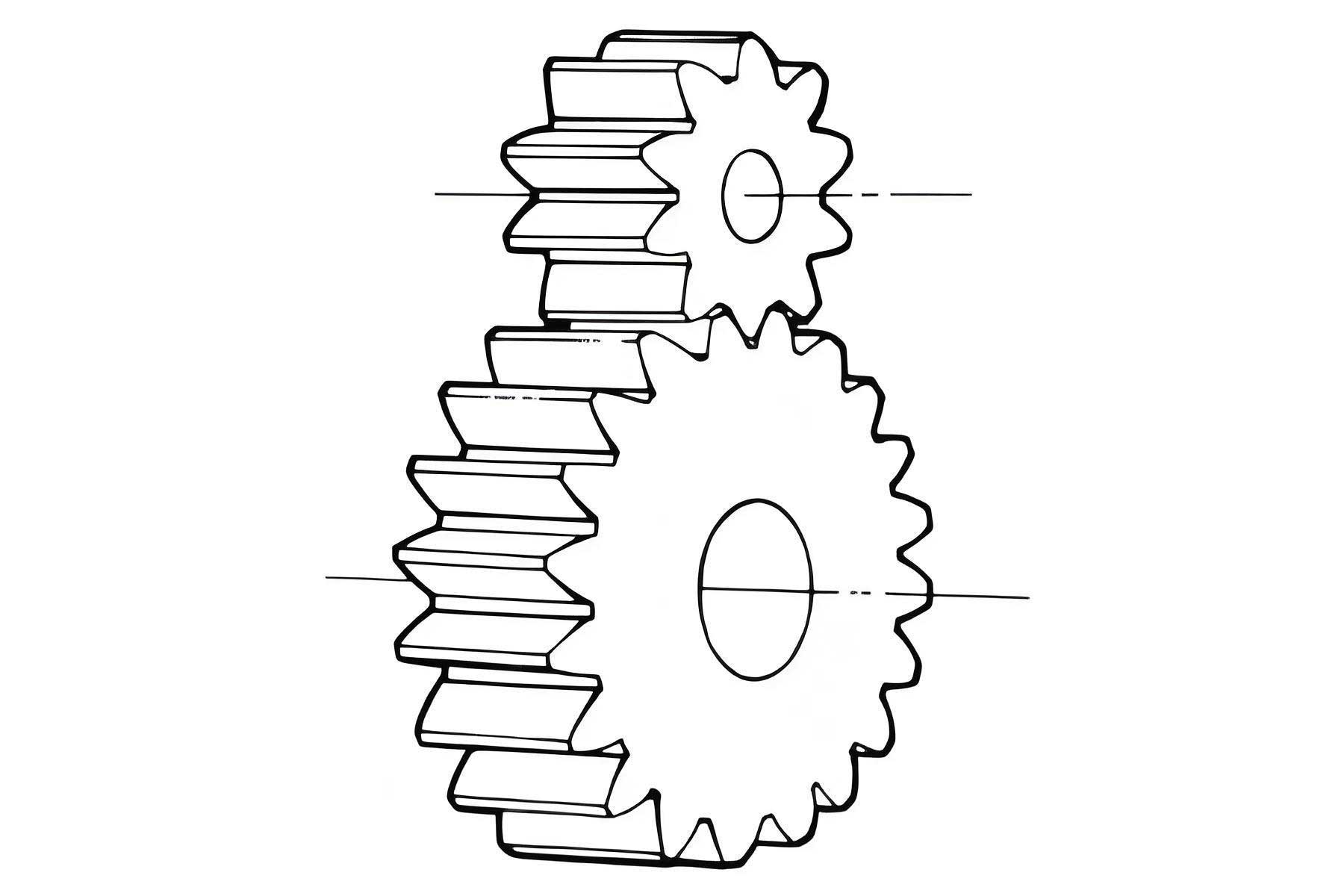
The meshing process of involute spur gears involves continuous contact along the line of action. As teeth engage, relative motion occurs, leading to sliding and rolling. Sliding friction results from differential tangential velocities at the contact point, while rolling friction stems from asymmetric deformation under load. For spur gears, these phenomena are influenced by factors such as module, pressure angle, gear ratio, and torque. I will derive formulas based on mechanical and geometric principles, enabling the prediction of power loss trends along the meshing path. This methodology is essential for optimizing spur gear design to minimize energy waste.
To begin, consider the sliding friction mechanism in spur gears. When two spur gear teeth mesh, the contact point moves along the line of action. The velocities of the driving and driven gears at this point have equal components normal to the contact but unequal tangential components, causing sliding. The sliding direction reverses before and after the pitch point, and the sliding velocity is zero at the pitch point, reaching maxima near the tooth tip or root. For spur gears, this sliding generates frictional power loss, which can be modeled using a power loss ratio. Let $\phi_s$ represent the sliding friction power loss ratio, defined as:
$$ \phi_s = \frac{P_3}{P_1} = \frac{P_1 – P_2}{P_1}, $$
where $P_1$ is the input power, $P_2$ is the output power excluding rolling friction, and $P_3$ is the sliding friction power loss. For spur gears, input and output powers relate to torque and angular velocity. Denoting $T_1$ and $\omega_1$ as the driving gear torque and speed, and $T_2$ and $\omega_2$ for the driven gear, we have:
$$ P_1 = T_1 \omega_1 = F_{12} \cdot O_1H \cdot \cos(\alpha \pm \theta_\mu) \cdot \omega_1, $$
$$ P_2 = T_2 \omega_2 = F_{12} \cdot O_2H \cdot \cos(\alpha \pm \theta_\mu) \cdot \omega_2, $$
where $F_{12}$ is the transmitted force, $\alpha$ is the pressure angle, $\theta_\mu$ is the friction angle with $\mu = \tan \theta_\mu$ as the coefficient of friction, and $O_1H$ and $O_2H$ are geometric distances. The sign depends on meshing position: plus before the pitch point and minus after for spur gears. Substituting into $\phi_s$ yields:
$$ \phi_s = \frac{O_1H \cdot \omega_1 – O_2H \cdot \omega_2}{O_1H \cdot \omega_1}. $$
Introduce $n = \pm \frac{PK}{N_1P}$ as the dimensionless distance from the pitch point (negative before, positive after), and $i_{21} = \frac{\omega_2}{\omega_1} = \frac{PO_1}{PO_2}$ as the inverse gear ratio, with $i_{12} = \frac{1}{i_{21}}$. Using geometric relations from similar triangles, the sliding friction power loss ratio for spur gears simplifies to:
$$ \phi_s = \begin{cases}
\frac{(1 + i_{21}) n \cdot \mu \cdot \tan \alpha}{-1 + (n+1) \mu \cdot \tan \alpha}, & n < 0 \text{ (before pitch point)}, \\
\frac{(1 + i_{21}) n \cdot \mu \cdot \tan \alpha}{1 + (n+1) \mu \cdot \tan \alpha}, & n \geq 0 \text{ (after pitch point)}.
\end{cases} $$
This formula shows that $\phi_s$ depends on gear ratio $i_{21}$, friction coefficient $\mu$, pressure angle $\alpha$, and meshing position $n$ for spur gears. It is asymmetric around the pitch point, with maximum loss near the tooth extremities.
For rolling friction in spur gears, consider the contact deformation under load. The normal force shifts due to asymmetric stress distribution, creating a resisting moment. Define $\phi_r$ as the rolling friction power loss ratio, similar to sliding:
$$ \phi_r = \frac{1 + i_{21}}{M + 1}, $$
where $M = \frac{PO_1}{PH}$. From geometry, $M = \frac{O_1 N_1}{KD}$, with $KD = k \cdot b_H$ as the offset distance, $k$ an experimental coefficient, and $b_H$ half the Hertzian contact width. For spur gears, Hertzian theory gives:
$$ b_H = \sqrt{4P’ \cdot (k_1 + k_2) \cdot \rho_R}, $$
$$ \sigma_H = \sqrt{\frac{P’}{\pi^2 \cdot (k_1 + k_2) \cdot \rho_{RP}}}, $$
where $\sigma_H$ is the normal contact stress at the pitch point, $P’$ is load per unit length, $\rho_R$ is reduced radius of curvature, and $\rho_{RP}$ is its value at the pitch point. The reduced radius for spur gears is:
$$ \rho_R = \frac{\rho_1 \cdot \rho_2}{\rho_1 \pm \rho_2}, $$
with plus for external spur gears and minus for internal. Here, $\rho_1$ and $\rho_2$ are curvatures of driving and driven spur gear teeth. Let $O_1N_1$ be the base radius-related distance. Then:
$$ \rho_1 = N_1P \cdot (1 \mp |n|), \quad \rho_2 = N_1N_2 – \rho_1 = N_1P \cdot (i_{12} \pm |n|), $$
with upper signs before pitch point and lower after. At the pitch point, $n=0$, so $\rho_{1P} = N_1P = O_1N_1 \tan \alpha$ and $\rho_{2P} = N_1P \cdot i_{12} = O_1N_1 \cdot i_{12} \cdot \tan \alpha$. Thus,
$$ \rho_R = \frac{(1+n) \cdot (i_{12} – n)}{1 + i_{12}} \cdot O_1N_1 \cdot \tan \alpha, $$
$$ \rho_{RP} = \frac{i_{12}}{1 + i_{12}} \cdot O_1N_1 \cdot \tan \alpha. $$
Substituting into $b_H$ and simplifying, we get:
$$ b_H = 2\pi \cdot (k_1 + k_2) \cdot \sigma_H \cdot O_1N_1 \cdot \tan \alpha \cdot \sqrt{\frac{(1+n) \cdot (i_{12} – n) \cdot i_{12}}{(1 + i_{12})^2}}. $$
Then, $M = \frac{1}{2\pi \cdot k \cdot (k_1 + k_2) \cdot \sigma_H \cdot \tan \alpha} \cdot \sqrt{\frac{(1+n) \cdot (i_{12} – n) \cdot i_{12}}{(1 + i_{12})^2}}$, and the rolling friction power loss ratio for spur gears is:
$$ \phi_r = \frac{1 + i_{21}}{1 + M}. $$
This model indicates that $\phi_r$ varies with gear ratio, contact stress, pressure angle, and meshing position for spur gears, being more pronounced near the pitch point.
To analyze the influence of spur gear parameters on meshing power loss, I computed trends using MATLAB programs. The sliding friction power loss ratio $\phi_s$ along the line of action shows a V-shaped curve, zero at the pitch point and peaking at tooth ends. For rolling friction, $\phi_r$ changes gradually, with maxima near the pitch point. Below, tables and formulas summarize key effects for spur gears.
Table 1: Impact of spur gear geometric parameters on sliding friction power loss ratio ($\phi_s$).
| Parameter | Effect on $\phi_s$ | Mathematical Relation |
|---|---|---|
| Module ($m$) | Increases with larger module | $\phi_s \propto m$ due to longer line of action |
| Pressure angle ($\alpha$) | Decreases with larger $\alpha$ | $\phi_s \approx \frac{(1+i_{21}) n \mu \tan \alpha}{1 \pm (n+1) \mu \tan \alpha}$ |
| Gear ratio ($i_{12}$) | Increases with higher ratio | $\phi_s$ scales with $i_{21} = 1/i_{12}$ |
| Friction coefficient ($\mu$) | Directly proportional | $\phi_s \propto \mu$ in numerator |
For rolling friction in spur gears, Table 2 outlines parameter influences.
| Parameter | Effect on $\phi_r$ | Mathematical Relation |
|---|---|---|
| Module ($m$) | Increases with larger module | $\phi_r \propto O_1N_1 \propto m$ |
| Pressure angle ($\alpha$) | Increases with larger $\alpha$ | $\phi_r$ via $\tan \alpha$ in $M$ |
| Gear ratio ($i_{12}$) | Increases with higher ratio | $\phi_r$ depends on $i_{21}$ and $i_{12}$ terms |
| Contact stress ($\sigma_H$) | Increases with higher stress | $\phi_r \propto \sigma_H$ inversely in $M$ |
| Tooth width ($b$) | Decreases with wider teeth | $\sigma_H \propto 1/b$, so $\phi_r \downarrow$ |
The combined meshing power loss ratio $\phi_{total}$ for spur gears is the sum of sliding and rolling contributions:
$$ \phi_{total} = \phi_s + \phi_r. $$
Along the line of action, $\phi_s$ dominates away from the pitch point, while $\phi_r$ is significant near it. This explains why pitting often occurs near the pitch point in spur gears, where high contact stress and rolling friction coincide with poor lubrication due to sliding reversal.
To quantify friction coefficient $\mu$ for spur gears, I use the average formula from Schlenk:
$$ \mu_{mz} = 0.048 \cdot \left( \frac{F_{tb}/b}{v_{\Sigma C} \rho_{redC}} \right)^{0.2} \cdot \eta_{oil}^{-0.05} \cdot R_a^{0.25} \cdot X_L, $$
where $F_{tb}$ is tangential force at base circle, $v_{\Sigma C}$ is pitch line velocity, $\rho_{redC}$ is reduced curvature radius at pitch point, $\eta_{oil}$ is oil dynamic viscosity, $R_a$ is surface roughness, and $X_L$ is lubricant factor. This empirical relation aids in practical calculations for spur gear systems.
Experimental validation was conducted on an FZG back-to-back spur gear test rig. The setup measures total power loss, comprising meshing, windage, and bearing losses. By subtracting no-load windage loss and computed bearing loss, meshing power loss for spur gears is isolated. Tests varied spur gear parameters: module, pressure angle, and gear ratio, under constant torque and speed ranges. Results confirm theoretical predictions.
Table 3: Experimental conditions for spur gear tests.
| Test | Driving Teeth | Module (mm) | Pressure Angle (°) | Gear Ratio |
|---|---|---|---|---|
| 1 | 30 | 2 | 20 | 1:1 |
| 2 | 20 | 3 | 20 | 1:1 |
| 3 | 30 | 2 | 17.5 | 1:1 |
| 4 | 20 | 2 | 20 | 1:2 |
The meshing power loss $P_{mesh}$ for spur gears is derived from total loss $P_{total}$:
$$ P_{mesh} = P_{total} – P_{spin} – P_{bear}, $$
with $P_{spin}$ measured at no-load and $P_{bear}$ calculated using Harris’s method. Figure 1 shows the test rig schematic, highlighting spur gear arrangement.
Findings indicate that for fixed center distance spur gears, larger module increases meshing power loss due to extended contact length. Higher pressure angle reduces sliding loss but increases rolling loss, with net reduction in total loss as sliding dominates. Larger gear ratio elevates loss from longer line of action and higher loads. These trends align with model outputs, emphasizing the need to balance parameters in spur gear design.
To further elucidate, consider the power loss distribution over a mesh cycle for spur gears. The average power loss ratio $\bar{\phi}_{total}$ can be integrated along the line of action:
$$ \bar{\phi}_{total} = \frac{1}{L} \int_0^L (\phi_s(n) + \phi_r(n)) \, dn, $$
where $L$ is the length of action for spur gears. For practical spur gear applications, this integral can be solved numerically based on gear geometry. For example, with standard involute spur gears, the line of action length is:
$$ L = \sqrt{r_{a1}^2 – r_{b1}^2} + \sqrt{r_{a2}^2 – r_{b2}^2} – a \sin \alpha, $$
where $r_a$ is addendum radius, $r_b$ is base radius, and $a$ is center distance. This formula is crucial for estimating total meshing loss in spur gear pairs.
Moreover, the effect of lubrication on spur gear power loss is significant. Using elastohydrodynamic lubrication (EHL) models, the friction coefficient $\mu$ varies with film thickness. For spur gears, the dimensionless film thickness $H$ is:
$$ H = \frac{h}{R_x} = 2.69 U^{0.67} G^{0.53} W^{-0.067} (1 – 0.61 e^{-0.73k}), $$
where $h$ is central film thickness, $R_x$ is effective radius, $U$ is speed parameter, $G$ is material parameter, $W$ is load parameter, and $k$ is ellipticity ratio. This influences $\mu$ and thus power loss in spur gears under lubricated conditions.
In summary, the meshing power loss of involute spur gears is a complex interplay of sliding and rolling friction. My models provide simple yet effective tools for prediction. For spur gear designers, key recommendations include: optimizing module and pressure angle to trade off sliding and rolling losses, selecting appropriate gear ratios to minimize line of action length, and ensuring adequate lubrication to reduce friction. Future work could extend these models to helical or bevel spur gears, though the core principles remain similar.
This study underscores the importance of considering both friction types in spur gear efficiency analysis. By applying the derived formulas and experimental insights, engineers can develop spur gear transmissions with enhanced performance and lower energy consumption, contributing to sustainable mechanical systems.