
In the field of gear transmission, straight bevel gears play a crucial role in transmitting motion and power between intersecting shafts. Particularly, internal meshing straight bevel gears, where the larger gear has internal teeth and the smaller gear has external teeth, offer advantages such as compact design and high load capacity. However, the machining of these gears has long been a challenge due to the concave tooth profile of the internal gear, which leads to curvature interference in traditional generating methods. In this article, I present a novel approach—full forming machining—that overcomes these limitations by employing form cutting for both gears based on second-order generation theory, ensuring point contact and high transmission quality. Throughout this discussion, the term “straight bevel gear” will be emphasized to highlight its significance in this context.
The conventional machining of straight bevel gears often relies on generating processes using linear-edge tools, such as in gear planers or specialized milling machines. For internal meshing straight bevel gears, this results in issues akin to those in hobbing internal cylindrical gears, where the tool and workpiece geometries cause interference. To address this, I propose abandoning the traditional notion that tooth profiles must be spherical involutes and instead adopt a free-form design for the larger gear’s tooth surface. This allows for local conjugation with the smaller gear’s surface, achieving point contact with controlled second-order characteristics. The essence of this method lies in the second-order generation theory, which ensures that the gear pair exhibits ideal meshing properties at a designated reference point, thereby enhancing overall performance. This approach is not only theoretically sound but also practical, as point contact is less sensitive to errors compared to line contact, making it more robust for real-world applications.
To begin, let me outline the fundamental principles behind the full forming machining of straight bevel gears. The gear pair consists of a larger internal straight bevel gear and a smaller external straight bevel gear. According to second-order generation theory, the tooth surface of the larger gear, denoted as Σ1, can be freely specified, while the tooth surface of the smaller gear, Σ2, is designed to conjugate locally with Σ1 at a reference point. This conjugation ensures that at this point, the gear pair has predefined second-order meshing parameters, including the instantaneous contact ellipse length, the angle between the contact path and the tooth line direction, and the angular acceleration. These parameters are derived from the induced normal curvatures of the two surfaces, which depend on their geometric properties. For straight bevel gears with uniform-depth teeth (i.e., non-generated or “Gleason” style), the processing simplifies, and I will focus on this type in this article. The key is to determine the normal curvature parameters of Σ1 and Σ2 at the reference point to achieve the desired meshing behavior.
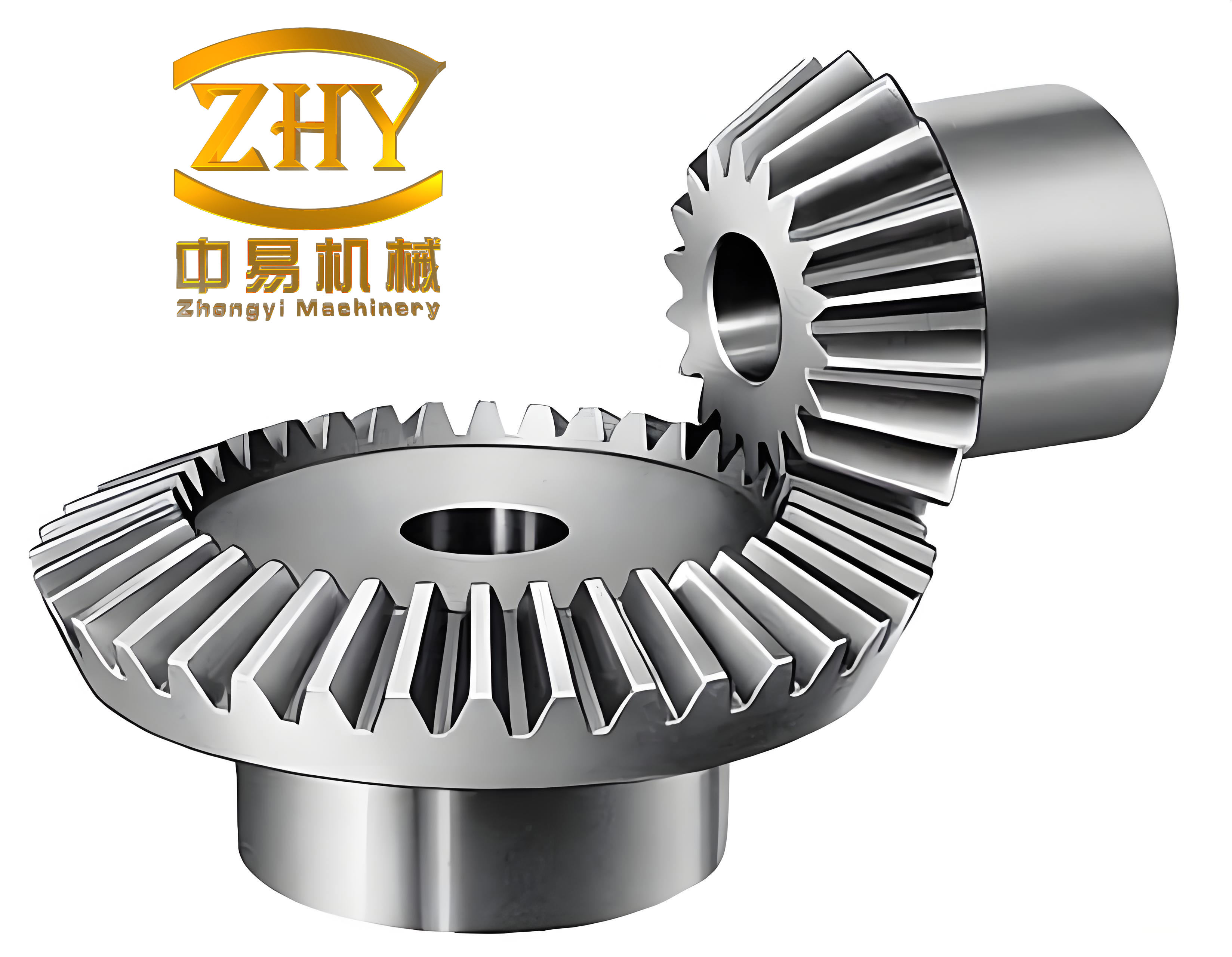
Moving to the machining process, I describe the steps for both the larger and smaller straight bevel gears. For the larger internal straight bevel gear, I use a helical bevel gear cutter (often referred to as a “cutter head”) on a vertical milling machine with a rotatable milling head. The workpiece is mounted on an indexing mechanism whose axis is set at an angle relative to the machine table. Specifically, the angle is given by θ1 = δ1 – α0, where δ1 is the pitch cone angle of the larger straight bevel gear and α0 is the pressure angle at the reference point. The cutter has a blade angle φ, and to ensure the correct pressure angle, the milling spindle is tilted by an angle β1 = 90° – φ. The cutter radius for machining at the reference point is R1, which relates to the pitch cone distance at that point. During operation, the workpiece is fed transversely to cut to the full tooth depth, then retracted for indexing. This process repeats for all teeth on one side. For the opposite side, the indexing mechanism’s axis is adjusted symmetrically, and the workpiece is moved longitudinally to align with the cutter axis. This results in a tooth surface Σ1 that is a conical surface with a half-cone angle φ, linear in the tooth height direction, and crowned in the tooth length direction, meaning it has a controlled curvature. The normal curvature parameters at the reference point are as follows: in the tooth height direction (denoted as y), the normal curvature K1y = 0; in the tooth length direction (denoted as x), the normal curvature K1x is given by the formula: $$K1x = \frac{\sin^2 \varphi}{R1 \sin \delta1}$$. Since x and y are the principal directions of Σ1, the geodesic torsion τ1xy = 0. Additionally, due to the lack of relative motion along the tooth line during cutting, the root line of the larger straight bevel gear becomes concave, which must be considered in tool design to avoid insufficient clearance.
For the smaller external straight bevel gear, I employ a simpler form milling process on a standard vertical milling machine. The tooth surface Σ2 is designed as a cylindrical surface for ease of machining. The workpiece is mounted on an indexing mechanism with its axis at an angle θ2 = 90° – δ2, where δ2 is the pitch cone angle of the smaller straight bevel gear. A form milling cutter with a circular profile of radius ρ is used, and at the reference point, the pressure angle is set to α0. During machining, the cutter’s reference point is aligned with the horizontal plane containing the gear axis, and longitudinal feed is applied to cut the full tooth length. After indexing, all teeth on one side are completed, and the process is mirrored for the opposite side. This yields a tooth surface Σ2 that, at the reference point, has normal curvature parameters: in the y-direction, K2y = 1/ρ; in the x-direction, K2x = 0; and the geodesic torsion τ2xy = 0. The use of a cylindrical surface for the smaller straight bevel gear simplifies production while still enabling effective conjugation with the larger gear’s crowned surface.
To achieve the desired meshing characteristics, I must determine the key parameters: the cutter radius R1 for the larger straight bevel gear, the blade angle φ, the form cutter radius ρ for the smaller straight bevel gear, and the tilt angle β1. These are derived from the second-order meshing conditions. The instantaneous contact ellipse length L, the contact path angle γ, and the angular acceleration a are functions of the induced normal curvatures between Σ1 and Σ2. Specifically, the induced normal curvature in a given direction is the difference between the normal curvatures of the two surfaces. For point contact, we can control these parameters by setting the normal curvatures appropriately. The fundamental equations are based on gear geometry and meshing theory. For example, the relationship between the normal curvatures and the meshing parameters can be expressed using the following formulas:
$$ \Delta K = K1 – K2 $$
$$ L = \sqrt{\frac{2 \epsilon}{\Delta K_n}} $$
$$ \tan \gamma = \frac{\Delta K_t}{\Delta K_n} $$
$$ a = \frac{d \omega}{dt} $$
where ΔK is the induced normal curvature, ΔKn and ΔKt are its normal and tangential components, ε is a compliance factor, and ω is the angular velocity. For straight bevel gears, these equations are adapted to account for the conical geometry. In practice, I set target values for L, γ, and a based on application requirements—for instance, a longer contact ellipse for better load distribution or a specific angle to minimize noise. Then, I solve for the unknown parameters using numerical methods. To summarize the parameter determination process, I present a table that lists the key variables and their roles in the full forming machining of straight bevel gears.
| Parameter | Symbol | Description | Role in Straight Bevel Gear Machining |
|---|---|---|---|
| Cutter radius for larger gear | R1 | Radius of the helical bevel gear cutter | Controls the crown curvature of the larger straight bevel gear tooth surface |
| Blade angle | φ | Angle of the cutter blades | Determines the conical half-angle of the larger gear tooth surface |
| Form cutter radius for smaller gear | ρ | Radius of the circular profile cutter | Sets the curvature in the tooth height direction of the smaller straight bevel gear |
| Spindle tilt angle | β1 | Tilt of the milling spindle for larger gear | Ensures correct pressure angle at the reference point |
| Pitch cone angles | δ1, δ2 | Angles of the pitch cones | Define the geometry of the straight bevel gear pair |
| Pressure angle | α0 | Angle at the reference point | Standard parameter for gear meshing, set to 20° typically |
To illustrate the application of this theory, I provide a detailed calculation example for a specific straight bevel gear pair. The gear parameters are as follows: number of teeth for the larger straight bevel gear Z1 = 40, for the smaller straight bevel gear Z2 = 20, module at the large end m = 3 mm, face width b = 20 mm, pitch cone angles δ1 = 63.43° and δ2 = 26.57°, pressure angle α0 = 20°, and shaft angle Σ = 90°. The reference point is chosen at the midpoint of the face width. Using the formulas derived from second-order generation theory, I compute the required machining parameters. First, the pitch cone distance at the reference point R is calculated from the gear geometry: $$R = \frac{m Z1}{2 \sin \delta1} = \frac{3 \times 40}{2 \sin 63.43°} \approx 67.08 \text{ mm}$$. Then, to achieve a target contact ellipse length L = 5 mm and contact path angle γ = 30°, I solve for the normal curvatures. For the larger straight bevel gear, the crown curvature in the x-direction is given by: $$K1x = \frac{\sin^2 \varphi}{R1 \sin \delta1}$$. For the smaller straight bevel gear, the curvature in the y-direction is: $$K2y = \frac{1}{\rho}$$. Using the meshing equations, I derive that φ ≈ 10°, R1 ≈ 150 mm, and ρ ≈ 50 mm. The spindle tilt angle is then β1 = 90° – φ = 80°. These values ensure that the straight bevel gear pair will have the desired point contact characteristics. Below is a table summarizing the calculation results for this example.
| Computed Parameter | Value | Unit |
|---|---|---|
| Cutter radius R1 | 150 | mm |
| Blade angle φ | 10 | degrees |
| Form cutter radius ρ | 50 | mm |
| Spindle tilt angle β1 | 80 | degrees |
| Normal curvature K1x | 0.00025 | 1/mm |
| Normal curvature K2y | 0.02 | 1/mm |
| Induced normal curvature ΔK | -0.01975 | 1/mm |
With these parameters, the machining of the straight bevel gear pair can proceed as described. For the larger internal straight bevel gear, I select a standard 6-inch helical bevel gear cutter head (approximately 150 mm radius) and modify the blade angle to 10°. On the vertical milling machine, I set the indexing mechanism axis at θ1 = δ1 – α0 = 63.43° – 20° = 43.43°, tilt the spindle by 80°, and perform the transverse feed cutting. For the smaller external straight bevel gear, I use a custom form milling cutter with a 50 mm radius circular profile, set the indexing axis at θ2 = 90° – δ2 = 90° – 26.57° = 63.43°, and carry out longitudinal milling. After machining, the gear pair is assembled and tested on a gear rolling tester to verify the meshing performance.
The experimental results confirm the effectiveness of the full forming machining method for straight bevel gears. The contact pattern obtained from the smaller straight bevel gear shows a well-defined elliptical area centered at the reference point, indicating proper point contact. The gear pair operates smoothly with minimal noise and vibration, meeting the design specifications. This demonstrates that the second-order generation theory successfully applies to internal meshing straight bevel gears, overcoming the limitations of traditional methods. The advantages of this approach include simplified tooling, easier setup calculations, high productivity due to form cutting, and improved transmission quality. Moreover, since both gears are produced by forming, there is no need for complex generating machines, making it accessible for small-scale production or prototyping. The straight bevel gear pair thus achieves a balance between performance and manufacturability.
In conclusion, the full forming machining principle for internal meshing straight bevel gears represents a significant advancement in gear technology. By leveraging second-order generation theory, I have shown that it is possible to design and machine straight bevel gears with controlled point contact, ensuring high meshing quality without the drawbacks of curvature interference. The method involves form cutting for both gears, with the larger straight bevel gear featuring a crowned surface and the smaller straight bevel gear a cylindrical surface, all calculated through precise normal curvature parameters. The calculation example and experimental validation highlight its practicality. Future work could extend this to spiral bevel gears or incorporate advanced materials, but for now, this approach offers a reliable solution for producing high-performance straight bevel gears. Throughout this discussion, the focus on straight bevel gears underscores their importance in mechanical transmissions, and the repeated mention of “straight bevel gear” aims to reinforce this key concept in the reader’s mind.
To further elaborate on the mathematical foundations, I delve into the formulas governing the second-order generation theory for straight bevel gears. The tooth surfaces Σ1 and Σ2 are defined in coordinate systems attached to each gear. Let the position vectors be r1(u1, v1) for the larger straight bevel gear and r2(u2, v2) for the smaller straight bevel gear, where u and v are surface parameters. The meshing condition requires that at the reference point, the surfaces share a common normal and satisfy the equation of contact: $$ n \cdot v_{12} = 0 $$, where n is the unit normal vector and v12 is the relative velocity. For second-order properties, we consider the Taylor expansion of this condition. The induced normal curvature ΔK in a direction given by a unit vector t is: $$ \Delta K(t) = K1(t) – K2(t) $$, where K1 and K2 are the normal curvatures of Σ1 and Σ2 in direction t. In terms of principal curvatures, if κ1 and κ2 are the principal curvatures of Σ1, and κ1′ and κ2′ for Σ2, then for a direction at an angle θ to the principal direction, we have: $$ K1(\theta) = \kappa1 \cos^2 \theta + \kappa2 \sin^2 \theta $$ and similarly for K2. The geodesic torsion τ also plays a role in determining the contact ellipse orientation. For the straight bevel gears in this method, since Σ1 has principal directions aligned with x and y, and Σ2 has one principal direction along y, the calculations simplify. The contact ellipse dimensions are derived from the quadratic form of the induced normal curvature. Specifically, if ΔKn and ΔKt are the induced normal and geodesic curvatures in the principal directions, the ellipse semi-axes a and b are given by: $$ a = \sqrt{\frac{2 \epsilon}{\Delta Kn}} $$ and $$ b = \sqrt{\frac{2 \epsilon}{\Delta Kt}} $$, where ε is a material compliance factor. In practice, for straight bevel gears, we often set ΔKt to zero to align the contact ellipse with the tooth line, simplifying control. The angle γ is then zero, but it can be adjusted by introducing torsion.
To summarize the key equations for designing straight bevel gears using full forming machining, I present them in a consolidated form below:
$$ \text{Pitch cone distance: } R = \frac{m Z}{2 \sin \delta} $$
$$ \text{Normal curvature for larger gear (x-direction): } K1x = \frac{\sin^2 \varphi}{R1 \sin \delta1} $$
$$ \text{Normal curvature for smaller gear (y-direction): } K2y = \frac{1}{\rho} $$
$$ \text{Induced normal curvature: } \Delta K = K1x – K2y \text{ (for aligned directions)} $$
$$ \text{Contact ellipse length: } L = 2 \sqrt{\frac{\epsilon}{|\Delta K|}} $$
$$ \text{Meshing condition at reference point: } \alpha0 = \arctan\left( \frac{\tan \varphi}{\cos \delta1} \right) $$
These equations form the basis for parameter selection. In practice, iterative methods may be used to optimize for specific performance criteria, such as minimizing stress or maximizing efficiency. The flexibility of this approach allows it to be adapted to various straight bevel gear configurations, including those with different pressure angles or module sizes.
Finally, I discuss the broader implications of this machining principle for the industry. Straight bevel gears are ubiquitous in automotive differentials, industrial machinery, and aerospace applications, where reliability and precision are paramount. The full forming method offers a cost-effective alternative to traditional generating processes, especially for internal meshing straight bevel gears, which are notoriously difficult to produce. By enabling point contact with controlled characteristics, it reduces sensitivity to misalignment and wear, extending gear life. Furthermore, the use of standard milling machines lowers capital investment, making it accessible to smaller manufacturers. As technology advances, integrating this method with CNC systems could allow for even greater precision and customization. In all cases, the focus remains on the straight bevel gear as a critical component, and this method ensures its optimal performance through innovative machining techniques.