
In the field of heavy machinery and marine propulsion, herringbone gear systems are widely adopted due to their high load-carrying capacity, smooth transmission, and ability to cancel axial forces. However, vibration and noise generated during operation remain critical challenges, impacting system reliability and performance. This article presents a comprehensive study on vibration transmission analysis, optimization, and experimental verification for herringbone gear systems. I will first analyze the internal excitation factors causing vibration, then predict structural vibration using a fluid-structure coupled finite element model, followed by multi-dynamic objective tooth surface modification optimization, and finally validate the results through experimental tests. The goal is to reduce vibration and noise effectively, enhancing the operational efficiency of herringbone gear systems.
Herringbone gears, with their double helical design, offer significant advantages over spur or single helical gears, but their complex dynamics necessitate detailed investigation. Vibration in herringbone gear systems primarily stems from internal excitations such as time-varying mesh stiffness, impact forces from off-line engagement, and tooth surface friction. Understanding these factors is essential for developing mitigation strategies. In this work, I consider all these excitations and integrate them into a dynamic model to simulate vibration transmission from gear meshing to the gearbox structure. The analysis leverages advanced numerical methods, including finite element analysis and optimization algorithms, to propose design improvements. Experimental verification using high-precision instruments confirms the theoretical predictions, demonstrating the effectiveness of the proposed optimization approach.
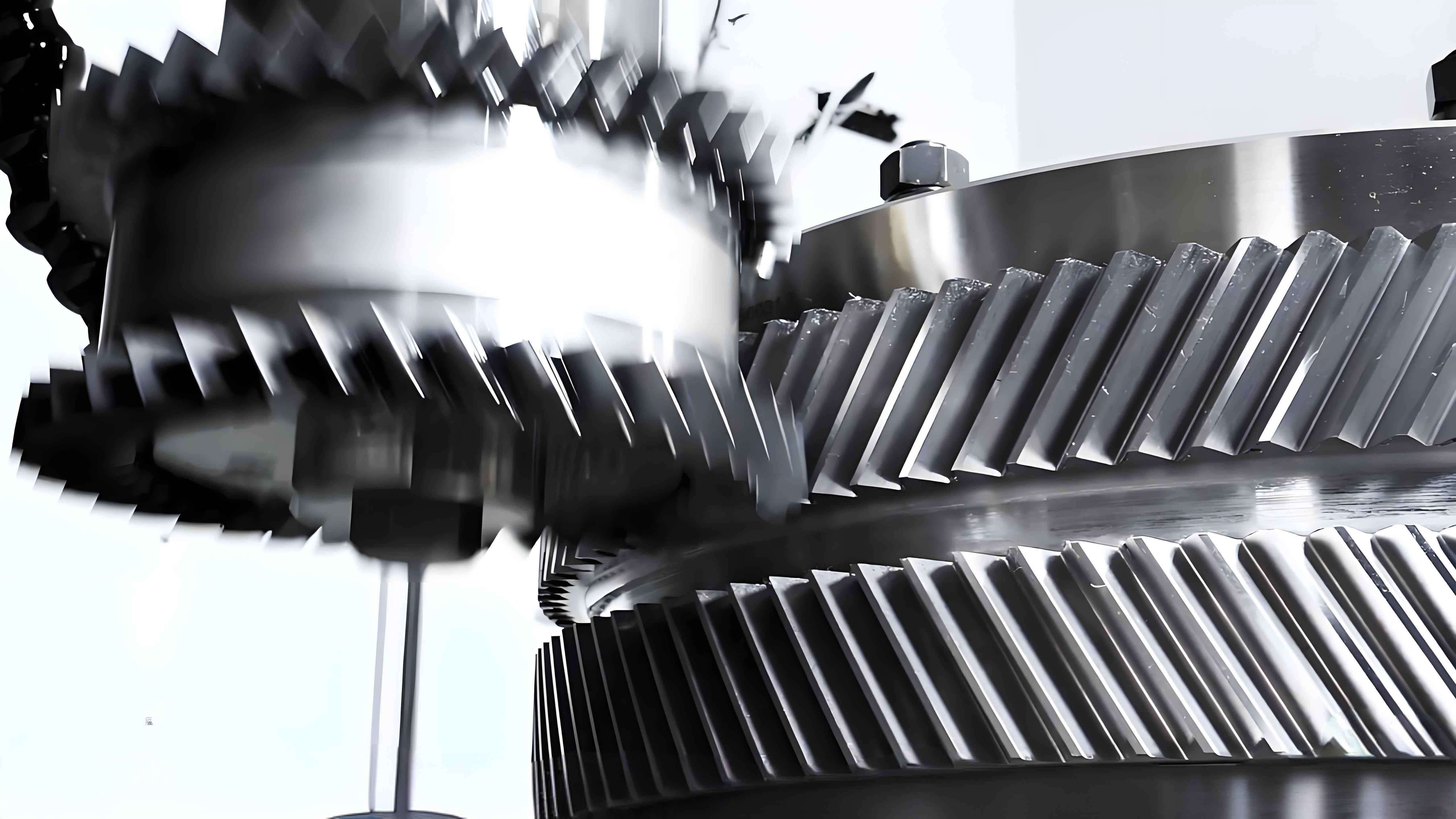
The herringbone gear system’s vibration characteristics are influenced by multiple factors, which I categorize into three main internal excitations: mesh stiffness variation, engagement impact, and tooth surface friction. Mesh stiffness variation arises due to the changing number of tooth pairs in contact during rotation, leading to periodic fluctuations that excite vibration. Engagement impact occurs when teeth first come into contact outside the ideal mesh line, generating impulsive forces. Tooth surface friction, under mixed elastohydrodynamic lubrication conditions, contributes to damping but also introduces additional dynamic effects. To quantify these, I develop mathematical models for each excitation source.
For mesh stiffness, I use loaded tooth contact analysis to compute the time-varying stiffness over a mesh cycle. The stiffness excitation function is derived from the transmission error, which is the difference between the theoretical and actual angular positions of the gears. The transmission error \(\delta_e\) for a herringbone gear pair can be expressed as a function of the gear parameters and load distribution. For impact forces, I calculate the off-line engagement force \(F_s\) based on the relative velocity and misalignment at the initial contact point. The impact force is modeled as a sudden load application, contributing to high-frequency vibrations.
Tooth surface friction is more complex due to the mixed lubrication regime. In herringbone gears, the contact patches form elliptical areas on the tooth surfaces, and the friction coefficient varies across these patches. The mixed lubrication friction coefficient \(\mu_{ML}\) is given by:
$$\mu_{ML} = f_\alpha \mu_{EL} + (1 – f_\alpha) \mu_{BL}$$
where \(\mu_{EL}\) is the friction coefficient under full-film elastohydrodynamic lubrication, \(\mu_{BL}\) is the boundary lubrication friction coefficient, and \(f_\alpha\) is the load-sharing ratio for mixed lubrication, as proposed by Zhu et al. This coefficient depends on local load, sliding velocity, lubricant viscosity, and surface roughness. For a herringbone gear, the friction torque on the pinion and gear can be computed by integrating the friction forces over all contact points during a mesh cycle. The equivalent friction coefficients for the pinion \(\xi_{pk}\) and gear \(\xi_{gk}\) at discrete time steps are:
$$\xi_{pk} = \sum_{i=1}^{\text{ceil}\left(\frac{n}{5}\right)} \sum_{j=1}^{\tau_{k+5(i-1)}} \lambda_{k+5(i-1),j} \mu_{k+5(i-1),j} X_{k+5(i-1),j} \cdot \text{sgn}(r_{p} – r_{k+5(i-1),j})$$
$$\xi_{gk} = \sum_{i=1}^{\text{ceil}\left(\frac{n}{5}\right)} \sum_{j=1}^{\tau_{k+5(i-1)}} \lambda_{k+5(i-1),j} \mu_{k+5(i-1),j} \left( r’_{g} – r’_{p} + \frac{a}{r_{p}} (r_{k+5(i-1),j} – r_{p}) \right) \cdot \text{sgn}(r_{k+5(i-1),j} – r_{p})$$
where \(n\) is the total number of discrete contact lines on a tooth surface, \(\tau\) is the number of contact points per line, \(\lambda\) is the load distribution coefficient, \(\mu\) is the friction coefficient, \(X\) is the moment arm, \(r\) is the distance from the contact point to the gear center, \(r_p\) and \(r_g\) are pitch radii, \(r’_p\) and \(r’_g\) are base circle radii, and \(a\) is the center distance. These equations capture the frictional effects in herringbone gear dynamics.
To assess the relative contribution of each excitation, I analyze a herringbone gear pair with parameters listed in Table 1. The root mean square (RMS) values of relative vibration acceleration under each excitation are computed across a range of speeds. The results show that mesh stiffness variation is the dominant factor, followed by engagement impact and tooth surface friction. This insight guides the optimization efforts, focusing on reducing stiffness fluctuations and impact forces.
| Parameter | Pinion | Gear |
|---|---|---|
| Normal Module (mm) | 6 | 6 |
| Pressure Angle (°) | 20 | 20 |
| Helix Angle (°) | 24.43 | -24.43 |
| Load Torque (N·m) | — | 828 |
| Number of Teeth | 17 | 44 |
| Tooth Hand | Left-Right | Right-Left |
| Face Width B (mm) | 55 | 55 |
| Pinion Speed (r/min) | 2500 | — |
Moving to structural vibration prediction, I develop a finite element model of the gearbox that accounts for fluid-structure coupling with the lubricating oil. The gearbox is modeled using SOLID45 elements in ANSYS, while the oil is modeled with FLUID30 elements. The interface between the gearbox and oil is defined as a fluid-structure interaction surface. Boundary conditions are applied by constraining the bolt holes at the gearbox feet. The dynamic loads from the bearings, calculated from the gear dynamic model, are applied at coupling reference points at the centers of bearing holes. These loads include time-varying forces from mesh stiffness, impact, and friction excitations.
The gearbox material properties and oil characteristics are summarized in Table 2. The transient dynamic analysis in ANSYS simulates the vibration response over multiple mesh cycles until steady-state is reached, determined by a convergence criterion on displacement values. The vibration acceleration at key points, such as the gearbox feet, is extracted for analysis. The results show that the herringbone gear system induces significant structural vibration, with peaks at the mesh frequency and its harmonics.
| Component | Property | Value |
|---|---|---|
| Gearbox | Elastic Modulus (N/m²) | 2.06 × 10¹¹ |
| Poisson’s Ratio | 0.3 | |
| Density (kg/m³) | 7.8 × 10³ | |
| Lubricant Oil | Sound Speed (m/s) | 1.53 × 10³ |
| Density (kg/m³) | 8.8 × 10² |
To reduce vibration, I propose a multi-dynamic objective optimization for tooth surface modification of the herringbone gear. Three-dimensional modification, including profile and lead corrections, is applied to the pinion tooth surface. The optimization aims to minimize four targets: loaded transmission error fluctuation amplitude (representing mesh stiffness variation), off-line impact force amplitude, friction coefficient fluctuation amplitude, and RMS of relative vibration acceleration in the mesh line direction. The optimization function is formulated as:
$$\min f(y) = w_1 \frac{F_e(y)}{F_{e0}} + w_2 \frac{F_f(y)}{F_{f0}} + w_3 \frac{F_I(y)}{F_{I0}} + w_4 \frac{F_a(y)}{F_{a0}}$$
subject to constraints on modification parameters: \(y_1, y_3\) for profile modification amounts, \(y_2, y_4\) for profile modification lengths, \(y_5, y_7\) for lead modification amounts, and \(y_6, y_8\) for lead modification lengths. The weights \(w_1, w_2, w_3, w_4\) are set to 0.3, 0.1, 0.2, and 0.4, respectively, based on the excitation analysis. The individual target functions are defined as:
$$F_e(y) = \max(\delta_e) – \min(\delta_e)$$
$$F_f(y) = \max(\xi_{pk} + \xi_{gk}) – \min(\xi_{pk} + \xi_{gk})$$
$$F_I(y) = \frac{F_s}{F_{s0}}$$
$$F_a(y) = \text{RMS}(a_k)$$
where \(\delta_e\) is the transmission error, \(\xi_{pk}\) and \(\xi_{gk}\) are friction coefficients, \(F_s\) is the impact force, \(a_k\) is the relative acceleration, and subscript 0 denotes initial values before modification.
I use an improved adaptive genetic algorithm to solve this optimization problem. The algorithm adjusts crossover and mutation probabilities based on population diversity, ensuring efficient convergence. The optimized modification parameters for the herringbone gear pinion are listed in Table 3. The modification surface is represented by a cubic B-spline curve, providing smooth transitions and high accuracy.
| Modification Type | Parameter | Value |
|---|---|---|
| Profile | y1 (μm) | 16 |
| y2 (mm) | 1.6 | |
| y3 (μm) | 18 | |
| y4 (mm) | 3.2 | |
| Profile Parabolic Order | 4 | |
| Lead | y5 (μm) | 14 |
| y6 (mm) | 11.2 | |
| y7 (μm) | 14 | |
| y8 (mm) | 11.2 | |
| Lead Parabolic Order | 4 | |
After applying the optimization, I recalculate the dynamic response. The results show a significant reduction in vibration. For instance, the RMS of relative vibration acceleration in the mesh line direction decreases from 40.51 m/s² to 32.40 m/s², and the vibration at the gearbox foot point M drops from 3.94 m/s² to 3.08 m/s² in the vertical direction. Frequency domain analysis reveals reduced amplitudes at the mesh frequency and its harmonics, confirming the effectiveness of the herringbone gear modification.
For experimental verification, I set up a closed power flow test rig for the herringbone gear system. The rig includes a driving motor, a test gearbox, a loading mechanism, and a torque sensor. High-precision Heidenhain circular grating encoders (ROD280, 18,000 lines) are installed on both gear shafts to measure angular displacements, enabling calculation of transmission error and mesh line relative acceleration. Accelerometers (Dytran-3035B1) are mounted on bearing housings and gearbox feet to measure structural vibration. The test conditions match the theoretical analysis, with a pinion speed of 2500 r/min and a load torque of 828 N·m.
The measurement principle for mesh line relative acceleration uses the angular data from the encoders. The relative displacement in the mesh line direction is computed as:
$$s(t) = \frac{\pi}{180} \left[ r_{b1} (\phi_1 – \phi_{10}) – r_{b2} (\phi_2 – \phi_{20}) \right]$$
where \(r_{b1}\) and \(r_{b2}\) are base circle radii, \(\phi_1\) and \(\phi_2\) are actual angles, and \(\phi_{10}\) and \(\phi_{20}\) are initial angles. The acceleration is obtained by double differentiation:
$$a(t) = \frac{d^2 s(t)}{dt^2}$$
In practice, I apply numerical differentiation with filtering to minimize noise. The experimental results for the herringbone gear system before and after modification are summarized in Table 4. The data shows good agreement with theoretical predictions, with vibration reductions across all measurement points.
| Vibration Parameter (RMS) | Theoretical Before (m/s²) | Theoretical After (m/s²) | Experimental Before (m/s²) | Experimental After (m/s²) |
|---|---|---|---|---|
| Mesh Line Relative Acceleration | 40.51 | 32.40 | 44.30 | 34.83 |
| Pinion Left Bearing Radial | 5.40 | 4.22 | 6.21 | 4.81 |
| Gear Left Bearing Radial | 4.27 | 3.39 | 4.94 | 3.91 |
| Gearbox Left Foot Point M | 3.94 | 3.08 | 4.35 | 3.37 |
| Pinion Right Bearing Radial | 5.47 | 4.35 | 6.25 | 4.95 |
| Gear Right Bearing Radial | 4.40 | 2.55 | 5.14 | 4.04 |
| Gearbox Right Foot Point | 4.01 | 3.22 | 4.63 | 3.58 |
The experimental data confirms that the herringbone gear modification reduces overall vibration. The average RMS vibration acceleration across all points decreases by 25.1% in theory and 21.2% in experiments, demonstrating the optimization’s effectiveness. Frequency spectra from the encoders show dominant peaks at the mesh frequency (708 Hz) and its harmonics, with reduced amplitudes after modification. The structural vibration at the gearbox feet also shows similar trends, validating the vibration transmission path from gear mesh to the structure.
In conclusion, this study provides a thorough analysis of vibration transmission in herringbone gear systems, combining theoretical modeling, numerical simulation, optimization, and experimental verification. The internal excitation factors are quantified, with mesh stiffness variation identified as the primary source. The fluid-structure coupled finite element model accurately predicts gearbox vibration, and the multi-dynamic objective optimization successfully reduces vibration through three-dimensional tooth surface modification. Experimental tests using high-precision instruments corroborate the theoretical results, showing significant vibration reduction. This approach can be applied to improve the design and performance of herringbone gear systems in various industrial applications, leading to quieter and more reliable operation.
Future work could explore the effects of different lubrication regimes, temperature variations, and manufacturing tolerances on herringbone gear vibration. Additionally, advanced control strategies could be integrated to further suppress vibration in real-time. The methodologies developed here offer a foundation for ongoing research into dynamic behavior of complex gear systems.