
The development and manufacturing of large-scale, high-precision herringbone gears represent a significant engineering challenge, particularly in heavy industries such as metallurgy and power generation. My experience in this field has centered on overcoming the limitations of traditional gear processing to enhance efficiency, durability, and precision. The herringbone gear, characterized by its double helical teeth that cancel out axial thrust, is crucial for transmitting high torque in demanding applications. However, its large module and absence of a central groove for tool relief make conventional machining difficult. This discussion synthesizes key technical approaches, process innovations, and the inherent advantages of this gear design, drawing from extensive hands-on practice.
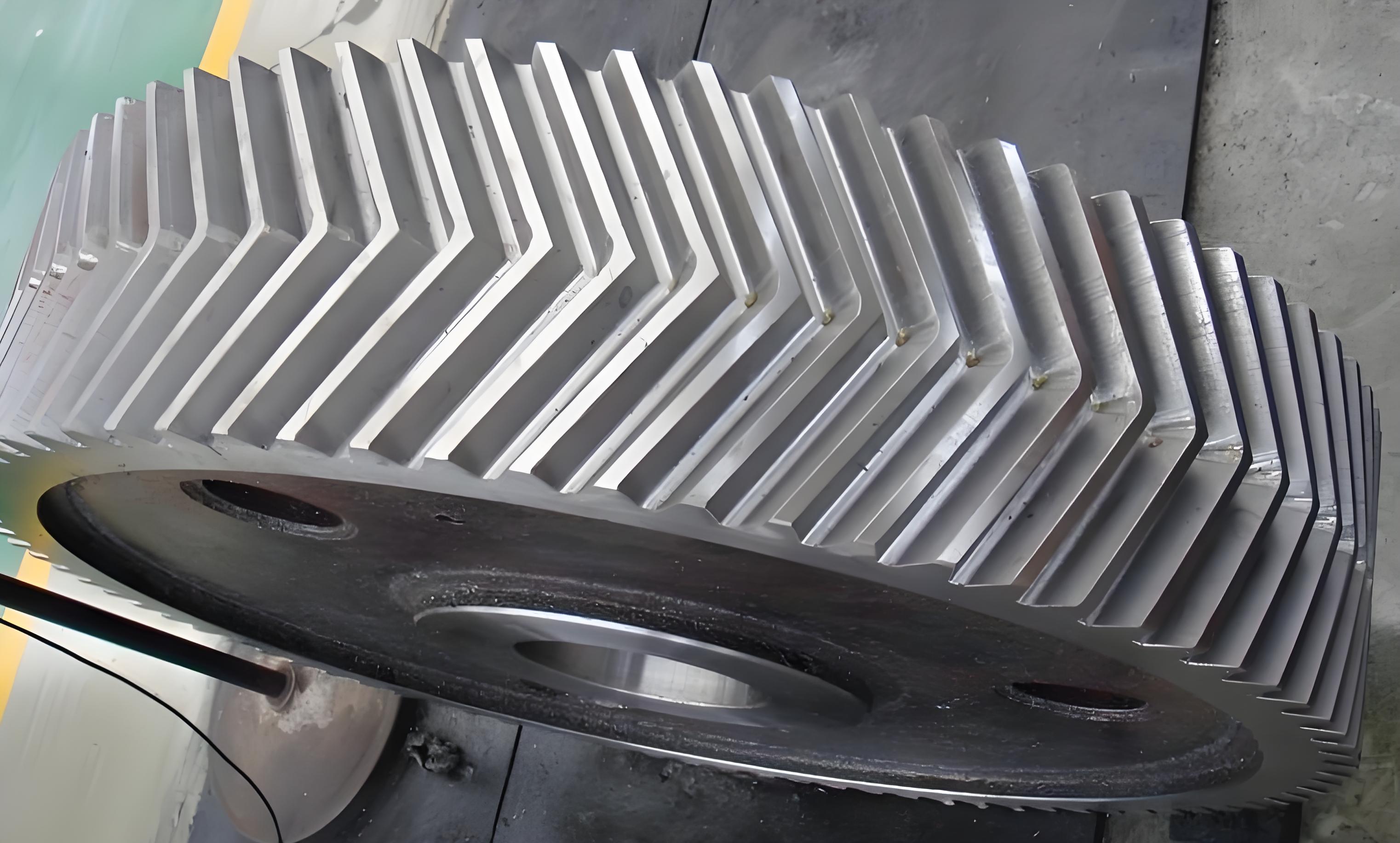
I. Overview of Manufacturing Process for Large Herringbone Gears
The fabrication of a high-precision herringbone gear shaft typically involves a multi-stage process designed to manage material stresses and achieve final dimensional and hardness specifications. A generalized process flow is outlined below:
- Rough turning and initial normalizing/annealing of the forged blank.
- Ultrasonic testing (UT) of the blank and key sections (e.g., shaft ends).
- Rough milling of the herringbone gear teeth.
- Secondary quenching and tempering (hardening) after rough milling.
- Semi-finish turning to remove scale and achieve pre-machining dimensions.
- Secondary rough milling of the gear teeth, leaving stock for finish machining.
- Finish turning or grinding of the bearing journals and other critical diameters.
- Precision finishing of the herringbone gear teeth via a gear shaping or skiving process.
- End-relief modification (crowning or end chamfering) of the gear teeth.
- Final inspection and dynamic balancing.
The core challenge lies in steps 3, 4, and 8. Rough milling before final hardening prevents excessive tool wear and allows for the correction of heat treatment distortions. The secondary hardening achieves the required surface hardness for the herringbone gear, typically in the range of 280-320 HB. The final skiving process is critical for attaining the necessary gear accuracy (e.g., AGMA 10 or DIN 6 standard).
II. Tooling Technology for Herringbone Gear Processing
Tool design and material selection are paramount. The evolution from standard hobs to specialized tools has dramatically improved productivity.
A. Double-Thread Hobs for Roughing
For roughing operations, especially on large modules, double-thread (or multi-thread) hobs offer significant efficiency gains. A direct comparison between a standard hob and a specialized double-thread hob for a large module gear reveals the advantage.
| Parameter | Standard Single-Thread Hob (m=20) | Double-Thread, Large OD Hob (m=20) |
|---|---|---|
| Number of Starts | 1 | 2 |
| Flute Type | Standard | Straight Flute |
| Rake Angle | Standard | Large Positive |
| Typical Feed (mm/rev) | 2.0 – 3.0 | 4.0 – 6.0 |
| Processing Time for Sample Gear | ~60 hours | ~22 hours |
| Tooth Thickness Variation | N/A | ≤ 0.15 mm (within tolerance) |
The double-thread hob’s primary benefit is the doubling of the workpiece rotation per hob revolution, effectively halving roughing time. The straight flute design simplifies manufacture and regrinding, while the large positive rake angle reduces cutting forces and compensates for any negative side rake inherent in the straight-flute geometry. The chip load per tooth $h$ can be approximated by:
$$ h = f_z \cdot \sin(\kappa) $$
where $f_z$ is the feed per tooth and $\kappa$ is the approach angle. For a double-thread hob, the feed rate can be increased while maintaining an acceptable $h$, leading to higher metal removal rates without overloading the tool. Despite initial concerns, the indexing error from a two-start hob has been shown to be within the cumulative pitch tolerance for many industrial herringbone gear applications.
B. Skiving Tools for Finish Machining
Final machining of the hardened herringbone gear teeth requires a hard, precise cutting tool. Skiving (or hard finishing) with a precision ground tool is the preferred method. The tool is essentially a rack-shaped cutter that meshes with the gear. Key specifications for a skiving tool used on a module 32 herringbone gear are:
| Parameter | Specification |
|---|---|
| Module (mn) | 32 mm |
| Pressure Angle (αn) | 20° |
| Helix Angle (β) | 30° 27′ |
| Tooth Profile Angle Tolerance | ± 1′ |
| Profile Straightness Tolerance | ± 0.005 mm |
| Clearance Angle Tolerance | ± 30′ |
| Rake Angle Tolerance | ± 30′ |
| Hardness (Tool Material) |
The challenge lies in tool fabrication, particularly heat treatment to avoid distortion and achieve consistent high hardness, followed by precise grinding of the complex geometry. Advanced tool materials like M42 cobalt HSS or even carbide inserts with PVD coatings (e.g., TiAlN) are employed to withstand the high hardness of the herringbone gear workpiece (280-320 HB). The cutting speed $V_c$ for skiving is relatively low compared to hobbing soft gears, often defined by:
$$ V_c = \frac{\pi \cdot D_c \cdot N}{1000} \quad \text{(m/min)} $$
where $D_c$ is the effective cutter diameter and $N$ is the spindle speed (rpm). The focus is on achieving superior surface finish and profile accuracy rather than high stock removal.
III. Heat Treatment and Distortion Control
The sequence of rough milling followed by quenching and tempering is critical for a herringbone gear. This “harden after roughing” approach minimizes the depth of the hardened case needed, reduces quenching stresses, and allows any distortion to be machined out in subsequent operations. A typical heat treatment cycle for a large, alloy steel herringbone gear shaft is:
| Process Stage | Temperature | Medium / Duration | Objective |
|---|---|---|---|
| Preheating | 400 – 450 °C | Furnace / 2-4 hours | Reduce thermal gradient |
| Austenitizing (Quench) | 830 – 860 °C | Furnace / Soak time based on section | Achieve uniform austenite structure |
| Quenching | Rapid cool from austenitizing temp. | Oil agitation | Form martensite for hardness |
| Tempering | 450 – 500 °C | Furnace / 6-10 hours | Relieve stresses, achieve final hardness (280-320 HB) |
| Stress Relieving | 180 – 200 °C | Furnace / 12-24 hours | Remove residual machining stresses |
The resulting hardness gradient must be carefully controlled to ensure the herringbone gear teeth have sufficient toughness at the core and high surface wear resistance. Distortion, particularly helical twist and bore distortion, is inevitable but predictable. The semi-finish turning and secondary rough milling operations are designed with adequate stock allowance $\Delta S$ to clean up these distortions:
$$ \Delta S \approx k \cdot D \cdot \left( \frac{\Delta T}{1000} \right) $$
where $D$ is a critical dimension, $\Delta T$ is the effective thermal gradient during quenching, and $k$ is an empirical coefficient derived from historical process data for similar herringbone gear components.
IV. Quality Assurance and Metrology
Measuring a large herringbone gear (e.g., 3 meters in length, module 32) presents a metrology challenge, as standard commercial gear testers lack the capacity. Custom-built inspection fixtures are often necessary. Key measured parameters and methods include:
- Pitch Deviation: A large-span pitch checking instrument with a precision inductive gauge is used. Measurements are taken using the equal-division method around the gear. Adjacent pitch error $f_{pt}$ and cumulative pitch error $F_p$ are calculated. For a high-precision herringbone gear, targets such as $f_{pt} \le 0.020$ mm and $F_p \le 0.070$ mm are achievable.
- Tooth Profile & Helix Trace: While full CNC gear inspection is ideal, on large gears, verification is often done via certified master gears for rolling tests or by using portable units that trace a single tooth flank. Profile form error $f_{f\alpha}$ and helix slope error $f_{h\beta}$ are critical for smooth meshing.
- Runout & Concentricity: A dedicated runout checking fixture with a precision dial indicator measures radial runout $F_r$ of the gear teeth relative to the bearing journals. This ensures the herringbone gear runs true under load.
- Tooth Thickness & Backlash: Span measurement over $k$ teeth ($M_{dk}$) is the most practical method for monitoring tooth thickness on the shop floor. The measured value must correspond to the calculated value for the specified backlash $j_n$:
$$ M_{dk} = m_n \cos \alpha_n \left[ \pi (k – 0.5) + z \cdot \text{inv}\alpha_t \right] + 2 x_n m_n \sin \alpha_n $$
where $z$ is the number of teeth, $x_n$ is the addendum modification coefficient, and $\text{inv}\alpha_t$ is the involute function of the transverse pressure angle.
The end-relief modification, a slight reduction in tooth thickness at the very ends of the face width (approximately 0.1-0.2 mm per side), is a crucial final step. It prevents the ends of the herringbone gear teeth from carrying the initial brunt of the load, promoting even load distribution and significantly reducing the risk of corner breakage—a common failure mode in heavily loaded drives.
V. Industrial Performance and Advantages
The successful implementation of this integrated manufacturing approach yields a herringbone gear with exceptional performance. Compared to traditionally manufactured gears, the benefits are substantial:
| Aspect | Traditional Gear (Old Design/Process) | Modern High-Precision Herringbone Gear |
|---|---|---|
| Surface Hardness | ~220-250 HB | 280-320 HB |
| Gear Accuracy Grade | AGMA 8-9 / DIN 8 | AGMA 10-11 / DIN 6-7 |
| Wear Rate | High; significant wear in < 1 year | Very low; minimal wear after 2+ years |
| Load Capacity | Limited by tooth strength & accuracy | High, due to accurate load sharing and hard surface |
| Noise & Vibration | Higher, due to pitch and profile errors | Significantly reduced |
The primary advantage of the herringbone gear design itself is the cancellation of axial thrust forces $F_a$ from the two opposing helices. For a single helical gear, the axial force is given by:
$$ F_a = F_t \cdot \tan \beta $$
where $F_t$ is the tangential force. In a herringbone gear, this force is balanced internally, eliminating the need for massive thrust bearings and simplifying housing design. This makes the herringbone gear ideal for high-torque, low-speed applications like rolling mill drives, where reliability is paramount.
Field data from a rolling mill application showed that a set of precision-finished herringbone gears operated continuously for over two years, processing millions of tons of material, with wear measurements significantly lower than those observed in previous gears after just one year of service. Furthermore, the gears withstood numerous operational overloads (e.g., motor trips, roll breakages) without failure, demonstrating superior robustness imparted by the combination of accurate geometry, controlled hardness, and the inherent strength of the herringbone gear design.
In conclusion, the advanced manufacturing of large herringbone gears is a multidisciplinary endeavor requiring synergistic development in tooling design, heat treatment sequencing, precision finishing, and specialized metrology. The investment in this integrated process is justified by the dramatic increase in service life, reliability, and load capacity of the final herringbone gear component, leading to substantial reductions in downtime and maintenance costs in critical industrial machinery.