
The rapid development of global offshore resources has placed unprecedented demands on the equipment used in marine engineering. This sector, encompassing heavy-lift offshore cranes, dynamic positioning systems for drilling platforms, pipelay vessel machinery, and wind turbine installation vessels, relies fundamentally on robust and reliable power transmission systems. Among these, large open gears are critical components found in the slewing mechanisms of cranes, the windlasses of mooring systems, and various other heavy-duty machinery. The operational environment in marine engineering is exceptionally harsh, characterized by saline atmospheres, significant dynamic loads, stringent space and weight constraints, and a paramount requirement for reliability and safety. Consequently, the gears deployed must exhibit not only high load-carrying capacity and precision but also excellent durability and corrosion resistance, all while aiming for minimized weight and footprint. In this context, the herringbone gear has emerged as a superior solution, effectively addressing the limitations of traditional large spur gears and meeting the exacting standards of modern marine applications.
Traditional large spur gears, while straightforward to manufacture and install due to the absence of axial thrust, present significant disadvantages for marine use. Their design often results in substantial weight, large overall dimensions, and consequently, high material consumption and manufacturing costs. The herringbone gear, essentially comprising two mirrored helical gear sections with opposite hand of helix, ingeniously combines the advantages of both spur and helical gears. It eliminates net axial thrust (as the thrust from each helix cancels out) while offering the high contact ratio, smooth operation, and superior load-bearing capacity characteristic of helical gears. This design allows for a narrower face width compared to an equivalent spur gear and, often through a bolted connection to a drum or shaft, enables a more compact radial design. The benefits are profound: reduced weight, lower material usage, decreased manufacturing cost, and a smaller spatial envelope. These attributes align perfectly with the marine industry’s relentless pursuit of high performance, lightweight design, and operational efficiency, making the large herringbone gear the preferred choice for critical drivetrains.
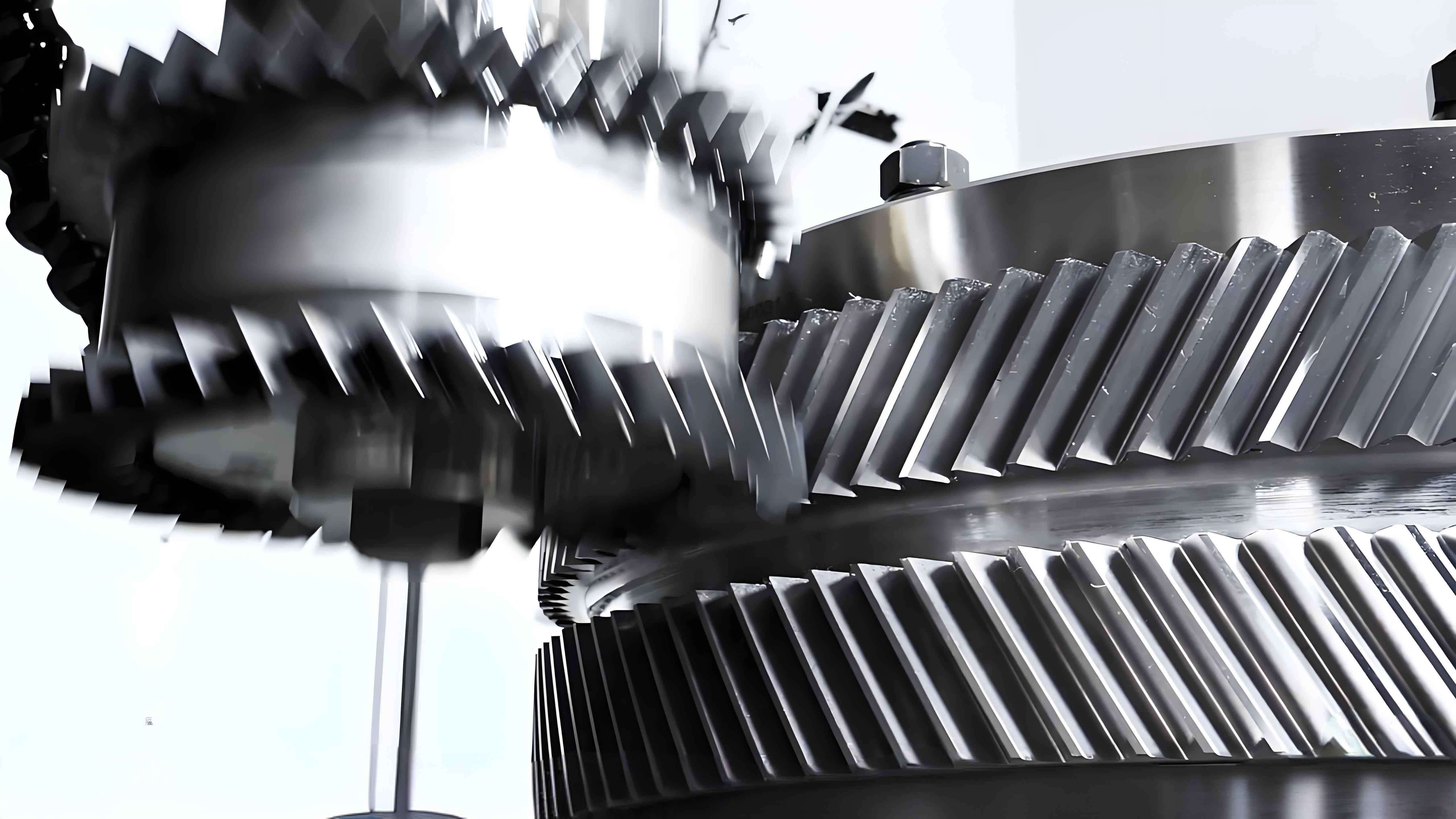
The manufacturing of large herringbone gears, especially those with diameters exceeding 2.5 meters and modules (m) in the range of 28-36 mm, presents a unique set of technical challenges. The components are typically fabricated from high-strength, low-alloy steels such as 34CrNiMo6 or similar grades, requiring a final齿面 hardness in the range of 240-280 HB to ensure an optimal balance of toughness and wear resistance. Controlling distortion during heat treatment and machining is paramount due to the thin-walled, large-diameter geometry of individual half-gears. The permissible error in the relative positioning of the two halves, particularly in the alignment of their theoretical mid-planes, is critical and must be maintained within tight tolerances (often requiring公法线 length variation between halves to be less than 0.1 mm) to ensure smooth meshing and load distribution. A meticulous and controlled manufacturing process flow is therefore essential. This paper delves into the key manufacturing technologies, focusing on advanced forging, precision heat treatment, innovative tooth machining, and accurate assembly, which collectively ensure the quality and performance of large herringbone gears for demanding marine engineering service.
Comprehensive Manufacturing Process for Marine-Grade Herringbone Gears
The production of a large marine herringbone gear is a multi-stage process where each step is crucial for mitigating distortion and achieving final dimensional and metallurgical specifications. A typical process sequence is outlined below, with particular emphasis on stages designed to control deformation:
- Forging of the Blank: Utilizing advanced ring rolling technology to produce a near-net-shape preform.
- Normalizing: Performed post-forging to refine the grain structure, homogenize the microstructure, and reduce subsequent quenching distortion.
- Rough Machining (Turning): Initial machining to remove forging scale and establish basic dimensions.
- Non-Destructive Testing (NDT): Typically ultrasonic testing (UT) to detect internal flaws in the rough-machined blank.
- Rough Tooth Cutting (Hobbing or Gashing): A critical preparatory step performed before final heat treatment. Cutting the tooth spaces roughly to depth ensures that the tooth roots, which are most critically stressed, undergo the full heat treatment cycle, achieving the desired mechanical properties throughout the critical section.
- Quenching and Tempering (Q&T /调质处理): The core heat treatment to achieve the required strength and toughness (索氏体组织). Precise control of temperature, time, and cooling is vital.
- Semi-Finish Machining (Turning): Machining after Q&T to correct distortion and prepare surfaces for final operations. This step helps control the roundness of locating diameters before subsequent hole-making operations which generate heat.
- NDT (Post-HT): Another UT inspection post-heat treatment to ensure no defects were introduced.
- Layout & Marking: Verifying the positional relationship between the tooth profile and bolt hole patterns.
- Drilling: Creating bolt holes and other connection features.
- Finish Machining (Turning): Final turning operation post-drilling to achieve precise locating diameters and face geometry, countering any distortion from drilling.
- First Assembly (Same Helix Hand): Temporarily assembling two half-gears of the same helix hand for the next operation. This is a setup technique for efficient batch machining.
- Finish Tooth Cutting (Precision Hobbing/Shaping): Generating the final tooth geometry to high accuracy.
- Disassembly.
- Final Assembly (Opposite Helix Hand): Pairing the correct left-hand and right-hand half-gears.
- Finish Reaming of Holes: Precision finishing of connection holes in the assembled state to ensure perfect alignment.
- Magnetic Particle Inspection (MPI) of Tooth Flanks: Final surface inspection to detect any grinding cracks or surface defects.
Among these, forging, heat treatment, tooth machining, and final assembly are the most technologically intensive and cost-determining stages.
In-Depth Analysis of Key Manufacturing Technologies
1. Advanced Forging: Ring Rolling Technology
Conventional free forging for large gear blanks is material-inefficient, requiring significant machining allowances and resulting in higher costs and longer lead times. For the annular geometry of a herringbone gear half, ring rolling has become the state-of-the-art process. In radial-axial ring rolling, a heated preform (from a forged pancake with a punched hole) is placed over an idling mandrel (core roller). A main radial roll presses against the outer diameter while axial cones (or rolls) control the face width. As the radial roll advances and the ring rotates, the wall thickness decreases, and the diameter expands plastically. The process continues until the desired annular cross-section with minimized machining allowance is achieved.
The advantages are substantial. Material savings of 20-25% compared to free forging are common. The continuous grain flow following the ring contour enhances mechanical properties. Modern ring rolling mills, such as those from SMS group or others, can produce seamless rings with diameters exceeding 9 meters, perfectly suited for the largest marine gears. The key process parameters include initial preform temperature ($T_0$), rolling speed ($\omega_r$), radial feed rate ($\dot{s}_r$), and the final target dimensions. The volume constancy principle governs the relationship:
$$ A_0 \cdot L_0 \approx A_f \cdot L_f $$
where $A_0$ and $A_f$ are the cross-sectional areas, and $L_0$ and $L_f$ are the mean circumferences of the preform and final ring, respectively.
| Parameter | Free Forging | Ring Rolling |
|---|---|---|
| Material Utilization | Low (~60-70%) | High (~85-95%) |
| Machining Allowance | Large, uneven | Small, consistent |
| Grain Flow | Less optimized | Contoured, superior |
| for final part shape | following part shape | |
| Production Rate | Lower | Higher for suitable volumes |
| Capital Equipment Cost | Lower (press) | Very High (specialized mill) |
| Ideal For | Very low volume, | Medium to high volume, |
| prototypes, complex shapes | annular shapes like herringbone gear halves |
2. Precision Heat Treatment: Quenching & Tempering (调质处理)
The objective of Q&T for a herringbone gear made from medium-carbon alloy steel is to produce a uniform microstructure of tempered martensite or bainite (often referred to as tempered索氏体 in the context), providing an optimal combination of yield strength, toughness, and hardness (target 240-280 HB). The primary challenges for thin-walled, large-diameter components are controlling distortion and achieving hardness uniformity.
The process is meticulously controlled in large pit furnaces with sophisticated temperature uniformity (±5°C) and stirring systems. A typical cycle for a steel like 34CrNiMo6 might be:
- Austenitizing: Heat to $860 \pm 5\,^{\circ}\mathrm{C}$, hold for approximately 1 hour per 100 mm of thickness to ensure thorough through-heating.
- Quenching: Rapid cooling in a polymer-based quenchant (water-soluble). The cooling rate must be fast enough to form martensite but controlled to minimize thermal gradients and stress. The intensity of quenching ($H$-value according to Grossmann) is carefully selected.
- Tempering: Reheat to $630 \pm 5\,^{\circ}\mathrm{C}$ and hold for an extended period (e.g., 12+ hours) to transform the brittle martensite into tough tempered martensite and achieve stress relief, followed by air cooling.
Key control measures include:
- Fixturing & Support: The gear half must be placed on a perfectly flat, level hearth or support fixture. Shimming may be used to ensure even contact and prevent sagging during the austenitizing soak.
- Furnace Load: The load in the furnace must be arranged to allow uniform heat circulation. Overloading can lead to temperature gradients and non-uniform properties.
- Process Modeling: Advanced simulation software using finite element analysis (FEA) coupled with metallurgical transformation kinetics is increasingly used to predict distortion and residual stresses. The governing heat transfer equation during quenching is:
$$ \rho c_p \frac{\partial T}{\partial t} = \nabla \cdot (k \nabla T) + \dot{q}_{trans} $$
where $\rho$ is density, $c_p$ is specific heat, $k$ is thermal conductivity, $T$ is temperature, $t$ is time, and $\dot{q}_{trans}$ is the internal heat generation rate due to phase transformations.
3. High-Efficiency Tooth Machining
Generating the precise helical tooth form on a large herringbone gear half is a major machining operation. Two primary methods are prevalent:
A. Multi-Part Stack Hobbing: For batch production of identical half-gears, a highly efficient method is to stack several blanks axially on a special mandrel and machine them simultaneously with a single hob. This significantly reduces non-cutting time (hob approach/retract per part) and increases productivity. Crucially, it also ensures that all gears in the stack have virtually identical helix characteristics, simplifying later matching of left-hand and right-hand pairs. The effective helix angle ($\beta$) is a critical design parameter, typically between 20° and 28° for marine herringbone gears, influencing axial force cancellation, contact ratio ($\epsilon_{\gamma}$), and bending strength. The transverse module ($m_t$) and normal module ($m_n$) are related by:
$$ m_t = \frac{m_n}{\cos \beta} $$
and the contact ratio is enhanced by the axial overlap: $\epsilon_{\gamma} = \epsilon_{\alpha} + \epsilon_{\beta}$, where $\epsilon_{\alpha}$ is the transverse contact ratio and $\epsilon_{\beta}$ is the overlap ratio.
B. Face Milling (Skiving/Planing) with Indexable Inserts: For very large modules and high-volume production, face milling heads mounted on specialized gear machines offer superior metal removal rates. These cutters use multiple indexable carbide inserts, allowing for high feed rates and cutting speeds. While the initial tooling cost is high and flexibility is lower (a cutter is typically designed for a specific module range), the long-term efficiency and excellent surface finish make this method economically attractive for dedicated production lines. The basic tooth geometry is defined by parameters that must be meticulously controlled during machining, as summarized below:
| Parameter | Symbol | Typical Range / Target for Marine Gears | Critical Influence |
|---|---|---|---|
| Normal Module | $m_n$ | 28 – 36 mm | Tooth size, bending strength |
| Helix Angle | $\beta$ | 20° – 28° | Smoothness, axial thrust cancellation, contact ratio |
| Face Width (per half) | $b$ | Designed per load, relatively narrow | Weight, compactness |
| Hardness (Tooth Flank) | HB | 240 – 280 HB | Wear resistance, pitting resistance, toughness |
| Tooth Profile Accuracy | (e.g., $f_{H\alpha}$, $f_{H\beta}$) | AGMA Class 10-12 or equivalent | Noise, vibration, load distribution |
| Lead (Helix) Accuracy | $f_{f\beta}$ | Tight tolerance required | Load concentration, edge loading |
| 公法线 Length Difference (between halves) | $W_k$ diff | < 0.1 mm | Assembled symmetry and mid-plane alignment |
4. Precision Assembly and Alignment
The final performance of the herringbone gear is critically dependent on the accurate assembly of the two half-gears. The goal is to ensure the theoretical mid-plane of the complete herringbone gear coincides with the designated assembly plane on the shaft or drum. The process involves:
- Selective Pairing: Prior to assembly, half-gears are measured (e.g., base tangent length over a specified number of teeth). Pairs are selected so that their measured values are as close as possible, minimizing inherent pitch error mismatch.
- Surface Preparation: All mating surfaces, locating diameters, and bolt holes are thoroughly cleaned of burrs, chips, and contaminants.
- Centering and Alignment: The halves are brought together on a flat surface or using a vertical assembly stand. Alignment is verified using precision levels, dial indicators, or laser alignment tools. A classic method involves using two precision centers or mandrels to ensure the gear teeth on both halves are symmetrically positioned about the central hub.
- Clamping and Final Connection: Once aligned, the halves are temporarily clamped using tooling bolts or a fixture. Following this, the final bolt holes are match-drilled and/or reamed in the assembled state. This guarantees perfect hole alignment. Finally, high-strength fitted bolts are installed and torqued to specification to create a rigid, integral gear body.
The accuracy of this assembly directly impacts the dynamic behavior. Misalignment can lead to unequal load sharing between the two helical halves, causing noise, vibration, and premature failure. The effective composite error function $E(\theta)$ of the assembled gear, which influences vibration excitation, is a combination of the individual half-gear errors $E_{LH}(\theta)$ and $E_{RH}(\theta)$ and the assembly phase error $\phi$:
$$ E(\theta) \approx E_{LH}(\theta) + E_{RH}(\theta + \phi) $$
Minimizing $\phi$ through precision assembly is therefore essential.
Conclusion and Future Perspectives
The adoption of large herringbone gears represents a significant technological advancement in marine engineering drivetrain design. By overcoming the weight and size penalties of traditional spur gears while offering smoother operation and higher load capacity, they enable more efficient and compact machinery for offshore cranes, pipelay systems, and other critical marine equipment. The successful manufacture of these demanding components hinges on a synthesis of advanced technologies: material-saving ring rolling, distortion-controlled precision heat treatment, high-productivity tooth machining, and micrometer-level assembly accuracy.
Future trends in large herringbone gear manufacturing will likely focus on further integration of digital technologies. This includes the broader application of simulation-driven process design for forging and heat treatment to minimize trial-and-error, the adoption of in-process monitoring and adaptive control during gear cutting to enhance accuracy, and the use of advanced metrology (like 3D optical scanning) for comprehensive quality assurance. Furthermore, while this discussion centered on through-hardened gears, the application of localized surface hardening techniques, such as induction hardening or carburizing for critical regions, may be explored for even higher power density requirements. As marine engineering continues to push into deeper waters and harsher environments, the ongoing refinement of herringbone gear manufacturing technology will remain pivotal in developing the reliable, high-performance transmission systems that underpin this vital industry.