
Herringbone gears, composed of two opposing helical gear halves, are renowned in marine propulsion systems for their ability to theoretically cancel out axial thrust, high contact ratio, substantial load-carrying capacity, and smooth operation. The acoustic stealth performance of vessels during navigation is paramount, making the accurate prediction and mitigation of vibration and noise generated by herringbone gear systems a critical engineering objective. Manufacturing deviations, such as long-period cumulative pitch error, are inevitable in gear production. For a herringbone gear, the left and right helical halves are typically manufactured separately, often resulting in different cumulative pitch errors for each half. Upon assembly of a herringbone gear pair, the left and right helical gear pairs exhibit distinct relative pitch deviations, a condition this study defines as Asymmetric Pitch Deviation (APD). APD represents an unavoidable deviation arising from the manufacturing and assembly of herringbone gear pairs, necessitating a thorough investigation into its effects on their quasi-static and dynamic characteristics.
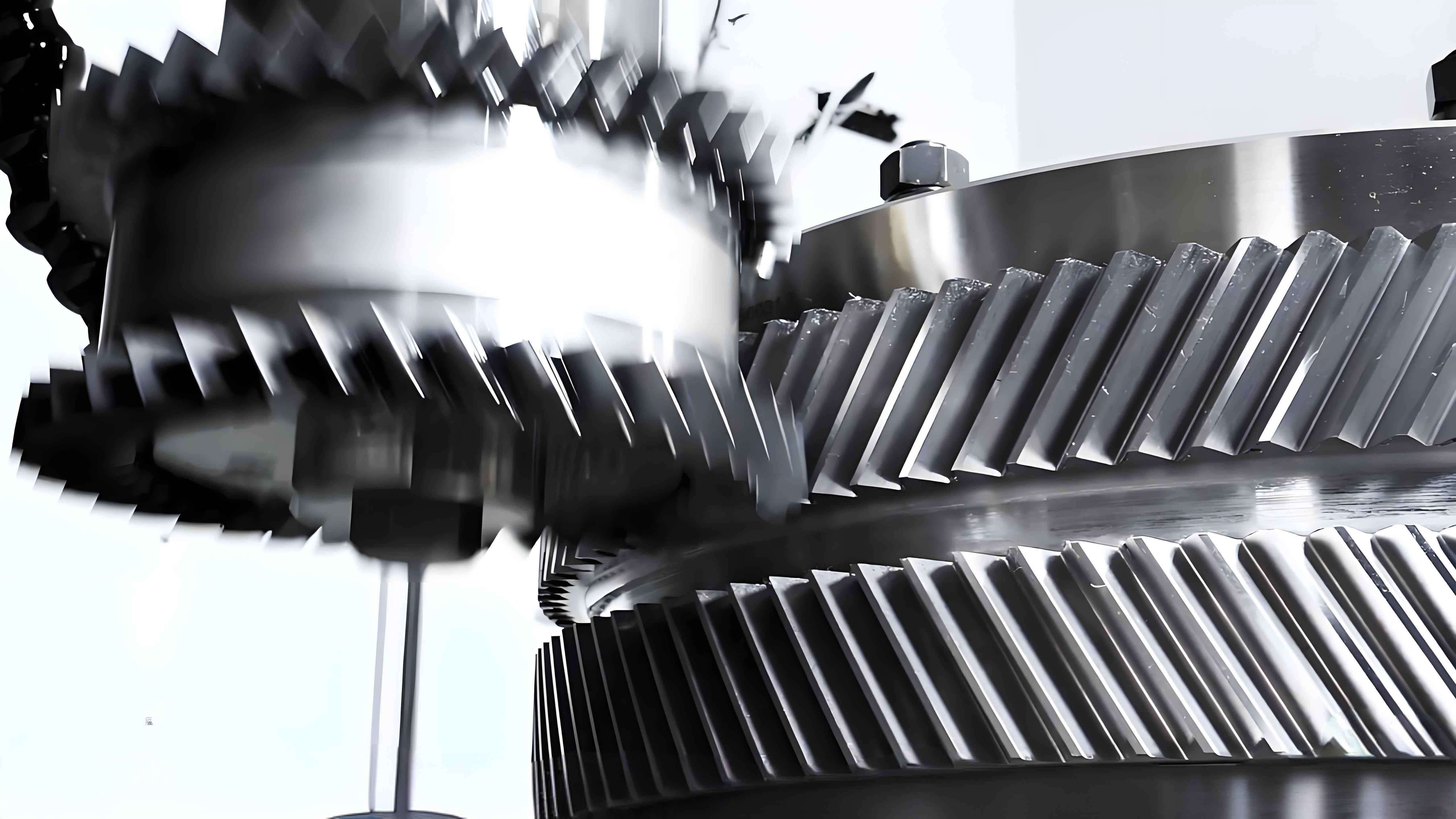
Loaded Tooth Contact Analysis for Herringbone Gears with Asymmetric Pitch Deviation
APD causes the left and right helical gear pairs of a herringbone gear to contact non-simultaneously during meshing, leading to an asymmetric meshing state. In practical engineering, the pinion shaft is often supported in an axially floating manner, allowing the pinion to move axially to equalize the load between the left and right gear pairs. When considering APD, the flank clearance at discrete points on the instantaneous contact lines for multiple tooth pairs in simultaneous contact within a single meshing cycle comprises three components:
- The initial flank clearance calculated from the geometrical contact analysis of a single tooth pair.
- The varying meshing clearance due to APD for the successively engaging tooth pairs on the left and right sides.
- The normal clearance increment induced by the axial movement of the pinion for both sides.
The pinion axial displacement, denoted as $\delta_p$, is defined as positive when the pinion moves axially leftward relative to the gear. The resulting normal clearance increments for the left ($\delta_{nl}$) and right ($\delta_{nr}$) helical gear pairs are given by:
$$ \delta_{nl} = \pm \delta_p \tan \beta \cos \alpha_t, \quad \delta_{nr} = \mp \delta_p \tan \beta \cos \alpha_t $$
where $\beta$ is the helix angle and $\alpha_t$ is the transverse pressure angle. The signs depend on the direction of axial movement required for load sharing.
Considering APD, an improved Loaded Tooth Contact Analysis (LTCA) model for a single meshing cycle of a herringbone gear can be formulated as a constrained optimization problem:
$$
\begin{aligned}
& \min \mathbf{p}^T \mathbf{F} \mathbf{p} + \mathbf{w}^T \mathbf{p} + \boldsymbol{\lambda}^T \mathbf{p} \\
& \text{subject to:} \\
& \quad \sum_{j=1}^{N} p_j – F_n / \cos \beta = 0 \\
& \quad \mathbf{F} \mathbf{p} + \mathbf{w} + \boldsymbol{\lambda} + Z \mathbf{e} + \delta_p \mathbf{A} – \mathbf{d} = 0 \\
& \quad p_j \geq 0, \quad d_j \geq 0, \quad p_j d_j = 0 \quad (j=1,2,…,N) \\
& \quad \delta_p, Z \text{ are free variables}
\end{aligned}
$$
where $\mathbf{p}$ is the vector of normal loads at discrete contact points, $\mathbf{F}$ is the global flexibility matrix, $\mathbf{w}$ is the initial geometrical separation vector, $\boldsymbol{\lambda}$ is the vector of meshing clearances from APD, $Z$ is the normal approach of the gear bodies, $\mathbf{e}$ is a unit vector, $\mathbf{d}$ is the vector of separations after deformation, and $\mathbf{A}$ is a vector with elements $\pm \tan \beta \cos \alpha_t$ corresponding to left and right side contact points. This model is solved using an improved simplex method.
The comprehensive meshing stiffness (CMS) for the left ($k_L$) and right ($k_R$) sides over a single mesh cycle is calculated from the LTCA results:
$$ k_L = \frac{F_{n12L}}{Z – e_{TE1}}, \quad k_R = \frac{F_{n12R}}{Z – e_{TE2}} $$
where $F_{n12L}$ and $F_{n12R}$ are the normal forces, and $e_{TE1}$ and $e_{TE2}$ are the static transmission errors for the left and right sides, respectively.
By solving this model repeatedly for $lcm(z_1, z_2)$ mesh cycles (where $lcm$ is the least common multiple of the pinion teeth $z_1$ and gear teeth $z_2$), the long-period variations of CMS, pinion axial displacement $\delta_p$, and comprehensive meshing error (CME) are obtained.
The meshing impact force $f_{si}$ at the start of engagement for each side (i=1 for left, i=2 for right) over the long period is calculated using:
$$ f_{si} = v_s \sqrt{ \frac{ k_s \left( I_1 I_2 r_{b2}^2 \right) }{ I_1 r_{b2}^2 + I_2 r_{b1}^2 } } \left( 1 + \sqrt{ 1 + \frac{2c}{v_s^2} \frac{ I_1 r_{b2}^2 + I_2 r_{b1}^2 }{ I_1 I_2 r_{b2}^2 } k_s } \right) $$
where $v_s$ is the relative velocity at the start of engagement, $k_s$ is the stiffness at that point, $I_1$ and $I_2$ are moments of inertia, $r_{b1}$ and $r_{b2}$ are base circle radii, and $c$ is a deformation coefficient under static load.
Thus, the LTCA model yields the long-period internal excitations for a herringbone gear with APD: CMS, $\delta_p$, CME, and meshing impact forces.
Dynamic Modeling of the Herringbone Gear System with APD
A lumped-parameter dynamic model of the herringbone gear system is established. The system has eight degrees of freedom per gear body: translational motions $x_{ij}$, $y_{ij}$, $z_{ij}$ and rotational motion $\theta_{ij}$ around the z-axis for the pinion (i=1) and gear (i=2) on the left (j=L) and right (j=R) sides. The governing equations of motion are derived using Newton’s second law. For the left-side pinion (1L), the equations are:
$$
\begin{aligned}
& m_{1L}\ddot{x}_{1L} + c_{x1L}\dot{x}_{1L} + k_{x1L}x_{1L} + c_b(\dot{x}_{1L}-\dot{x}_{1R}) + k_b(x_{1L}-x_{1R}) + (F_{nL} + f_{s1})\cos\beta_{bL}\sin\psi_{12L} = 0 \\
& m_{1L}\ddot{y}_{1L} + c_{y1L}\dot{y}_{1L} + k_{y1L}y_{1L} + c_b(\dot{y}_{1L}-\dot{y}_{1R}) + k_b(y_{1L}-y_{1R}) + (F_{nL} + f_{s1})\cos\beta_{bL}\cos\psi_{12L} = 0 \\
& m_{1L}\ddot{z}_{1L} + c_{z1L}\dot{z}_{1L} + k_{z1L}z_{1L} + c_p(\dot{z}_{1L}-\dot{z}_{1R}) + k_p(z_{1L}-z_{1R}) – (F_{nL} + f_{s1})\sin\beta_{bL} = 0 \\
& I_{1L}\ddot{\theta}_{1L} + c_t(\dot{\theta}_{1L}-\dot{\theta}_{1R}) + k_t(\theta_{1L}-\theta_{1R}) + (F_{nL} + f_{s1}) r_{b1L} \cos\beta_{bL} = T_{1L}
\end{aligned}
$$
Similar equations are formulated for the left-side gear (2L), right-side pinion (1R), and right-side gear (2R). In these equations, $F_{nj}$ (j=L,R) is the dynamic normal mesh force for each side, which is a function of the relative dynamic displacement along the line of action $\lambda_{12j}$, the time-varying mesh stiffness $k_{12j}(t)$, and damping $c_{12j}$: $F_{nj} = c_{12j} \dot{\lambda}_{12j} + k_{12j}(t) f(\lambda_{12j})$. The function $f(\lambda_{12j})$ accounts for gear backlash.
The relative displacement $\lambda_{12j}$ along the line of action for each side is:
$$
\begin{aligned}
\lambda_{12j} = & (x_{1j} – x_{2j})\sin\psi_{12j} + (y_{1j} – y_{2j})\cos\psi_{12j} + (z_{1j} – z_{2j})\sin\beta_{bj} \\
& + (r_{b1j}\theta_{1j} + r_{b2j}\theta_{2j})\cos\beta_{bj} – e_{TEj}(t) – \delta_p(t) \sin\beta_{bj}
\end{aligned}
$$
Crucially, the long-period internal excitations obtained from the LTCA—$k_{12j}(t)$, $\delta_p(t)$, $e_{TEj}(t)$, and $f_{sj}(t)$—are introduced into the dynamic model. They are expressed as Fourier series expansions:
$$
\begin{aligned}
k_m(t) &= k_{m0} + \sum_{i=1}^{N_k} [A_{ki} \cos(i\omega_l t) + B_{ki} \sin(i\omega_l t)] \\
\delta_p(t) &= \delta_{p0} + \sum_{i=1}^{N_p} [C_{pi} \cos(i\omega_l t) + D_{pi} \sin(i\omega_l t)] \\
e(t) &= e_0 + \sum_{i=1}^{N_e} [E_{ei} \cos(i\omega_l t) + F_{ei} \sin(i\omega_l t)] \\
f_s(t) &= f_{s0} + \sum_{i=1}^{N_s} [G_{si} \cos(i\omega_l t) + H_{si} \sin(i\omega_l t)]
\end{aligned}
$$
where $\omega_l = 2\pi n_1 / (60 z_2)$ is the fundamental frequency of the long period, with $n_1$ being the pinion rotational speed in rpm.
The dynamic responses are obtained by numerically integrating the system of differential equations using the Runge-Kutta method. The vibration acceleration along the line of action in the transverse plane is termed the transverse vibration acceleration. The axial vibration acceleration of the pinion, which directly results from the excitation $\delta_p(t)$, is also calculated. Together, they form the three-dimensional (3-D) vibration response of the herringbone gear system.
Influence of Asymmetric Pitch Deviation on Quasi-Static Characteristics
A case study is performed on a herringbone gear pair with parameters listed in Table 1. Measured cumulative pitch deviations for the pinion and gear are scaled by factors of 1.0, 0.7, 0.4, and 0.1 to simulate different levels of APD severity.
| Parameter | Pinion | Gear |
|---|---|---|
| Number of Teeth | 17 | 44 |
| Normal Module (mm) | 6 | 6 |
| Normal Pressure Angle (°) | 20 | 20 |
| Helix Angle (°) | +24.43 | -24.43 |
| Face Width (mm) | 55 | 55 |
Under a constant load torque of 5000 N·m on the gear, the long-period quasi-static characteristics are computed using the LTCA model.
- Comprehensive Meshing Stiffness (CMS): As the APD level decreases (from 1.0× to 0.1× scale), the CMS for both left and right sides increases. Reduced pitch deviation increases the effective contact ratio, enhancing the gear pair’s resistance to deformation.
- Pinion Axial Displacement ($\delta_p$): The axial displacement exhibits a clear long-period variation with 17 cycles per gear revolution, matching the pinion tooth count. The magnitude of $\delta_p$ fluctuations decreases significantly as APD is reduced. This is because the difference in relative pitch deviation between the left and right sides diminishes, requiring less axial movement to achieve load sharing.
- Comprehensive Meshing Error (CME): The amplitude of the long-period CME wave decreases with reduced APD, as smaller manufacturing errors are introduced into the system.
- Meshing Impact Force: For high APD (1.0×), the impact forces for the left and right sides are visibly asymmetric and vary considerably from one mesh cycle to the next. As APD decreases, the impact forces on both sides become more symmetric and their variation range narrows substantially.
The key quasi-static results are summarized in Table 2, showing the trend of decreasing excitation magnitudes with improved pitch accuracy.
| APD Level | CMS Amplitude | $\delta_p$ Peak-to-Peak | CME Amplitude | Impact Force Asymmetry |
|---|---|---|---|---|
| 1.0× | Lowest | Largest | Largest | High |
| 0.7× | Medium-Low | Large | Large | Medium-High |
| 0.4× | Medium-High | Medium | Medium | Medium |
| 0.1× | Highest | Smallest | Smallest | Low (Nearly Symmetric) |
Influence of Asymmetric Pitch Deviation on Dynamic Characteristics
The dynamic responses are analyzed for the same APD levels under a pinion speed of 2000 rpm and the 5000 N·m load. Key system parameters include bearing stiffnesses and the stiffness of the central groove connecting the two helical halves.
The 3-D vibration accelerations (transverse and axial) are computed. The spectral characteristics evolve significantly with APD:
- No APD (Ideal Case): The spectrum is dominated by the meshing frequency ($f_m$) and its harmonics. The axial vibration acceleration at these frequencies is very small.
- With APD: Sideband components appear around the meshing frequency harmonics in the transverse vibration spectrum. In the axial vibration spectrum, prominent sidebands appear, particularly around the second meshing harmonic ($2f_m$). These sidebands are spaced at the pinion rotational frequency ($f_1$), i.e., $2f_m \pm n f_1$, which corresponds to the long-period excitation frequency $\omega_l$.
- Effect of APD Magnitude: As the APD level increases, the amplitudes at the meshing frequency and its harmonics grow. More importantly, the amplitudes of the sideband components increase dramatically. The axial vibration is much more sensitive to APD than the transverse vibration.
This is quantified by the Root Mean Square (RMS) values of the vibration accelerations, shown in Table 3.
| APD Level | Transverse Accel. RMS (m/s²) | Axial Accel. RMS (m/s²) |
|---|---|---|
| No Deviation | 41.89 | 3.28 |
| 0.1× | 44.42 | 13.60 |
| 0.4× | 53.98 | 40.08 |
| 0.7× | 61.28 | 79.32 |
| 1.0× | 67.84 | 115.53 |
The results clearly show that both transverse and axial vibrations increase with APD, but the axial vibration escalates at a much higher rate. For instance, from the “No Deviation” case to the 1.0× APD case, the transverse RMS increases by about 62%, while the axial RMS increases by over 3400%. This underscores the profound impact of APD on exciting axial vibration in herringbone gear systems.
Conclusion
This study investigates the influence of Asymmetric Pitch Deviation (APD) on the quasi-static and dynamic behavior of herringbone gears. An improved Loaded Tooth Contact Analysis model and a corresponding dynamic model incorporating multi-source, long-period internal excitations were developed. The key findings are:
- The pinion axial displacement, necessary for load sharing under APD, varies with a long period equal to the period of the asymmetric pitch error itself.
- Reducing APD increases the comprehensive meshing stiffness, while decreasing the amplitudes of the pinion axial displacement, comprehensive meshing error, and meshing impact forces. The impact forces on the left and right sides become more symmetric.
- APD significantly exacerbates the three-dimensional vibration of the herringbone gear system. It introduces prominent sidebands in the vibration spectrum, particularly around the second meshing harmonic in the axial direction. The axial vibration response is exceptionally sensitive to APD levels.
- Improving gear manufacturing precision to minimize cumulative pitch error, and thereby reducing APD, is an effective strategy for lowering the 3-D vibration acceleration, suppressing sideband energy, and ultimately reducing the noise and vibration of herringbone gear transmission systems.
This research provides a theoretical foundation for accurately predicting and mitigating vibration in herringbone gears, which is vital for applications demanding high acoustic stealth, such as marine propulsion.