
As a tooling engineer specializing in gear manufacturing, I have dedicated significant effort to the development of cutting tools for large module herringbone gears. These gears are critical components in high-tonnage, heavy-duty forging and pressing machinery, where they transmit substantial power and torque under demanding conditions. The design of tools for machining herringbone gears, particularly those with modules ranging from M10 to M20 and spiral angles around 30°, presents unique challenges that require a deep understanding of gear geometry, cutting dynamics, and manufacturing precision. In this article, I will share my insights and methodologies for designing these tools, focusing on the helical gear shaper cutter, often referred to as the斜齿梳齿刀 in Chinese contexts, but universally applicable to herringbone gear production. The goal is to provide a comprehensive guide that emphasizes practical calculations, design principles, and technical specifications, all while ensuring the keyword “herringbone gear” is central to our discussion.
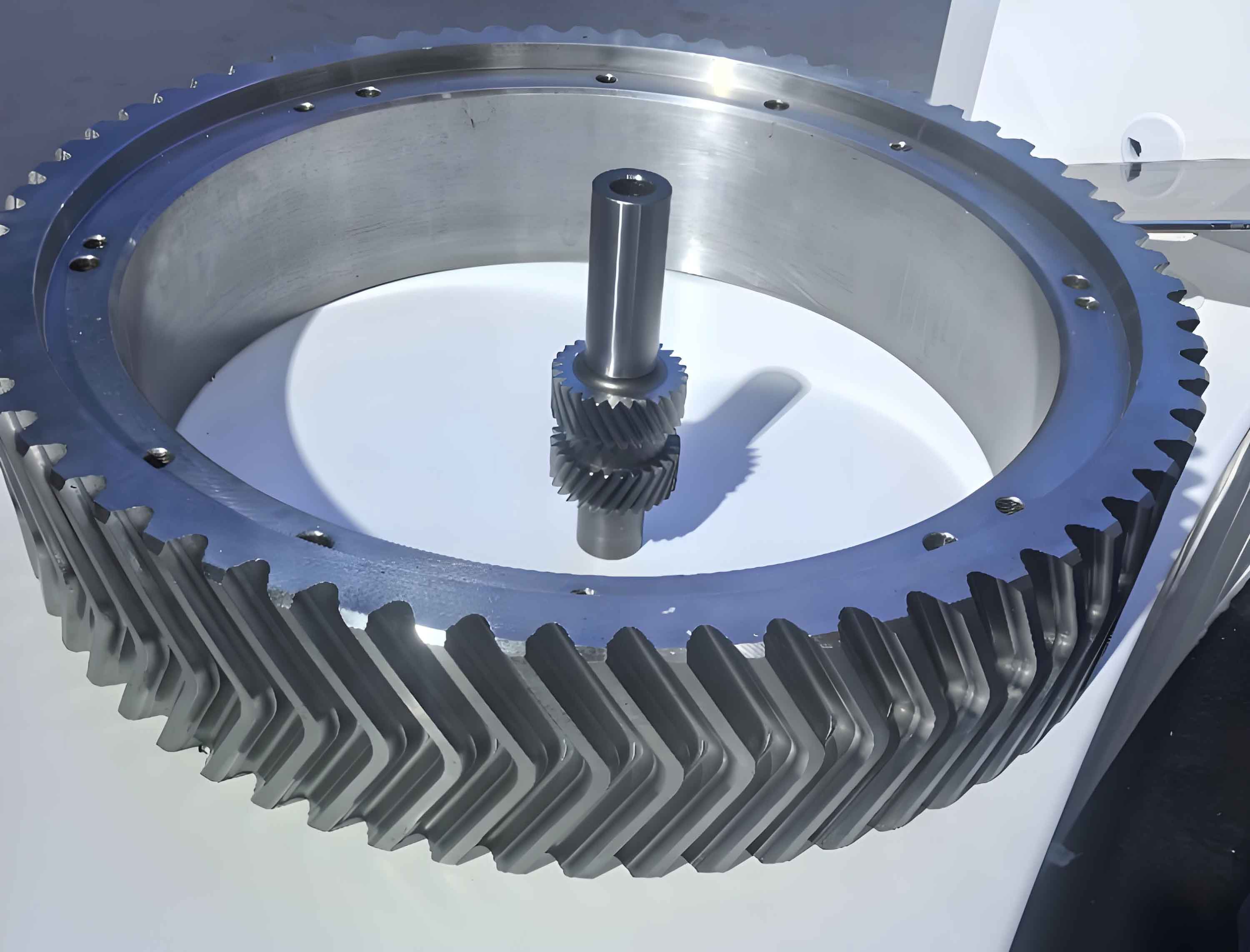
The herringbone gear, characterized by its double helical teeth that resemble a herringbone pattern, offers advantages such as smooth operation, high load capacity, and reduced axial thrust. However, machining these gears requires specialized tools that can accurately generate the complex tooth profiles while maintaining efficiency and tool life. My experience has shown that the design of these tools hinges on the fundamental principles of gear meshing, where the tool acts as a generating rack or gear in relation to the workpiece. For herringbone gears, this involves adapting standard gear theory to account for helical angles, tool geometries, and cutting motions. In the following sections, I will delve into the design process, starting with the basic principles and moving through detailed parameter calculations, technical requirements, and application considerations, all aimed at optimizing tool performance for herringbone gear machining.
The cutting tool for herringbone gears, which I refer to as the helical gear shaper cutter, operates based on the engagement between a herringbone gear and a theoretical rack. This rack corresponds to the tool’s working surface, and during cutting, the tool moves along a direction inclined relative to this surface while performing a generating motion with the gear. This process ensures that the tooth profile on the herringbone gear is accurately formed. To design such a tool, one must first understand the gear parameters: the end module \( M \), end pressure angle \( \alpha \), end circular tooth thickness \( S_f \), major diameter \( D \), minor diameter \( d \), and number of teeth \( z \). These parameters define the herringbone gear’s end cross-section, which serves as the basis for tool design. The key challenge lies in translating these end-section characteristics into tool geometries that account for helical angles, cutting angles, and manufacturing constraints.
In my design approach, I focus on several critical parameters: the normal spiral angle \( \beta_n \), the axial angles \( \alpha_1′ \) and \( \alpha_2′ \), and the normal machining angles \( \alpha_1” \) and \( \alpha_2” \). These angles determine the tool’s cutting efficiency, profile accuracy, and overall performance when machining herringbone gears. The calculations involve trigonometric relationships derived from the tool’s geometry, considering factors such as rake angle \( \gamma’ \) and relief angle \( \gamma” \). Below, I will outline these calculations in detail, supported by formulas and tables to summarize key relationships. By mastering these parameters, tool designers can ensure that the helical gear shaper cutter produces herringbone gears with precise tooth forms and minimal errors.
Let’s begin with the normal spiral angle \( \beta_n \). This angle defines the helix of the tool relative to its normal plane and is crucial for aligning the tool with the herringbone gear’s helical teeth. Based on the gear’s end spiral angle \( \beta \) and the tool’s relief angle \( \gamma” \), the normal spiral angle is calculated using the following formula:
$$ \beta_n = \arctan(\cos \gamma” \tan \beta) $$
This equation ensures that the tool’s helical orientation matches the herringbone gear’s geometry, facilitating smooth cutting action. In practice, for herringbone gears with \( \beta = 30^\circ \) and \( \gamma” = 6.5^\circ \), \( \beta_n \) typically ranges from 28° to 29°, depending on specific design choices. Accurate computation of \( \beta_n \) is essential for subsequent angle calculations and tool fabrication.
Next, we move to the axial angles \( \alpha_1′ \) and \( \alpha_2′ \), which describe the tool’s tooth profile in the axial plane. These angles are influenced by the gear’s end pressure angle \( \alpha \), rake angle \( \gamma’ \), and end spiral angle \( \beta \). From geometric analysis, I derive the following formulas:
$$ \alpha_1′ = \arctan[(\tan \alpha + \tan \gamma’ \tan \beta) \cos \gamma’] $$
$$ \alpha_2′ = \arctan[(\tan \alpha – \tan \gamma’ \tan \beta) \cos \gamma’] $$
Here, \( \alpha_1′ \) corresponds to the leading edge of the tool tooth, while \( \alpha_2′ \) corresponds to the trailing edge. For standard herringbone gears with \( \alpha = 20^\circ \), \( \gamma’ = 6.5^\circ \), and \( \beta = 30^\circ \), these angles help define the tool’s cutting geometry in the axial direction, ensuring proper engagement with the herringbone gear teeth during machining. It’s important to note that these angles must be precisely controlled to avoid profile deviations in the finished herringbone gear.
The normal machining angles \( \alpha_1” \) and \( \alpha_2” \) are equally critical, as they define the tool’s tooth profile in the normal plane, which is the reference for grinding and inspection. These angles account for the relief angle \( \gamma” \) and normal spiral angle \( \beta_n \), and are calculated as follows:
$$ \alpha_1” = \arctan\left[\frac{(\tan \alpha – \sin \gamma” \tan \beta_n) \cos \beta_n}{\cos \gamma”}\right] $$
$$ \alpha_2” = \arctan\left[\frac{\sin \gamma” \sin \beta_n + \tan \alpha \cos \beta_n}{\cos \gamma”}\right] $$
In these equations, \( \alpha_1” \) and \( \alpha_2” \) ensure that the tool’s cutting edges are correctly oriented in the normal section, which is essential for accurate herringbone gear tooth generation. For instance, with \( \alpha = 20^\circ \), \( \gamma” = 6.5^\circ \), and \( \beta_n = 28.5^\circ \), these angles typically fall within a range that balances cutting performance and tool strength. By computing these parameters, tool designers can specify the grinding angles needed to produce the helical gear shaper cutter, ultimately contributing to high-quality herringbone gear production.
To summarize these key parameters, I have compiled a table that outlines their typical values for large module herringbone gears. This table serves as a quick reference for tool designers working on herringbone gear projects:
| Parameter | Symbol | Typical Value for Herringbone Gears | Remarks |
|---|---|---|---|
| End Module | \( M \) | 10 to 20 mm | Defines gear size |
| End Pressure Angle | \( \alpha \) | 20° | Standard value |
| End Spiral Angle | \( \beta \) | 30° | Common for herringbone gears |
| Rake Angle | \( \gamma’ \) | 6.5° | Improves cutting efficiency |
| Relief Angle | \( \gamma” \) | 6.5° | Ensures tool clearance |
| Normal Spiral Angle | \( \beta_n \) | 28.5° (approx.) | Calculated from \( \beta \) and \( \gamma” \) |
| Axial Angle (Leading) | \( \alpha_1′ \) | 22° to 24° | Depends on \( \alpha \), \( \gamma’ \), \( \beta \) |
| Axial Angle (Trailing) | \( \alpha_2′ \) | 16° to 18° | Depends on \( \alpha \), \( \gamma’ \), \( \beta \) |
| Normal Machining Angle (Leading) | \( \alpha_1” \) | 18° to 20° | Critical for grinding |
| Normal Machining Angle (Trailing) | \( \alpha_2” \) | 22° to 24° | Critical for grinding |
Beyond the angular parameters, the design of the helical gear shaper cutter for herringbone gears involves other geometric considerations. For example, the tool’s tooth thickness, pitch, and profile modifications must align with the herringbone gear’s specifications. The end circular tooth thickness \( S_f \) of the gear directly influences the tool’s tooth form, and adjustments may be needed to account for backlash or thermal expansion during machining. In my practice, I use the following relationship to relate gear and tool tooth dimensions:
$$ S_t = S_f – \Delta S $$
where \( S_t \) is the tool tooth thickness in the end section, and \( \Delta S \) is a correction factor based on machining conditions for herringbone gears. This ensures that the tool produces gears with the desired fit and function. Additionally, the tool’s major and minor diameters must be designed to clear the herringbone gear’s profiles, preventing interference during cutting. These diameters can be derived from the gear’s \( D \) and \( d \), with allowances for cutting edges and tool wear.
Another aspect of tool design for herringbone gears is the calculation of pitch-related parameters. The axial pitch \( t \) of the tool is fundamental, as it determines the tool’s movement relative to the gear. For a herringbone gear with end module \( M \) and spiral angle \( \beta \), the axial pitch is given by:
$$ t = \frac{\pi M}{\sin \beta} $$
This pitch ensures that the tool advances correctly along the helical path, generating the continuous herringbone pattern. In combination with the generating motion, this parameter controls the tooth spacing and lead accuracy of the herringbone gear. Tool designers must also consider the normal pitch \( p_n \), which is used in grinding and inspection:
$$ p_n = t \cos \beta_n $$
These pitch calculations are integral to setting up the tool grinding machines and for quality control of the herringbone gear teeth.
Moving to the technical requirements for the helical gear shaper cutter, material selection is paramount. For machining large module herringbone gears, the tool must withstand high cutting forces and wear. I typically recommend high-speed steels such as W6Mo5Cr4V2 for general applications, offering a hardness of 63 to 66 HRC after heat treatment. However, for herringbone gears made from harder materials (e.g., 250 to 280 HB), cobalt high-speed steels with hardness up to 67 HRC are preferable. This ensures tool durability and consistent performance when producing herringbone gears over long production runs.
Precision is another critical factor, especially for herringbone gears used in heavy machinery. I categorize the tools into roughing and finishing cutters, each with distinct tolerance levels. For finishing cutters designed for herringbone gears, the following specifications are essential:
| Requirement | Tolerance | Notes for Herringbone Gear Tools |
|---|---|---|
| Tooth-to-tooth pitch error | ±0.015 mm | Ensures uniform herringbone tooth spacing |
| Cumulative pitch error (3 teeth) | ±0.03 mm | Controls overall herringbone gear accuracy |
| Pressure angle error | ±3 minutes of arc | Maintains correct herringbone tooth profile |
| Tooth thickness consistency at pitch line | 0.01 mm | Critical for herringbone gear meshing |
| Spiral angle error | ±5 minutes of arc | Affects herringbone gear helix alignment |
| Surface roughness (tooth face) | Ra 0.2 μm | Reduces friction in herringbone gear operation |
| Surface roughness (other faces) | Ra 0.4 μm | Improves tool life for herringbone gear cutting |
For roughing cutters used on herringbone gears, these tolerances can be relaxed by a factor of 2 to 3, as the primary goal is material removal rather than final accuracy. Additionally, visual inspections are necessary to detect cracks or voids that could compromise tool performance during herringbone gear machining. By adhering to these requirements, tool manufacturers can produce reliable cutters that meet the demands of herringbone gear production.
In terms of tool geometry validation, I employ various methods to verify the design parameters for herringbone gear cutters. One approach involves using coordinate measuring machines (CMMs) to check the axial and normal angles, ensuring they match the calculated values. Simulation software is also valuable for modeling the cutting process and predicting tool wear patterns specific to herringbone gears. For instance, finite element analysis (FEA) can assess stress distribution in the tool under cutting loads, helping optimize the design for herringbone gear applications. These validation steps are crucial for avoiding costly errors in herringbone gear manufacturing.
To illustrate the design process, consider a practical example involving a herringbone gear with the following parameters: end module \( M = 15 \) mm, end pressure angle \( \alpha = 20^\circ \), end spiral angle \( \beta = 30^\circ \), number of teeth \( z = 50 \), major diameter \( D = 800 \) mm, and minor diameter \( d = 750 \) mm. For this herringbone gear, we design a helical gear shaper cutter with a rake angle \( \gamma’ = 6.5^\circ \) and relief angle \( \gamma” = 6.5^\circ \). Using the formulas above, we compute the key tool parameters:
First, calculate the normal spiral angle \( \beta_n \):
$$ \beta_n = \arctan(\cos 6.5^\circ \tan 30^\circ) = \arctan(0.9936 \times 0.5774) = \arctan(0.5737) = 29.8^\circ $$
Next, determine the axial angles \( \alpha_1′ \) and \( \alpha_2′ \):
$$ \alpha_1′ = \arctan[(\tan 20^\circ + \tan 6.5^\circ \tan 30^\circ) \cos 6.5^\circ] = \arctan[(0.3640 + 0.1140 \times 0.5774) \times 0.9936] = \arctan[(0.3640 + 0.0658) \times 0.9936] = \arctan[0.4298 \times 0.9936] = \arctan[0.4271] = 23.1^\circ $$
$$ \alpha_2′ = \arctan[(\tan 20^\circ – \tan 6.5^\circ \tan 30^\circ) \cos 6.5^\circ] = \arcton[(0.3640 – 0.0658) \times 0.9936] = \arctan[0.2982 \times 0.9936] = \arctan[0.2963] = 16.5^\circ $$
Then, compute the normal machining angles \( \alpha_1” \) and \( \alpha_2” \):
$$ \alpha_1” = \arctan\left[\frac{(\tan 20^\circ – \sin 6.5^\circ \tan 29.8^\circ) \cos 29.8^\circ}{\cos 6.5^\circ}\right] = \arctan\left[\frac{(0.3640 – 0.1132 \times 0.5740) \times 0.8679}{0.9936}\right] = \arctan\left[\frac{(0.3640 – 0.0650) \times 0.8679}{0.9936}\right] = \arctan\left[\frac{0.2990 \times 0.8679}{0.9936}\right] = \arctan\left[\frac{0.2595}{0.9936}\right] = \arctan[0.2612] = 14.6^\circ $$
$$ \alpha_2” = \arctan\left[\frac{\sin 6.5^\circ \sin 29.8^\circ + \tan 20^\circ \cos 29.8^\circ}{\cos 6.5^\circ}\right] = \arctan\left[\frac{0.1132 \times 0.4970 + 0.3640 \times 0.8679}{0.9936}\right] = \arctan\left[\frac{0.0563 + 0.3159}{0.9936}\right] = \arctan\left[\frac{0.3722}{0.9936}\right] = \arctan[0.3747] = 20.5^\circ $$
These calculations provide the foundation for manufacturing the tool, ensuring it can accurately machine the herringbone gear. In practice, these angles are used to set up grinding machines and for quality checks during tool production. This example highlights the importance of precise computations in herringbone gear tool design.
Beyond the theoretical aspects, practical considerations play a significant role in herringbone gear tool design. For instance, tool wear management is critical due to the high cutting forces involved in machining large module herringbone gears. I recommend implementing coatings such as titanium nitride (TiN) or aluminum chromium nitride (AlCrN) to enhance tool life and reduce friction during herringbone gear cutting. Additionally, cooling and lubrication strategies must be optimized to dissipate heat and prevent chip welding, which can degrade the herringbone gear surface finish. These factors contribute to the overall efficiency of herringbone gear production.
Another area of focus is the tool’s structural design. The helical gear shaper cutter for herringbone gears often features a modular or assembled construction to facilitate grinding and replacement of worn sections. This is particularly useful for large tools used in herringbone gear manufacturing, where cost and downtime are concerns. By designing the tool with interchangeable inserts or segments, manufacturers can maintain precision while extending tool life for herringbone gear applications. This approach aligns with industry trends toward sustainable and cost-effective machining solutions for herringbone gears.
In terms of inspection and quality control, herringbone gear tools require rigorous testing to ensure compliance with design specifications. I advocate for using optical comparators or profile projectors to verify tooth forms, especially for the complex profiles of herringbone gears. Additionally, hardness testing and microstructure analysis of the tool material can predict performance in herringbone gear cutting operations. Documentation of these checks is essential for traceability and continuous improvement in herringbone gear tooling.
Looking ahead, advancements in additive manufacturing and digital twins are poised to revolutionize herringbone gear tool design. For example, 3D printing allows for the creation of complex tool geometries that were previously impossible, potentially improving cutting efficiency for herringbone gears. Similarly, digital simulations can model the entire machining process for herringbone gears, optimizing tool paths and reducing trial-and-error. As a tooling engineer, I am excited by these innovations and their potential to enhance herringbone gear production.
To further elaborate on the design process, let’s explore the relationship between tool parameters and herringbone gear quality. The accuracy of the herringbone gear teeth depends heavily on the tool’s profile consistency. Any deviations in the axial or normal angles can lead to errors in tooth thickness, spiral angle, or pressure angle, affecting the herringbone gear’s meshing and noise characteristics. Therefore, statistical process control (SPC) methods are employed during tool manufacturing to monitor key parameters and ensure they remain within tolerances for herringbone gear applications. This proactive approach minimizes defects and improves yield in herringbone gear production.
Moreover, the design of the helical gear shaper cutter must account for the herringbone gear’s dual helical nature. Unlike single helical gears, herringbone gears have two opposing helices that meet at a central groove. This requires the tool to be designed with symmetrical or mirrored profiles to cut both sides accurately. In some cases, separate tools may be used for the left and right helices of the herringbone gear, but integrated designs are preferred for efficiency. The tool’s geometry must ensure smooth transitions between the helices to avoid stress concentrations in the herringbone gear teeth.
In conclusion, the design of cutting tools for large module herringbone gears is a multifaceted endeavor that blends theoretical calculations with practical engineering. From computing angles like \( \beta_n \), \( \alpha_1′ \), and \( \alpha_1” \) to specifying materials and tolerances, each step contributes to the tool’s ability to produce high-quality herringbone gears. As herringbone gears continue to be vital in heavy machinery, advancing tool design methodologies will remain a priority. I hope this detailed exposition provides valuable insights for engineers and manufacturers engaged in herringbone gear projects. By mastering these principles, we can push the boundaries of precision and efficiency in herringbone gear machining, ensuring reliable performance in the most demanding applications.
Throughout this article, I have emphasized the importance of the keyword “herringbone gear” to underscore its centrality in tool design. Whether discussing parameter calculations, technical requirements, or future trends, the focus remains on optimizing tools for herringbone gear production. As I reflect on my experiences, I am confident that continued innovation in this field will drive progress in gear manufacturing, making herringbone gears even more robust and efficient for industrial use.