
In my research on power transmission systems, particularly in marine applications, I have focused on the static and dynamic behavior of herringbone gears. These gears are widely used in ship propulsion systems due to their ability to handle high loads and minimize axial thrust. However, understanding their vibration characteristics under meshing conditions is crucial for ensuring reliability and longevity. In this article, I will delve into the theoretical modeling, finite element analysis (FEA) approaches, and practical case studies to explore the static contact stresses and dynamic modal responses of herringbone gears. My goal is to provide insights that can aid in optimizing gear design for reduced vibration and enhanced safety.
Herringbone gears, characterized by their V-shaped teeth, offer significant advantages over straight or helical gears in terms of load distribution and noise reduction. In marine gearboxes, they transmit substantial power, such as in the case of a 25,000 kW gas turbine reduction system. The complexity of their meshing behavior necessitates advanced analysis techniques. Traditional methods, like Hertzian contact theory, often fall short due to simplifications, especially when dealing with dynamic effects. Therefore, I employ finite element analysis using tools like NX MasterFEM to simulate real-world conditions accurately. Throughout this discussion, I will emphasize the importance of herringbone gears in engineering applications and repeatedly reference their unique attributes to underscore key points.
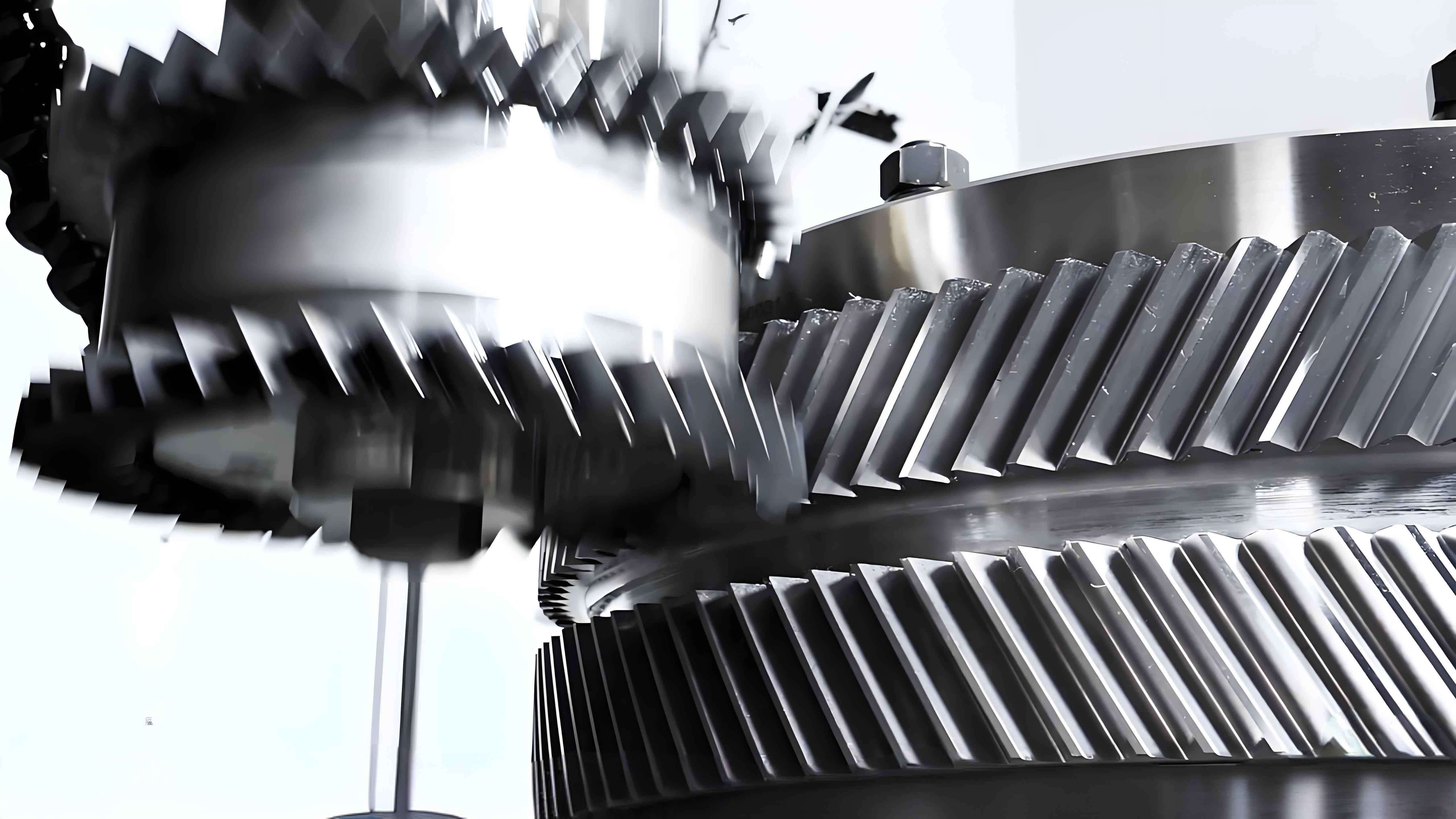
The meshing process of herringbone gears involves multiple tooth pairs engaging simultaneously, leading to time-varying stiffness and load sharing. To model this, I start with the quasi-static analysis. For a double-tooth contact scenario, the load distribution between two meshing tooth pairs can be described as follows. Let \( F_L \) be the total normal load, \( x \) be the displacement along the line of action, and \( K_{c1} \) and \( K_{c2} \) be the meshing stiffnesses of the first and second tooth pairs, respectively. The loads carried by each pair, \( F_{s1} \) and \( F_{s2} \), are given by:
$$F_{s1} + F_{s2} = F_L$$
$$F_{s1} = K_{c1} x$$
$$F_{s2} = K_{c2} x$$
This implies that the load is shared based on the relative stiffness of each tooth pair. The meshing stiffness \( K_{cj} \) for a tooth pair \( j \) is a critical parameter, derived from the total deformation at the contact point. It comprises three components: contact deformation \( \delta_H \), tooth bending and shear deformation \( \delta_T \), and elastic deformation of the gear body \( \delta_A \). For a pair with gears 1 and 2, the stiffness is expressed as:
$$K_{cj} = \frac{F_L}{\delta_H + \delta_{T1} + \delta_{T2} + \delta_{A1} + \delta_{A2}} \quad \text{for} \quad j = 1, 2$$
In dynamic analysis, the vibration of herringbone gears arises from variations in meshing stiffness and manufacturing errors. I model the system as a two-degree-of-freedom oscillator along the line of action. The equivalent masses \( m_1 \) and \( m_2 \) for the pinion and gear are calculated from their moments of inertia \( I_i \) and base circle radii \( r_{bi} \):
$$m_i = \frac{I_i}{r_{bi}^2} \quad \text{for} \quad i = 1, 2$$
The reduced mass \( m \) is then:
$$m = \frac{m_1 m_2}{m_1 + m_2}$$
The equation of motion for the relative displacement \( x \) between the gears is:
$$m \ddot{x} + K_c x = F_L$$
Here, \( K_c \) represents the time-varying meshing stiffness, which depends on the contact position. Solving this requires discretizing the meshing cycle into small intervals where stiffness is assumed constant, followed by iterative methods. However, for complex herringbone gear systems, analytical solutions become impractical, prompting the use of FEA for comprehensive response analysis.
My finite element analysis workflow, implemented in NX MasterFEM, follows a structured process for both static and dynamic responses. The steps include: geometry modeling, meshing, applying boundary conditions, solving, and post-processing. For herringbone gears, I focus on static contact analysis to determine stress distributions and dynamic modal analysis to identify natural frequencies and mode shapes. This integrated approach allows me to capture the coupled effects of torsion, bending, and axial vibrations inherent in gear systems.
To illustrate, I examine a herringbone gear pair from a marine gearbox used in a 25,000 kW gas turbine application. The pinion (driving gear) has a speed of 1000 rpm, and the gear pair transmits significant torque. Key parameters are summarized in Table 1, which I derived from the system specifications. These parameters are essential for building accurate finite element models.
| Parameter | Pinion (Gear 1) | Gear (Gear 2) |
|---|---|---|
| Number of Teeth, \( Z \) | 24 | 125 |
| Base Circle Radius, \( r_b \) (m) | 0.20 | 1.04 |
| Moment of Inertia, \( I \) (kg·m²) | 21.3 | 4192.4 |
| Equivalent Mass, \( m_i \) (kg) | 532.5 | 3876.9 |
| Reduced Mass, \( m \) (kg) | 468.45 | |
| Tangential Load, \( F_L \) (N) | 1.19 × 10⁶ | |
The tangential load \( F_L \) is computed from the input power \( P = 25,000 \, \text{kW} \) and speed \( n_1 = 1000 \, \text{rpm} \):
$$F_L = \frac{M_1}{r_{b1}} = \frac{9.55 \times 10^3 \times P}{n_1 \times r_{b1}} = 1.19 \times 10^6 \, \text{N}$$
For static contact analysis, I create a 3D solid model of the herringbone gear pair using NX software. Meshing is critical for accuracy; I use hexahedral elements with localized refinement at the tooth contacts to capture stress concentrations. The finite element model comprises approximately 200,000 elements, ensuring a balance between computational cost and precision. Contact conditions are defined using surface-to-surface contact pairs, which account for large sliding and friction effects. The boundary conditions include constraining the gear’s rotational nodes in radial and axial directions while allowing tangential motion for the pinion, with the load applied as a concentrated force equivalent to the torque.
In the static analysis, I solve for contact stresses and deformations. The results reveal that maximum stresses occur at the tooth fillets and contact zones, with deformations influencing the effective meshing stiffness. For instance, the deformation \( \delta_H \) at the contact point can be extracted from FEA outputs, aiding in stiffness calculations. This stiffness variation is pivotal for dynamic studies, as it directly impacts the vibration response of herringbone gears.
Moving to dynamic analysis, I focus on free vibration modes to identify natural frequencies and resonant conditions. The finite element model for modal analysis includes spring elements at bearing locations to simulate the elastic support from the gearbox housing. The spring stiffness values, derived from theoretical modeling of the housing, are listed in Table 2. These springs represent the horizontal and vertical stiffness of each bearing, affecting the system’s dynamic behavior.
| Bearing Location | Horizontal Stiffness, \( K_h \) (N/m) | Vertical Stiffness, \( K_v \) (N/m) |
|---|---|---|
| Pinion Bearings | 8.45 × 10⁸ | 8.92 × 10⁸ |
| Gear Bearings | 9.35 × 10⁸ | 9.13 × 10⁸ |
I use the Lanczos method in NX MasterFEM to extract modal parameters, as it is efficient for large models. The first 50 natural frequencies and mode shapes are computed, with the initial 16 modes being particularly relevant for operational avoidance. Table 3 summarizes these results, highlighting key modes that could lead to excessive vibrations in herringbone gears.
| Mode | Natural Frequency (Hz) | Mode Shape Description |
|---|---|---|
| 1 | 32.86 | Overall radial expansion of the gear |
| 2 | 64.32 | Overall horizontal bending of the gear in opposite phase |
| 3 | 65.39 | Overall vertical bending of the gear in opposite phase |
| 4 | 76.18 | Disk-like horizontal bending of the gear |
| 5 | 77.09 | Disk-like vertical bending of the gear |
| 6 | 126.50 | Overall axial stretching of the gear |
| 7 | 195.05 | Horizontal bending of the gear shaft |
| 8 | 199.10 | Vertical bending of the gear shaft |
| 9 | 230.19 | Overall horizontal bending of the pinion in same phase |
| 10 | 231.77 | Overall vertical bending of the pinion in same phase |
| 11 | 296.43 | Overall radial expansion of the pinion |
| 12 | 318.35 | Partial radial expansion of the gear shaft |
| 13 | 343.64 | Disk torsional vibration in alternating direction |
| 14 | 343.65 | Disk torsional vibration in same direction |
| 15 | 422.60 | Overall horizontal bending of the pinion in opposite phase |
| 16 | 427.97 | Overall vertical bending of the pinion in opposite phase |
The mode shapes indicate that herringbone gears exhibit complex vibrational behaviors, starting from low frequencies around 32.9 Hz for the gear and 230.0 Hz for the pinion. These frequencies fall within typical operational ranges for marine systems, emphasizing the need for careful design to avoid resonance. For example, if the excitation frequencies from engine harmonics coincide with these natural frequencies, amplified vibrations could lead to fatigue damage. Therefore, I recommend design modifications, such as increasing stiffness or adding damping plates, to shift natural frequencies or reduce vibration amplitudes.
To further analyze the dynamic response, I consider the forced vibration under operational loads. The equation of motion can be extended to include damping and external excitation. Using modal superposition, the response \( x(t) \) can be expressed as a sum of mode shapes \( \phi_i \) and modal coordinates \( q_i(t) \):
$$x(t) = \sum_{i=1}^{n} \phi_i q_i(t)$$
where \( q_i(t) \) satisfies:
$$\ddot{q}_i + 2 \zeta_i \omega_i \dot{q}_i + \omega_i^2 q_i = \frac{F_i(t)}{m_i}$$
Here, \( \omega_i \) are the natural frequencies, \( \zeta_i \) are damping ratios, and \( F_i(t) \) are modal forces. For herringbone gears, the time-varying meshing stiffness \( K_c(t) \) introduces parametric excitation, making the system more susceptible to instabilities. I approximate \( K_c(t) \) as a periodic function based on the static contact analysis results, with a fundamental frequency equal to the gear meshing frequency \( f_m = \frac{n_1 Z_1}{60} \). For this gear pair, \( f_m \approx 400 \, \text{Hz} \), which lies close to higher natural modes, indicating potential for vibration amplification.
In terms of design optimization, I explore the effects of varying parameters like tooth geometry, material properties, and support stiffness. For instance, increasing the face width of herringbone gears can enhance bending stiffness, thereby raising natural frequencies. Similarly, using high-strength alloys can reduce deformations. I formulate an optimization problem to minimize vibration amplitudes subject to constraints on stress and weight. The objective function \( J \) might be defined as the root-mean-square of the dynamic response over a operational cycle:
$$J = \sqrt{\frac{1}{T} \int_0^T x^2(t) \, dt}$$
where \( T \) is the period of meshing. Through iterative FEA simulations, I can identify optimal configurations that improve the performance of herringbone gears in marine applications.
Another aspect I investigate is the impact of misalignment and manufacturing errors on vibration. Herringbone gears are sensitive to axial misalignment due to their dual-helix structure. I model a small misalignment \( \Delta \) in the axial direction, which introduces additional loads and alters the contact pattern. The modified load distribution can be expressed as:
$$F_{s1}’ = K_{c1} (x + \Delta \sin \beta)$$
$$F_{s2}’ = K_{c2} (x – \Delta \sin \beta)$$
where \( \beta \) is the helix angle. This asymmetry increases vibration levels, underscoring the importance of precise manufacturing and alignment in herringbone gear systems.
In my case study, I also perform a harmonic response analysis to simulate steady-state vibrations under sinusoidal excitation. Using NX MasterFEM, I apply a force \( F(t) = F_0 \sin(2\pi f t) \) at the pinion, with \( f \) swept from 10 to 500 Hz. The response amplitude spectrum reveals peaks at the natural frequencies listed in Table 3, confirming the modal analysis results. For example, at 32.86 Hz, the response shows a significant peak, indicating resonance. This analysis helps in designing damping strategies, such as tuned mass dampers or viscoelastic layers, to attenuate vibrations in herringbone gears.
Furthermore, I examine the thermal effects on vibration characteristics. In marine gearboxes, operating temperatures can reach high levels, affecting material properties and clearances. The modulus of elasticity \( E \) decreases with temperature, reducing stiffness and shifting natural frequencies. I incorporate a temperature-dependent stiffness model:
$$K_c(T) = K_{c0} \left(1 – \alpha (T – T_0)\right)$$
where \( K_{c0} \) is the stiffness at reference temperature \( T_0 \), and \( \alpha \) is a thermal coefficient. For steel herringbone gears, \( \alpha \approx 1.2 \times 10^{-4} \, \text{°C}^{-1} \). At elevated temperatures, the natural frequencies may drop, bringing them closer to excitation frequencies and increasing vibration risks. Thus, thermal management becomes crucial in gear design.
To summarize, my analysis demonstrates that herringbone gears exhibit complex static and dynamic behaviors influenced by meshing stiffness, load sharing, and support conditions. The finite element approach provides a robust tool for predicting these behaviors accurately. Key findings include the identification of critical natural frequencies that should be avoided in operation and the importance of optimizing design parameters to mitigate vibrations. For marine applications, where reliability is paramount, such analyses are essential for extending the service life of gear systems.
In conclusion, herringbone gears play a vital role in high-power transmission, and their vibration characteristics must be thoroughly understood to prevent failures. Through static contact and dynamic modal analyses, I have shown how FEA can uncover insights that traditional methods might miss. Future work should focus on integrated multi-body dynamics simulations, experimental validation, and advanced optimization algorithms to further enhance the performance of herringbone gears. By continually refining these approaches, we can ensure safer and more efficient marine propulsion systems.