
The evolution of China’s manufacturing sector has driven significant advancements within the metal forming industry, particularly in the domain of forging and stamping equipment. A key area of progress has been the gradual breaking of foreign technological monopolies in high-precision and large-scale machinery. However, a persistent gap remains in product precision and reliability, often rooted in fundamental research on component processing and foundational manufacturing processes. This gap is acutely felt in the production of core components for heavy-duty machinery, such as mechanical presses. This article presents a detailed, first-person analysis focused on a critical machining challenge: improving the machining accuracy of keyways on the core transmission component—the herringbone gear. The precision of these keyways is paramount for the synchronous operation and overall stability of double-point mechanical presses.
The central function of the herringbone gear in a double-point press cannot be overstated. In the main drive system, the motion is transmitted from the flywheel shaft to the herringbone gear. This gear is connected to a gear shaft via its keyway, and this assembly then drives the eccentric gear. The eccentric portion of this gear acts as the pivot for the connecting rod, which ultimately drives the slide’s reciprocating motion. In a double-point configuration, two such drive systems operate in parallel. The synchronization between the two eccentric bodies, and consequently the two slides, is fundamentally dictated by the angular alignment of the keyways on the two herringbone gears. Any deviation in the positional relationship between the keyway and the gear’s tooth profile directly translates into a phase difference between the two drive points, leading to uneven loading, reduced slide guidance accuracy, accelerated wear, and potential machine failure. Therefore, achieving a high-precision locational requirement between the keyway and the datum tooth profile of the herringbone gear is a critical manufacturing objective.
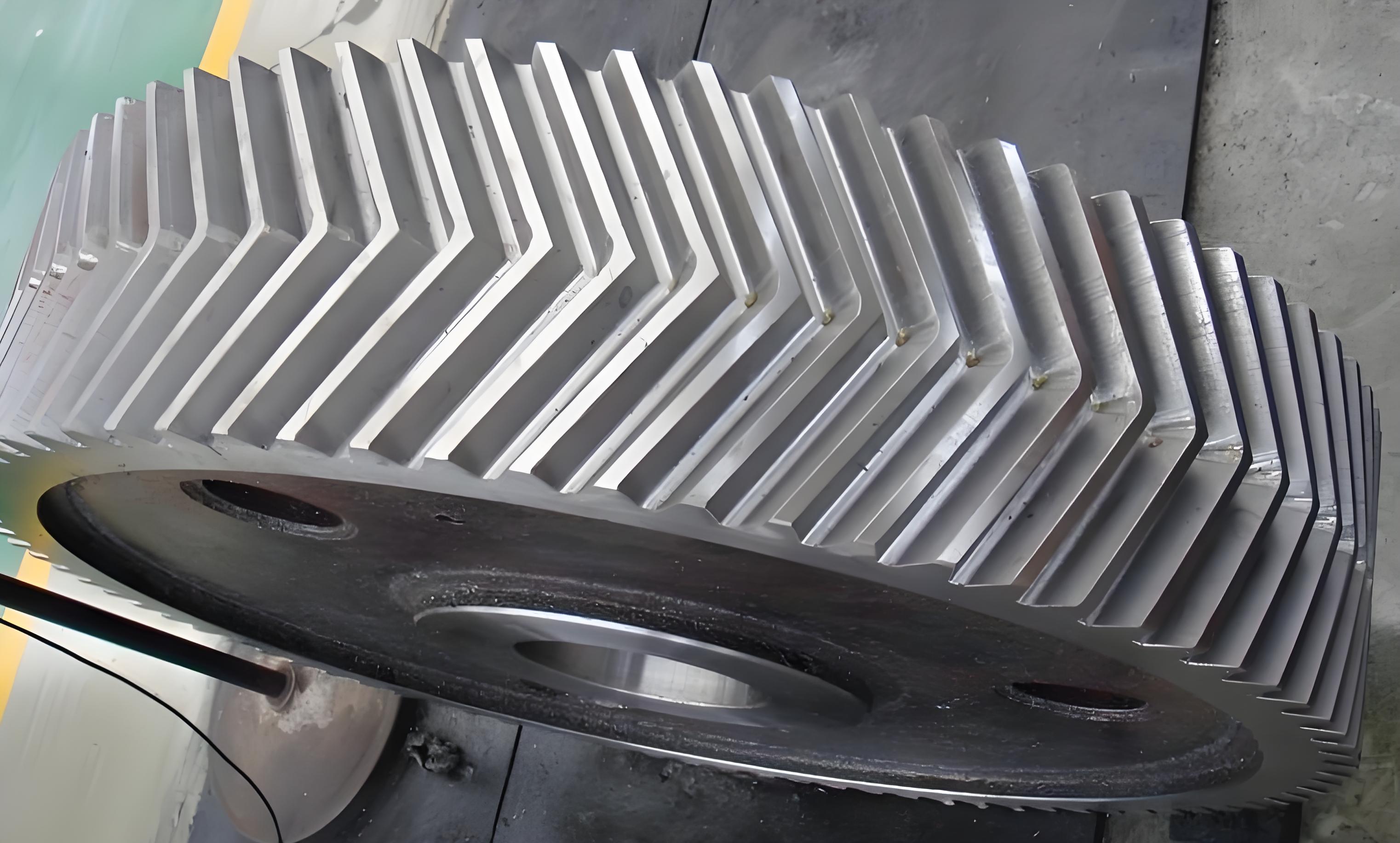
1. Analysis of Machining Deviation in Herringbone Gear Keyways
1.1 Impact of Keyway Directional Deviation
The primary consequence of inaccuracies in machining the keyway direction on herringbone gears is the loss of synchronization in a double-point press. The design requires that the centerline of the datum tooth space, the centerline of the keyway, and the rotational center of the herringbone gear itself must be collinear within a very tight tolerance, typically on the order of 0.10 mm. When this condition is not met for one or both herringbone gears, the torque transmission to the two eccentric gears becomes phase-shifted. One eccentric gear leads or lags behind the other, causing the two connecting rods to pull on the slide with a slight temporal difference. This results in a twisting moment on the massive slide, compromising its parallel motion against the guides, inducing unwanted lateral forces, and severely affecting the quality of the stamped part, especially in precision applications. The stability and longevity of the entire press are contingent upon minimizing this deviation.
1.2 Root Causes of Machining Deviation
The genesis of this precision problem lies in the sequential nature of gear manufacturing and the limitations of traditional workshop methods. Herringbone gears are typically machined using a generating process (e.g., hobbing), where the gear teeth form is produced by the meshing motion between the cutter and the workpiece. A fundamental characteristic of this method is that the starting point of the cut on the workpiece circumference cannot be precisely pre-defined or easily referenced afterward. Consequently, the critical locational relationship between the finished tooth profile and the yet-to-be-machined keyway is not established during tooth cutting.
Traditionally, the solution was to determine the keyway position post-gear-cutting. The established method relied on manual scribing by a skilled fitter. A datum was established on the end face of the herringbone gear, often targeting the center of a specific tooth space. However, herringbone gears present a unique challenge due to their helix angle. Performing accurate spatial layout on a helical tooth flank to project a precise centerline onto the gear’s bore for keyway machining is inherently prone to significant error. The three-dimensional nature of the tooth space makes visual alignment and manual scribing highly subjective and inaccurate. To compensate for the compounded machining errors from this process, the final assembly often required a remedial, time-consuming step: the fitting of custom stepped keys during machine commissioning. This “fix” is labor-intensive, inconsistent, and does not guarantee long-term reliability, as it addresses the symptom rather than the cause of the poor initial machining accuracy.
The traditional process introduces multiple, compounding error sources. These can be systematically broken down as shown in Table 1.
| Error Source | Description | Estimated Magnitude |
|---|---|---|
| Spatial Layout Error | Inaccuracy in manually scribing the keyway centerline from the helical tooth datum on the gear end face. | ±0.25 mm |
| Alignment Error | Error in aligning the scribed line with the cutting tool (e.g., on a slotting or shaping machine). | ±0.10 mm |
| Machine Tool Error | Inherent inaccuracy of the machine tool used for cutting the keyway (e.g., slotter). | 0.02 mm |
| Single-Gear Cumulative Error (Max) | Sum of the maximum possible errors from the above sources. | 0.37 mm |
| Two-Gear System Error (Max) | Worst-case combined error from two independently machined herringbone gears. | 0.74 mm |
As evident, the worst-case system error (0.74 mm) vastly exceeds the typical collinearity tolerance of 0.10 mm, explaining the need for compensatory fitting and the associated performance issues.
2. A Systematic Solution for Machining Deviation
2.1 Core Principle: Redefining the Datum
The proposed solution moves away from the unreliable end-face tooth space center and introduces a new, intrinsically accurate datum feature specific to herringbone gears. The fundamental insight is to utilize the intersection point (“crossover point”) of the left-hand and right-hand helices at the center of the gear face width. This point is a fixed, unique geometric feature of the machined herringbone gear, unlike the end-face datum which varies with gear width tolerance.
The goal is to establish a machining coordinate system where the line connecting this herringbone intersection point (for the datum tooth space) and the gear’s rotational center defines the required direction for the keyway. Mathematically, if we define the gear’s rotational center as the origin O(0,0), and the coordinates of the herringbone intersection point for the designated datum tooth are H(x_h, y_h), then the ideal keyway centerline must satisfy the vector equation of the line passing through O and H. The problem reduces to aligning the workpiece on the machine tool such that this line is parallel to the machine’s primary cutting direction (e.g., the Y-axis of a slotting machine table).
2.2 Implementation: Precision Tooling and Machine Alignment
To physically realize this principle, a simple but precise tooling element is introduced: a datum sphere (or “master ball”) fixture. This fixture is designed to sit securely in the tooth space, with its spherical center precisely located at the theoretical herringbone intersection point when engaged with both the left and right flanks of the chosen datum tooth space.
The machining process, now performed on a precision slotting machine with a rotary table, is transformed from a skill-dependent scribing operation to a metrology-driven alignment procedure. The sequence is as follows:
- The herringbone gear is mounted on the machine table via its finished center bore, supported on three equal-height blocks.
- The gear’s bore is meticulously indicated to run true with the rotary axis of the machine table, establishing the geometric rotational center O.
- The datum sphere fixtures are placed in two symmetric tooth spaces equidistant from the datum tooth. Let the angular position of these spaces relative to the datum be ±θ. The centers of these spheres, S1 and S2, now act as precise, measurable proxies for points on the line defined by O and H.
The alignment involves two orthogonal adjustments, guided by dial indicators with a resolution of 0.01 mm:
Step A: Aligning the Keyway Direction (Parallel to OH). A dial indicator (Indicator 1) is fixed to the machine ram. The machine’s X-axis and rotary table (C-axis) are used to touch off the tops of the two datum spheres (S1 and S2). Any height difference (Δz) between S1 and S2 as measured by Indicator 1 indicates that the line S1-S2 (and by extension, O-H) is not parallel to the machine’s Y-axis (cutting direction). The workpiece is adjusted via the rotary table and X-axis until Indicator 1 reads the same value for both spheres. This ensures:
$$ \text{Line(OH)} \parallel \text{Machine Y-axis} $$
Step B: Centering the Tool on the Keyway Symmetry Axis. A second dial indicator (Indicator 2) is attached to the gear body. The machine’s rotary table is turned 180°, and the Y-axis is used to measure the distance from the gear’s side face to each side of the slotting tool (Measurements M1 and M2). Any difference (Δy = M1 – M2) indicates the tool is offset from the symmetry axis passing through O. The workpiece is shifted along the machine’s X-axis until M1 = M2, ensuring the tool is centered on the plane of symmetry, which contains the line O-H.
$$ \text{Tool Center} \in \text{Plane defined by line OH and gear axis} $$
Once both conditions A and B are satisfied simultaneously, the keyway is machined. This method leverages the high positioning accuracy and repeatability of the machine tool’s axes and rotary table, effectively replacing human judgment with mechanical precision.
3. Quantitative Improvement and Formulaic Representation
The improvement from the new process is dramatic and quantifiable. The error budget is now dominated by measurement and machine tool accuracy, not manual layout.
| Error Source | Description | Estimated Magnitude |
|---|---|---|
| Measurement/Alignment Error | Cumulative error from 5 dial indicator alignment steps (0.01 mm resolution). | 0.05 mm |
| Machine Tool Error | Inherent inaccuracy of the slotting machine. | 0.02 mm |
| Single-Gear Cumulative Error (Max) | Root-sum-square or direct sum of the above. | 0.07 mm |
| Two-Gear System Error (Max) | Worst-case combined error from two gears. | 0.14 mm |
The reduction in the worst-case system error from 0.74 mm to 0.14 mm represents an improvement factor of approximately 5.3. This brings the maximum expected error much closer to, and in many cases within, the specified 0.10 mm tolerance, enabling a true “fit and function” assembly without remedial fitting.
The relationship can be summarized formulaically. For the traditional method, the total error (E_old) for a system with two herringbone gears was a linear sum of large, independent errors:
$$ E_{old} = 2 \times (e_{layout} + e_{align} + e_{machine}) $$
where typical values were e_layout=0.25, e_align=0.10, e_machine=0.02.
For the new method, the total error (E_new) is significantly reduced, as the major error sources are eliminated and replaced with a smaller, more controlled metrological error (e_measure):
$$ E_{new} = 2 \times (e_{measure} + e_{machine}) $$
where e_measure=0.05 and e_machine=0.02.
4. Broader Implications and Conclusion
The precision machining of keyways in herringbone gears exemplifies the critical importance of foundational process engineering in high-end manufacturing. This case study demonstrates that significant gains in product quality and reliability are often achieved not by purchasing more expensive machine tools, but by intelligently re-engineering the process sequence and fixturing to exploit the existing accuracy of standard machines.
The success of this method hinges on a deep understanding of the geometry of herringbone gears. By identifying the herringbone intersection point as a stable, high-precision intrinsic datum, the process bypasses the ambiguities of traditional referencing. The use of datum sphere fixtures transforms a complex 3D alignment problem into a series of 2D measurements that can be reliably executed by a machine operator.
The implications extend beyond double-point presses. Any application where the angular orientation of a shaft-connected herringbone gear is critical—such as in high-power, multi-path gearboxes or synchronized drive systems—can benefit from this or a similar principle. The methodology underscores a universal tenet in precision manufacturing: controlling the source of error at the earliest possible stage, the component machining level, is vastly more effective and economical than attempting to correct for it during final assembly. This focus on perfecting the manufacture of core components like herringbone gears is a essential step in closing the gap in product reliability and advancing the global competitiveness of domestic heavy machinery.