
In the realm of high-power, high-torque transmission systems, such as those found in marine propulsion and heavy industrial machinery, herringbone gears represent a critical and sophisticated component. The unique double-helical configuration of herringbone gears offers significant advantages over their single helical or spur gear counterparts, primarily by theoretically canceling out the substantial axial thrust forces generated during operation. This intrinsic feature allows for more compact bearing arrangements and contributes to smoother, quieter power transmission. However, the idealized condition of perfect load sharing between the two opposing helices is seldom achieved in practice. Manufacturing inaccuracies, including pitch errors and helix angle deviations, combined with inevitable assembly misalignments, create a phase difference between the left-hand and right-hand tooth meshes. This discrepancy disrupts the intended force equilibrium, leading to uneven torque distribution across the gear’s faces. To counteract this and achieve balanced loading, the pinion in a herringbone gear set is typically mounted with axial freedom, allowing it to “float” and self-align under load. This axial displacement is the key mechanism for load equalization. Accurately predicting this displacement is not only essential for ensuring durability and efficiency but also forms a fundamental input for dynamic analysis, as its periodic variation acts as a potent excitation source for vibration at higher operational speeds. This article delves into a comprehensive theoretical framework for analyzing the load-sharing behavior of herringbone gears, integrating both unloaded and loaded contact mechanics, and validates the model against experimental data.
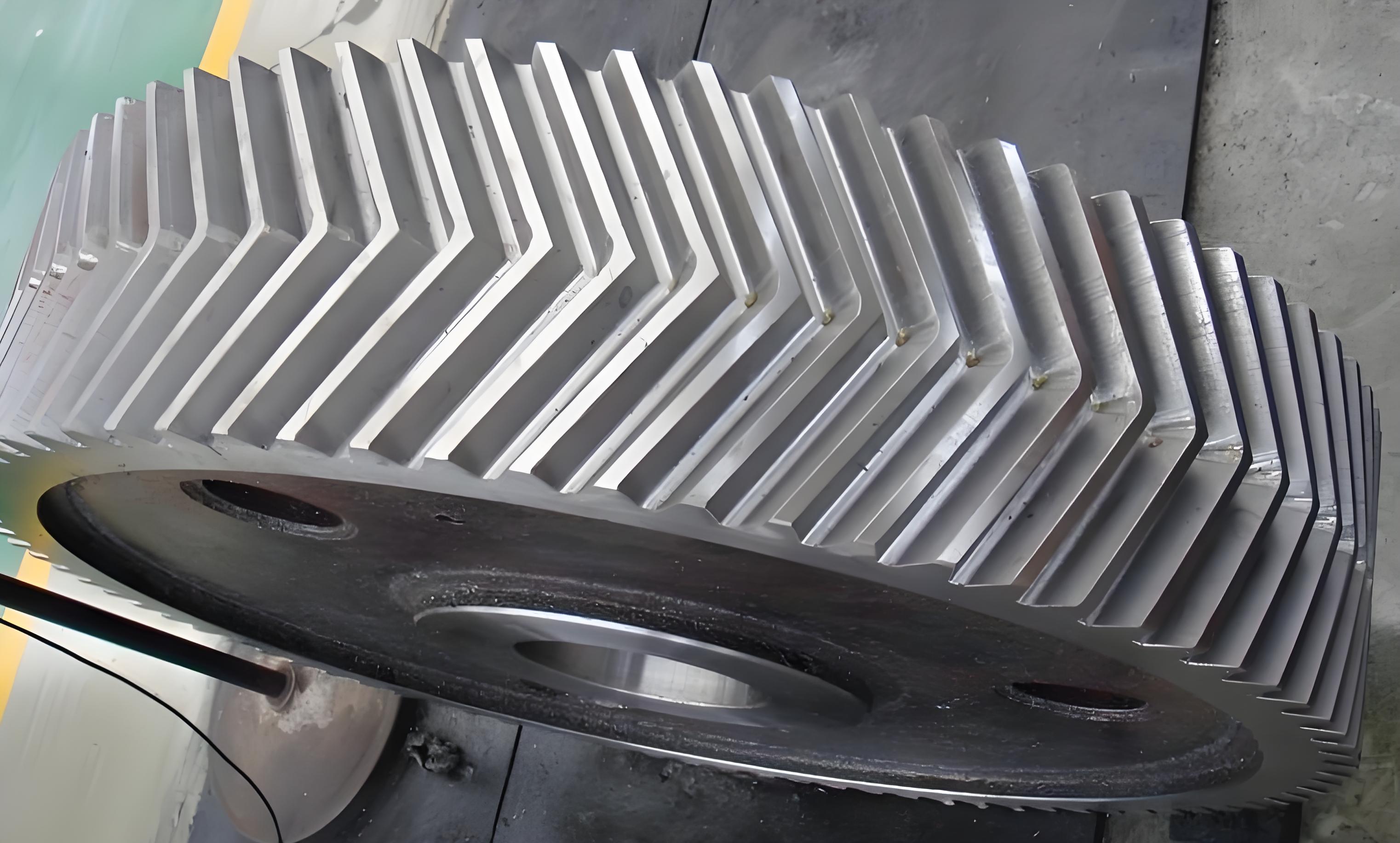
The core of the theoretical analysis lies in the sequential application of Tooth Contact Analysis (TCA) and Loaded Tooth Contact Analysis (LTCA), specifically adapted for the dual-helix geometry of herringbone gears. TCA simulates the kinematic meshing of gear teeth under no-load conditions, identifying the potential contact points and lines while accounting for systematic errors. For herringbone gears, this requires modeling two distinct but simultaneous meshing actions. A critical aspect modeled within TCA is the effective “phase lag” or lead between the left and right helices caused by cumulative manufacturing errors. This is introduced by assigning a slight rotational offset \(\Delta \phi\) to one side of the pinion relative to the other in the computational model. This offset is derived from the measured relative manufacturing errors between the two helical halves, as shown in the following equation:
$$ \Delta \phi = \frac{\sum e}{r_b \cos \beta_b} $$
where \(\sum e\) represents the relative cumulative pitch error between the left and right helical sections, \(r_b\) is the base circle radius, and \(\beta_b\) is the base helix angle. The primary output of the TCA for each instantaneous meshing position is the geometrical separation, or flank clearance, between mating tooth surfaces for both the left-hand and right-hand pairs.
This geometrical data serves as the essential input for the subsequent LTCA. The LTCA model transforms the gear mesh into a statically indeterminate elastic system. The contacting flanks are discretized into a series of potential contact cells along the potential contact lines identified by TCA. The compliance of each cell, representing the combined local deformation of the two teeth, is calculated considering bending, shear, and foundation effects. The fundamental equation solved by LTCA is the compatibility condition, ensuring that the sum of the initial geometrical separation (from TCA, which may be positive or negative) and the elastic deformation at every potential contact point equals zero for points that are in actual contact. This is governed by a system of equations:
$$ [\mathbf{C}]\{\mathbf{p}\} + \{\mathbf{\delta}\} = \{\mathbf{u}\} $$
Here, \([\mathbf{C}]\) is the global flexibility matrix of the contacting tooth pairs, \(\{\mathbf{p}\}\) is the vector of discrete contact loads to be solved for, \(\{\mathbf{\delta}\}\) is the vector of initial separations from TCA, and \(\{\mathbf{u}\}\) is the vector of rigid body approach (related to the applied torque). Solving this system yields the precise load distribution across all contacting tooth pairs in both helices for a given pinion position and applied torque. From this detailed load distribution, the total axial force generated by each helical section can be computed by summing the axial components of all individual contact forces on that side.
The condition for perfect load sharing, and thus zero net axial force on the floating pinion, is the balance of axial forces from the left and right sides. In reality, due to errors, these forces are unequal, creating a net axial thrust. The floating pinion responds by moving axially until equilibrium is restored. This axial displacement \(\Delta A\) is found iteratively. For a given rotational position, the net axial force \(F_{axial}^{net}\) is calculated from the LTCA results. If \(F_{axial}^{net} \neq 0\), a small incremental axial displacement \(\delta A\) is applied to the pinion in the TCA model, the LTCA is recalculated, and a new net force is found. This process repeats until the following equilibrium condition is satisfied within a specified tolerance:
$$ \sum_{j=1}^{n_I} p_j^I \cos\gamma_j^I + \sum_{j=1}^{n_{II}} p_j^{II} \cos\gamma_j^{II} – \left( \sum_{j=1}^{n_{III}} p_j^{III} \cos\gamma_j^{III} + \sum_{j=1}^{n_{IV}} p_j^{IV} \cos\gamma_j^{IV} \right) \approx 0 $$
The superscripts \(I, II\) denote tooth pairs on the left-hand helix and \(III, IV\) denote pairs on the right-hand helix. \(p_j\) is the discrete load on the \(j\)-th contact cell, and \(\gamma_j\) is the pressure angle relative to the axial direction. The total axial displacement for that meshing position is the sum of all applied \(\delta A\) increments. This calculation is performed for every angular position within a mesh cycle. It is crucial to recognize that manufacturing errors exhibit both short-period (tooth-to-tooth) and long-period (one revolution of the gear) components. Therefore, to capture the complete behavior, the analysis must be conducted over a “hunting tooth” period encompassing the least common multiple of the pinion and gear tooth numbers.
To validate this theoretical framework, a case study was performed on a specific herringbone gear pair. The essential geometric parameters of these test herringbone gears are summarized in Table 1.
| Gear Parameter | Pinion | Gear |
|---|---|---|
| Number of Teeth, \(z\) | 31 | 102 |
| Normal Module, \(m_n\) (mm) | 4.5 | 4.5 |
| Normal Pressure Angle, \(\alpha_n\) (°) | 20 | 20 |
| Helix Angle, \(\beta\) (°) | 28.34 | 28.34 |
| Face Width per Helix, \(B\) (mm) | 90 | 90 |
| Hand of Helix | Right/Left | Left/Right |
The gears were manufactured from case-hardened steel. The manufacturing errors, specifically the total cumulative pitch error across the tooth flanks for both the pinion and gear, were meticulously measured using a precision gear inspection instrument. These measured error profiles served as the primary input for the theoretical TCA model, defining the initial separations \(\{\mathbf{\delta}\}\).
The experimental validation was conducted on a dedicated gear test rig. The pinion shaft was mounted with axial float, and its displacement was measured in real-time using high-precision eddy-current sensors. Tests were run under two distinct output torque levels at a very low rotational speed (“crawling speed”) to isolate the quasi-static load-sharing effects from dynamic influences. The operational parameters for the measurement are listed in Table 2.
| Drive Motor Speed (rpm) | Low-Speed Shaft (Gear) Speed (rpm) | High-Speed Shaft (Pinion) Speed (rpm) |
|---|---|---|
| 1420 | 1.943 | 6.390 |
The theoretical analysis proceeded as outlined. For the given gear pair (31 and 102 teeth), the long-period error cycle encompasses 3162 mesh cycles (the least common multiple divided by the pinion teeth). Consequently, the axial displacement calculation was performed sequentially over these 3162 meshing positions to generate the complete long-period theoretical waveform. The results for the two torque levels are graphically compared with the experimentally measured data, after appropriate signal processing and fitting. A key quantitative comparison is the amplitude of the axial displacement fluctuation over one long period, as shown in Table 3.
| Output Torque (N·m) | Calculated Amplitude (μm) | Measured Amplitude (μm) |
|---|---|---|
| 600 | 19.7 | 20.4 |
| 2000 | 23.8 | 24.3 |
The analysis of the results yields several important conclusions. Firstly, the waveform of the theoretically calculated axial displacement shows excellent agreement in trend and phase with the experimentally measured data for both torque levels. The characteristic periodic variation, driven by the combination of mesh frequency and the longer rotational error period, is accurately captured by the model. Secondly, the amplitudes of displacement predicted by the theory are in very close agreement with the measured values, as evidenced by Table 3. The slight underestimation by the theoretical model is rational and expected; the experimental measurement inherently includes axial displacement contributions from all error sources (e.g., minor alignment errors, bearing clearances) present on the physical test rig, whereas the theoretical model explicitly accounted only for the dominant influence of the measured cumulative pitch errors. This close correlation between theory and experiment strongly validates the proposed integrated TCA-LTCA methodology for analyzing load sharing in herringbone gears.
In conclusion, this work establishes a robust and validated theoretical framework for predicting the load-sharing behavior and the resulting axial displacement in herringbone gear transmissions. By rigorously incorporating the effects of manufacturing and assembly errors through TCA and solving the complex elastic contact problem through LTCA, the model accurately simulates the self-correcting floating action of the pinion. The successful experimental validation confirms the model’s fidelity. This capability is of paramount engineering significance. It provides a powerful tool for designers to assess the sensitivity of herringbone gear designs to manufacturing tolerances, to optimize tooth modifications for improved load distribution and reduced transmission error, and to supply critical input data—specifically the time-varying mesh stiffness and the axial displacement excitation—for advanced dynamic and vibro-acoustic simulations of herringbone gear systems. Thus, a deep understanding of the static load sharing in herringbone gears, as detailed here, forms the essential foundation for enhancing their performance, reliability, and quiet operation in demanding applications.