
In my extensive experience within the die and mold manufacturing sector, particularly focusing on gear production, I have consistently sought to enhance the efficiency, precision, and longevity of dies used for forging and trimming critical components like miter gears. Miter gears, a fundamental type of bevel gear where the shafts intersect typically at a right angle, are ubiquitous in automotive differentials, machinery, and various transmission systems. The demand for high-quality miter gears necessitates advanced die technologies that can withstand rigorous forging cycles and deliver precise tooth profiles. This article delves into two pivotal innovations: a novel composite heat treatment process for hot forging dies and a groundbreaking method for determining wire electrical discharge machining (WEDM) trajectories for trimming dies of straight bevel gears, which directly applies to miter gears. These advancements not only improve die performance but also significantly reduce manufacturing costs and enhance product quality.
The cornerstone of durable forging dies lies in their material properties and热处理. Traditional methods often fall short in balancing surface hardness with core toughness, leading to premature failure. My research and practical applications have centered on a composite heat treatment strategy for 5CrNiMo steel, a common alloy for hot forging dies. This process integrates bulk isothermal treatment with contour induction hardening. The primary challenge addressed is the formation of a low-hardness zone near the boundary of the淬火 layer, which can act as a site for crack initiation and propagation. To mitigate this, a crucial step involves preheating the entire die to approximately 500°C before induction hardening. This preheating effectively minimizes the thermal gradient, thereby reducing the detrimental effects of the low-hardness transition region.
The sequence and parameters of this composite process are critical. The bulk isothermal treatment aims to refine the microstructure throughout the die, ensuring good overall toughness. Subsequently, the contour induction hardening selectively heats and quenches the working surface, creating a hard, wear-resistant layer. The interplay between these treatments can be summarized by the following relationship governing the effective case depth and hardness profile:
$$ H(x) = H_0 – \Delta H \cdot e^{-k(x-d)^2} $$
Where \( H(x) \) is the hardness at depth \( x \) from the surface, \( H_0 \) is the peak surface hardness, \( \Delta H \) is the hardness drop parameter, \( k \) is a material- and process-dependent constant, and \( d \) is the depth of the low-hardness zone. Preheating reduces \( \Delta H \) and shifts \( d \), effectively flattening the hardness transition. The benefits are quantified in the table below, comparing traditional淬火 with the new composite process for dies used in forging miter gear blanks.
| Process Parameter | Traditional Bulk Quenching | Composite (Isothermal + Induction) |
|---|---|---|
| Surface Hardness (HRC) | 48-52 | 54-58 |
| Core Toughness (J/cm²) | 60-70 | 65-75 |
| Low-Hardness Zone Width (mm) | 1.5-2.0 | 0.5-1.0 |
| Estimated Die Life (Forging Cycles) | 15,000-20,000 | 35,000-50,000 |
| Application to Miter Gear Forging Dies | Moderate wear, frequent rework | High wear resistance, stable performance |
This composite treatment fundamentally enhances the service life of dies for forging miter gears by providing a superior combination of surface hardness and bulk toughness. The extended die life directly translates to lower tooling costs per gear produced, a significant advantage in high-volume manufacturing of miter gears for automotive applications.
Following the forging process, miter gear blanks feature flash or burrs that must be precisely trimmed. The quality of the trimming die directly impacts the final gear tooth accuracy. Historically, the trimming die for straight bevel gears, including miter gears, was manufactured via electrical discharge machining (EDM) drilling, a method fraught with inefficiencies. It produces tapered walls, limits refurbishment次数, and offers poor accuracy. My work has pioneered a shift to wire EDM (WEDM) for these trimming dies. The core challenge for WEDM of a bevel gear trim die is defining the exact wire path (trajectory) that corresponds to the projected tooth profile of the forged gear onto the die’s cutting plane.
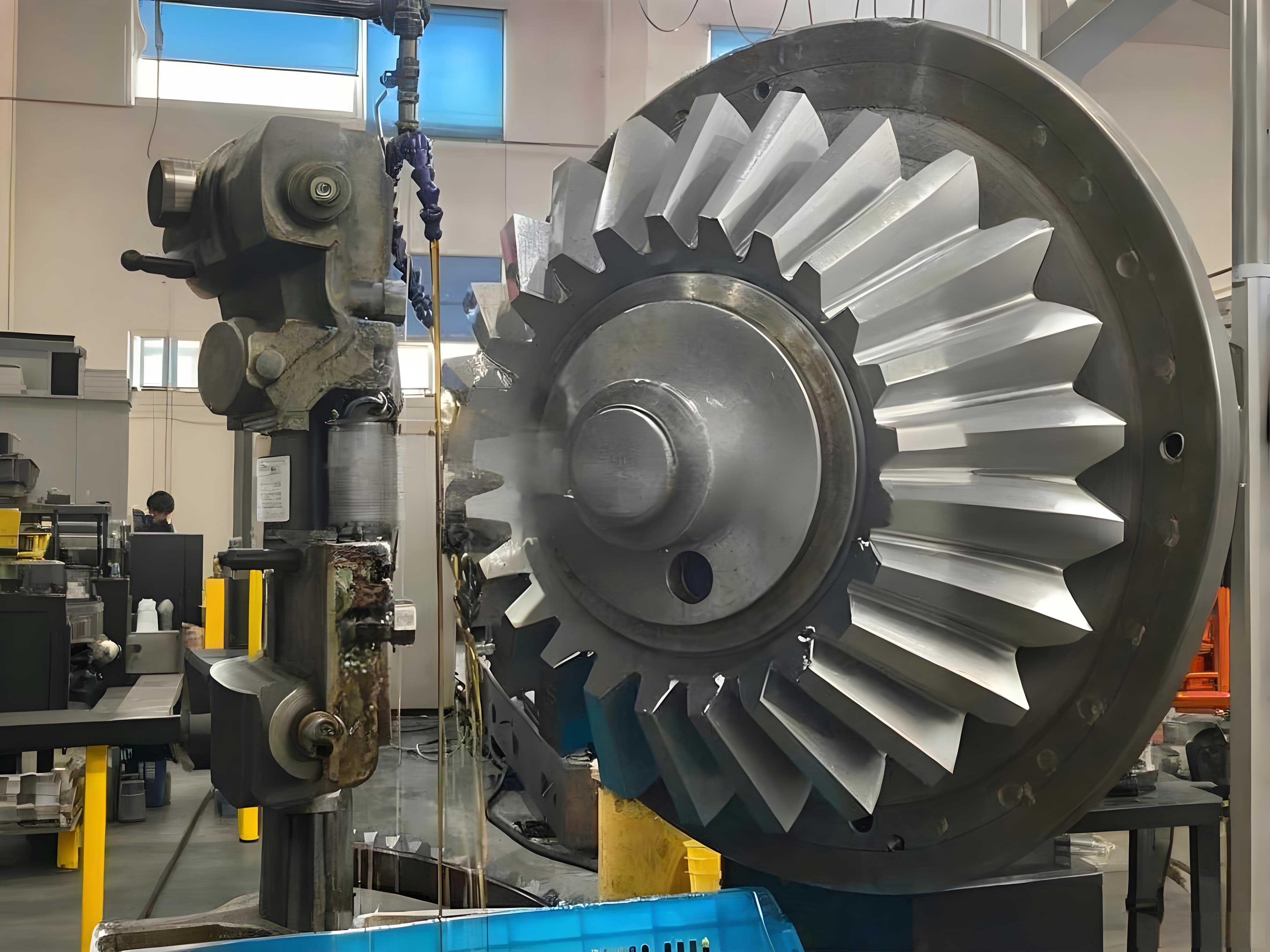
The forged miter gear has its tooth profile on a conical surface. The trimming die’s cutting edge, however, lies in a plane perpendicular to the trimming direction. For a gear with pitch cone angle \( \delta \), the profile on the cone must be projected onto this plane. The key innovation lies in discretizing the gear’s large-end tooth profile and mathematically projecting these points onto the die plane, then fitting these projected points with connected circular arcs to define the WEDM path. This method is universally applicable to straight bevel gears, especially miter gears where \( \delta \) is often 45° for a 90° shaft intersection.
Let’s consider a straight bevel gear, which is the geometric basis for miter gears. Its equivalent spur gear (virtual gear) parameters are used for calculation. The number of teeth on the equivalent gear is \( z_v = z / \cos \delta \), where \( z \) is the actual number of teeth on the miter gear. The profile on the large end is essentially an involute curve from this equivalent gear. We discretize this involute into \( n \) points. For any point \( i \) on the involute, its radius vector in the equivalent gear plane is \( r_{vi} \). The coordinates in the equivalent gear coordinate system \( (x_v, y_v) \) are:
$$ x_v = r_{vi} \sin \phi_i $$
$$ y_v = r_{vi} \cos \phi_i $$
Here, \( \phi_i \) is half of the angular tooth thickness at radius \( r_{vi} \). It is calculated using involute functions:
$$ \phi_i = \frac{\pi}{2z_v} + \text{inv} \alpha – \text{inv} \alpha_i $$
where \( \alpha \) is the standard pressure angle, \( \text{inv} \alpha = \tan \alpha – \alpha \), and \( \alpha_i = \arccos( r_b / r_{vi} ) \) with \( r_b = m z_v \cos \alpha / 2 \) being the base radius (\( m \) is the module).
These points are then projected onto the die plane coordinate system \( (x, y) \). The projection involves a scaling factor of \( \cos \delta \) along the \( y \)-axis (assuming the die plane is aligned such that the projection compresses the profile along the cone’s element):
$$ x = x_v = r_{vi} \sin \phi_i $$
$$ y = y_v \cos \delta = r_{vi} \cos \phi_i \cos \delta $$
The selection of discrete radii \( r_{vi} \) is systematic to ensure uniform coverage from the root to the tip of the tooth profile on the equivalent gear, often starting from the equivalent root radius \( r_{vf} \) (or base radius \( r_b \) if larger) to the equivalent tip radius \( r_{va} \):
$$ r_{vi} = r_{vf} + (i-1) \frac{r_{va} – r_{vf}}{n-1}, \quad i = 1, 2, …, n $$
with \( r_{va} = r_a / \cos \delta \) and \( r_{vf} = r_f / \cos \delta \), where \( r_a \) and \( r_f \) are the actual tip and root radii of the miter gear.
Once the set of projected points \( P_i(x_i, y_i) \) is obtained, the WEDM trajectory is constructed by fitting consecutive circular arcs through every three adjacent points. This means points \( P_1, P_2, P_3 \) define the first arc from \( P_1 \) to \( P_3 \), points \( P_3, P_4, P_5 \) define the next arc from \( P_3 \) to \( P_5 \), and so on. The arcs are tangent at the shared points, ensuring a smooth continuous path ideal for WEDM. For three points \( (x_1, y_1), (x_2, y_2), (x_3, y_3) \), the center \( (x_0, y_0) \) and radius \( R \) of the passing circle are given by:
$$ x_0 = -\frac{A}{2}, \quad y_0 = -\frac{B}{2}, \quad R = \frac{1}{2} \sqrt{A^2 + B^2 – 4C} $$
where the determinants are computed as follows:
$$
\begin{aligned}
A &= \frac{(x_1^2+y_1^2)(y_3-y_2) + (x_2^2+y_2^2)(y_1-y_3) + (x_3^2+y_3^2)(y_2-y_1)}{D}, \\
B &= \frac{(x_1^2+y_1^2)(x_2-x_3) + (x_2^2+y_2^2)(x_3-x_1) + (x_3^2+y_3^2)(x_1-x_2)}{D}, \\
C &= \frac{(x_1^2+y_1^2)(y_2 x_3 – y_3 x_2) + (x_2^2+y_2^2)(y_3 x_1 – x_3 y_1) + (x_3^2+y_3^2)(x_2 y_1 – x_1 y_2)}{D}, \\
D &= x_1(y_2-y_3) – x_2(y_1-y_3) + x_3(y_1-y_2).
\end{aligned}
$$
To illustrate this process, consider a practical example relevant to miter gear production: a differential side gear (which functions as a miter gear in a set) with parameters: module \( m = 6.35 \) mm, number of teeth \( z = 22 \), pressure angle \( \alpha = 22.5^\circ \), pitch cone angle \( \delta = 63.43^\circ \), tip radius \( r_a = 72.09 \) mm, root radius \( r_f = 67.05 \) mm. Using \( n = 7 \) discrete points, the calculated equivalent radii and their projected coordinates on the die plane are tabulated below. This gear, while not a 90° miter gear itself, exemplifies the method that is directly applicable to standard miter gears with appropriate \( \delta \) values like 45°.
| Point Index (i) | Equivalent Radius \( r_{vi} \) (mm) | Projected Coordinate \( x \) (mm) | Projected Coordinate \( y \) (mm) |
|---|---|---|---|
| 1 | 150.2711 | 6.9449 | 66.9790 |
| 2 | 152.1634 | 6.4522 | 67.8339 |
| 3 | 154.0657 | 5.8718 | 68.6849 |
| 4 | 155.5948 | 5.2108 | 69.5448 |
| 5 | 157.8403 | 4.4742 | 70.3997 |
| 6 | 159.7326 | 3.6657 | 71.2536 |
| 7 | 161.6249 | 2.7882 | 72.1059 |
Applying the circle-fitting formulas to consecutive triplets yields the WEDM trajectory defined by connected arcs. The parameters for these arcs are summarized in the following table. This trajectory data can be directly input into a CNC WEDM machine to accurately manufacture the trimming die for this miter gear. The process ensures the die cavity walls are parallel, allowing for multiple regrinds and significantly extending die life.
| Arc Segment | Endpoints (Point Indices) | Defining Points | Center Coordinates (\( x_0 \), \( y_0 \)) (mm) | Arc Radius \( R \) (mm) |
|---|---|---|---|---|
| I | 1 to 3 | 1, 2, 3 | (-5.2383, 60.5274) | 13.7860 |
| II | 3 to 5 | 3, 4, 5 | (-10.8393, 56.4598) | 20.7081 |
| III | 5 to 7 | 5, 6, 7 | (-16.7681, 51.0953) | 28.7036 |
The implementation of this WEDM trajectory determination method represents a paradigm shift in manufacturing trimming dies for miter gears. Compared to the obsolete EDM drilling method, the benefits are substantial and quantifiable. The accuracy of the tooth profile in the die is vastly improved, leading to cleaner trim edges on the forged miter gears with minimal burrs. The parallel walls of the WEDM-produced die allow for multiple refurbishments—simply by grinding down the top surface—whereas the tapered cavity from EDM drilling becomes unusable after minimal wear. In my practice, this has extended the service life of trimming dies for miter gears by a factor of eight or more. Furthermore, WEDM is a more efficient process with lower energy consumption and faster machining times compared to EDM drilling for complex profiles like those of miter gears.
The synergy between the advanced composite heat treatment for forging dies and the precision WEDM method for trimming dies creates a comprehensive manufacturing solution for miter gears. A forging die treated with the isothermal-induction process can produce tens of thousands of precise miter gear blanks with excellent surface integrity. These blanks are then cleanly trimmed by a die manufactured via the discrete-point-projection WEDM method, ensuring the final gear meets stringent dimensional and quality standards. This integrated approach is particularly valuable for industries relying on high-performance miter gears, such as automotive, aerospace, and heavy machinery, where reliability and efficiency are paramount.
In conclusion, my work demonstrates that continuous innovation in die material processing and manufacturing techniques is essential for advancing the production of critical components like miter gears. The composite heat treatment process for 5CrNiMo steel dies effectively solves the historical problem of low-hardness zones, yielding dies with exceptional hardness-toughness synergy that dramatically increases lifespan in forging applications for miter gears. Simultaneously, the mathematical framework for determining WEDM trajectories for straight bevel gear trimming dies—through discretization, conical projection, and circular arc fitting—has successfully replaced inefficient EDM drilling. This method guarantees high-precision, long-life trimming dies specifically tailored for miter gears. Together, these innovations contribute significantly to reducing the total cost of ownership for dies, improving the quality of manufactured miter gears, and enhancing the overall competitiveness of manufacturers in the global market. The principles outlined here are not limited to miter gears but can be adapted to other types of bevel and complex-geometry gears, paving the way for further advancements in gear manufacturing technology.
Looking forward, the integration of these processes with digital twins and advanced simulation software could optimize parameters in real-time. For instance, finite element analysis could refine the preheat temperature in the composite treatment for specific miter gear die geometries, while the discrete-point algorithm could be embedded directly into CAM software for autonomous WEDM path generation. The relentless pursuit of such integrations will undoubtedly shape the future of die manufacturing, ensuring that the production of essential power transmission components like miter gears remains at the forefront of industrial technology.