
As a manufacturing engineer with decades of experience in gear production, I have witnessed a transformative shift in the industry: the move from traditional cutting methods to precision forging for components like gears. This evolution is particularly impactful for straight bevel gears, often referred to as miter gears when designed for 90-degree shaft angles. In this comprehensive discussion, I will delve into the intricacies of precision forged miter gears, highlighting their advantages, manufacturing nuances, and the underlying engineering principles. The core premise is that precision forging is no longer limited to producing rough blanks; it can now yield near-net or final shapes, drastically reducing or even eliminating subsequent machining. This is especially true for straight bevel miter gears, where the complex tooth geometry can be directly formed, bypassing intricate cutting operations. Throughout this article, I will emphasize the term “miter gear” to underscore its relevance in power transmission systems requiring right-angle drives.
The journey begins with understanding the fundamental difference between a conventionally cut miter gear and a precision forged one. Traditionally, a gear blank is forged as a rough shape, requiring extensive machining—hobbing, shaping, or grinding—to achieve the final tooth profile. This process is material-intensive and time-consuming. In contrast, precision forging involves deforming metal under high pressure and controlled conditions within closed dies to produce a gear that is very close to its final dimensions. For a straight bevel miter gear, this means the teeth, pitch cone, and back face are forged to tight tolerances. Typically, only secondary operations like boring the hub or finishing the back surface for mounting are necessary. This capability has elevated precision forged miter gears to AGMA (American Gear Manufacturers Association) quality class 9 or higher as a standard production method. To visualize a typical precision forged miter gear, consider the following image, which showcases the intricate form achievable through this process:
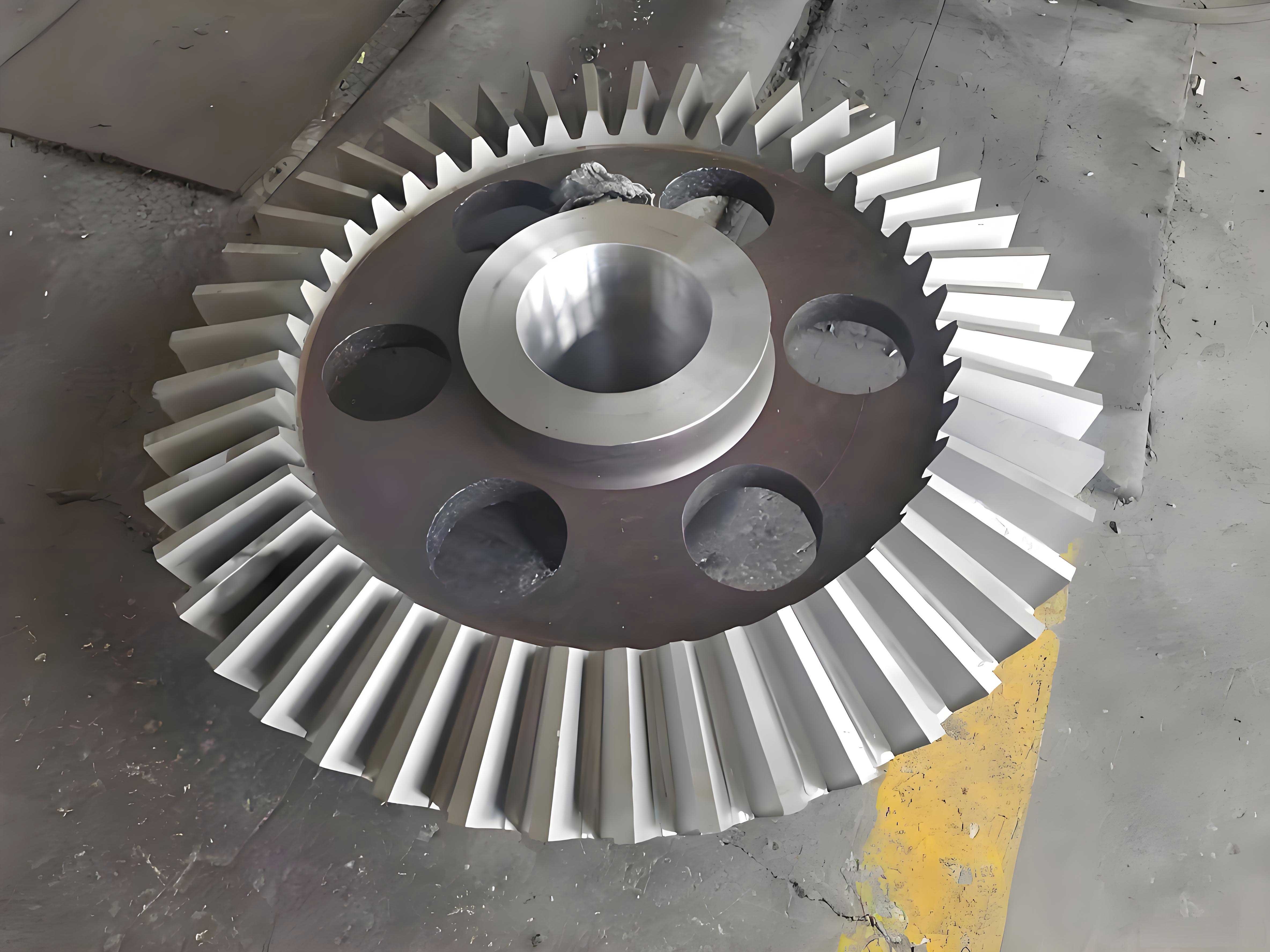
The superiority of precision forged miter gears extends beyond mere cost savings from omitted cutting steps. One of the most significant benefits is enhanced mechanical strength. Compared to their machined counterparts, precision forged miter gears exhibit superior bending strength and resistance to pitting on the tooth flanks. Research has consistently shown that the bending strength of a forged miter gear can be 30% to 50% higher than that of a cut gear. This improvement is attributed to the grain flow of the metal. During forging, the metal’s grain structure is aligned parallel to the tooth root surface, following the contour of the tooth. In a cut miter gear, the machining process severs the grains, often leaving them perpendicular to the root surface, which creates potential weak points. The grain flow alignment in a forged miter gear results in a more continuous and supportive structure, akin to the strength of a forged crankshaft versus a machined one. The bending stress at the root of a miter gear tooth can be approximated by the Lewis formula modified for bevel gears:
$$ \sigma_b = \frac{F_t}{b m_n} Y_F Y_S Y_\beta Y_K $$
Where $\sigma_b$ is the bending stress, $F_t$ is the tangential force at the pitch circle, $b$ is the face width, $m_n$ is the normal module, $Y_F$ is the form factor, $Y_S$ is the stress correction factor, $Y_\beta$ is the helix angle factor (which is 1 for straight miter gears), and $Y_K$ is a forging factor that accounts for the improved grain flow. For a precision forged miter gear, $Y_K$ can be less than 1, effectively reducing the calculated stress compared to a cut gear with the same geometry. This factor is not yet standardized in AGMA documents but is a focus of ongoing research. Additionally, the resistance to surface pitting, a fatigue phenomenon, is better in forged miter gears. The forged surface tends to be denser and more uniform, with fewer micro-cracks or stress risers introduced by cutting tools. The contact stress for pitting resistance is given by the Hertzian formula:
$$ \sigma_H = Z_E \sqrt{\frac{F_t}{b d_1} \cdot \frac{u \pm 1}{u}} $$
Here, $\sigma_H$ is the contact stress, $Z_E$ is the elasticity factor, $d_1$ is the pitch diameter of the pinion, and $u$ is the gear ratio. For a miter gear set where the gears are identical, $u=1$. The forged surface’s integrity allows for higher permissible contact stresses, extending the service life of the miter gear pair.
Another compelling advantage is material savings. Since precision forging produces near-net shapes, it minimizes the amount of material that must be removed by machining. In traditional manufacturing, a significant volume of metal is cut away to form the tooth spaces. For a precision forged miter gear, the tooth spaces are formed by the forging die, so no material is wasted from that area. This leads to a dramatic reduction in the starting blank weight. Consider the following table comparing the weights for producing a specific straight bevel miter gear:
| Manufacturing Method | Blank/Forging Weight | Finished Gear Weight | Material Utilization Efficiency |
|---|---|---|---|
| Conventional Cutting (Rough Forged Blank) | 5 lb 12 oz | 3 lb 0 oz | Approx. 53% |
| Precision Forging (Near-Net Shape) | 3 lb 8 oz | 3 lb 0 oz | Approx. 86% |
The table illustrates that precision forging the miter gear reduces the initial forging weight from 5 lb 12 oz to just 3 lb 8 oz for the same final gear. This 40% reduction in starting material translates directly to cost savings in raw material and reduced energy for forging and machining. Moreover, the tighter tolerances achievable on all surfaces of a precision forged miter gear—such as the tooth profile, pitch diameter, and hub dimensions—mean that subsequent finishing operations are minimized or sometimes eliminated. This streamlining of the process chain further reduces labor, tooling costs, and production time. The economic equation for producing a miter gear batch becomes significantly more favorable with precision forging, especially for high-volume applications.
The design freedom offered by precision forging is perhaps its most innovative aspect. It enables the production of special or non-standard miter gear geometries that are difficult or impossible to achieve with conventional cutting. For instance, a straight bevel miter gear can be forged with integral reinforcing ribs or flanges at the heel (large end) and toe (small end) of the teeth. These ribs act as continuous supports, transforming the tooth from a cantilever beam to a beam supported on three sides. This design drastically increases the bending rigidity and strength. Studies indicate that a rib at the large end alone can reduce the maximum bending stress in a miter gear tooth by up to 30%. If ribs are added at both ends, the stress reduction can be even more pronounced. The fundamental bending stress equation modifies to account for this added support:
$$ \sigma_{b,ribbed} = \sigma_b \cdot C_{rib} $$
Where $C_{rib}$ is a rib support factor, typically ranging from 0.5 to 0.7 for a well-designed miter gear rib. This factor is derived from finite element analysis (FEA) simulations of the forged geometry. Such integrated features are forged in a single operation, eliminating assembly steps and potential weak joints. Other complex forms include miter gears with built-in splines, unusual pressure angles, or customized hub shapes for direct mounting. The forging process accommodates these variations simply by modifying the die cavity, offering tremendous flexibility for custom power transmission solutions.
Delving deeper into the manufacturing process, precision forging of a miter gear requires meticulous control. The sequence typically involves: 1) Cutting billet to size, 2) Heating to forging temperature (e.g., 1100-1200°C for steel), 3) Performing one or more forging strikes in closed dies, 4) Trimming flash, 5) Heat treatment (e.g., carburizing and hardening for high-strength miter gears), and 6) Final finishing (e.g., shot blasting, grinding of mounting surfaces). The heart of the process is the forging die, which must be machined with the negative image of the final miter gear, including tooth profiles. Die design must account for material flow, cooling shrinkage, and ejection. The precision required is extreme; for an AGMA class 9 miter gear, the tooth profile tolerance might be on the order of ±0.025 mm. The forging press must provide sufficient force, which can be estimated for a steel miter gear using the formula:
$$ F_{forge} = k \cdot A \cdot \sigma_{flow} $$
Where $F_{forge}$ is the required forging force, $k$ is a factor accounting for shape complexity (higher for a miter gear with teeth, typically 3-10), $A$ is the projected area of the forging in the parting plane, and $\sigma_{flow}$ is the flow stress of the material at forging temperature. For a medium-sized miter gear, this force can easily exceed 10,000 kN. Process parameters like temperature, lubrication, and forging speed are critical to achieving the desired grain flow and surface finish. Modern precision forging lines are often automated and monitored with sensors to ensure consistency for every miter gear produced.
Material selection is another crucial facet. While carbon and alloy steels are most common for high-strength miter gears, precision forging is also applicable to other materials like brass, aluminum alloys, and even some powder metals. The choice influences the forging parameters, die life, and final properties of the miter gear. For example, a case-hardening steel like AISI 8620 is popular for automotive differential miter gears because precision forging can produce a fine-grained structure that responds well to subsequent carburizing, yielding a hard, wear-resistant surface and a tough core. The relationship between forging conditions and final hardness can be modeled using equations like the Hollomon equation for work hardening:
$$ \sigma = K \epsilon^n $$
Where $\sigma$ is the true stress, $\epsilon$ is the true strain, $K$ is the strength coefficient, and $n$ is the work-hardening exponent. The controlled deformation during forging of a miter gear optimizes these material properties.
Quality control and testing of precision forged miter gears are paramount. Dimensional inspection uses coordinate measuring machines (CMMs) to verify tooth geometry, pitch, and runout. Non-destructive testing methods like magnetic particle inspection or ultrasonic testing check for internal flaws. Furthermore, functional testing on gear test rigs assesses noise, efficiency, and load capacity. The AGMA standards provide guidelines, but for precision forged miter gears, additional criteria related to grain flow and surface integrity are often evaluated. The following table summarizes key quality attributes for a precision forged miter gear versus a cut one:
| Quality Attribute | Precision Forged Miter Gear | Cut Miter Gear |
|---|---|---|
| Tooth Profile Accuracy (AGMA Class) | 9-11 | 8-10 (after cutting), higher after grinding |
| Surface Roughness (Ra, µm) | 1.6 – 3.2 (as-forged) | 0.8 – 1.6 (after grinding) |
| Bending Fatigue Limit (Relative) | 1.3 – 1.5 (base = cut gear) | 1.0 |
| Pitting Fatigue Limit (Relative) | 1.1 – 1.3 | 1.0 |
| Material Utilization | High (≥80%) | Medium (50-70%) |
| Lead Time for Dies/Tooling | Longer initial die development | Shorter for cutting tools |
The table highlights that while the initial tooling for a precision forged miter gear is more complex and time-consuming to produce, the long-term benefits in strength and material savings are substantial, especially for large production runs.
From an application perspective, precision forged miter gears are found in demanding environments. Automotive differentials are a prime example, where high strength and durability are critical. Other applications include agricultural machinery, industrial gearboxes, marine propulsion systems, and aerospace actuators. In each case, the reliability and performance of the miter gear pair are enhanced by the forging process. For instance, in a vehicle differential, the miter gears (often called spider gears) transmit torque between the axle shafts. The higher bending strength of a forged miter gear allows for a more compact design or higher torque capacity. The weight savings also contribute to overall vehicle efficiency. The torque capacity of a miter gear set can be estimated based on bending and pitting limits. For bending, the permissible tangential force is:
$$ F_{t,perm} = \frac{\sigma_{FP} \cdot b \cdot m_n}{Y_F Y_S Y_K} $$
Where $\sigma_{FP}$ is the permissible bending stress for the material. For a precision forged miter gear, $\sigma_{FP}$ can be higher due to the favorable grain structure. Similarly, for pitting, the permissible torque $T_{perm}$ is derived from the contact stress formula. The net effect is that a precision forged miter gear can transmit more power in the same envelope or achieve the same power with a smaller, lighter gearset.
Looking forward, advancements in simulation technology, such as finite element analysis (FEA) for metal flow and structural performance, are further optimizing the precision forging process for miter gears. Additive manufacturing is also emerging as a tool for producing complex forging dies with conformal cooling channels, improving die life and consistency. The integration of Industry 4.0 concepts allows for real-time monitoring and adaptive control during forging, ensuring each miter gear meets exact specifications. Moreover, research is ongoing to expand precision forging to helical bevel gears and hypoid gears, though the complexity increases significantly. For straight bevel miter gears, however, the technology is mature and proven.
In conclusion, the adoption of precision forging for manufacturing straight bevel miter gears represents a significant leap in gear technology. The process delivers components with superior mechanical properties, exceptional material efficiency, and unparalleled design flexibility. As an engineer, I firmly believe that the future of high-performance gear manufacturing lies in such net-shape processes. The precision forged miter gear is not just an alternative to cut gears; it is a superior solution for applications where strength, weight, and reliability are paramount. The continuous improvement in forging techniques, coupled with sophisticated design and quality assurance, ensures that precision forged miter gears will play an increasingly vital role in advanced mechanical systems worldwide. The journey from a rough billet to a finished, high-precision miter gear through forging is a testament to the ingenuity of modern manufacturing, and I am excited to be part of this evolving field.