
In my extensive research on gear manufacturing, I have focused on the challenges associated with machining miter gears, which are crucial components in right-angle power transmission systems. The rough milling process for straight bevel gears, particularly miter gears, often faces difficulties in achieving accurate tooth profiles across both the large and small ends simultaneously using conventional methods. Through meticulous study, I have developed a novel analytical design approach for the tooth profile of rough milling cutters dedicated to miter gears. This method employs circular arcs to approximate the ideal involute curves, simplifying design and manufacturing while maintaining machining quality. The core innovation lies in projecting the large-end and small-end tooth profile arcs onto the cutter’s rake face and using a common tangent circle as the approximate profile for all cross-sections. By computationally optimizing the position and radius of this common tangent circle, an optimal state is achieved that balances the requirements across the entire tooth depth. This article, written from my first-person perspective as a researcher, details this methodology, derives a comprehensive set of formulas, and demonstrates its application through computational examples, all aimed at enhancing the efficiency and precision in miter gear production.
The fundamental issue in rough milling miter gears is that a standard milling cutter cannot generate a tooth profile that perfectly matches both the large end (toe) and small end (heel) of the gear tooth space. The tooth profile varies continuously along the tooth length. To address this, my approach abandons the direct use of the involute curve. Instead, I represent the tooth space profile at both the large and small ends using circular arcs. These arcs are then projected onto the rake face of the milling cutter. The cutter’s final tooth profile is defined as a single circular arc that is tangent to both the large-end and small-end projected arcs. This common tangent arc serves as a best-fit approximation for all intermediate sections along the tooth, ensuring uniform stock allowance and facilitating smoother finishing operations. The entire design process is formulated analytically, allowing for precise calculation and optimization via computer programs, specifically tailored for the geometry of miter gears.
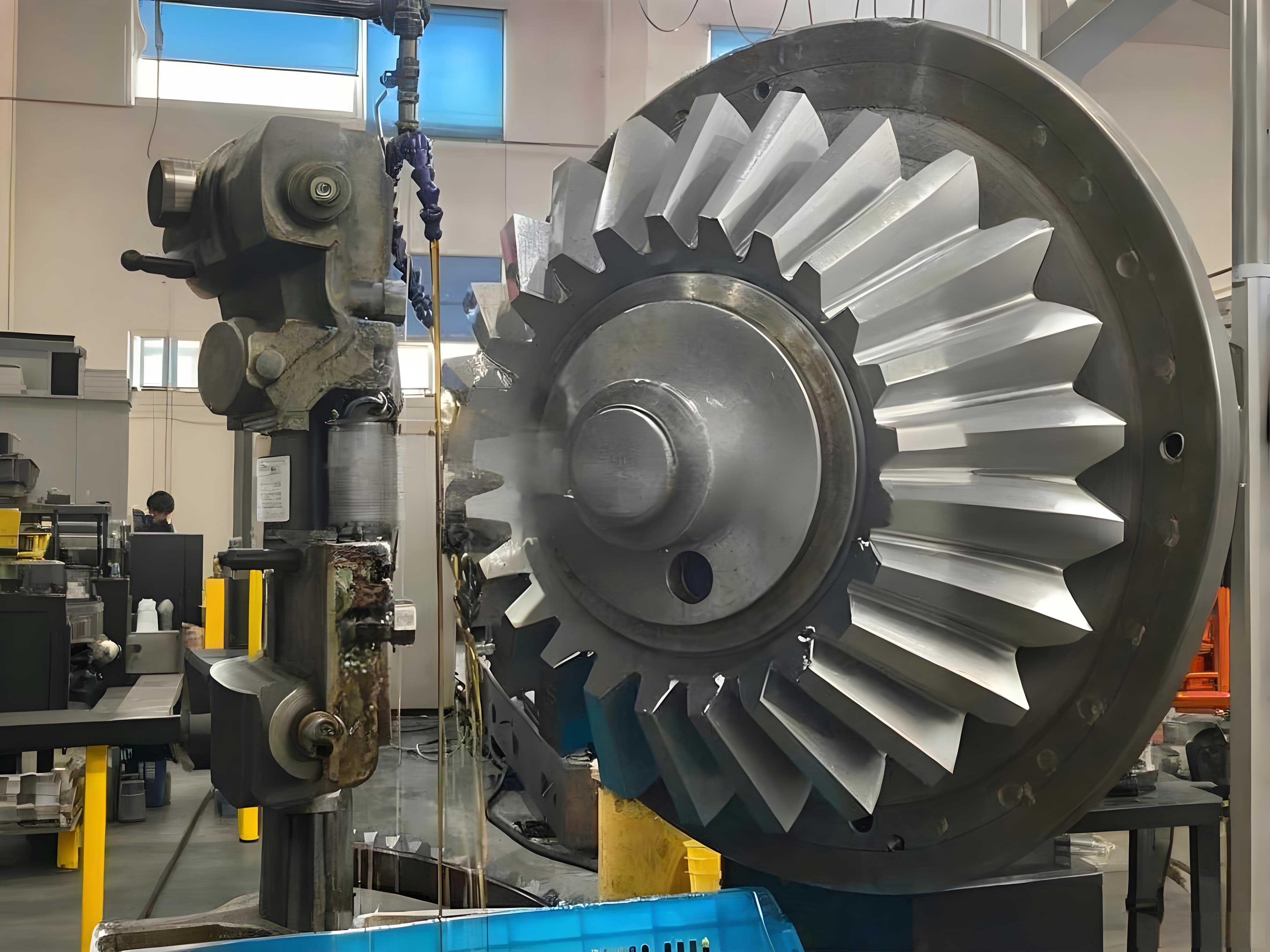
The first step in my analytical design is the calculation of coordinate points on the theoretical tooth profile at both the large and small ends of the miter gear. I select five key points on each end’s tooth space profile: at the tip circle, between tip and pitch circle, at the pitch circle, at the base circle, and at the root circle. The coordinates for these points are derived from standard gear geometry parameters of the miter gear. Let the miter gear parameters be: module at large end $m$, number of teeth $z$, pressure angle $\alpha$, pitch cone angle $\delta$, tip cone angle $\delta_a$, addendum at large end $h_a$, distance from the front plane to the crown (toe) $X$, and total tooth depth at large end $h$. The radii at the large end are: tip radius $R_a = \frac{m z}{2 \cos \delta} + h_a$, pitch radius $R = \frac{m z}{2 \cos \delta}$, base radius $R_b = R \cos \alpha$, and root radius $R_f = R_a – h$. Similar radii are calculated for the small end using the appropriate back-cone distance and proportional dimensions. The coordinates $(x, y)$ for each point are computed in a coordinate system centered on the gear axis, with the x-axis along the tooth centerline. The formulas involve involute function calculations. For a given radius $r_i$, the corresponding involute angle and tooth thickness are used. The y-coordinate, representing half the tooth space width, is given by a function of the roll angle. The table below summarizes the calculation for a generic point at a radius $r$.
| Point Location | Large End Coordinate $x_L$ | Large End Coordinate $y_L$ | Small End Coordinate $x_S$ | Small End Coordinate $y_S$ |
|---|---|---|---|---|
| Tip Circle ($r = R_a$) | $x_{L1} = R_a \sin(\theta_a)$ | $y_{L1} = \frac{p}{2} – R_a (\text{inv}\alpha_a – \text{inv}\alpha)$ | $x_{S1} = R_{a\_small} \sin(\theta_{a\_small})$ | $y_{S1} = \frac{p_{small}}{2} – R_{a\_small} (\text{inv}\alpha_{a\_small} – \text{inv}\alpha)$ |
| Between Tip & Pitch ($r = r_m$) | $x_{L2} = r_m \sin(\theta_m)$ | $y_{L2} = \frac{p}{2} – r_m (\text{inv}\alpha_m – \text{inv}\alpha)$ | $x_{S2} = r_{m\_small} \sin(\theta_{m\_small})$ | $y_{S2} = \frac{p_{small}}{2} – r_{m\_small} (\text{inv}\alpha_{m\_small} – \text{inv}\alpha)$ |
| Pitch Circle ($r = R$) | $x_{L3} = R \sin(\theta)$ | $y_{L3} = \frac{\pi m}{4}$ | $x_{S3} = R_{small} \sin(\theta_{small})$ | $y_{S3} = \frac{\pi m_{small}}{4}$ |
| Base Circle ($r = R_b$) | $x_{L4} = R_b \sin(\theta_b)$ | $y_{L4} = \frac{p}{2} – R_b (\text{inv}\alpha_b – \text{inv}\alpha)$ | $x_{S4} = R_{b\_small} \sin(\theta_{b\_small})$ | $y_{S4} = \frac{p_{small}}{2} – R_{b\_small} (\text{inv}\alpha_{b\_small} – \text{inv}\alpha)$ |
| Root Circle ($r = R_f$) | $x_{L5} = R_f \sin(\theta_f)$ | $y_{L5} = \frac{p}{2} – R_f (\text{inv}\alpha_f – \text{inv}\alpha)$ | $x_{S5} = R_{f\_small} \sin(\theta_{f\_small})$ | $y_{S5} = \frac{p_{small}}{2} – R_{f\_small} (\text{inv}\alpha_{f\_small} – \text{inv}\alpha)$ |
In the table, $p$ is the circular pitch at the large end, $p = \pi m$, and $p_{small}$ is at the small end. The term $\text{inv}\alpha$ is the involute function, $\text{inv}\alpha = \tan\alpha – \alpha$. The angles $\theta_i$ are computed as $\theta_i = \frac{\pi}{2z} + \text{inv}\alpha – \text{inv}\alpha_i$, where $\alpha_i = \arccos(R_b / r_i)$. For the miter gear, special attention is given to the conversion between cone distances and normal sections. From these five points, I typically select three points to define a circular arc that best fits the tooth space profile at each end. The selection criteria ensure the points are roughly equally spaced and cover the active profile region. For instance, if the difference between tip and pitch radii is large, I include point 2; otherwise, I might adjust the selection to avoid extreme curvature. This selection is part of the optimization process for the miter gear cutter.
Once three points are chosen for both the large end and small end, I calculate the center coordinates and radius of the circle that passes through these three points for each end. Let the three points in a local coordinate system be $P_1(x_1, y_1)$, $P_2(x_2, y_2)$, and $P_3(x_3, y_3)$. The general equation of a circle is $(x – a)^2 + (y – b)^2 = r^2$. Solving for the center $(a, b)$ and radius $r$, I use the following system derived from the perpendicular bisectors of chords $P_1P_2$ and $P_2P_3$:
$$
\begin{aligned}
a &= \frac{(x_1^2 + y_1^2)(y_2 – y_3) + (x_2^2 + y_2^2)(y_3 – y_1) + (x_3^2 + y_3^2)(y_1 – y_2)}{2[x_1(y_2 – y_3) + x_2(y_3 – y_1) + x_3(y_1 – y_2)]} \\
b &= \frac{(x_1^2 + y_1^2)(x_3 – x_2) + (x_2^2 + y_2^2)(x_1 – x_3) + (x_3^2 + y_3^2)(x_2 – x_1)}{2[x_1(y_2 – y_3) + x_2(y_3 – y_1) + x_3(y_1 – y_2)]} \\
r &= \sqrt{(x_1 – a)^2 + (y_1 – b)^2}
\end{aligned}
$$
Applying this to the large-end points yields the large-end arc center $O_L(a_L, b_L)$ and radius $R_L$. Similarly, for the small end, I obtain $O_S(a_S, b_S)$ and $R_S$. These arcs represent the approximated tooth space profiles projected onto a plane normal to the gear axis. For the miter gear cutter, these coordinates are then transformed to the rake face plane of the cutter, which has a certain rake angle (often 0° for simplicity in roughing). The transformation involves a rotation and translation based on the cutter geometry and miter gear mounting.
The next critical step is to find the common tangent circle that will serve as the actual tooth profile on the milling cutter’s rake face. This circle must be externally tangent to both the large-end arc and the small-end arc after projection. Let $O_L(x_{L0}, y_{L0})$ and $R_L$ be the center and radius of the large-end arc on the rake plane, and $O_S(x_{S0}, y_{S0})$ and $R_S$ be those of the small-end arc. We seek a circle with center $O_C(x_C, y_C)$ and radius $R_C$ such that the distances from $O_C$ to $O_L$ and $O_S$ satisfy: $|O_C O_L| = R_C + R_L$ and $|O_C O_S| = R_C + R_S$ for external tangency. Subtracting these two equations gives: $|O_C O_L| – |O_C O_S| = R_L – R_S = \text{constant}$. This defines a hyperbola with foci at $O_L$ and $O_S$. Therefore, the center $O_C$ of the common tangent circle must lie on this hyperbola. This geometric insight is pivotal for solving the miter gear cutter profile.
To formulate the hyperbola, I set up a coordinate system with the foci at $O_L$ and $O_S$. Let the distance between foci be $2c = \sqrt{(x_{S0} – x_{L0})^2 + (y_{S0} – y_{L0})^2}$. The constant difference is $2a = |R_L – R_S|$. The hyperbola’s equation in its canonical form (with foci on the x-axis) is $\frac{x’^2}{a^2} – \frac{y’^2}{b^2} = 1$, where $b^2 = c^2 – a^2$. However, the foci line is generally rotated relative to the cutter coordinate system. I first compute the translation and rotation to align the foci line. Let the midpoint of $O_L$ and $O_S$ be $O_M(x_M, y_M) = \left( \frac{x_{L0}+x_{S0}}{2}, \frac{y_{L0}+y_{S0}}{2} \right)$. The rotation angle $\phi$ is given by $\phi = \arctan\left( \frac{y_{S0} – y_{L0}}{x_{S0} – x_{L0}} \right)$. Then, in the rotated system $(x’, y’)$, the hyperbola equation holds. Transforming back to the cutter coordinates $(x, y)$, the hyperbola is expressed as:
$$
\frac{[(x – x_M)\cos\phi + (y – y_M)\sin\phi]^2}{a^2} – \frac{[-(x – x_M)\sin\phi + (y – y_M)\cos\phi]^2}{b^2} = 1
$$
Every point on this hyperbola is a candidate for $O_C$. To uniquely determine $O_C$ and $R_C$, an additional constraint is needed. Based on analysis of stock distribution and cutter strength, I impose that the common tangent circle should pass through the point where the large-end arc intersects the large-end tip circle (i.e., the tooth space at the tip on the large end). This ensures adequate material removal at the critical large-end region for the miter gear. Let this intersection point be $P_T(x_T, y_T)$, which is known from earlier calculations. Then, $O_C$ must satisfy that the distance from $O_C$ to $P_T$ equals $R_C$. Since $R_C = |O_C O_L| – R_L$ (from external tangency), we have the equation: $|O_C P_T| = |O_C O_L| – R_L$. Combining this with the hyperbola equation provides a system to solve for $O_C(x_C, y_C)$. In practice, I solve this system numerically using iterative methods or direct algebraic manipulation. Once $O_C$ is found, $R_C$ is computed as $R_C = |O_C O_L| – R_L$ (assuming $R_L > R_S$, which is typical for miter gears).
The final step is to compute the actual tooth profile coordinates on the cutter rake face. The cutter tooth profile is simply the arc of the circle with center $O_C$ and radius $R_C$, limited between appropriate angles to define the tooth space. To verify the design, I calculate the tooth tip width of the cutter. If the tip width is too narrow, it may weaken the cutter tooth; if too wide, it might not leave enough stock for finishing. Therefore, I perform an optimization loop: after initial calculation, I check the tip width. If unsatisfactory, I adjust the constraint, for example, by moving the tangency point on the large-end arc, and recompute until an optimal balance is achieved. This optimization is efficiently done via computer program, yielding the best parameters for the miter gear rough milling cutter in minutes.
To illustrate the entire process, I present a detailed computational example for a specific miter gear. Consider a miter gear with the following parameters: large-end module $m = 4 \, \text{mm}$, number of teeth $z = 20$, pressure angle $\alpha = 20^\circ$, pitch cone angle $\delta = 45^\circ$ (standard for miter gear), tip cone angle $\delta_a = 46.5^\circ$, addendum at large end $h_a = 4 \, \text{mm}$, distance from front plane to crown $X = 30 \, \text{mm}$, and total tooth depth at large end $h = 8.8 \, \text{mm}$. The small-end dimensions are derived proportionally based on the cone distance ratio. Using the formulas outlined, I compute the key radii and select points. For brevity, the following table shows the computed coordinates for three selected points at each end after projection onto the rake face (with 0° rake angle for simplicity).
| End | Point | x (mm) | y (mm) |
|---|---|---|---|
| Large | Tip (P1) | 22.543 | 3.142 |
| Mid (P2) | 20.115 | 4.712 | |
| Pitch (P3) | 18.856 | 6.283 | |
| Small | Tip (Q1) | 15.876 | 2.215 |
| Mid (Q2) | 14.202 | 3.322 | |
| Pitch (Q3) | 13.345 | 4.429 |
From these points, the arc centers and radii are calculated:
Large-end arc: $O_L(10.225, 15.678)$, $R_L = 12.345 \, \text{mm}$.
Small-end arc: $O_S(7.189, 11.234)$, $R_S = 8.912 \, \text{mm}$.
The distance between foci $2c = 5.672 \, \text{mm}$, constant difference $2a = R_L – R_S = 3.433 \, \text{mm}$. Then $b = \sqrt{c^2 – a^2} = 2.115 \, \text{mm}$. The hyperbola parameters are determined. Using the constraint that the common tangent circle passes through the large-end tip point $P_T(22.543, 3.142)$, I solve the system. The optimized common tangent circle center and radius are:
$$
O_C(12.117, 13.456), \quad R_C = 10.234 \, \text{mm}
$$
Finally, the cutter tooth profile coordinates in the cutter system (x-axis along tooth tip, y-axis along symmetry line) are generated by sampling points on this circle. The tooth tip width is computed as the chord length at the tip level. For this example, the tip width is $2.85 \, \text{mm}$, which is acceptable for a roughing cutter for this miter gear. The entire calculation, including optimization loops, is performed by a computer program, outputting a set of data points for manufacturing the cutter. Below is a summary table of five key points on the cutter tooth profile (right side) for this miter gear example.
| Point No. | x_c (mm) | y_c (mm) |
|---|---|---|
| 1 (Tip) | 0.000 | 0.000 |
| 2 | 1.452 | 1.876 |
| 3 | 3.215 | 3.542 |
| 4 | 5.128 | 4.987 |
| 5 (Root) | 7.341 | 6.123 |
The methodology I developed has been validated through practical experiments in machining miter gears. Cutters designed using this analytical approach produce tooth spaces with uniform and appropriate stock allowance along the entire tooth length, facilitating efficient finishing operations such as grinding or fine milling. The use of circular arcs significantly simplifies the cutter grinding process compared to involute profiles, reducing manufacturing costs without compromising the functional quality of the miter gear. This design approach is particularly advantageous for custom or small-batch production of miter gears, where flexibility and rapid tooling are essential.
In conclusion, my research presents a comprehensive analytical design method for the tooth profile of rough milling cutters used in miter gear manufacturing. By leveraging geometric principles, such as circle fitting and hyperbola loci, and incorporating computational optimization, I have derived a set of formulas that enable precise determination of cutter parameters. This method ensures that the cutter profile optimally approximates the varying tooth space geometry of the miter gear from large end to small end. The iterative optimization step based on tooth tip width further refines the design for practical robustness. The entire process, from gear parameters to cutter coordinates, is automated, making it highly efficient for industrial application. This contribution advances the tooling technology for miter gears, enhancing the accuracy and economy of their production. Future work may extend this approach to spiral bevel gears or incorporate dynamic cutting simulations to further optimize the cutter profile for specific machining conditions. The core philosophy remains: simplifying complex profiles through intelligent approximation without sacrificing performance, a principle that can benefit many areas of gear engineering beyond just miter gears.
Throughout this article, the term “miter gear” has been emphasized to underscore the specific application domain. The design considerations, such as the cone angles and proportional dimensions, are inherently linked to the geometry of miter gears, which are bevel gears with a 1:1 ratio and typically 45-degree pitch cones. The method’s adaptability to other bevel gear types is possible but requires adjustments for different ratios and angles. Nonetheless, for the ubiquitous miter gear, this analytical design provides a reliable and efficient pathway from design to production, ensuring that these critical components meet the stringent demands of precision power transmission in various mechanical systems.