
In the realm of power transmission systems for aerospace, high-speed rail, and other advanced machinery, the demand for high precision, exceptional stability, and predictable noise and vibration performance is ever-increasing. Spiral bevel gears are a critical component in such systems due to their ability to transmit power smoothly and efficiently between intersecting shafts. The performance and dynamic behavior of these gears are fundamentally governed by their geometric accuracy and the interaction between meshing teeth. Among the various sources of excitation in gear systems, transmission error stands out as the primary contributor to vibration and noise. Transmission error, defined as the deviation from the perfectly kinematic motion that the gear pair is designed to produce, acts as a primary displacement-type excitation within the gear mesh. Understanding and accurately modeling this error, particularly under no-load conditions, is therefore paramount for predicting and controlling the dynamic response of geared systems.
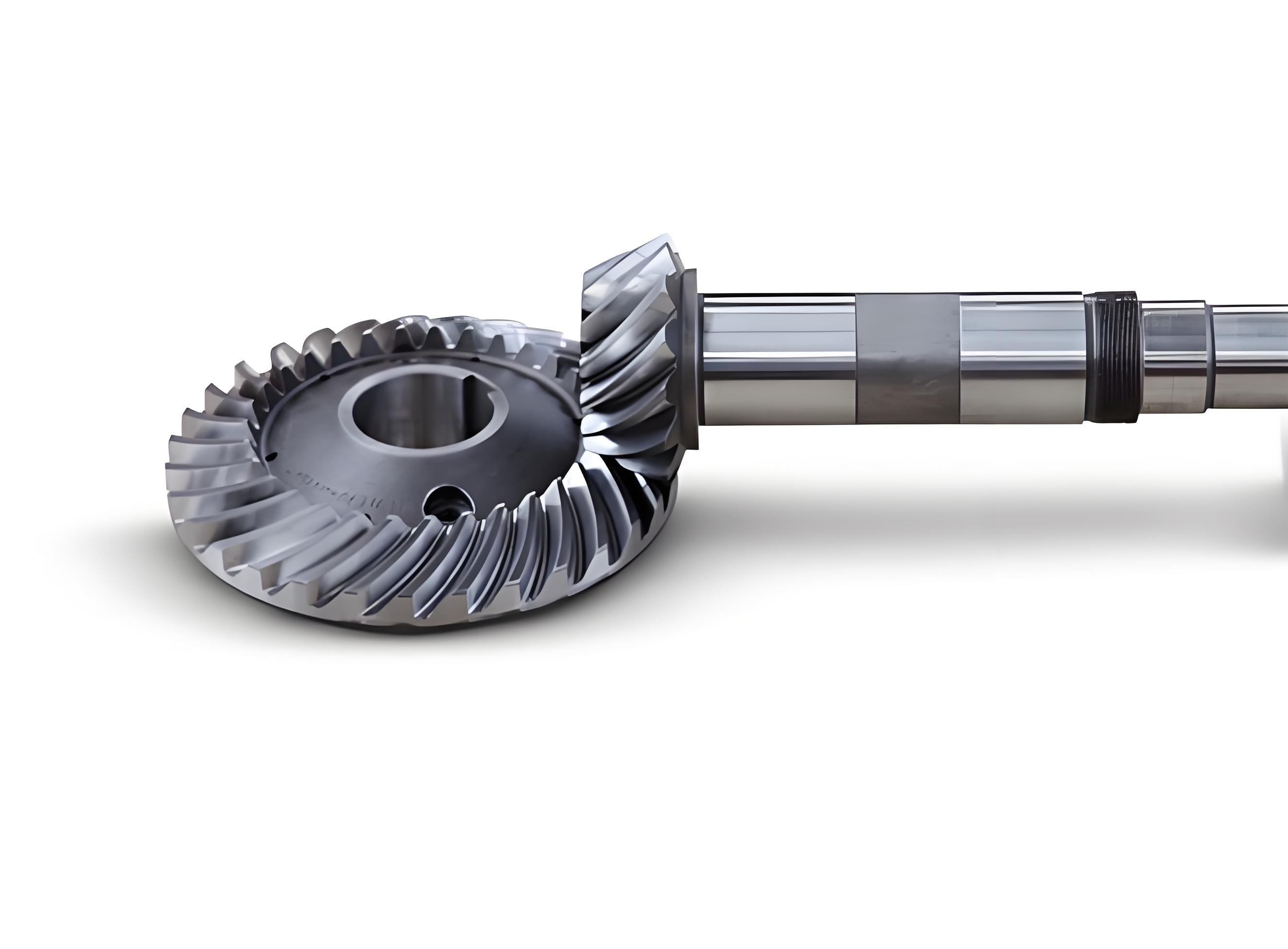
Traditional approaches to analyzing spiral bevel gears often rely on complex mathematical equations to describe the theoretical tooth surface geometry derived from the generation process. While powerful, these models inherently assume perfect geometry. In reality, manufacturing processes inevitably introduce deviations and errors on the actual tooth surface. Incorporating these real-world imperfections into classic Tooth Contact Analysis (TCA) or dynamic models is a significant challenge, often requiring sophisticated modifications to the surface equations. Furthermore, in dynamic simulations, error excitations are frequently simplified, for instance, as single-frequency sinusoidal functions, thereby neglecting the potential influence of higher-order harmonic content present in real manufacturing errors. This paper presents a comprehensive framework that circumvents these limitations by introducing a discrete-point methodology for determining the Static Transmission Error (STE) of spiral bevel gears directly from measured coordinate data of the actual tooth surfaces. This model is then integrated into a fully coupled dynamic model to investigate the nuanced effects of real surface imperfections on the system’s dynamic performance.
Discrete-Point Modeling of Static Transmission Error for Spiral Bevel Gears
The cornerstone of the proposed methodology is the construction of a high-fidelity, discrete representation of the spiral bevel gear tooth surfaces, independent of any parametric surface equations. This approach liberates the analysis from the constraints of theoretical geometry and allows for the direct incorporation of as-measured surface data.
Model Foundation and Procedure
The process begins with data acquisition. The coordinates of points on the actual tooth surfaces of both the pinion and gear are obtained using a high-precision Coordinate Measuring Machine (CMM). A typical measurement might involve collecting data at 261 discrete points per tooth flank, with measurement accuracy on the order of $10^{-6}$ m. This cloud of points forms the foundational dataset representing the real, manufactured geometry of the spiral bevel gears.
The core of the model involves transforming this sparse point cloud into a sufficiently dense mesh suitable for accurate contact simulation. This is achieved through interpolation. The original CMM points are used as nodes for a high-order interpolation scheme (e.g., a 4th-order interpolation), generating a dense grid of surface points. The spacing between adjacent interpolated points is controlled to be extremely fine, for example, $5 \times 10^{-7}$ m, to ensure geometric fidelity. A critical step in this phase is the identification and removal of interpolated points that fall outside the physical boundaries of the actual tooth flank. This boundary culling is performed by referencing the convex hull or boundary of the original measured points, ensuring the final discrete surface accurately represents only the functional area of the tooth.
With the discrete point surfaces for both members of the spiral bevel gear pair prepared, they are algorithmically assembled into a meshing position. The contact analysis is performed numerically by searching for the minimum distance between the two discrete surfaces as one gear is incrementally rotated relative to the other. For a given angular position of the driving member (e.g., the pinion), the position of the driven member (the gear) is adjusted until the minimum Euclidean distance between any point on the pinion surface and any point on the gear surface falls within a specified contact tolerance, $E$. This process simulates the condition of unloaded meshing contact.
Tolerance Setting and Contact Detection
The selection of the contact tolerance $E$ is crucial for the stability and accuracy of the algorithm. It must be larger than the maximum possible distance a point on one surface can travel towards the other during a single rotational step, preventing false non-interference judgments. Consider a grid cell on the active surface defined by four adjacent interpolated points A, B, C, D, with grid spacings $a$ and $b$. Let $P$ be a point on the opposing surface. The minimum distance $c$ from $P$ to the quadrilateral defined by A, B, C, D can be approximated. If the rotational step for the driven gear is $\theta$ and the approximate radius at the point of contact is $r$, then the linear travel $l$ is $r\theta$. To ensure contact is detected before physical interference occurs in the simulation, the tolerance must satisfy:
$$ E \geq \sqrt{ \left( \frac{a}{2} \right)^2 + \left( \frac{b}{2} \right)^2 + \left( l \right)^2 } $$
This criterion guarantees that the search algorithm will identify a contact condition within the tolerance band before the surfaces would have passed through each other in a real continuous motion.
Calculation of Static Transmission Error
Once the contact positions are found for a sequence of pinion rotations, the Static Transmission Error (STE) is calculated. The STE is defined as the difference between the actual angular position of the driven gear and its ideal, perfectly conjugate position, corresponding to the same driver position. For a discrete set of angular positions, it is computed as:
$$ \text{STE}(i) = \left( \theta_p^{(i)} – \theta_p^{(1)} \right) – \frac{Z_g}{Z_p} \left( \theta_g^{(i)} – \theta_g^{(1)} \right) $$
where:
- $\theta_p^{(i)}$ is the angular position of the pinion at step $i$,
- $\theta_g^{(i)}$ is the corresponding angular position of the gear found from contact analysis at step $i$,
- $\theta_p^{(1)}$ and $\theta_g^{(1)}$ are the angular positions at the first detected contact point (defining the reference),
- $Z_p$ and $Z_g$ are the numbers of teeth on the pinion and gear, respectively.
The result is a discrete vector representing the unloaded STE over one mesh cycle for the spiral bevel gear pair, directly derived from the measured tooth surfaces.
Model Validation and Analysis of Actual Spiral Bevel Gear STE
To establish the validity of the discrete-point STE model, a comparative analysis is essential. This involves applying the model to a pair of spiral bevel gears with known, perfect theoretical geometry and comparing the results against those obtained from a well-established, classical TCA method based on the mathematical surface equations.
Validation Against Theoretical Geometry
A spiral bevel gear pair with the parameters listed in Table 1 is used for validation. First, a cloud of points is generated directly from the theoretical flank equations, simulating a perfect CMM measurement. These “theoretical measurement points” are then fed into the proposed discrete-point STE model. The calculated STE curve is compared to the STE curve produced by a standard, equation-based TCA software.
| Parameter | Pinion (Driver) | Gear (Driven) |
|---|---|---|
| Number of Teeth ($Z$) | 55 | 47 |
| Module (mm) | 3.0 | 3.0 |
| Normal Pressure Angle ($\alpha_n$) | 20° | 20° |
| Mean Spiral Angle ($\beta_m$) | 35° | 35° |
| Hand of Spiral | Right | Left |
| Shaft Angle ($\Sigma$) | 90° | 90° |
| Face Width (mm) | 19 | 19 |
The STE curve from the discrete-point model for the theoretical surfaces shows an amplitude of approximately $3.95 \times 10^{-5}$ rad. It exhibits the expected parabolic-like trend characteristic of misalignment-free conjugate contact, with minor numerical oscillations due to the discrete nature of the model. The STE curve from the classical TCA for the same theoretical spiral bevel gears shows an amplitude of $3.72 \times 10^{-5}$ rad. The close agreement in both amplitude and trend validates the fundamental correctness and accuracy of the proposed discrete-point methodology for calculating the STE of spiral bevel gears.
Characterization of Actual Tooth Surface STE
The true power of the model is demonstrated when applied to real CMM data from manufactured spiral bevel gears. The actual tooth surfaces contain a complex superposition of form errors, waviness, and roughness from the grinding or cutting process. When the discrete-point STE model processes this data, it yields an STE curve that reflects these real-world imperfections.
For the same gear pair, the STE calculated from the actual measured surfaces has an amplitude of $5.20 \times 10^{-5}$ rad. While the overall amplitude is somewhat larger than the theoretical case, the most striking difference is in the character of the curve. The actual STE curve is not smooth; it displays significant high-frequency fluctuations and a more irregular pattern superimposed on the fundamental parabolic shape. This complex waveform contains information about various manufacturing errors.
A frequency domain analysis reveals further insights. Performing a Fast Fourier Transform (FFT) on both the theoretical and actual STE curves (converted to linear displacement at the pitch point) allows for a harmonic comparison.
| Harmonic Order (Mesh Multiple) | Theoretical Surface STE Amplitude (m) | Actual Surface STE Amplitude (m) |
|---|---|---|
| 1st (1×) | $1.37 \times 10^{-5}$ | $1.42 \times 10^{-5}$ |
| 2nd (2×) | $8.31 \times 10^{-6}$ | $7.21 \times 10^{-6}$ |
| 3rd (3×) | $7.02 \times 10^{-6}$ | $6.52 \times 10^{-6}$ |
Table 2 shows that the amplitudes of the first three harmonic components are relatively similar between the theoretical and actual cases. The primary difference lies in the spectral content beyond these first few harmonics. The actual STE spectrum exhibits numerous higher-order harmonics with non-negligible amplitudes, which are absent or minimal in the theoretical spectrum. These higher-order components represent the complex, non-sinusoidal nature of the real manufacturing errors on the spiral bevel gear teeth. This rich harmonic content is typically lost when errors are modeled as simple sinusoidal functions in dynamic analyses.
Dynamic Modeling of Spiral Bevel Gear Systems
To assess the impact of the detailed STE on system behavior, a comprehensive dynamic model of the spiral bevel gear transmission is required. A lumped-parameter model with multiple degrees of freedom (DOF) is developed, capturing the essential dynamics of the gear pair, supporting shafts, and connected inertias.
System Configuration and Degrees of Freedom
The model considers the three-dimensional dynamics of the spiral bevel gear pair mounted on flexible bearings. The coordinate system is established at the intersection point of the pinion and gear rotational axes. The gear (driven) rotational axis defines the Y-axis, and the pinion (driver) rotational axis defines the Z-axis. The model accounts for 14 degrees of freedom in total:
- Drive Motor & Load: Torsional vibrations of the motor rotor ($\theta_E$) and the load inertia ($\theta_L$).
- Gear (Driven) Body: Three translational ($X_g$, $Y_g$, $Z_g$) and three rotational ($\theta_{gx}$, $\theta_{gy}$, $\theta_{gz}$) vibrations.
- Pinion (Driver) Body: Three translational ($X_p$, $Y_p$, $Z_p$) and three rotational ($\theta_{px}$, $\theta_{py}$, $\theta_{pz}$) vibrations.
This formulation allows the model to capture bending, axial, and torsional vibrations of the gear bodies, as well as the interactions between these modes, which is critical for spiral bevel gears due to their complex spatial mesh forces.
Equations of Motion
The equations of motion for the 14-DOF system are derived using Newton-Euler methods and can be expressed in matrix form as:
$$ [\mathbf{M}] \{\ddot{\mathbf{q}}\} + [\mathbf{C}] \{\dot{\mathbf{q}}\} + [\mathbf{K}] \{\mathbf{q}\} = \{\mathbf{F}\} $$
where:
- $[\mathbf{M}]$ is the mass/inertia matrix: $\text{diag}[I_E, M_g, M_g, M_g, I_{gx}, I_{gy}, I_{gz}, M_p, M_p, M_p, I_{px}, I_{py}, I_{pz}, I_L]$.
- $\{\mathbf{q}\}$ is the displacement vector: $\{\theta_E, X_g, Y_g, Z_g, \theta_{gx}, \theta_{gy}, \theta_{gz}, X_p, Y_p, Z_p, \theta_{px}, \theta_{py}, \theta_{pz}, \theta_L\}^T$.
- $[\mathbf{C}]$ and $[\mathbf{K}]$ are the damping and stiffness matrices representing bearing support and shaft flexibility.
- $\{\mathbf{F}\}$ is the excitation force vector containing the mesh forces and external torques.
Nonlinear Mesh Force Model
The gear mesh interaction is the primary source of nonlinearity and excitation. The mesh force $F_m$ acts along the line of action. It is modeled as a nonlinear function of the dynamic transmission error (DTE), which is the relative displacement between the pinion and gear along the line of action, considering all body motions.
$$ \delta_D = \mathbf{n}_p \cdot \mathbf{d}_p + \boldsymbol{\lambda}_p \cdot \boldsymbol{\Theta}_p – (\mathbf{n}_g \cdot \mathbf{d}_g + \boldsymbol{\lambda}_g \cdot \boldsymbol{\Theta}_g) $$
Here, $\mathbf{d}_p=(X_p, Y_p, Z_p)$ and $\boldsymbol{\Theta}_p=(\theta_{px}, \theta_{py}, \theta_{pz})$ are the pinion’s translational and rotational displacement vectors (similarly for the gear, subscript $g$). The vectors $\mathbf{n}_p$ and $\mathbf{n}_g$ are the unit normals along the line of action at the contact point on the pinion and gear, respectively. The vectors $\boldsymbol{\lambda}_p$ and $\boldsymbol{\lambda}_g$ represent the moment arms from the body center of mass to the contact point.
The total dynamic mesh force is then:
$$ F_m = K_m(t) \cdot f(\delta_D – E_t(t), b_c) $$
where:
- $K_m(t)$ is the time-varying mesh stiffness. For spiral bevel gears, this is calculated via finite element contact analysis (e.g., using Abaqus). It is defined as $K_m = F_{\text{total}} / (\lambda_{pz} (e_L – e_0))$, where $F_{\text{total}}$ is the total static contact force under load, $e_L$ is the loaded static transmission error, $e_0$ is the unloaded STE, and $\lambda_{pz}$ is a relevant moment arm component.
- $E_t(t)$ is the static unloaded transmission error as a function of mesh cycle, obtained from the discrete-point model. This is the key excitation input.
- $b_c$ is half the total backlash.
- $f(x, b_c)$ is a piecewise function accounting for contact loss: $$ f(x, b_c) = \begin{cases} x – b_c, & x \ge b_c \\ 0, & -b_c < x < b_c \\ x + b_c, & x \le -b_c \end{cases} $$
The excitation force vector $\{\mathbf{F}\}$ is populated by projecting $F_m$ onto the 14 degrees of freedom:
$$ \{\mathbf{F}\} = [T_E,\; n_{gx}F_m,\; n_{gy}F_m,\; n_{gz}F_m,\; \lambda_{gx}F_m,\; \lambda_{gy}F_m,\; \lambda_{gz}F_m,\; n_{px}F_m,\; n_{py}F_m,\; n_{pz}F_m,\; \lambda_{px}F_m,\; \lambda_{py}F_m,\; \lambda_{pz}F_m,\; -T_L]^T $$
where $T_E$ and $T_L$ are the motor and load torques. The discrete data for $E_t(t)$, $\mathbf{n}_p$, $\mathbf{n}_g$, $\boldsymbol{\lambda}_p$, and $\boldsymbol{\lambda}_g$ over a mesh cycle are imported directly from the results of the discrete-point STE and TCA model, creating a seamless link between the geometric/diagnostic model and the dynamic simulation.
Impact of Actual Surface STE on the Dynamic Response of Spiral Bevel Gears
The fully coupled dynamic model is employed to simulate the response of the spiral bevel gear system across a range of operating speeds. Two primary excitation cases are considered: one using the STE, normal vectors, and moment arms derived from the perfect theoretical surfaces, and another using those derived from the actual measured surfaces. Key dynamic metrics are compared to isolate the effect of real surface imperfections.
Dynamic Transmission Error and Relative Vibration
The Dynamic Transmission Error (DTE), defined as the peak-to-peak value of $\delta_D$ over a steady-state cycle for each speed, is a direct indicator of mesh vibration severity. The Root Mean Square (RMS) of the dynamic transmission error over a cycle provides a measure of the average vibration energy. Figure 1 shows the variation of DTE and RMS with pinion speed for both theoretical and actual STE inputs.
While the overall trends for the spiral bevel gear pair are similar—showing resonance peaks near the same critical speeds (e.g., ~700 rpm, ~1400 rpm, ~4600 rpm, ~9300 rpm)—the magnitudes differ. At the primary resonance near 1400 rpm, the DTE for the actual surface case reaches 100.20 μm, compared to 98.81 μm for the theoretical case. The RMS values show a comparable relationship. This indicates that the real surface errors slightly increase the severity of vibration at resonant conditions. The more significant observation is the behavior in the off-resonance regions, particularly at lower speeds (< 3000 rpm). The response for the actual STE case exhibits more numerous and pronounced minor peaks and fluctuations, reflecting the excitation from the higher harmonic content in the actual STE spectrum. The vibration is more complex and less smooth compared to the theoretical case.
Dynamic Mesh Force and Load Factor
The dynamic mesh force, $F_m^{\text{max}}$, and the dynamic load factor (ratio of dynamic to static mesh force) are critical for assessing gear strength and fatigue life. The trends for these parameters generally follow the DTE trends, as expected. Table 3 compares key values at two significant resonant speeds.
| Parameter | Speed ~4600 rpm | Speed ~9300 rpm |
|---|---|---|
| Theoretical STE | ||
| Max Dynamic Mesh Force | 6,991 N | 7,482 N |
| Dynamic Load Factor | 2.087 | 2.234 |
| Actual STE | ||
| Max Dynamic Mesh Force | 7,185 N | 7,705 N |
| Dynamic Load Factor | 2.144 | 2.301 |
The actual surface STE leads to higher dynamic forces and load factors at resonance. More importantly, at lower speeds, the dynamic load factor curve for the actual STE case shows additional, smaller resonant peaks not present in the theoretical case (e.g., a noticeable bump near 1200 rpm). This is a direct consequence of the complex, multi-harmonic nature of the actual STE excitation. The simplified, smoother theoretical STE fails to excite these secondary dynamic responses. This finding has practical implications: a design validated only with theoretical error models might overlook potential vibration and stress issues that occur at specific non-rated speeds due to manufacturing imperfections.
Discussion on Nonlinear Interactions
The inclusion of backlash and time-varying stiffness introduces nonlinear phenomena such as sub-harmonic resonances and chaotic motion, especially near primary resonance regions. The complex, broadband excitation provided by the actual STE can interact with these nonlinearities in more intricate ways than a simple, low-harmonic theoretical STE. While both models capture the jump phenomenon and hysteresis near resonance, the actual STE case can lead to a slightly widened or distorted resonance peak due to the excitation of coupled modes by its various frequency components. This suggests that for high-precision spiral bevel gears operating under demanding conditions, accurately modeling the real error spectrum is crucial for predicting the complete nonlinear dynamic landscape, including stability boundaries and bifurcations.
Conclusions
This study has presented an integrated methodology for analyzing the dynamic behavior of spiral bevel gears by directly incorporating high-fidelity geometric data from actual manufactured tooth surfaces. The key contributions and findings are summarized as follows:
- A Novel Discrete-Point STE Model: A robust model for calculating the Static Transmission Error of spiral bevel gears was developed, completely independent of parametric tooth surface equations. This model uses measured coordinate points, performs intelligent interpolation and boundary culling to create a dense discrete surface, and executes a numerical contact analysis to determine STE. Its validity was confirmed through excellent agreement with classical TCA results for theoretical gear geometry.
- Characterization of Real Surface Errors: Application of the model to actual CMM data revealed that while the fundamental amplitude of STE might be similar to theory, the real STE waveform is significantly more complex, containing substantial high-frequency harmonic content. This rich spectral composition represents the totality of manufacturing imperfections and is typically absent in simplified error models.
- Comprehensive Dynamic Simulation: A 14-degree-of-freedom, nonlinear dynamic model for spiral bevel gear pairs was formulated, incorporating rotor dynamics, time-varying mesh stiffness, backlash, and bearing flexibility. The discrete data for STE, line-of-action vectors, and moment arms from the geometric model were seamlessly integrated as the primary excitation source.
- Impact on Dynamic Performance: Comparative dynamic simulations using theoretical versus actual STE data demonstrated that real surface imperfections have a measurable impact on the dynamic response of spiral bevel gears. The primary effects are:
- Increased Response at Resonance: Slightly higher vibration amplitudes (DTE, RMS) and dynamic mesh forces occur at major system resonances.
- Excitation of Secondary Dynamics: The multi-harmonic content of actual STE can excite minor resonant peaks and cause more complex vibration patterns at off-resonance speeds, particularly in the low-to-mid speed range. These phenomena are not predicted by models using smooth, low-order theoretical STE.
- Potential for Altered Nonlinear Behavior: The broadband excitation may interact differently with system nonlinearities like backlash, potentially affecting the structure of resonance regions and sub-harmonic responses.
In conclusion, for the accurate prediction of vibration and dynamic load in high-performance spiral bevel gear transmissions, moving beyond idealized error models is essential. The discrete-point methodology proposed here provides a practical and powerful bridge between metrology data and dynamic analysis, enabling a more realistic assessment of how real-world manufacturing variations influence the operational behavior of these critical mechanical components. This approach is not limited to spiral bevel gears and can be extended to other gear types, offering a generalized framework for high-fidelity gear dynamics simulation rooted in actual geometry.