
In the field of aero-engine design, improving fuel efficiency is a critical objective, and one significant area of focus is the reduction of mechanical losses within transmission systems. Among these losses, windage loss generated by high-speed gears, particularly spiral bevel gears, represents a substantial portion. Spiral bevel gears are commonly used in central drive systems of aircraft engines due to their ability to transmit power between non-parallel shafts efficiently. However, at high rotational speeds, the interaction between the gear teeth and the surrounding air or oil-air mixture creates significant drag, leading to power dissipation. This windage loss not only reduces overall system efficiency but also increases thermal loads, necessitating more robust cooling systems. Therefore, investigating methods to mitigate windage loss in spiral bevel gears is of paramount importance for enhancing engine performance and economy.
My research focuses on utilizing computational fluid dynamics (CFD) simulations to analyze and reduce windage loss in spiral bevel gears. The primary approach involves the application of strategically designed baffles around the gear to alter the airflow patterns and minimize the ingress of fluid into the tooth spaces. This study explores various baffle configurations, their distances from the gear, and the influence of different gear tooth tangential velocities. The goal is to provide insights into effective design strategies that can be implemented in practical aero-engine applications to lower windage losses. The following sections detail the methodology, simulation results, and engineering implications of this investigation.
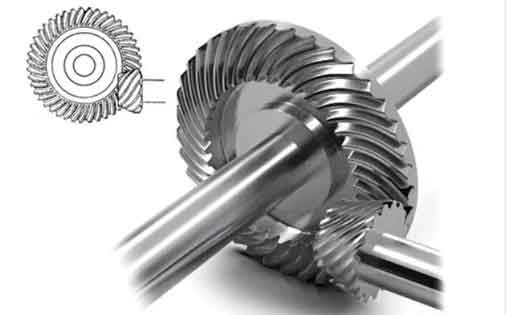
The fundamental mechanism behind windage loss in spiral bevel gears involves the rotation of the gear in a fluid medium, typically air or an oil-air mist. As the gear spins, it acts like a fan, drawing fluid into the gaps between adjacent teeth. This fluid is then accelerated and expelled, creating a pressure differential that results in a resisting torque on the gear. The power consumed to overcome this torque is the windage loss. For spiral bevel gears, the airflow entry is primarily from the small end and the tooth flank side, with expulsion occurring along the tooth length toward the large end. This characteristic flow pattern is key to designing effective mitigation techniques, such as baffles, which aim to block or redirect the fluid entry paths.
Previous studies have established empirical formulas to estimate windage loss for gears. One widely referenced model for spur gears, which can be adapted for spiral bevel gears, is given by:
$$Q = C_3 \left(1 + 4.6 \frac{F}{D}\right) n^{2.8} D^{4.6} (0.028\mu + C_4)^{0.2}$$
Here, \(Q\) represents the windage power loss, \(C_3\) and \(C_4\) are constants, \(F\) is the face width, \(D\) is the pitch diameter, \(n\) is the rotational speed, and \(\mu\) is the dynamic viscosity of the working fluid. This equation highlights that windage loss increases with face width, speed, diameter, and fluid viscosity. However, in practical design, these parameters are often constrained by strength, transmission requirements, and lubrication needs, leaving little room for direct optimization. Therefore, alternative methods, such as adding external baffles, become attractive for reducing windage loss without altering the fundamental gear geometry.
To conduct a detailed analysis, a specific spiral bevel gear from an aero-engine central drive system was selected as the case study. The key parameters of this spiral bevel gear are summarized in Table 1. These parameters define the baseline geometry used in all subsequent CFD simulations.
| Parameter | Value | Unit |
|---|---|---|
| Face Width (F) | 21 | mm |
| Large End Module | 3.875 | mm |
| Number of Teeth | 47 | – |
| Spiral Angle | 35 | ° |
| Hand of Spiral | Left | – |
The CFD simulation model was constructed to represent the gear rotating freely in air, neglecting the effects of the housing, mating gear, lubrication, and other ancillary components to isolate the windage phenomenon. The computational domain included a pressure inlet, a pressure outlet, and a stationary wall behind the gear. Periodicity was employed to reduce computational cost by modeling only a segment of the full gear. The gear was set to rotate counter-clockwise when viewed from the small end toward the large end. The mesh consisted of approximately 1 million cells, with refinement near critical surfaces such as the tooth flanks, web, and baffle locations. The turbulence was modeled using the standard \(k-\varepsilon\) model with Enhanced Wall Treatment to accurately capture near-wall flow characteristics at low \(y^+\) values. The fluid was treated as incompressible air, given the Mach number was below 0.3 for the considered speeds.
The core of this investigation revolves around four distinct baffle configurations, designated as Baffle 1, Baffle 2, Baffle 3, and Baffle 4. Their geometries and placements relative to the spiral bevel gear are described below:
- Baffle 1: A flat plate positioned parallel to and near the small end face and front web of the spiral bevel gear.
- Baffle 2: A curved or flat plate placed parallel to and near the tooth flank surface of the spiral bevel gear.
- Baffle 3: A combination of Baffles 1 and 2, covering both the small end and the tooth flank side.
- Baffle 4: An enclosing shroud that surrounds the small end, tooth flank, and large end of the spiral bevel gear, with surfaces parallel to the respective gear faces.
For each baffle type, the distance between the baffle and the gear surface was varied at 1 mm, 3 mm, and 5 mm to study its influence. Furthermore, simulations were performed at two different gear tooth tangential velocities: 50 m/s and 100 m/s, representing different operational speeds for spiral bevel gears in aero-engine applications.
The governing equations for the CFD simulations are the Navier-Stokes equations for incompressible flow. The continuity and momentum equations in tensor notation are:
$$\frac{\partial u_i}{\partial x_i} = 0$$
$$\rho \frac{\partial u_i}{\partial t} + \rho u_j \frac{\partial u_i}{\partial x_j} = -\frac{\partial p}{\partial x_i} + \mu \frac{\partial^2 u_i}{\partial x_j \partial x_j} + \rho f_i$$
where \(u_i\) represents the velocity components, \(p\) is pressure, \(\rho\) is density, \(\mu\) is dynamic viscosity, and \(f_i\) denotes body forces. For turbulent flow, the Reynolds-Averaged Navier-Stokes (RANS) approach was used with the \(k-\varepsilon\) model to close the system. The windage torque \(\tau\) and power loss \(P\) were calculated from the surface integrals of shear stress and pressure over the gear teeth and web:
$$\tau = \int_S (\vec{r} \times (\vec{\tau} \cdot \vec{n})) \, dS$$
$$P = \tau \cdot \omega$$
where \(\vec{r}\) is the position vector, \(\vec{\tau}\) is the stress tensor, \(\vec{n}\) is the unit normal vector, \(S\) is the gear surface area, and \(\omega\) is the angular velocity.
The simulation results for the baseline case (no baffle) provided a reference for comparison. The airflow pattern showed fluid being drawn into the tooth spaces from the small end and tooth flank, forming vortices and high-velocity regions as it was expelled radially outward. The calculated windage power loss at 50 m/s tangential velocity was used to normalize subsequent results. Table 2 summarizes the normalized windage power loss for each baffle configuration at different distances for the 50 m/s case.
| Baffle Type | Distance = 1 mm | Distance = 3 mm | Distance = 5 mm |
|---|---|---|---|
| No Baffle | 1.000 | 1.000 | 1.000 |
| Baffle 1 | 0.985 | 0.990 | 0.995 |
| Baffle 2 | 1.250 | 1.150 | 1.075 |
| Baffle 3 | 0.450 | 0.600 | 0.750 |
| Baffle 4 | 0.280 | 0.530 | 0.700 |
The data clearly indicates that Baffle 1 has a negligible effect, reducing loss by less than 2.5% regardless of distance. This is because it only blocks a minor airflow path from the small end, which is not the dominant contributor for spiral bevel gears. In contrast, Baffle 2 unexpectedly increases windage loss, with a 25% rise at 1 mm distance. This adverse effect occurs because while it restricts fluid entry from the flank, it also impedes the radial outflow of fluid, leading to increased fluid accumulation and higher velocities within the tooth spaces. The negative impact diminishes as the distance increases, highlighting the importance of clearance design when placing components near spiral bevel gears.
Baffles 3 and 4, however, demonstrate significant windage loss reduction. Baffle 3 combines the small end and flank coverage, achieving up to a 55% reduction at 1 mm distance. Baffle 4, the fully enclosing shroud, performs best, reducing loss by up to 72% at 1 mm distance. The effectiveness of both baffles decreases with increasing distance, as a larger gap allows more fluid to enter the gear region. The relationship between power loss reduction and baffle distance \(d\) can be approximated by an exponential decay function for these effective baffles:
$$P_{\text{norm}} = A e^{-Bd} + C$$
where \(A\), \(B\), and \(C\) are constants derived from curve fitting the simulation data. For instance, for Baffle 4 at 50 m/s, the fit yields values indicating that closer placement is crucial for maximizing benefit.
To understand the influence of operational speed, simulations were repeated at a gear tooth tangential velocity of 100 m/s. The absolute windage loss values were higher, scaling approximately with speed to the power of 2.8, consistent with the empirical formula. The relative trends, however, remained similar. Table 3 presents the normalized results for the 100 m/s case.
| Baffle Type | Distance = 1 mm | Distance = 3 mm | Distance = 5 mm |
|---|---|---|---|
| No Baffle | 1.000 | 1.000 | 1.000 |
| Baffle 1 | 0.990 | 0.992 | 0.996 |
| Baffle 2 | 1.230 | 1.140 | 1.065 |
| Baffle 3 | 0.400 | 0.550 | 0.720 |
| Baffle 4 | 0.250 | 0.480 | 0.680 |
At this higher speed, Baffle 4 achieves a 75% reduction in windage loss at 1 mm distance, slightly better than the 72% at 50 m/s. This suggests that the relative benefit of effective baffling may improve marginally with increasing speed for spiral bevel gears. The flow fields visualized from the simulations show that Baffles 3 and 4 drastically lower the velocity magnitudes within the tooth spaces and reduce the volume of entrained fluid, explaining the loss reduction. The persistent trend across speeds validates the robustness of the baffle design principle for spiral bevel gears operating under different conditions.
From an engineering application perspective, implementing baffles around spiral bevel gears in aero-engines requires a careful trade-off between performance gains and added complexity. Using the specific spiral bevel gear from this study as an example, the potential benefits can be quantified. At maximum engine speed without baffles, the estimated windage loss in air is approximately 1.516 kW. With an optimally designed Baffle 4 at 1 mm distance, this loss drops to about 0.351 kW, a reduction of 76.8%. Assuming an engine thermal efficiency of 38% and current aviation fuel prices, this saving translates to significant operational cost reductions over the lifespan of an aircraft fleet. For a small airline operating around 50 regional jets, annual fuel cost savings could exceed $80,000.
Furthermore, the reduction in windage loss directly decreases the heat generated within the gearbox. This, in turn, reduces the demand for cooling oil flow. Preliminary calculations indicate that the required lubricant circulation rate for the central drive gearbox could be lowered by approximately 20%, leading to a 5% reduction in the overall engine oil system flow. Consequently, components like oil tanks, heat exchangers, and coolers can be made smaller and lighter. The mass addition from adding aluminum baffles (estimated at 0.25 kg per engine) is likely offset by the downsizing of the lubrication system. Additionally, the reduced engine weight and drag contribute to further fuel savings, creating a compounding positive effect.
However, practical challenges must be addressed. Baffles are thin-walled structures susceptible to vibrations, thermal deformation, and pressure differentials during operation. To prevent contact with the high-speed spiral bevel gear, which would cause catastrophic failure, the baffle’s stiffness must be carefully designed, and clearances must account for all dynamic and thermal displacements. Finite element analysis (FEA) should be coupled with the CFD study to ensure structural integrity. Moreover, the installation of baffles adds assembly steps and requires precise alignment, potentially increasing manufacturing and maintenance costs. Therefore, a holistic lifecycle cost-benefit analysis is essential before adopting such modifications for spiral bevel gears in production engines.
Another consideration is the interaction between baffles and the lubrication system. In real engines, spiral bevel gears operate in an oil-mist environment. While this study focused on air to simplify the model, the presence of oil droplets can alter windage loss characteristics. The empirical formula includes viscosity \(\mu\), suggesting higher losses with oil. Baffles that are effective in air may also reduce oil churning losses, but they might also affect oil splash and distribution for gear tooth lubrication. Future work should involve multiphase CFD simulations to optimize baffle designs for both windage and lubrication performance in spiral bevel gear systems.
In summary, this simulation-based investigation demonstrates that windage loss in spiral bevel gears can be substantially reduced through the application of properly designed baffles. The key findings are:
- Baffles that enclose both the small end and tooth flank (Baffle 3) or fully shroud the gear (Baffle 4) are highly effective, achieving up to 75% reduction in windage loss for the studied spiral bevel gears.
- Baffles placed only near the small end (Baffle 1) have minimal impact, while those placed only near the tooth flank (Baffle 2) can increase loss by up to 25%, underscoring the need for comprehensive flow path blockage.
- The effectiveness of baffles is inversely related to their distance from the gear surface; smaller gaps yield greater loss reduction.
- The beneficial trends hold across different gear tooth tangential velocities (50 m/s and 100 m/s), indicating the robustness of the approach for high-speed spiral bevel gears.
- Engineering implementation requires balancing performance gains against added mass, complexity, and structural dynamics, but potential fuel savings and system downsizing offer compelling incentives.
This research provides a foundation for integrating aerodynamic optimization into the design of spiral bevel gear transmissions. By leveraging CFD tools, engineers can tailor baffle geometries to specific gear configurations, potentially achieving even greater efficiencies. As aero-engines continue to push the boundaries of performance, every fractional percentage gain in efficiency matters, making the reduction of windage loss in critical components like spiral bevel gears a valuable endeavor.
The mathematical modeling and simulation approach used here can be extended to other gear types and operating conditions. The core principle of controlling fluid ingress into tooth spaces is universal. Future studies could explore parametric optimization of baffle shapes using genetic algorithms or adjoint methods, further pushing the limits of loss reduction. Additionally, experimental validation on a dedicated test rig would be crucial to confirm the simulation predictions and refine the models for spiral bevel gears under real engine conditions. The continuous improvement in computational power and CFD fidelity will enable even more accurate analyses, driving innovation in the design of efficient and reliable spiral bevel gear systems for aviation and beyond.