
In this analysis, I will systematically explore the meshing efficiency of spiral gear drives, also commonly known as crossed helical gear drives or skew gear drives. These gears are used to transmit motion and power between two non-parallel, non-intersecting shafts. Unlike parallel-axis gears where power loss is primarily due to friction along the tooth profile height, a significant source of inefficiency in spiral gear drives is the sliding friction generated along the helix of the teeth due to their inherent relative sliding motion. This characteristic makes the efficiency analysis both critical and distinct. I will derive the fundamental efficiency equation, examine the conditions for positive efficiency and self-locking, and determine the optimal configuration for maximum efficiency. The analysis will culminate in specific formulas for the worm and worm wheel, a prominent special case of the spiral gear drive.
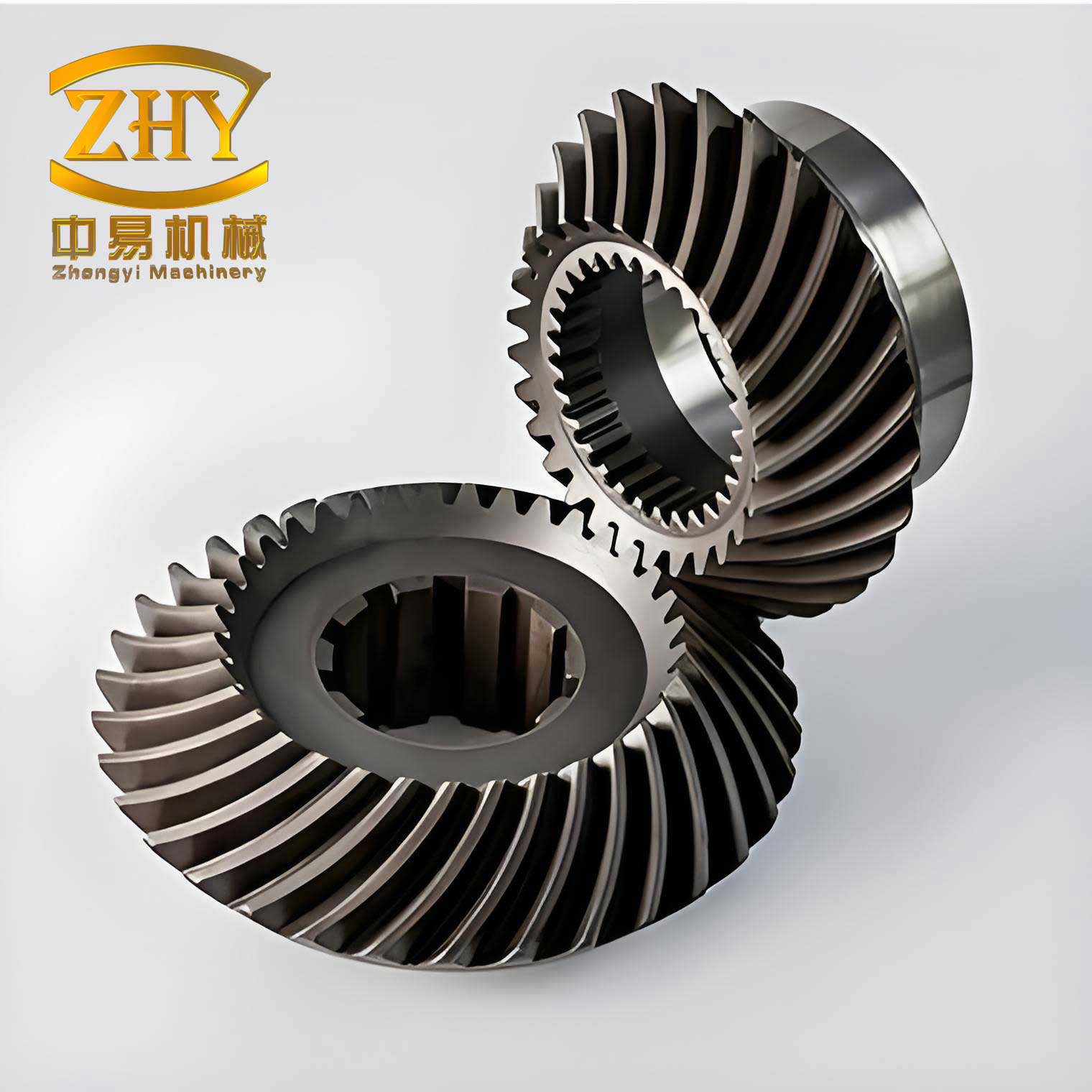
To begin, let’s establish the mechanical model. Consider a pair of meshing spiral gears. Gear 1 is the driving gear, and Gear 2 is the driven gear. The helix angles are denoted as $\beta_1$ and $\beta_2$, respectively. By convention, I will consider a right-hand helix as positive. The angle between the two shafts, $\Sigma$, is the sum of the helix angles if both gears have the same hand, or the absolute difference if they are opposite. For this general analysis, I will assume $\Sigma = \beta_1 + \beta_2$. Let $F_n^t$ be the tangential force component acting on the driving gear in its transverse plane. The normal force $F_n$ between the tooth surfaces is $F_n = F_n^t / \cos\alpha_n$, where $\alpha_n$ is the normal pressure angle. The sliding friction force along the tooth helix is $F_f = f F_n = f F_n^t / \cos\alpha_n$, where $f$ is the coefficient of sliding friction.
The kinematic relationship at the point of contact is crucial. The velocities involved are: $v_1$, the tangential velocity of the driving gear at the pitch point; $v_2$, the tangential velocity of the driven gear; and $v_{21}$, the relative sliding velocity of gear 2’s tooth surface relative to gear 1’s along the helix direction. Using the velocity polygon, the following relationship can be established:
$$ \frac{v_{21}}{\sin(\beta_1 + \beta_2)} = \frac{v_1}{\cos\beta_2} = \frac{v_2}{\cos\beta_1} $$
From this, the relative sliding speed is:
$$ v_{21} = v_1 \frac{\sin(\beta_1 + \beta_2)}{\cos\beta_2} $$
Now, I can proceed to derive the meshing efficiency. The input power from the driving gear (Gear 1) is the product of the tangential force component in the direction of $v_1$ and the velocity itself:
$$ P_{in} = (F_n^t \cos\beta_1) \cdot v_1 $$
The power loss due to friction is the product of the friction force and the sliding speed:
$$ P_{loss} = F_f \cdot |v_{21}| = \frac{f F_n^t}{\cos\alpha_n} \cdot \left| v_1 \frac{\sin(\beta_1 + \beta_2)}{\cos\beta_2} \right| $$
Therefore, the output power delivered to the driven gear is:
$$ P_{out} = P_{in} – P_{loss} = F_n^t \cos\beta_1 v_1 – \frac{f F_n^t}{\cos\alpha_n} \left| v_1 \frac{\sin(\beta_1 + \beta_2)}{\cos\beta_2} \right| $$
The meshing efficiency $\eta$ is defined as the ratio of output power to input power:
$$ \eta = \frac{P_{out}}{P_{in}} = \frac{ F_n^t \cos\beta_1 v_1 – \frac{f F_n^t}{\cos\alpha_n} \left| v_1 \frac{\sin(\beta_1 + \beta_2)}{\cos\beta_2} \right| }{ F_n^t \cos\beta_1 v_1 } $$
Simplifying this expression, I obtain the fundamental efficiency formula for a spiral gear drive:
$$ \eta = 1 – \frac{f}{\cos\alpha_n} \cdot \left| \frac{\sin(\beta_1 + \beta_2)}{\cos\beta_1 \cos\beta_2} \right| $$
This can be written in a more compact form by introducing the equivalent friction coefficient $f_v = f / \cos\alpha_n$, which accounts for the effect of the normal pressure angle on the frictional force component:
$$ \eta = 1 – f_v \left| \tan\beta_1 + \tan\beta_2 \right| \tag{1} $$
This elegant result clearly shows that the efficiency loss in a spiral gear drive is directly proportional to the sum of the tangents of the helix angles. A larger sum leads to greater relative sliding and thus higher frictional loss.
A highly important and common application of spiral gear theory is the worm drive, where the shaft angle $\Sigma = 90^\circ$. Substituting $\beta_1 + \beta_2 = 90^\circ$ (which implies $\beta_2 = 90^\circ – \beta_1$) into the general efficiency formula yields the worm gear meshing efficiency:
$$ \eta = 1 – f_v \left| \tan\beta_1 + \tan(90^\circ – \beta_1) \right| = 1 – f_v \left| \tan\beta_1 + \cot\beta_1 \right| $$
Using the trigonometric identity $\tan\beta_1 + \cot\beta_1 = \frac{2}{\sin(2\beta_1)}$, the formula simplifies to:
$$ \eta = 1 – \frac{2 f_v}{|\sin(2\beta_1)|} \tag{2} $$
This formula is valid regardless of which member is driving. For the condition of positive efficiency ($\eta > 0$), we require:
$$ \frac{2 f_v}{|\sin(2\beta_1)|} < 1 \quad \Rightarrow \quad |\sin(2\beta_1)| > 2 f_v $$
Thus, the helix angle must satisfy:
$$ |\beta_1| > \frac{1}{2} \sin^{-1} (2 f_v) \tag{3} $$
If this condition is not met, the efficiency becomes zero or negative, indicating self-locking—a state where the worm cannot be driven by the worm wheel. For typical values of $f_v \leq 0.1$, we can use the small-angle approximations $\sin(2f_v) \approx 2f_v$ and $\sin f_v \approx \tan f_v \approx f_v$. The self-locking condition then approximates to the well-known rule:
$$ |\beta_1| \lesssim \tan^{-1} f_v = \rho_v $$
where $\rho_v$ is the equivalent friction angle. To illustrate, the table below compares the precise self-locking angle from Equation (3) with the common approximation for various $f_v$ values.
| $f_v$ | $|\beta_1| > \frac{1}{2}\arcsin(2f_v)$ (degrees) | $|\beta_1| > \arctan(f_v)$ (degrees) | Relative Error (%) |
|---|---|---|---|
| 0.01 | 0.5730 | 0.5729 | 0.02 |
| 0.03 | 1.7199 | 1.7184 | 0.09 |
| 0.05 | 2.8696 | 2.8624 | 0.25 |
| 0.08 | 4.6035 | 4.5739 | 0.65 |
| 0.10 | 5.7685 | 5.7106 | 1.01 |
| 0.15 | 8.7288 | 8.5308 | 2.32 |
Furthermore, the efficiency calculated from Equation (2) aligns closely with the traditional formulas found in literature for worm-driving and wheel-driving scenarios. The following table demonstrates this consistency for a case where $\beta_1 = 10^\circ$ (worm wheel driving).
| $f_v$ | $\eta$ from Eq. (2) | Traditional Formula $\eta = \tan(\lambda – \rho_v)/\tan\lambda$ | Relative Error (%) |
|---|---|---|---|
| 0.02 | 0.8830 | 0.8835 | 0.06 |
| 0.05 | 0.7076 | 0.7102 | 0.37 |
| 0.08 | 0.5322 | 0.5387 | 1.21 |
| 0.10 | 0.4152 | 0.4254 | 2.40 |
Returning to the general spiral gear case, several key characteristics of the efficiency function warrant detailed analysis. First, for the drive to transmit power ($\eta > 0$), Equation (1) imposes the constraint:
$$ |\tan\beta_1 + \tan\beta_2| < \frac{1}{f_v} \tag{4} $$
This inequality defines a feasible region for the helix angles in the $\beta_1$-$\beta_2$ plane. For a given $\beta_1$, the permissible range for $\beta_2$ is:
$$ \tan^{-1}\left( -\frac{1}{f_v} – \tan\beta_1 \right) < \beta_2 < \tan^{-1}\left( \frac{1}{f_v} – \tan\beta_1 \right) \tag{5} $$
In practical design, we often require the efficiency to meet or exceed a specified minimum value $\eta_{min}$. This imposes a stricter condition than Equation (4):
$$ |\tan\beta_1 + \tan\beta_2| \le \frac{1 – \eta_{min}}{f_v} \tag{6} $$
Consequently, for a chosen $\beta_1$, the helix angle $\beta_2$ must lie within the range:
$$ \tan^{-1}\left( -\frac{1-\eta_{min}}{f_v} – \tan\beta_1 \right) \le \beta_2 \le \tan^{-1}\left( \frac{1-\eta_{min}}{f_v} – \tan\beta_1 \right) \tag{7} $$
Let’s consider a detailed application example to solidify this concept. Suppose we need to design a spiral gear set with a shaft angle $\Sigma = \beta_1 + \beta_2 = 50^\circ$. The equivalent friction coefficient is $f_v = 0.1$, and the required minimum efficiency is $\eta_{min} = 0.9$. The designer might propose several candidate pairs of $(\beta_1, \beta_2)$. For each proposed $\beta_1$, we can calculate the allowable range for $\beta_2$ using Equation (7) and check if the proposed $\beta_2 (=50^\circ – \beta_1)$ falls within it. The corresponding efficiency is calculated using Equation (1).
| Proposed $\beta_1$ (deg) | Implied $\beta_2$ (deg) | Allowable $\beta_2$ Range from Eq. (7) (deg) | Valid Design? | Efficiency $\eta$ from Eq. (1) |
|---|---|---|---|---|
| -30 | 80 | -22.9 to 57.6 | No | 0.4906 |
| -10 | 60 | -39.4 to 49.6 | No | 0.8444 |
| 0 | 50 | -45.0 to 45.0 | No | 0.8808 |
| 10 | 40 | -49.6 to 39.4 | No | 0.8985 |
| 20 | 30 | -53.7 to 32.4 | Yes | 0.9059 |
| 25 | 25 | -55.7 to 28.1 | Yes | 0.9067 |
| 30 | 20 | -57.6 to 22.9 | Yes | 0.9059 |
| 40 | 10 | -61.4 to 9.1 | No | 0.8985 |
This table clearly shows that only designs with $\beta_1$ between approximately $20^\circ$ and $30^\circ$ (and correspondingly $\beta_2$ between $30^\circ$ and $20^\circ$) satisfy the minimum 90% efficiency requirement. This analytical method provides a powerful tool for preliminary design selection.
Finally, I will investigate the optimal configuration for maximum efficiency in a spiral gear drive. Given a fixed shaft angle $\Sigma$, we can express $\beta_2 = \Sigma – \beta_1$ and substitute into the efficiency formula:
$$ \eta = 1 – f_v \left| \tan\beta_1 + \tan(\Sigma – \beta_1) \right| $$
To find the maximum, I treat the absolute value function by considering the case where the sum inside is positive (typical for standard drives). Taking the derivative with respect to $\beta_1$ and setting it to zero to find the critical point:
$$ \frac{d\eta}{d\beta_1} = -f_v \frac{d}{d\beta_1} \left( \tan\beta_1 + \tan(\Sigma – \beta_1) \right) = 0 $$
$$ \Rightarrow \frac{d}{d\beta_1}\left( \tan\beta_1 + \tan(\Sigma – \beta_1) \right) = \sec^2\beta_1 – \sec^2(\Sigma – \beta_1) = 0 $$
$$ \Rightarrow \sec^2\beta_1 = \sec^2(\Sigma – \beta_1) $$
Since $\sec^2\theta$ is always positive and monotonic in the intervals of interest, this equality implies:
$$ \beta_1 = \Sigma – \beta_1 \quad \Rightarrow \quad \beta_1 = \frac{\Sigma}{2} $$
Therefore, the maximum meshing efficiency for a given shaft angle $\Sigma$ is achieved when the helix angles are equal: $\beta_1 = \beta_2 = \Sigma/2$. Substituting this condition back into Equation (1) gives the expression for maximum efficiency:
$$ \eta_{max} = 1 – f_v \left| 2 \tan\left(\frac{\Sigma}{2}\right) \right| = 1 – 2 f_v \left| \tan\left(\frac{\Sigma}{2}\right) \right| \tag{8} $$
In the example above with $\Sigma = 50^\circ$ and $f_v=0.1$, the optimal configuration is indeed $\beta_1 = \beta_2 = 25^\circ$, yielding $\eta_{max} = 1 – 2 \times 0.1 \times |\tan 25^\circ| \approx 0.9067$, which matches the highest value found in the table.
In conclusion, this comprehensive analysis of spiral gear meshing efficiency has yielded several important results. The core efficiency equation $\eta = 1 – f_v |\tan\beta_1 + \tan\beta_2|$ provides a direct link between geometric parameters and power loss. For the special and critical case of worm gears, the formula simplifies to $\eta = 1 – 2f_v / |\sin(2\beta_1)|$, from which precise self-locking conditions can be derived. The analysis of efficiency constraints provides designers with clear mathematical tools, via inequalities and allowable angle ranges, to select helix angles that meet specific performance targets. Finally, the principle that maximum efficiency is attained when the helix angles are equal, i.e., $\beta_1 = \beta_2 = \Sigma/2$, offers a valuable guideline for optimizing the geometry of any spiral gear drive. Understanding these relationships is fundamental to the effective design and application of these unique and useful mechanical components.