
In my experience working on precision components for cinematic projection systems, the spiral gear stands out as a critical element that directly influences performance. These spiral gears are essential for transmitting motion and power within film projectors, and their accuracy is paramount to ensuring smooth operation, minimizing noise, and achieving stable sound reproduction. For years, our approach to manufacturing multi-start spiral gears, specifically seven-start variants, relied on conventional single-point turning methods. This process was not only time-consuming but also prone to significant errors, leading to inconsistent performance in the final assembly. The quest for higher precision and efficiency drove us to develop and implement a novel seven-cutter tooling system, which has transformed our production capabilities. This article delves into the principles, mathematical foundations, and practical outcomes of this advanced machining technique, emphasizing the central role of the spiral gear in modern mechanical systems.
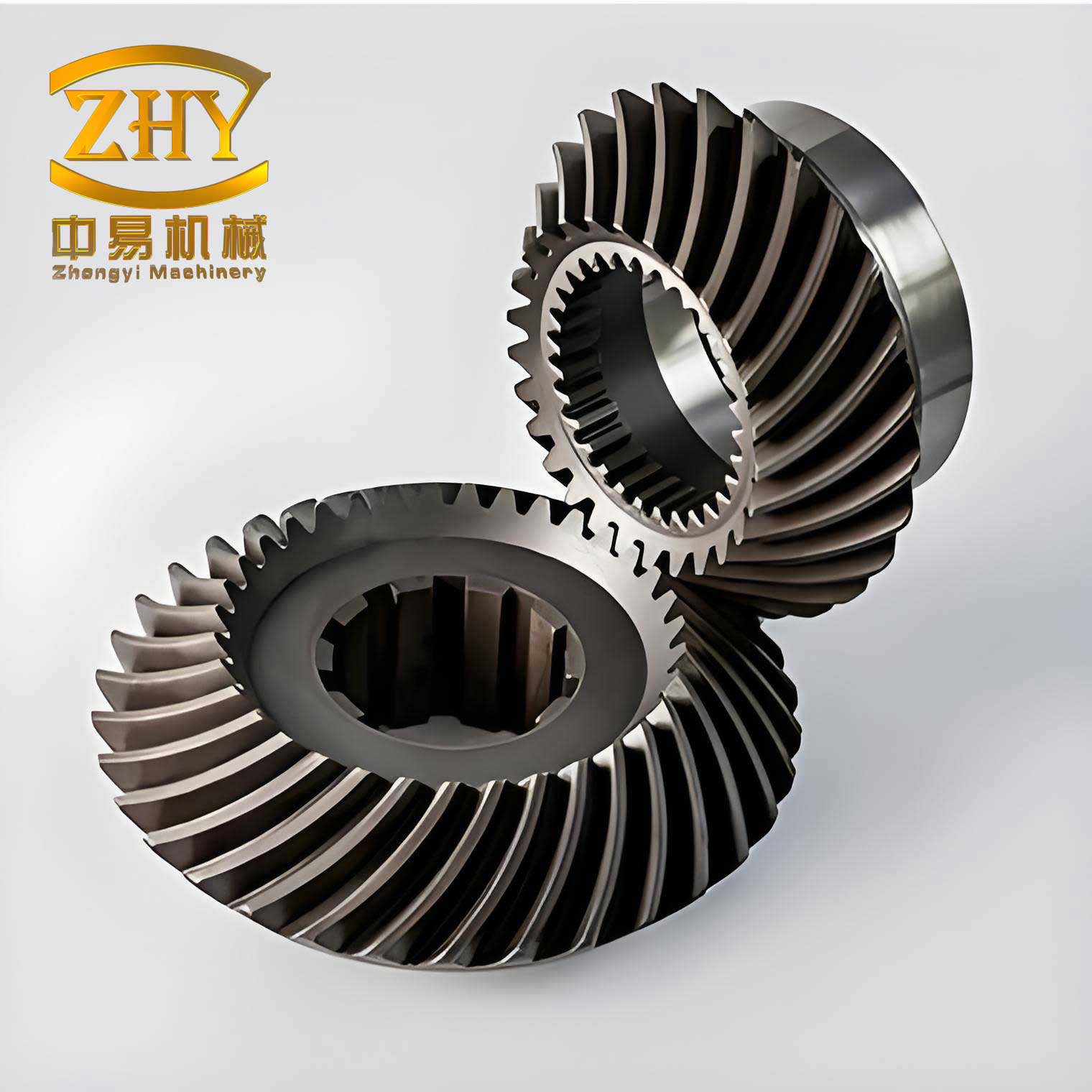
The fundamental operation of a spiral gear involves its helical teeth, which engage gradually to provide smooth and quiet power transmission. In projection equipment, any imperfection in the spiral gear can cause vibrations, audible mechanical noise, and fluctuations in audio quality, ultimately degrading the viewer’s experience. Therefore, enhancing the machining accuracy of spiral gears is not merely a technical improvement but a necessity for achieving superior device reliability. Initially, we employed a traditional lathe-based method where a single cutting tool was used to machine each tooth of the seven-start spiral gear sequentially. This required precise calculation of the gear’s lead—the axial distance traveled per complete revolution of the helix—and the installation of change gears to achieve the correct thread. Additionally, a seven-hole indexing plate mounted on the headstock was used to divide the gear blank for each start after completing one tooth. While theoretically sound, this method proved inefficient, with a production rate of only about ten pieces per shift, and more critically, it introduced substantial pitch errors. These errors often exceeded acceptable limits, leading to uneven transmission characterized by tight and loose engagements during operation.
To address these challenges, we focused on the root cause: the cumulative and individual pitch errors inherent in sequential machining. The pitch of a spiral gear, defined as the distance between corresponding points on adjacent teeth along the pitch circle, must be held to tight tolerances to ensure uniform motion. For a seven-start spiral gear, the cumulative pitch over seven teeth is equally critical. Our analysis revealed that the single-point method could result in pitch errors as high as 0.05 mm or more, with cumulative errors reaching even greater magnitudes. This prompted the development of a dedicated seven-cutter tooling block, or “刀排” as it was termed, which allows for simultaneous machining of all seven starts in a single pass. By integrating multiple cutters precisely spaced according to the theoretical pitch, this tooling system eliminates the need for indexing and significantly reduces human-induced errors. The cutters are made from high-speed steel (such as W18Cr4V, though specific material grades are generalized here), and the workpiece material is typically carbon steel, ensuring durability and fine finish. The implementation of this multi-cutter approach has dramatically improved accuracy, with pitch errors now controlled within 0.02 mm and cumulative errors within 0.05 mm, meeting or exceeding the required precision grade (e.g., Grade 7 per relevant standards). Surface finish achieved is consistently high, with radial runout minimized, leading to spiral gears that perform flawlessly in projection systems.
The mathematical foundation for machining spiral gears centers on the relationship between lead, pitch, and helix angle. For any spiral gear, the lead \( L \) is a function of the pitch diameter \( d \) and the helix angle \( \beta \), expressed as:
$$ L = \pi \cdot d \cdot \cot(\beta) $$
In the context of a multi-start spiral gear, the axial pitch \( P_a \)—the distance between adjacent teeth along the axis—is related to the lead by the number of starts \( N \). Specifically, for a gear with \( N \) starts, the lead is given by:
$$ L = N \cdot P_a $$
where \( P_a \) is the axial pitch. For our seven-start spiral gear, \( N = 7 \). The nominal axial pitch is often specified; for instance, from our data, the single-tooth pitch is 6.28 mm, and the seven-tooth cumulative pitch is 43.96 mm. The tolerances for these are ±0.02 mm and ±0.05 mm, respectively. To set up the lathe for machining, the change gears must be calculated to produce this lead accurately. The gear ratio \( i \) for the lead screw is derived from:
$$ i = \frac{L_{\text{gear}}}{L_{\text{screw}}} $$
where \( L_{\text{screw}} \) is the lead of the machine’s lead screw. By using high-precision change gears, we ensure that the tooling block moves axially at the correct rate relative to the workpiece rotation, thereby generating the precise helix. The cutter spacing in the seven-cutter block is set according to the axial pitch \( P_a \), which for our spiral gear is 6.28 mm. This spacing is machined to within tight tolerances, typically within 0.005 mm, to guarantee that each cutter engages the workpiece at the exact required position. The cumulative effect of these spacings must align with the seven-tooth pitch of 43.96 mm, ensuring that the spiral gear’s starts are evenly distributed around the circumference. Any deviation in cutter spacing directly translates to pitch errors, which we monitor using coordinate measuring machines and optical comparators.
The advantages of the multi-cutter tooling system are evident when comparing key performance indicators before and after its implementation. Below, Table 1 summarizes the typical errors and production metrics for the traditional single-point method versus the advanced seven-cutter method.
| Parameter | Traditional Single-Point Method | Seven-Cutter Tooling Method |
|---|---|---|
| Pitch Error (ΔP) | Up to 0.05 mm or more | ≤ 0.02 mm |
| Cumulative Pitch Error (ΔPcum) | Often > 0.05 mm | ≤ 0.05 mm |
| Production Rate (pieces per shift) | Approximately 10 | Over 100 |
| Surface Finish | Moderate, may require polishing | High, consistent finish |
| Radial Runout | Variable, often exceeding 0.03 mm | Controlled within 0.02 mm |
| Setup Time | Long, due to indexing and adjustments | Short, with minimal manual intervention |
As shown, the seven-cutter method reduces pitch errors by more than 50% and increases productivity tenfold, highlighting its transformative impact on spiral gear manufacturing. This improvement stems from the elimination of indexing errors and the inherent stability of the multi-cutter setup. Moreover, the spiral gears produced exhibit enhanced meshing characteristics, leading to quieter operation and longer service life in projection systems. The consistency achieved allows for tighter integration in assemblies, reducing the need for selective fitting and lowering overall production costs.
Delving deeper into the precision aspects, the pitch error ΔP is defined as the deviation between the actual measured pitch and the nominal pitch. For a spiral gear with nominal axial pitch \( P_{a,\text{nom}} = 6.28 \) mm, the error is calculated as:
$$ \Delta P = P_{a,\text{measured}} – P_{a,\text{nom}} $$
Similarly, the cumulative pitch error over \( N \) teeth (where \( N=7 \)) is given by:
$$ \Delta P_{\text{cum}} = \sum_{k=1}^{N} \Delta P_k $$
where \( \Delta P_k \) is the pitch error for the k-th tooth. In the seven-cutter system, the cutters are fixed relative to each other, so any systematic error in spacing affects all teeth equally, but random errors are minimized. We use statistical process control to monitor these errors, ensuring they remain within the specified limits. Table 2 provides a hypothetical dataset of pitch measurements for spiral gears machined with the seven-cutter tooling, illustrating the consistency achieved.
| Tooth Number | Nominal Pitch (mm) | Measured Pitch (mm) | Error ΔP (mm) |
|---|---|---|---|
| 1 | 6.28 | 6.281 | +0.001 |
| 2 | 6.28 | 6.279 | -0.001 |
| 3 | 6.28 | 6.280 | 0.000 |
| 4 | 6.28 | 6.282 | +0.002 |
| 5 | 6.28 | 6.278 | -0.002 |
| 6 | 6.28 | 6.281 | +0.001 |
| 7 | 6.28 | 6.279 | -0.001 |
| Cumulative | 43.96 | 43.960 | 0.000 |
This table demonstrates that individual pitch errors are tightly clustered around zero, and the cumulative error is negligible, ensuring the spiral gear meets the stringent requirements. The control of these errors is crucial because even minor deviations can lead to uneven loading and accelerated wear in the spiral gear assembly. Furthermore, the surface finish, often quantified as roughness average (Ra), is typically better than 0.8 μm, achieved through optimal cutting parameters such as speed, feed, and depth of cut. For high-speed steel cutters, we use cutting speeds in the range of 30-50 m/min and feeds of 0.05-0.1 mm/rev, which balance tool life and finish quality.
The design and fabrication of the seven-cutter tooling block itself are critical to success. The block must be rigid to withstand cutting forces without deflection, as any flexure would introduce errors in the spiral gear teeth. We construct it from hardened tool steel, with precisely ground slots to hold the individual cutters. The cutter spacing is set using gauge blocks and verified with a coordinate measuring machine. Each cutter is aligned to ensure its cutting edge lies on the same helical path defined by the gear’s lead. This alignment is checked using the following relationship for the helix angle \( \beta \):
$$ \tan(\beta) = \frac{\pi \cdot d}{L} $$
where \( d \) is the pitch diameter of the spiral gear. By adjusting the cutter positions until they conform to this angle, we guarantee that all seven starts are machined simultaneously and accurately. Additionally, the cutters are ground to the correct profile to generate the desired tooth form, which for spiral gears often involves an involute shape modified for helical engagement. This profile must be consistent across all cutters to avoid variations in tooth thickness, which could affect the spiral gear’s meshing with its mate.
In practice, the machining process begins with mounting the workpiece—a cylindrical blank of appropriate material—in the lathe chuck. The seven-cutter block is attached to the tool post, aligned with the workpiece axis. After setting the correct spindle speed and engaging the lead screw via the calculated change gears, the cut is made in a single pass, with the tooling block moving axially as the workpiece rotates. This simultaneous cutting action not only saves time but also ensures that all teeth are generated from the same reference, eliminating indexing errors. Coolant is applied to manage heat and improve surface finish. Post-machining, each spiral gear is inspected for pitch errors, cumulative pitch, radial runout, and surface quality. The use of automated inspection equipment has further enhanced our ability to maintain consistency across large production runs.
The impact on overall system performance is profound. Spiral gears machined with this method exhibit minimal backlash and uniform transmission torque, which in projection systems translates to stable film movement and clear sound reproduction. The reduction in noise is particularly noticeable; previously, spiral gears with high pitch errors caused audible rattling and vibration, but now the operation is virtually silent. This improvement aligns with industry trends toward quieter and more reliable mechanical systems. Moreover, the increased production rate allows us to meet higher demand without compromising quality, providing a competitive advantage in the market for precision spiral gear components.
Looking beyond immediate benefits, the principles of multi-cutter tooling can be extended to other types of spiral gears with different numbers of starts or helix angles. The key lies in accurately calculating the lead and cutter spacing for each configuration. For a spiral gear with \( N \) starts and axial pitch \( P_a \), the lead \( L \) is always \( N \cdot P_a \), and the cutter spacing in the tooling block must equal \( P_a \). This modular approach enables flexibility in production. We have successfully applied similar tooling for five-start and nine-start spiral gears, achieving comparable precision gains. The mathematical framework remains consistent, underscoring the versatility of the method.
To further illustrate the technical details, Table 3 summarizes the typical machining parameters and material specifications for producing high-precision spiral gears using the seven-cutter system.
| Aspect | Specification or Value |
|---|---|
| Workpiece Material | Medium Carbon Steel (e.g., AISI 1045) |
| Tool Material | High-Speed Steel (HSS) |
| Number of Starts (N) | 7 |
| Nominal Axial Pitch (Pa) | 6.28 mm |
| Nominal Lead (L) | 43.96 mm |
| Helix Angle (β) | Approximately 15° (varies with diameter) |
| Cutting Speed | 35 m/min |
| Feed Rate | 0.08 mm/rev |
| Depth of Cut | 0.5 mm per side |
| Coolant | Soluble oil emulsion |
| Target Pitch Error (ΔP) | ≤ 0.02 mm |
| Target Cumulative Error (ΔPcum) | ≤ 0.05 mm |
These parameters are optimized based on extensive testing to balance tool wear, surface finish, and dimensional accuracy for spiral gears. The helix angle β is derived from the pitch diameter d; for instance, if d is 50 mm, then β can be calculated as:
$$ \beta = \arctan\left(\frac{\pi \cdot d}{L}\right) = \arctan\left(\frac{\pi \cdot 50}{43.96}\right) \approx 15.2^\circ $$
This angle influences the cutting forces and must be considered in tool design. The multi-cutter block is angled to match β, ensuring that each cutter engages the workpiece correctly along the helical path. This attention to geometric detail is what sets this method apart from conventional approaches and enables the production of spiral gears with exceptional consistency.
In conclusion, the adoption of multi-cutter tooling for machining seven-start spiral gears has revolutionized our production process, yielding significant improvements in precision, efficiency, and final product performance. By eliminating the need for indexing and leveraging simultaneous cutting, we have reduced pitch errors to within 0.02 mm and cumulative errors to within 0.05 mm, while increasing output by an order of magnitude. The spiral gears produced now meet stringent accuracy standards, contributing to quieter and more reliable projection systems. This methodology is grounded in sound mathematical principles, from lead calculation to error analysis, and is supported by rigorous process controls. As demand for high-quality spiral gears grows in various mechanical applications, techniques like this will continue to play a vital role in advancing manufacturing capabilities. The spiral gear, once a source of operational challenges, has become a testament to innovation in precision engineering.
The success of this project underscores the importance of continuous improvement in manufacturing. By focusing on the fundamental parameters of the spiral gear—such as pitch, lead, and helix angle—and developing tailored tooling solutions, we can overcome historical limitations. Future work may involve integrating CNC technology for even greater flexibility or exploring new materials for cutters to further enhance tool life. Regardless, the core lesson remains: precision machining of spiral gears is achievable through careful design, mathematical rigor, and a commitment to quality. I am confident that these advancements will benefit not only our own operations but also the broader industry seeking reliable spiral gear components for critical applications.