
In my extensive experience in manufacturing and mechanical design, I have often encountered complex challenges that require innovative solutions. One such area is the application of advanced Computer-Aided Manufacturing (CAM) techniques for machining intricate components, particularly in mold and die production. Another critical aspect involves the design and analysis of spiral gears, which are essential in power transmission systems with non-parallel shafts. This article delves into both domains, offering a comprehensive guide to special toolpaths in CAM software and the geometric intricacies of spiral gears. Throughout, I will emphasize the importance of spiral gears in modern engineering, and I will use tables and formulas to summarize key concepts. The goal is to provide a deep understanding that can be applied in practical scenarios.
CAD/CAM software, such as UG NX, is renowned for its powerful capabilities in generating efficient machining toolpaths. However, its complexity can be daunting for newcomers. Through careful parameter adjustments, one can unlock special toolpaths that enhance productivity and precision. Similarly, in gear design, spiral gears—specifically those with a 90-degree shaft angle—present unique calculation challenges. By analogizing them to gear-and-rack pairs, we can simplify their design process. I will explore these topics in detail, starting with CAM techniques and then moving to spiral gears. Along the way, I will incorporate mathematical formulations and comparative tables to solidify the concepts.
Let me begin with the CAM aspects. In mold manufacturing, machining features like cooling channels or flow paths on curved surfaces demands specialized toolpaths. Two particularly useful methods are the modified “Surface Region” and “Area Milling” operations. These toolpaths optimize cutting efficiency and reduce non-productive time, which is crucial for high-speed machining applications.
Special “Surface Region” Machining Toolpath
This toolpath is ideal for roughing operations on complex geometries, such as injection mold flow channels. By tweaking the CAM operation parameters, one can generate a toolpath that cuts with uniform depth increments without retractions. The key steps are: first, avoid selecting the actual part as the “geometry”; instead, create an auxiliary surface to serve as the “drive geometry.” Second, set the “tool position” to “on” relative to the drive surface. Third, configure the cutting pattern to “parallel lines” with a “zig-zag” cutting type. Finally, define non-cutting moves with linear approach and retract motions. This approach ensures smooth, continuous cutting, which is perfect for ball-nose tools machining 3D curved paths. However, it requires extra time to prepare the auxiliary surface.
To illustrate the parameters, consider the following table summarizing the settings for this toolpath:
| Parameter | Value | Description |
|---|---|---|
| Drive Geometry | Auxiliary Surface | Used instead of the part body |
| Tool Position | On | Tool center on drive surface |
| Cutting Pattern | Parallel Lines | Linear toolpath pattern |
| Cutting Type | Zig-Zag | Alternating direction cuts |
| Non-Cutting Moves | Linear | Simple approach and retract |
The effectiveness of this toolpath can be quantified using formulas related to cutting forces and material removal rates. For instance, the material removal rate (MRR) for a ball-nose tool in such a path can be approximated by:
$$MRR = a_p \times a_e \times v_f$$
where \(a_p\) is the axial depth of cut, \(a_e\) is the radial engagement, and \(v_f\) is the feed rate. By optimizing these parameters, one can achieve efficient machining while minimizing tool wear.
Special “Area Milling” Machining Toolpath
Another valuable toolpath is derived from the “Area Milling” operation, modified for semi-finishing or finishing tasks on features like semi-circular or U-shaped grooves. This toolpath produces a spiral-like, pipe-cutting motion that is smooth and suitable for high-speed machining. The programming essentials include: setting the cutting pattern to “parallel lines” with a “zig” cutting type, and adjusting the “cutting angle” to align with the feature. Additionally, in the non-cutting parameters, set the “transfer” motion to “smooth,” and enable the “remove edge tracking” option in the cutting parameters. This configuration reduces sharp directional changes, promoting tool longevity and surface quality.
Here is a table contrasting the two special toolpaths:
| Aspect | Surface Region Toolpath | Area Milling Toolpath |
|---|---|---|
| Primary Use | Roughing on 3D curves | Semi-finishing on grooves |
| Toolpath Pattern | Parallel zig-zag | Parallel zig with smooth transfers |
| Tool Type | Ball-nose end mill | Flat or ball-nose end mill |
| Advantage | Uniform depth, no retractions | Smooth, high-speed compatible |
| Disadvantage | Requires auxiliary surface | Limited to simpler geometries |
The feed rate for high-speed machining can be derived from the spindle speed and chip load:
$$v_f = n \times z \times f_z$$
where \(n\) is the spindle speed in RPM, \(z\) is the number of teeth on the tool, and \(f_z\) is the feed per tooth. Proper selection of these parameters is critical for achieving the desired surface finish and tool life.
Transitioning to gear design, spiral gears are a fascinating subject. Spiral gears, also known as crossed helical gears, are used to transmit motion between non-parallel, non-intersecting shafts. When the shaft angle is 90 degrees, the system resembles a worm gear pair, but with different geometric considerations. In my work, I frequently design spiral gears for automotive and industrial applications, where precise tooth form is essential for performance and noise reduction.
Spiral gears with a 90-degree shaft angle involve calculations similar to those for helical gears, but with separate parameters for each gear due to differences in helix angles and tooth numbers. The small gear in such a pair often resembles a multi-start worm, machined on a CNC lathe, requiring accurate tooth profile data. The key insight is that in the plane containing the small gear’s axis and perpendicular to the large gear’s axis, the small gear acts like a rack, and the large gear like an involute gear. Thus, the meshing can be analyzed as a gear-and-rack pair, simplifying the design process.
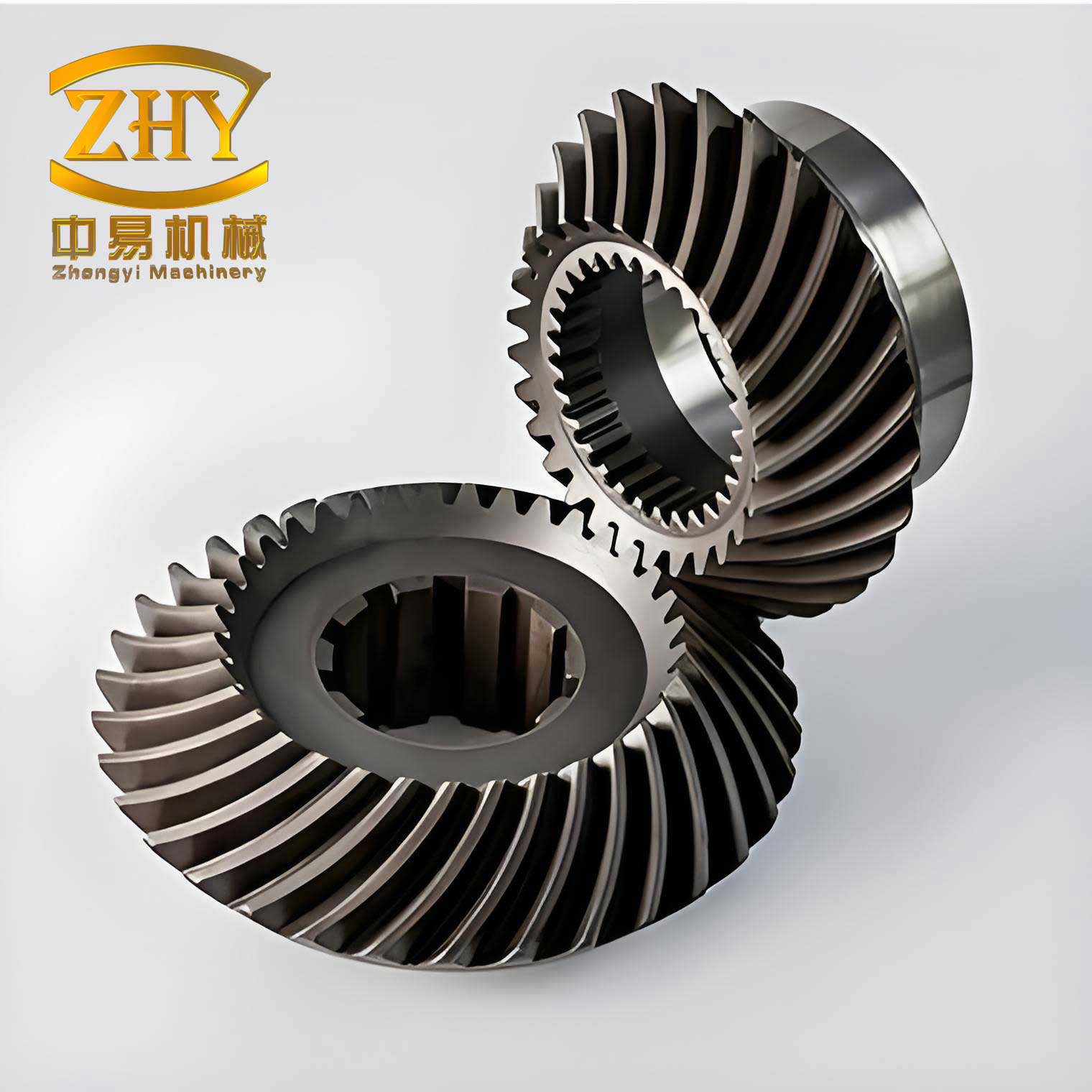
This analogy is crucial for understanding spiral gears. For the large gear, the parameters are defined in the transverse plane, while for the small gear, axial parameters are derived. The fundamental equations for spiral gears stem from helical gear theory. Let me outline the essential formulas and parameters.
First, consider the basic geometric relationships for a pair of spiral gears. The shaft angle \(\Sigma\) is the sum of the helix angles of the two gears:
$$\Sigma = \beta_1 + \beta_2$$
For a 90-degree shaft angle, \(\Sigma = 90^\circ\), so \(\beta_1 + \beta_2 = 90^\circ\). Here, \(\beta_1\) and \(\beta_2\) are the helix angles of the small and large gears, respectively. The helix angles are related to the axial pitch and transverse pitch.
The transverse module \(m_t\) is standard for the gear pair, but the axial module \(m_x\) differs for each gear. The axial pitch \(p_x\) of the small gear (like a rack) is given by:
$$p_x = \pi m_x$$
where \(m_x\) is the axial module. For the large gear, the transverse pitch is \(p_t = \pi m_t\). The relationship between axial and transverse modules involves the helix angle:
$$m_x = \frac{m_t}{\cos \beta}$$
Thus, for the small gear with helix angle \(\beta_1\), the axial module is \(m_{x1} = m_t / \cos \beta_1\), and for the large gear, \(m_{x2} = m_t / \cos \beta_2\). Since the shaft angle is 90 degrees, we have \(\beta_2 = 90^\circ – \beta_1\).
The tooth form of the small gear can be drawn using rack parameters. The pressure angle in the transverse plane \(\alpha_t\) is related to the normal pressure angle \(\alpha_n\) by:
$$\tan \alpha_t = \frac{\tan \alpha_n}{\cos \beta}$$
For the large gear, the transverse pressure angle is used, while for the small gear (rack), the axial pressure angle equals the transverse pressure angle of the large gear. This consistency ensures proper meshing.
To compute the diameters of the small gear, we use helical gear formulas. The pitch diameter \(d\) is:
$$d = \frac{m_t z}{\cos \beta}$$
where \(z\) is the number of teeth. For the small gear, often a multi-start worm, the number of starts \(N\) replaces \(z\). Thus, the pitch diameter of the small gear is:
$$d_1 = \frac{m_t N}{\cos \beta_1}$$
The addendum diameter \(d_a\) and dedendum diameter \(d_f\) are calculated by adding or subtracting the addendum and dedendum heights, which depend on the module. Typically, the addendum height is \(1 \times m_n\) (normal module), and the dedendum height is \(1.25 \times m_n\). The normal module \(m_n = m_t \cos \beta\). Therefore, for the small gear:
$$d_{a1} = d_1 + 2 m_n$$
$$d_{f1} = d_1 – 2.5 m_n$$
These dimensions allow for precise modeling of the small gear’s tooth profile. Below is a table summarizing key parameters for a 90-degree shaft angle spiral gear pair:
| Parameter | Small Gear (Worm-like) | Large Gear (Gear) |
|---|---|---|
| Helix Angle | \(\beta_1\) | \(\beta_2 = 90^\circ – \beta_1\) |
| Number of Teeth/Starts | \(N\) (starts) | \(z_2\) |
| Transverse Module | \(m_t\) (common) | \(m_t\) |
| Axial Module | \(m_{x1} = m_t / \cos \beta_1\) | \(m_{x2} = m_t / \cos \beta_2\) |
| Pitch Diameter | \(d_1 = m_t N / \cos \beta_1\) | \(d_2 = m_t z_2 / \cos \beta_2\) |
| Axial Pitch | \(p_{x1} = \pi m_{x1}\) | \(p_{x2} = \pi m_{x2}\) |
| Pressure Angle (Transverse) | \(\alpha_t\) (from \(\alpha_n\)) | \(\alpha_t\) |
In practice, designing spiral gears requires iterative calculations to balance strength, wear, and efficiency. The contact ratio for spiral gears is influenced by the overlap of teeth due to helix angles. The total contact ratio \(C_r\) is the sum of the transverse contact ratio \(C_{rt}\) and the axial contact ratio \(C_{ra}\):
$$C_r = C_{rt} + C_{ra}$$
where \(C_{rt}\) depends on the tooth profiles and \(C_{ra}\) is related to the helix angle and face width. For spiral gears, a higher contact ratio often leads to smoother operation, which is why spiral gears are preferred in noise-sensitive applications.
Another critical aspect is the lubrication and thermal analysis of spiral gears. Due to sliding contact, spiral gears can generate significant heat, requiring proper oil selection and cooling. The sliding velocity \(v_s\) between meshing teeth is:
$$v_s = v_1 \sin \beta_1 + v_2 \sin \beta_2$$
where \(v_1\) and \(v_2\) are the pitch line velocities. This sliding contributes to wear, so material selection—such as bronze for the small gear and hardened steel for the large gear—is common.
My approach to spiral gear design often involves simulation software to validate tooth contact patterns and load distribution. However, the foundational formulas remain essential. For instance, the center distance \(a\) between the two shafts is:
$$a = \frac{d_1 + d_2}{2}$$
This must be adjusted for backlash and manufacturing tolerances. In production, the small gear is typically machined on a CNC lathe with a tool shaped to the rack profile. The tool geometry is derived from the axial tooth dimensions, emphasizing the importance of accurate calculations.
To further explore spiral gears, consider the dynamics of their operation. Spiral gears transmit torque with a velocity ratio determined by the number of starts and teeth:
$$i = \frac{z_2}{N}$$
This ratio is fixed, but efficiency \(\eta\) depends on friction and helix angles. An approximate formula for efficiency is:
$$\eta = \frac{\cos \alpha_n – \mu \tan \beta}{\cos \alpha_n + \mu \cot \beta}$$
where \(\mu\) is the coefficient of friction. For spiral gears with a 90-degree shaft angle, optimizing \(\beta_1\) can enhance efficiency.
In the context of CAM, machining spiral gears requires specialized toolpaths. For example, the small gear’s helical teeth might be milled using 5-axis CNC machines with custom toolpaths that follow the helix. The special “Area Milling” toolpath discussed earlier can be adapted for finishing gear teeth by setting the cutting angle to match the helix angle. This highlights the synergy between advanced CAM techniques and mechanical design.
Throughout this discussion, I have emphasized spiral gears because they are pivotal in many mechanical systems, from automotive differentials to industrial mixers. Their ability to transmit power between crossed shafts with high efficiency and low noise makes them invaluable. By mastering both CAM toolpaths and spiral gear design, engineers can tackle complex manufacturing challenges effectively.
To summarize, I have detailed two special CAM toolpaths for mold machining and extensively covered the geometry of spiral gears with 90-degree shaft angles. The tables and formulas provided should serve as a reference for practical applications. As I reflect on my experiences, I realize that continuous learning and parameter experimentation are key to unlocking the full potential of software and theoretical principles. Whether optimizing a toolpath for a mold flow channel or calculating the tooth profile of a spiral gear, attention to detail and a deep understanding of underlying mechanics are essential.
In conclusion, the integration of advanced CAM techniques and precise gear design enables the production of high-quality components. Spiral gears, with their unique characteristics, offer solutions for complex motion transmission. I encourage engineers to explore further modifications in CAM operations and to delve into the analytical aspects of spiral gears. By doing so, we can push the boundaries of manufacturing and design, achieving greater efficiency and innovation in the industry.