
In modern aero-engine transmission systems, high-speed, lightweight, and high-power-density gears are extensively employed. Among these, spiral bevel gears are critical components due to their ability to transmit power between non-parallel shafts. However, the pursuit of lightweight design often leads to increased flexibility and reduced natural frequencies, making bevel gear systems prone to resonance within the operational speed range, particularly for diameter-mode vibrations. To mitigate such vibrations, damping rings have emerged as a practical, effective, and stable solution for enhancing system damping. This article presents a comprehensive approach to the design, analysis, and experimental validation of damping rings for an aero-engine spiral bevel gear system, aiming to reduce resonance amplitudes during operation.
The study begins with a detailed modal analysis of the bevel gear system, considering gear contact effects to accurately predict dangerous vibration modes and corresponding resonance speeds. Following this, a damping ring is designed based on friction energy dissipation principles, and its vibration reduction performance is theoretically evaluated. Finally, experimental tests are conducted to verify the effectiveness of the damping ring. Throughout this work, the term ‘bevel gear’ is emphasized to underscore its centrality in the analysis.
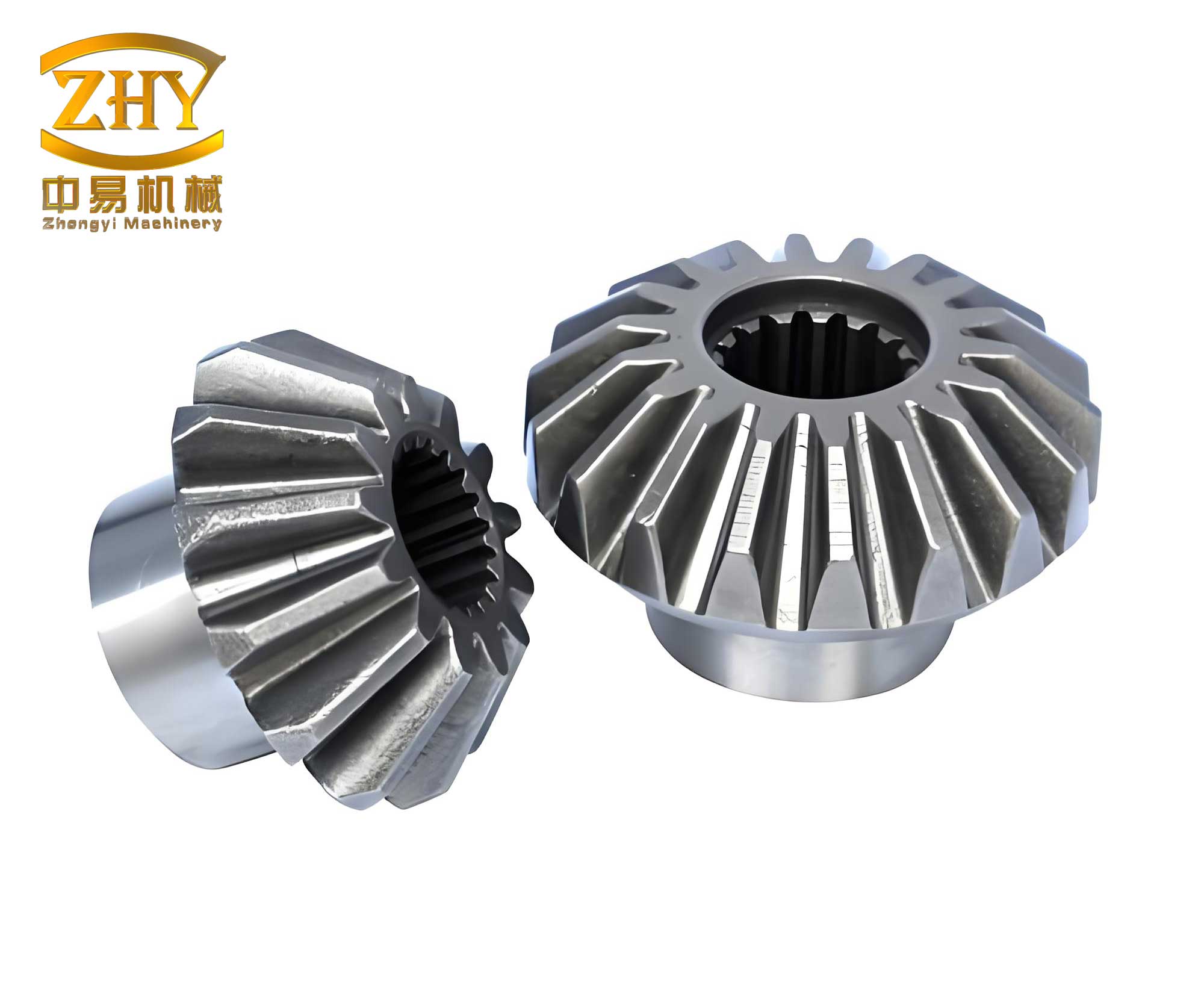
Modal analysis is crucial for understanding the dynamic behavior of the bevel gear system. Since the gear pair remains in constant mesh during operation, contact modal analysis is performed to account for interaction effects. The system includes a spiral bevel gear pair, gear shafts, and bearings, with support stiffness representing the housing. Key design parameters for the bevel gear pair are summarized in Table 1.
| Parameter | Pinion (Driven Gear) | Gear (Driving Gear) |
|---|---|---|
| Number of Teeth | 43 | 47 |
| Module (mm) | 3.75 | 3.75 |
| Midpoint Spiral Angle (°) | 35 | 35 |
| Normal Pressure Angle (°) | 20 | 20 |
| Shaft Angle (°) | 78.3 | 78.3 |
| Hand of Spiral | Right | Left |
The finite element model incorporates contact connections between the bevel gear teeth and applies bearing support stiffness. Extracted diameter-mode natural frequencies are listed in Table 2, with corresponding mode shapes showing coupled vibrations between the pinion and gear. For instance, modes often exhibit pinion diameter modes coupled with local gear modes, necessitating focus on pinion resonance speeds.
| Mode Type | Frequency (Hz) |
|---|---|
| 2 Diameter (2D) | 2617.3, 2754.8 |
| 3 Diameter (3D) | 5190.4, 5715.4, 6553.9, 7934.8 |
| 4 Diameter (4D) | 9083.9, 11346 |
Resonance speed prediction must consider traveling wave characteristics. For a bevel gear system, resonance occurs when the excitation frequency matches the forward or backward traveling wave frequency. The excitation frequency \( f_e \) is given by:
$$ f_e = \frac{n}{60} z_1 $$
where \( n \) is the rotational speed in rpm, and \( z_1 \) is the number of teeth of the driving gear. The resonance condition leads to:
$$ n = \frac{60 f_d}{z_1 / z_2 (z_2 \mp m)} $$
Here, \( f_d \) is the natural frequency, \( z_2 \) is the number of teeth of the driven gear, and \( m \) is the number of diameters (e.g., m=3 for 3-diameter mode). The minus sign corresponds to forward traveling waves, and the plus sign to backward traveling waves. Using this formula, predicted resonance speeds for the bevel gear system are calculated and shown in Table 3.
| Mode Type | Natural Frequency (Hz) | Pinion Resonance Speed (rpm) – Forward/Backward | Gear Resonance Speed (rpm) – Forward/Backward |
|---|---|---|---|
| 2D | 2617.3 | 3193, 3504 | – |
| 2D | 2754.8 | 4580, 5027 | – |
| 3D | 5190.4 | 6194, 7123 | – |
| 3D | 5715.4 | 6820, 7843 | – |
| 3D | 6553.9 | 7821, 8994 | – |
| 3D | 7934.8 | 9469, 10889 | – |
| 3D-4D Coupled | 9083.9 | 10610, 12786 | 10901, 12387 |
| 4D | 11346 | 13252, 15970 | – |
Experimental tests were conducted on the bevel gear system without damping rings to validate the predictions. Vibration responses were measured using accelerometers on the housing during speed sweeps under different torque loads. Results indicated resonance speeds aligned with predicted diameter-mode vibrations, particularly for pinion 3-diameter and 4-diameter modes. The comparison between predicted and measured resonance speeds is summarized in Table 4, showing reasonable agreement and confirming the need for vibration reduction in these modes.
| Torque (N·m) | Measured Resonance Speed (rpm) | Predicted Resonance Speed (rpm) | Corresponding Mode | Relative Error (%) |
|---|---|---|---|---|
| 80 | 8640 | 8994 | 3D | 4.10 |
| 80 | 12200 | 12786 | 3D-4D | 4.80 |
| 80 | 14680 | 15970 | 4D | 8.79 |
| 120 | 8604 | 8994 | 3D | 4.53 |
| 120 | 12200 | 12786 | 3D-4D | 4.80 |
| 120 | 14880 | 15970 | 4D | 7.33 |
Given that resonance primarily involves the pinion, a damping ring is designed for installation on the pinion’s small end. The damping ring features a C-shaped opening with a rectangular cross-section, as detailed in Table 5. Key parameters include width, thickness, and geometry to fit within the bevel gear assembly constraints.
| Parameter | Value |
|---|---|
| Width (K) mm | 4.4 |
| Thickness (L) mm | 3.6 |
| Fillet Radius (R) mm | 0.7 |
| Chamfer (M) mm | 0.9 |
| Shoulder Diameter mm | 109.6 |
| Groove Diameter mm | 114.2 |
| Opening Width mm | 3.0 |
The vibration reduction mechanism of the damping ring relies on friction energy dissipation. During resonance, relative motion between the damping ring and the gear groove generates friction, converting kinetic energy into heat. The effectiveness is evaluated using the resonance amplitude coefficient Q, defined as the ratio of energy stored per cycle to energy dissipated per cycle:
$$ Q = \frac{2\pi E_s}{E_d} = \frac{1}{2\pi\xi} = \frac{\pi}{\delta} $$
where \( E_s \) is the stored energy from meshing and centrifugal forces, \( E_d \) is the dissipated energy from friction, \( \xi \) is the damping ratio, and \( \delta \) is the logarithmic decrement. Lower Q values indicate higher damping and better vibration reduction.
For the bevel gear system, modal displacements at the damping groove are critical. Table 6 lists the radial and axial modal displacements for the pinion’s 3-diameter and 4-diameter modes, along with the neutral axis radius, which are used in subsequent analysis.
| Mode Type | Radial Modal Displacement (mm) | Axial Modal Displacement (mm) | Neutral Axis Radius (mm) |
|---|---|---|---|
| 3D | 15.24 | 26.23 | 60 |
| 4D | 22.05 | 29.79 | 60 |
The radial vibration displacement \( d_{ra} \) is related to the axial vibration displacement \( d_{ax} \) by:
$$ d_{ra} = d_{ax} \frac{B_{fe\_ra}}{B_{fe\_ax}} $$
where \( B_{fe\_ax} \) and \( B_{fe\_ra} \) are the maximum axial and radial modal displacements at the damping groove, respectively. The contact force \( F_c \) on the damping ring due to centrifugal effects is:
$$ F_c = \rho A R \omega^2 $$
Here, \( \rho \) is the material density, \( A \) is the cross-sectional area, \( R \) is the centroid radius of the damping ring, and \( \omega \) is the angular velocity in rad/s. The initial radial vibration displacement required to overcome static friction and initiate sliding is:
$$ B_{i\_ra} = \frac{\mu F_c R^3}{n A E c} \frac{1}{\left[ \left( \frac{c_0}{c} \right) \left( \frac{R}{R_0} \right)^2 + 1 \right] (n^2 – 1)} $$
where \( \mu \) is the friction coefficient, \( E \) is the elastic modulus, \( c_0 = R_0 – R_g \), \( c = R_g – R \), \( R_0 \) is the neutral axis radius, \( R_g \) is the groove bottom radius, and \( n \) is a geometric factor. The pressure \( P_P \) at displacement \( B_{i\_ra}(j) \) is:
$$ P_P(j) = \frac{B_{i\_ra}(j) n A E c}{\mu R^3 \left[ \frac{c_0}{c} \left( \frac{R}{R_0} \right)^2 + 1 \right] (n^2 – 1)} $$
The corresponding angle \( \theta(j) \) is:
$$ \theta(j) = \arcsin \frac{F_c}{P_P(j)} $$
The optimal dissipated energy \( D_0(j) \) is:
$$ D_0(j) = 1.7915 \frac{f}{n^2} \frac{\mu^2 P_P^2(j) R^3}{E A} $$
with \( f \) being the natural frequency. The radial dissipated energy \( D_{ra}(j) \) becomes:
$$ D_{ra}(j) = \left| D_0(j) \frac{1}{0.11197} \left[ \frac{F_c}{P_P(j)} \right]^2 \left( -\frac{R_g}{R} \right) \left\{ \frac{1}{\tan[\theta(j)]} + \theta(j) – \frac{\pi}{2} \right\} + \frac{1}{3} \left[ \frac{\pi}{2} – \theta(j) \right]^3 \right| $$
The radial Q-value is then:
$$ Q_{RA}(j) = \frac{2\pi f K_e(j)}{D_{ra}(j)} $$
where \( K_e(j) = \frac{1}{2} (2\pi f)^2 \left[ \frac{B_{i\_ax}(j)}{B_{fe\_ax}} \right]^2 \). Similarly, for axial vibration, the dissipated energy \( D_{ax}(j) \) is:
$$ D_{ax}(j) = 2\pi^2 R_g B_{i\_ax}(j) \mu F_c \sqrt{1 – \frac{\pi^2}{4} \left[ \frac{\mu R \omega^2}{B_{i\_ax}(j) (2\pi f)^2} \right]^2} $$
and the axial Q-value is:
$$ Q_{AX}(j) = \text{real} \left[ \frac{2\pi K_e}{D_{ax}(j)} \right] $$
Using these equations, Q-values versus vibration displacements are plotted for the 3-diameter and 4-diameter modes. Assuming initial axial resonance displacements of 0.035 mm for 3D and 0.03 mm for 4D, analysis shows that after installing the damping ring, the Q-value for 3D axial displacement drops from 690 to 107.7 (84% reduction), and axial displacement decreases from 0.035 mm to 0.0032 mm (91% reduction). For 4D, the Q-value reduces from 436 to 83.5 (81% reduction), and axial displacement from 0.03 mm to 0.0032 mm (89% reduction). This indicates significant vibration reduction and increased damping in the bevel gear system.
To validate the theoretical analysis, experimental tests were performed on the bevel gear system with and without the damping ring. Vibration acceleration was measured on the housing under torque loads of 80 N·m and 120 N·m during speed sweeps. Results with the damping ring showed resonance speed shifts up to 3.75% and notable amplitude reductions, especially at higher loads. Table 7 summarizes the comparison of vibration amplitudes at key resonance speeds.
| Torque (N·m) | Resonance Speed (rpm) – No Ring | Vibration Amplitude (g) – No Ring | Resonance Speed (rpm) – With Ring | Vibration Amplitude (g) – With Ring | Speed Shift (%) | Amplitude Reduction (%) |
|---|---|---|---|---|---|---|
| 80 | 8640 | 96.34 | 8568 | 121.9 | -0.83 | -26.53 |
| 80 | 12200 | 84.81 | 12250 | 37.91 | 0.41 | 55.30 |
| 80 | 14680 | 62.95 | 15230 | 67.05 | 3.75 | -6.51 |
| 120 | 8604 | 116.7 | 8496 | 112 | -1.26 | 4.03 |
| 120 | 12200 | 90.88 | 12270 | 41.67 | 0.57 | 54.15 |
| 120 | 14880 | 99.87 | 14880 | 52.64 | 0.00 | 47.29 |
The experimental data reveal that the damping ring effectively reduces vibration amplitudes by approximately 50% for coupled modes like 3D-4D, particularly under higher torque. For non-coupled modes, the effect varies, indicating that the damping ring’s performance depends on the vibration mode and operational conditions. The relationship between acceleration reduction and displacement reduction can be approximated by \( a = \omega^2 x \), implying that percentage reductions in acceleration and displacement are consistent, supporting the theoretical predictions.
In conclusion, this study presents a systematic approach to damping ring design and analysis for aero-engine bevel gear systems. The methodology involves modal analysis to identify critical diameter-mode vibrations, followed by damping ring design based on friction energy dissipation principles. Theoretical evaluations show substantial reductions in Q-values and vibration displacements for both 3-diameter and 4-diameter modes. Experimental tests confirm the damping ring’s effectiveness, with vibration amplitude reductions around 50% under typical operating conditions. The bevel gear system benefits from enhanced damping, demonstrating the viability of damping rings for vibration control in high-speed applications. Future work could focus on optimizing damping ring parameters for specific bevel gear configurations and extending the analysis to include more complex dynamic interactions.