
In my extensive work on mining machinery safety and efficiency, I have focused on the critical components of auxiliary transport systems in coal mines. Among these, the aerial passenger device stands out as a vital piece of equipment for transporting personnel through inclined and horizontal roadways. The drive system of this device incorporates a speed reducer that often utilizes bevel gears, which are subjected to harsh operational conditions including frequent starts and stops, high output torque, and discontinuous impacts from the drive wheel. These factors necessitate a thorough understanding of the dynamic behavior of bevel gears to prevent excessive vibrations that could compromise safety. In this article, I will detail my comprehensive modal analysis of a bevel gear used in such a reducer, employing finite element methods to extract its natural frequencies and mode shapes. This analysis aims to provide insights for optimizing bevel gear design and ensuring reliable performance in demanding environments.
The bevel gear, as a key transmission element, plays a pivotal role in converting rotational motion between intersecting shafts, often at right angles. In the context of coal mine aerial passenger devices, the bevel gear must withstand variable loads and shock forces, making its dynamic characteristics crucial for overall system stability. Modal analysis, a fundamental technique in structural dynamics, allows me to determine the inherent vibrational properties of the bevel gear without external excitation. By identifying resonant frequencies, I can assess potential risks and guide design improvements. This study is particularly relevant given the increasing demand for robust and safe mining equipment, where failures in components like bevel gears can lead to costly downtime and safety hazards.
To begin, I established the theoretical foundation for modal analysis. The linear vibration of a structure can be described by the differential equation:
$$ M \ddot{\delta} + C \dot{\delta} + K \delta = F(t) $$
where \( M \) is the mass matrix, \( C \) is the damping matrix, \( K \) is the stiffness matrix, \( \delta \) is the displacement vector, and \( F(t) \) is the external force vector. For free vibration analysis, which focuses on natural frequencies and mode shapes, I set \( F(t) = 0 \) and neglect damping (\( C = 0 \)), simplifying the equation to:
$$ M \ddot{\delta} + K \delta = 0 $$
Assuming harmonic motion, I derive the eigenvalue problem:
$$ (K – \omega^2 M) \phi = 0 $$
where \( \omega \) represents the natural angular frequency and \( \phi \) is the corresponding mode shape vector. Solving this equation yields the bevel gear’s natural frequencies and mode shapes, which are intrinsic properties independent of external loads. This theoretical approach underpins my finite element analysis, enabling me to predict how the bevel gear will vibrate under various conditions.
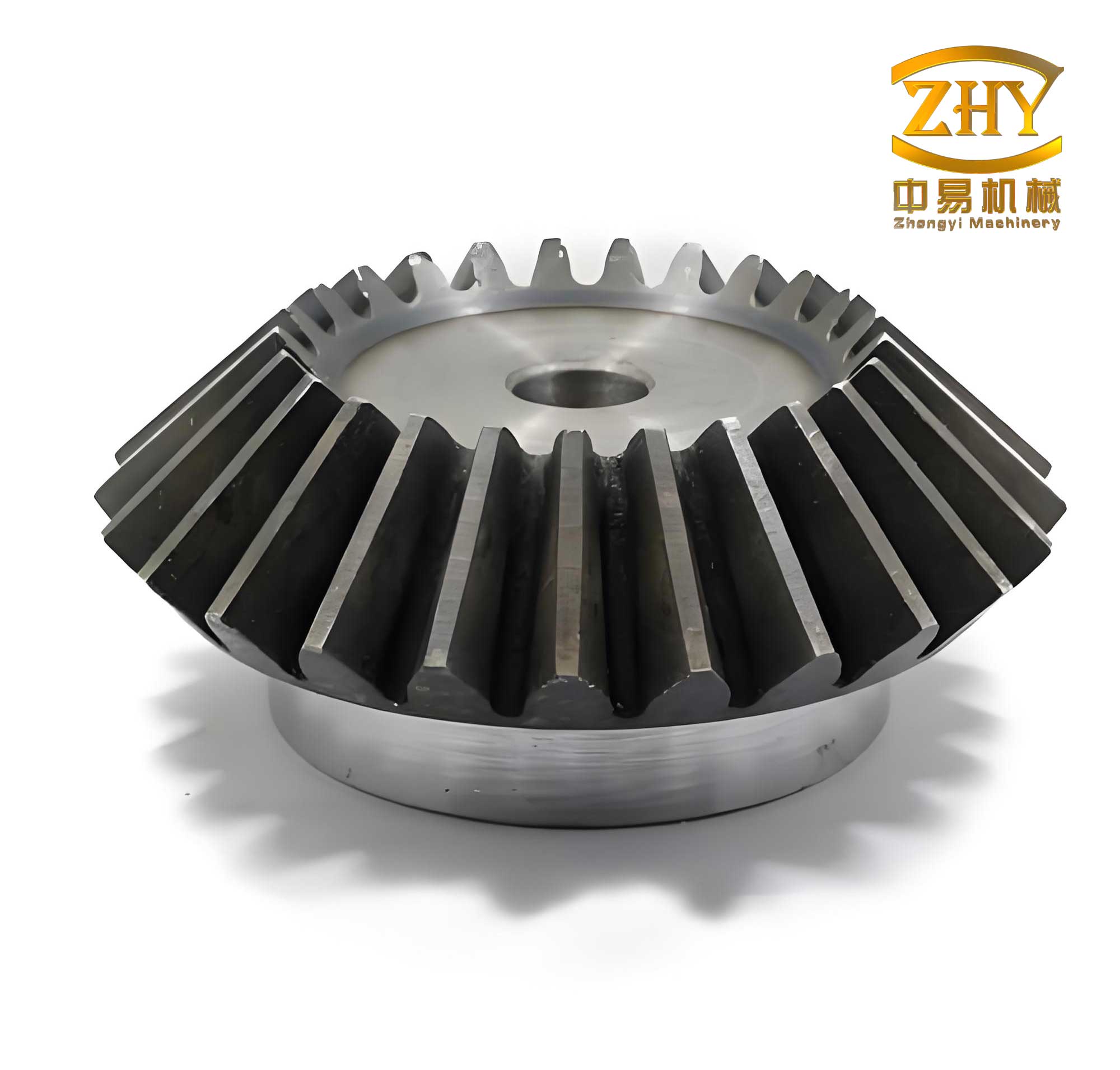
In my methodology, I first created a detailed three-dimensional model of the bevel gear. Using UGNX software, I developed a geometry based on design specifications, simplifying minor features like small fillets that have negligible impact on modal results. The bevel gear model was then exported in IGES format for integration into ANSYS Workbench, a powerful simulation environment. Accurate representation of the bevel gear geometry is essential for capturing its dynamic behavior, as even slight deviations can affect frequency predictions. Below, I include a visual reference to illustrate a typical bevel gear design, which aids in understanding the complex shape involved in this analysis.
Next, I proceeded with finite element mesh generation. Given the irregular geometry of the bevel gear, I opted for free meshing with tetrahedral elements, which provide flexibility in capturing complex shapes. After refinement, the mesh consisted of 17,964 nodes and 8,005 elements, ensuring a balance between computational accuracy and efficiency. I verified that the mesh quality was high, with no distorted elements that could skew results. The material properties assigned to the bevel gear are critical for accurate modal analysis. I used alloy steel 40Cr, a common choice for high-strength gears, with parameters summarized in Table 1.
| Property | Value | Units |
|---|---|---|
| Density | 7,850 | kg/m³ |
| Young’s Modulus | 206 | GPa |
| Poisson’s Ratio | 0.28 | Dimensionless |
These material parameters directly influence the stiffness and mass matrices in the finite element model, thereby affecting the natural frequencies of the bevel gear. With the mesh and material defined, I applied boundary conditions to simulate the bevel gear’s installation in the reducer. Specifically, I constrained axial displacements at the gear shoulder and sleeve contact surfaces, and applied frictionless supports to the inner bore and keyway faces. These constraints replicate real-world mounting conditions, ensuring that the modal analysis reflects operational scenarios. The application of constraints is a crucial step, as improper boundary conditions can lead to unrealistic mode shapes.
I then performed the modal analysis using ANSYS Workbench’s Modal module. This solver extracts eigenvalues and eigenvectors from the discretized system, corresponding to natural frequencies and mode shapes. I focused on the first six modes, as they typically dominate the dynamic response of structures like bevel gears. The results are presented in Table 2, which lists the natural frequencies for each mode.
| Mode Number | Natural Frequency (Hz) |
|---|---|
| 1 | 1,253.5 |
| 2 | 2,533.1 |
| 3 | 2,605.5 |
| 4 | 2,680.8 |
| 5 | 2,890.2 |
| 6 | 2,919.8 |
These frequencies indicate that the bevel gear has a relatively high stiffness, with natural frequencies ranging from approximately 1.25 kHz to 2.92 kHz. To interpret these results, I examined the mode shapes associated with each frequency. The first mode shape exhibits torsional vibration, where the bevel gear rotates about its axis, with maximum amplitude occurring at the outer region away from the keyway. This torsional mode is common in rotating components like bevel gears and can be critical if excitation frequencies coincide. The second and third modes show bending vibrations, partitioned into two zones with opposite motion directions. In the second mode, maximum amplitude is near the keyway, while in the third mode, it is perpendicular to the keyway centerline. These bending modes highlight areas of potential stress concentration in the bevel gear.
Moving to higher modes, the fourth mode involves inward bending of the gear teeth from the periphery, with peak amplitude at the outer edge opposite the keyway. The fifth and sixth modes are more complex, featuring four vibrational zones symmetrically distributed around the bevel gear. In these modes, adjacent zones vibrate in opposite directions, and maximum amplitudes are located at the outermost teeth. These mode shapes reveal that as frequency increases, the bevel gear develops more nodal lines and partitions, indicating a higher risk of localized deformation. This insight is valuable for design optimization, as it suggests that additional reinforcement might be needed in these amplitude-prone areas to enhance the durability of the bevel gear.
To assess resonance risks, I compared these natural frequencies with potential excitation sources in the aerial passenger device. The drive system operates with an active wheel speed of 980 rpm and a gear tooth count of 20, leading to a meshing frequency calculated as:
$$ f_{\text{mesh}} = \frac{\text{RPM} \times \text{Number of Teeth}}{60} = \frac{980 \times 20}{60} = 326.67 \, \text{Hz} $$
This meshing frequency is significantly lower than the lowest natural frequency of the bevel gear (1,253.5 Hz), implying that resonance is unlikely under normal operating conditions. However, other excitations, such as impact loads or motor harmonics, could pose risks if they align with higher modes. Therefore, in designing bevel gears for such applications, I recommend incorporating a safety margin by keeping excitation frequencies well below the natural frequencies, or by modifying the bevel gear geometry to shift modes away from critical ranges.
My analysis underscores the importance of modal analysis in the design process for bevel gears. Traditionally, gear design relies heavily on static stress calculations, but dynamic factors can lead to unforeseen failures. By integrating finite element modal analysis, I can predict vibrational behavior and make informed decisions about material selection, geometry adjustments, and manufacturing tolerances. For instance, the results indicate that the bevel gear’s natural frequencies are sufficiently high to avoid common excitations, but the mode shapes suggest that bending stresses might be amplified in certain regions. This calls for a comprehensive approach that combines static and dynamic analyses to ensure the reliability of bevel gears in coal mine environments.
In conclusion, through this detailed modal analysis, I have extracted the dynamic characteristics of a bevel gear used in a coal mine aerial passenger device. The first six natural frequencies and mode shapes provide a foundation for understanding its vibrational response. The bevel gear demonstrates robust dynamic properties, with natural frequencies well above typical excitation frequencies, reducing resonance risks. However, the mode shapes reveal complex deformation patterns that could inform design enhancements, such as optimizing tooth profiles or adding damping elements. Future work could involve experimental validation through vibration testing, as well as extending the analysis to include nonlinear effects or coupled systems with other reducer components. Ultimately, this study contributes to safer and more efficient mining operations by highlighting the critical role of dynamic analysis in bevel gear design.
Reflecting on this process, I emphasize that modal analysis is not just an academic exercise but a practical tool for engineering improvement. By leveraging advanced simulation software, I can iterate designs rapidly and mitigate potential issues before physical prototyping. For bevel gears in particular, which are often subjected to severe loads in mining applications, such proactive analysis is invaluable. I hope that my findings encourage further research into the dynamic optimization of bevel gears, leading to innovations that enhance the longevity and safety of coal mine equipment. As technology advances, integrating real-time monitoring with modal predictions could also pave the way for predictive maintenance strategies, ensuring that bevel gears and other critical components operate within safe vibrational limits throughout their service life.