
In my extensive investigation into the premature cracking of bevel gears, I embarked on a detailed failure analysis to uncover the root causes. Bevel gears are critical components in power transmission systems, such as automotive differentials, where they transmit torque between intersecting axes. The sudden appearance of longitudinal cracks in a batch of bevel gears prior to service posed a significant reliability concern. My objective was to systematically analyze the failure using advanced metallurgical techniques, with a focus on the bevel gear’s material integrity, microstructure, and fracture characteristics. This analysis aims to provide insights that can prevent future failures in bevel gear production.
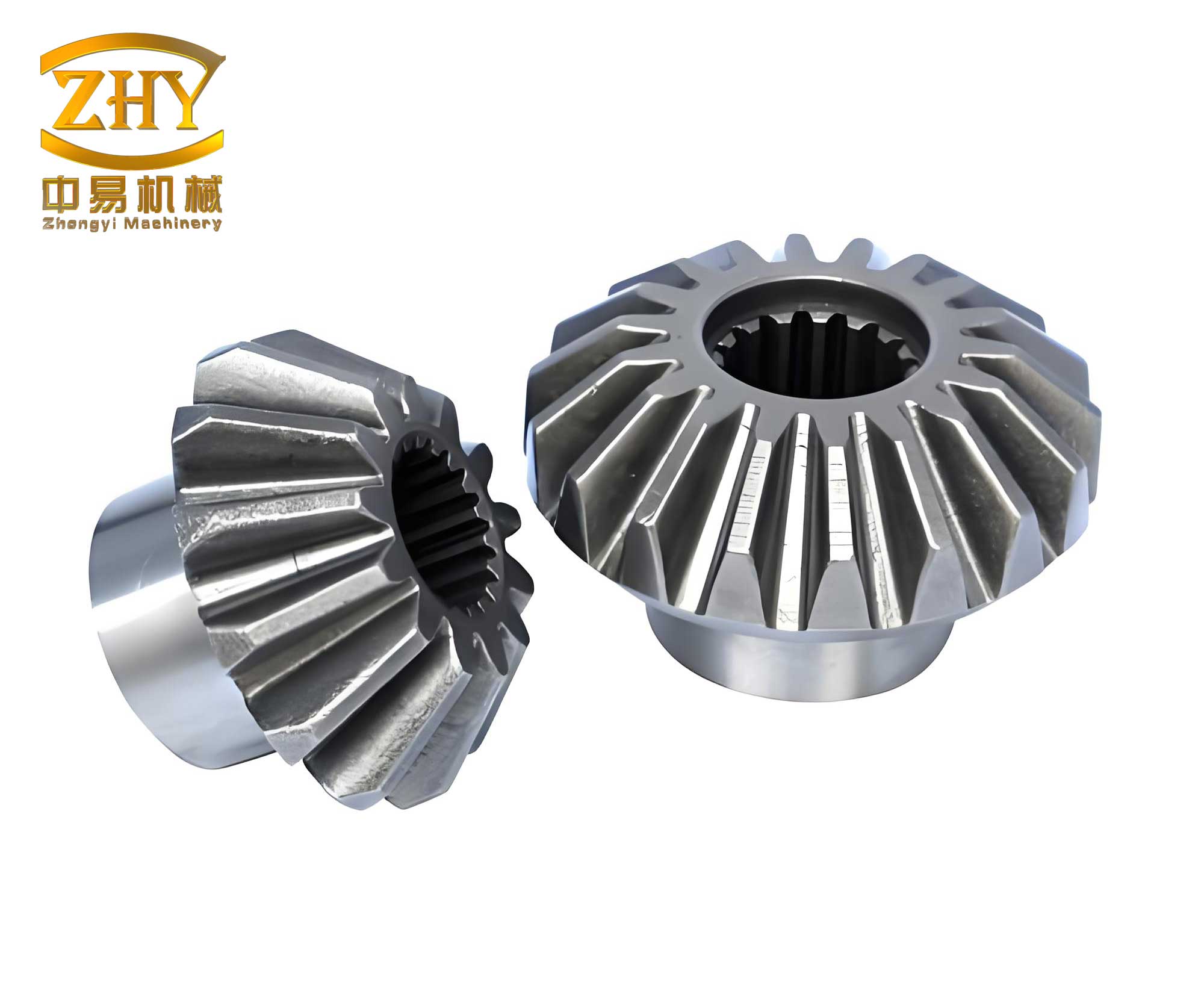
The bevel gears in question were manufactured from 20CrMoH steel, a case-hardening grade commonly used for high-strength applications. The manufacturing process involved sequential steps: forging, normalizing, machining, carburizing, quenching, and grinding. Cracks were detected post-processing, extending from the spline region along the axis toward the tooth flank, with lengths up to 161 mm and depths of approximately 17 mm in the tooth region. The straight, unbranched nature of the cracks suggested a single-event fracture rather than fatigue, prompting a thorough examination. My approach integrated multiple analytical methods to assess the bevel gear’s condition comprehensively.
I initiated the analysis by examining the macroscopic fracture surface. The crack origin was identified through classic fractographic features: chevron patterns converged at a subsurface location about 5 mm from the outer surface. This indicated that the failure initiated internally, not at the surface. The silver-gray appearance of the fracture surface confirmed a brittle fracture mode, typical of quenched steels under high stress. For the bevel gear, this subsurface initiation was anomalous, as surface defects often dominate in geared components. I then proceeded to microstructural and chemical evaluations to delve deeper.
Chemical composition analysis was performed using a direct reading spectrometer. The results, summarized in Table 1, show the elemental makeup of the bevel gear material. All values conform to the specifications for 20CrMoH steel per GB/T 5216-2004, indicating that bulk chemistry was not the primary culprit. However, localized variations, particularly near the crack origin, were suspected.
| Element | C | Cr | Mn | Si | Mo | P | S |
|---|---|---|---|---|---|---|---|
| Measured Value | 0.22 | 0.99 | 0.83 | 0.34 | 0.22 | 0.013 | 0.009 |
| Standard Requirement | 0.17-0.23 | 0.85-1.25 | 0.60-0.95 | 0.17-0.37 | 0.15-0.25 | ≤0.035 | ≤0.035 |
Metallographic examination of the bevel gear was conducted on samples extracted from the tooth region. After standard preparation and etching with 4% nital, I observed the microstructure under an optical microscope. The case-hardened surface layer exhibited acicular martensite and retained austenite, rated as Grade 3 according to relevant standards. The core region showed a mixture of lath martensite and free ferrite, also rated as Grade 3. Both microstructures met technical requirements for carburized and quenched bevel gears. However, a critical finding emerged when I assessed the banding structure in the core. After an isothermal anneal at 930°C for 60 minutes followed by 660°C for 120 minutes, the banded ferrite-pearlite structure was severe, as shown in Table 2. Banding severity was rated Grade 4, exceeding the acceptable limit of Grade 3 per GB/T 13299-1991. This indicated significant microsegregation in the bevel gear material, which can detrimentally affect mechanical properties.
| Region | Microstructure | Rating | Acceptance Criteria |
|---|---|---|---|
| Surface Case | Acicular Martensite + Retained Austenite | Grade 3 | Grade 1-4 acceptable |
| Core | Lath Martensite + Free Ferrite | Grade 3 | Grade 1-3 acceptable |
| Banded Structure (After Anneal) | Ferrite-Pearlite Bands | Grade 4 | Grade 1-3 acceptable |
To investigate the crack origin in detail, I employed scanning electron microscopy (SEM) coupled with energy-dispersive X-ray spectroscopy (EDS). The subsurface crack origin region, approximately 1.415 mm long and 0.345 mm wide, appeared as a white band under SEM. EDS analysis revealed elevated concentrations of oxygen, aluminum, calcium, and magnesium, as detailed in Table 3. Elemental mapping confirmed the localized enrichment of Al and O, indicating the presence of oxide inclusions such as Al2O3 and CaO. These inclusions act as stress raisers, disrupting the continuity of the steel matrix and initiating cracks under applied stresses.
| Element | C | O | F | Mg | Al | S | Ca | Cr | Mn | Fe |
|---|---|---|---|---|---|---|---|---|---|---|
| Concentration | 3.67 | 13.21 | 0.30 | 2.40 | 19.55 | 0.39 | 4.78 | 0.66 | 0.56 | 54.48 |
The role of inclusions in crack initiation can be modeled using stress concentration factors. For an elliptical inclusion within a matrix, the stress concentration factor \(K_t\) is given by:
$$ K_t = 1 + 2\sqrt{\frac{a}{\rho}} $$
where \(a\) is the inclusion size and \(\rho\) is the radius of curvature at the tip. For oxide inclusions with sharp edges, \(\rho\) is small, leading to high \(K_t\) values. This elevates local stresses beyond the yield strength, promoting crack formation. In the bevel gear, the subsurface inclusions likely created such stress concentrations, especially during quenching.
Another critical factor is the banded segregation observed in the core. Banding arises from microsegregation of alloying elements during solidification, leading to alternating layers of ferrite (low carbon) and pearlite (high carbon). This heterogeneity affects phase transformation behavior during heat treatment. The martensite start temperature \(M_s\) is influenced by carbon content, as described by the following empirical relation for steel:
$$ M_s (°C) = 539 – 423C – 30.4Mn – 17.7Ni – 12.1Cr – 7.5Mo $$
where elemental concentrations are in weight percent. In banded regions, carbon varies, causing differential \(M_s\) points. For instance, low-carbon ferrite bands have higher \(M_s\), while high-carbon pearlite bands have lower \(M_s\). During quenching of the bevel gear, this leads to non-simultaneous martensitic transformation. The subsurface crack origin, located in a region with lower carbon than the case, may have transformed earlier, inducing internal stresses due to volume expansion. The subsequent transformation of the higher-carbon surface layer at lower temperatures, where plasticity is reduced, exacerbates these stresses.
To quantify the effect of banding on mechanical properties, I consider the Hall-Petch relationship, which relates yield strength \(\sigma_y\) to grain size \(d\):
$$ \sigma_y = \sigma_0 + \frac{k_y}{\sqrt{d}} $$
Here, \(\sigma_0\) is the friction stress, and \(k_y\) is a constant. Banded structures often exhibit coarse grains in some regions, reducing \(\sigma_y\) locally. This creates weak paths for crack propagation. In the bevel gear, the Grade 4 banding likely resulted in anisotropic properties, lowering overall toughness and facilitating crack growth along the band directions.
The geometric aspect of the crack location also contributes to failure. The crack origin coincided with a diameter change on the bevel gear shaft, creating a stress concentration due to the notch effect. The stress concentration factor for a step shaft under torsion or bending can be approximated using empirical formulas. For instance, for a shaft with a shoulder fillet, the factor depends on the ratio of fillet radius to diameter. In this bevel gear, the abrupt change acted as a stress raiser, combining with internal stresses from quenching. The total stress \(\sigma_{total}\) at the subsurface can be expressed as:
$$ \sigma_{total} = K_t \cdot \sigma_{applied} + \sigma_{residual} $$
where \(\sigma_{applied}\) includes any operational loads (though minimal pre-service) and \(\sigma_{residual}\) is the quenching residual stress. For the bevel gear, residual stresses dominate, driven by thermal gradients and phase transformations.
I further analyzed the quenching process for the bevel gear. Carburizing at 920°C enriches the surface with carbon, followed by quenching from 830°C. The cooling rate influences the microstructure and stress development. Using the Koistinen-Marburger equation, the volume fraction of martensite \(f_m\) as a function of temperature below \(M_s\) is:
$$ f_m = 1 – \exp[-\alpha (M_s – T)] $$
where \(\alpha\) is a constant, and \(T\) is temperature. Differential transformation between subsurface and surface layers leads to incompatible strains. The strain mismatch \(\Delta \epsilon\) can be estimated from the volume change during martensitic transformation, approximately 4% for steel. This generates high internal stresses, particularly at interfaces like the subsurface region in the bevel gear.
The presence of oxide inclusions exacerbates this scenario. Inclusions have different thermal expansion coefficients \(\alpha_{incl}\) compared to the steel matrix \(\alpha_{steel}\). During cooling, the mismatch induces additional stresses \(\sigma_{thermal}\):
$$ \sigma_{thermal} = E \cdot (\alpha_{steel} – \alpha_{incl}) \cdot \Delta T $$
where \(E\) is Young’s modulus, and \(\Delta T\) is the temperature change. For Al2O3 inclusions, \(\alpha_{incl}\) is about \(8 \times 10^{-6} /°C\), while for steel, \(\alpha_{steel}\) is around \(12 \times 10^{-6} /°C\). This difference causes tensile stresses around inclusions, promoting decohesion and crack initiation in the bevel gear.
To summarize the failure mechanism, I propose a multi-stage model for the bevel gear cracking: First, during solidification, microsegregation forms severe banded structures and oxide inclusions. Second, during carburizing and quenching, differential martensite transformation between subsurface and surface layers creates high residual stresses. Third, the subsurface inclusions act as stress concentrators, while the banded structure weakens the matrix. Fourth, the geometric stress concentration at the diameter change amplifies these effects. Finally, the combined stresses exceed the local fracture strength, initiating a crack that propagates longitudinally along the bevel gear axis.
Preventive measures for future bevel gear production include optimizing the steelmaking process to reduce inclusions and banding. Techniques such as ladle refining and controlled cooling can minimize segregation. Additionally, modifying the heat treatment cycle, perhaps using a lower quenching rate or tempering immediately after quenching, could alleviate residual stresses. Non-destructive testing like ultrasonic inspection can detect subsurface flaws in bevel gears before they enter service.
In conclusion, my failure analysis of the bevel gear cracks reveals a complex interplay of material defects and processing-induced stresses. The bevel gear’s conformity in bulk chemistry and surface microstructure masked underlying issues: subsurface oxide inclusions and severe banded segregation. These, coupled with transformation stresses and geometric factors, led to catastrophic longitudinal cracking. This study underscores the importance of holistic quality control in bevel gear manufacturing, from melt practice to final heat treatment. By addressing these factors, the reliability of bevel gears in critical applications can be significantly enhanced.