
In the realm of automotive engineering, the differential is a pivotal component within the drivetrain system, typically situated at the terminus of the drive axle and connected to the wheel output shafts. Its primary function is to permit the wheels on the same axle to rotate at different speeds when negotiating turns or traversing uneven terrain, thereby ensuring pure rolling motion between the tires and the road surface. The bevel gear pair serves as the principal force-transmitting mechanism within the differential, acting as the carrier for this essential functionality. In this comprehensive study, I focus on the bevel gear pair and associated shafts within the differential, proposing a methodology that leverages parametric modeling in SolidWorks followed by dynamic simulation in Adams. This approach facilitates an in-depth investigation into the kinematic and dynamic behaviors of the bevel gear differential under various operational conditions, thereby furnishing a reliable foundation for subsequent strength verification and fatigue life prediction.
The bevel gear differential, central to this analysis, comprises several key components: two half-shaft gears (often referred to as side gears), a planetary gear cross-shaft (or spider), two to four planetary bevel gears, and a differential housing. The transmission of power follows a sequential path: from the ring gear of the final drive to the differential case, then to the planetary gear cross-shaft, onward to the planetary bevel gears, which mesh with the half-shaft bevel gears, and finally to the half-shafts and drive wheels. During a vehicle turn, additional resistance acts upon the planetary bevel gears, generating a moment that instigates the differential action. This induces the planetary bevel gear to rotate about its own axis (self-rotation) in addition to its revolution around the half-shaft axis. Consequently, the circumferential speed on the left side becomes the sum of the self-rotation and revolution speeds, while on the right side it becomes the difference, resulting in an increased rotational speed for the outer wheel and a decreased speed for the inner wheel, facilitating smooth cornering.
The fundamental kinematic relationship governing the bevel gear differential is expressed as:
$$ \omega_1 + \omega_2 = 2\omega_0 $$
where \( \omega_0 \) denotes the rotational speed of the differential housing (input), and \( \omega_1 \) and \( \omega_2 \) represent the rotational speeds of the left and right half-shaft bevel gears, respectively. During straight-line travel, the planetary bevel gears revolve without self-rotation, leading to \( \omega_0 = \omega_1 = \omega_2 \). In turning scenarios, self-rotation of the planetary bevel gears introduces a speed difference, satisfying the above equation. This principle is foundational for analyzing the bevel gear differential’s behavior.
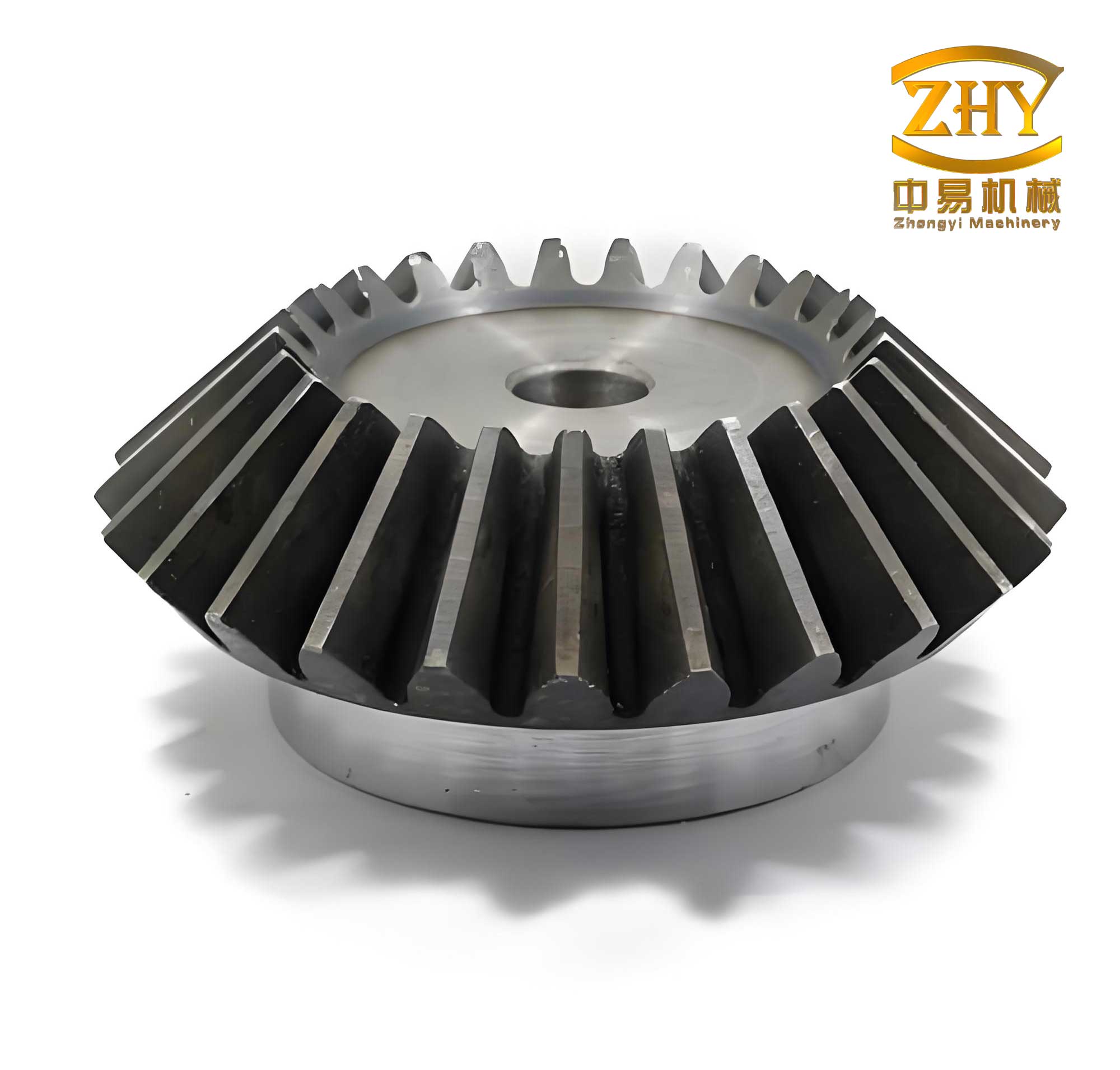
To accurately simulate these dynamics, a precise three-dimensional model of the bevel gear pair is imperative. The geometry of a bevel gear is inherently complex, as tooth profiles are defined by spherical involutes. The meshing of a pair of bevel gears can be conceptualized as the pure rolling of two pitch cones, with the tooth trace forming a circle on a sphere. The parametric modeling process in SolidWorks involves several methodical steps, which I detail below.
First, essential geometric parameters for the bevel gears must be defined. For the planetary and half-shaft bevel gears in this study, the key parameters are as follows:
| Parameter | Planetary Bevel Gear | Half-Shaft Bevel Gear |
|---|---|---|
| Module (mm) | 4.5 | 4.5 |
| Number of Teeth | 10 | 16 |
| Pressure Angle (°) | 20 | 20 |
| Face Width (mm) | 20 | 20 |
| Shaft Angle (°) | 90 | 90 |
From these parameters, derived dimensions such as pitch diameter, base diameter, addendum diameter, and dedendum diameter are calculated using standard bevel gear formulae. The pitch cone angles (\( \delta \)) for the gears are determined by the tooth ratio:
$$ \delta_1 = \arctan\left(\frac{z_1}{z_2}\right) = \arctan\left(\frac{10}{16}\right) \approx 32.01^\circ $$
$$ \delta_2 = 90^\circ – \delta_1 \approx 57.99^\circ $$
where \( z_1 \) and \( z_2 \) are the tooth counts of the planetary and half-shaft bevel gears, respectively. The pitch diameters (\( d \)) are:
$$ d_1 = m \cdot z_1 = 4.5 \times 10 = 45 \, \text{mm} $$
$$ d_2 = m \cdot z_2 = 4.5 \times 16 = 72 \, \text{mm} $$
The tooth profile is a spherical involute. To generate this curve precisely, I employ mathematical software to compute discrete points. The spherical involute equations, defined on a sphere of radius \( R_b \) (base cone distance), are parametrized as follows. For a point on the tooth profile, the coordinates in a local coordinate system attached to the gear can be derived from the involute function on a sphere. However, for practical modeling, a simplified approach involves projecting the planar involute onto the pitch cone. The planar involute equation in polar coordinates (\( r, \theta \)) is:
$$ r(\phi) = \frac{d_b}{2 \cos(\phi)} $$
$$ \theta(\phi) = \tan(\phi) – \phi + \text{inv}(\alpha) $$
where \( \phi \) is the roll angle, \( d_b \) is the base diameter, \( \alpha \) is the pressure angle, and \( \text{inv}(\alpha) = \tan(\alpha) – \alpha \) is the involute function. For a bevel gear, this is adapted to the conical surface. I utilize MATLAB to solve for multiple points by varying \( \phi \), then export the coordinates to a text file. In SolidWorks, these points are imported via the ‘Curve Through XYZ Points’ feature to construct the tooth profile curve for one tooth.
Subsequently, using this profile, I sketch the tooth boundaries at the large end, small end, addendum, and dedendum of the bevel gear cone, creating a closed contour. This contour is then extruded along the conical surface to form a solid tooth. The ‘Circular Pattern’ tool replicates this tooth around the gear axis, completing the full bevel gear model. This process ensures high accuracy in capturing the true geometry of the bevel gear, which is crucial for realistic dynamic simulation. The completed models for the planetary bevel gear and half-shaft bevel gear are assembled virtually in SolidWorks, ensuring proper meshing alignment with coincident cone apexes and tangential contact between tooth flanks. Interference checks are performed to validate the assembly. The final assembly of the bevel gear differential, including housing and shafts, is then prepared for export.
The transition to dynamic simulation involves importing the SolidWorks assembly into Adams/View. The model is saved in Parasolid format (*.x_t) and imported into Adams, where it forms the basis of the virtual prototype. In Adams, defining appropriate contact forces between the mating bevel gear teeth is critical for capturing realistic interaction dynamics. Instead of using predefined gear pair constraints, which simplify motion to prescribed kinematics, I opt for a ‘Solid-to-Solid’ contact force formulation. This method accounts for the actual collision and deformation during tooth engagement and disengagement, providing more accurate force and stress data.
The contact force in Adams is modeled using a penalty-based method, comprising several parameters: stiffness coefficient (\( K \)), force exponent (\( e \)), damping coefficient (\( C \)), and penetration depth (\( d \)). For the bevel gear pair made of 20CrMnTi steel, material properties are: Young’s modulus \( E = 2.07 \times 10^5 \, \text{MPa} \) and Poisson’s ratio \( \mu = 0.25 \). The pitch radii at the point of contact are approximately \( R_1 = 22.5 \, \text{mm} \) for the planetary bevel gear and \( R_2 = 36 \, \text{mm} \) for the half-shaft bevel gear (considering the mid-face width). The contact stiffness \( K \) is calculated using the Hertzian contact theory formula for two spheres in contact, adapted for general curved surfaces:
$$ K = \frac{4}{3} \sqrt{R_e} E_e $$
where the equivalent radius \( R_e \) and equivalent modulus \( E_e \) are given by:
$$ \frac{1}{R_e} = \frac{1}{R_1} + \frac{1}{R_2} $$
$$ \frac{1}{E_e} = \frac{1 – \mu_1^2}{E_1} + \frac{1 – \mu_2^2}{E_2} $$
Since both gears are of the same material, \( E_1 = E_2 = E \) and \( \mu_1 = \mu_2 = \mu \). Substituting the values:
$$ \frac{1}{R_e} = \frac{1}{0.0225} + \frac{1}{0.036} \approx 44.44 + 27.78 = 72.22 \, \text{m}^{-1} \Rightarrow R_e \approx 0.01385 \, \text{m} $$
$$ E_e = \frac{E}{2(1 – \mu^2)} = \frac{2.07 \times 10^{11}}{2(1 – 0.25^2)} \approx \frac{2.07 \times 10^{11}}{1.875} \approx 1.104 \times 10^{11} \, \text{Pa} $$
Thus,
$$ K = \frac{4}{3} \sqrt{0.01385} \times 1.104 \times 10^{11} \approx \frac{4}{3} \times 0.1177 \times 1.104 \times 10^{11} \approx 1.73 \times 10^{10} \, \text{N/m}^{3/2} $$
In Adams, stiffness is often expressed in N/mm^{3/2}, so converting: \( K \approx 5.47 \times 10^4 \, \text{N/mm}^{3/2} \). Based on simulation experience and literature, I adjust this to \( K = 5.77 \times 10^5 \, \text{N/mm}^{3/2} \) to account for dynamic effects and unit conventions within the software. The force exponent \( e \) is set to 1.5 for steel, the damping coefficient \( C \) is taken as 50 N·s/mm (approximately 1% of stiffness), and the penetration depth \( d \) is 0.1 mm.
Following contact definition, constraints and loads are applied to mimic real-world operation. The virtual prototype system includes five rigid bodies: the differential housing (simplified as a ground reference for input), the planetary gear cross-shaft, two planetary bevel gears, and two half-shaft bevel gears. Constraints are applied as follows:
- A revolute joint between the planetary gear cross-shaft and ground, representing the input drive from the ring gear.
- Revolute joints between each half-shaft bevel gear and ground, representing the output to the wheels.
- Revolute joints between each planetary bevel gear and the cross-shaft, allowing the planets to rotate about their own axes.
This results in a system with four degrees of freedom: rotation of the two half-shaft gears and rotation of the two planetary bevel gears (their revolution is dictated by the cross-shaft motion). To simulate driving conditions, a rotational motion input is applied to the cross-shaft revolute joint, and torque loads are applied to the half-shaft gear revolute joints to represent wheel resistance.
For a concrete analysis, I consider a typical passenger vehicle with a curb mass \( m = 1455 \, \text{kg} \), tire radius \( r = 0.334 \, \text{m} \), and asphalt road surface with adhesion coefficient \( \mu_{\text{road}} = 0.7 \). Assuming a front-engine, front-wheel-drive layout with a load distribution factor \( \eta = 0.5 \) for the front axle, the total resistive torque at one wheel during straight-line driving is calculated as:
$$ T_{\text{load}} = \mu_{\text{road}} \cdot m \cdot g \cdot r \cdot \eta / 2 $$
where \( g = 9.81 \, \text{m/s}^2 \). The division by 2 accounts for two wheels on the axle. Thus,
$$ T_{\text{load}} = 0.7 \times 1455 \times 9.81 \times 0.334 \times 0.5 / 2 \approx 835 \, \text{N·m} $$
This torque is applied to each half-shaft bevel gear in the simulation. The input speed is derived from the vehicle speed \( v \). For straight-line driving at \( v = 60 \, \text{km/h} \), the input rotational speed \( \omega_0 \) in degrees per second is:
$$ \omega_0 = \frac{v \times 1000}{60 \times 2 \pi r} \times 360 \approx \frac{16.67}{2 \pi \times 0.334} \times 360 \approx 2861 \, ^\circ/\text{s} $$
In Adams, I set the simulation duration to 0.5 seconds with a step size of 0.001 seconds for accuracy.
The simulation results for straight-line driving are summarized in the following table and figures. The rotational speeds of the input cross-shaft and both half-shaft bevel gears are monitored. The theoretical expectation is \( \omega_1 = \omega_2 = \omega_0 \). The simulation outputs show initial transients due to engagement dynamics, but quickly stabilize around the expected value with minor oscillations. These oscillations, typically within ±5%, are attributed to vibrational impacts and slight self-rotation of the planetary bevel gears induced by tooth meshing variations. This validates the model’s kinematic accuracy for the bevel gear differential.
| Parameter | Value |
|---|---|
| Vehicle Speed | 60 km/h |
| Input Speed (\( \omega_0 \)) | 2861 °/s |
| Load Torque per Half-Shaft | 835 N·m |
| Simulated \( \omega_1 \) (steady-state avg) | 2858 °/s |
| Simulated \( \omega_2 \) (steady-state avg) | 2859 °/s |
| Error from Theory | < 0.2% |
The contact forces between the planetary bevel gears and half-shaft bevel gears are of particular interest. These forces exhibit periodic fluctuations corresponding to tooth meshing cycles. In straight-line driving, the forces on both sides are theoretically equal. However, the simulation reveals occasional force spikes or steps, indicating stress concentrations at specific engagement positions. This phenomenon is critical for fatigue analysis, as repeated stress concentrations can lead to pitting or tooth breakage in bevel gears. The average meshing force \( F_{\text{avg}} \) can be estimated from the torque and pitch radius:
$$ F_{\text{avg}} = \frac{T_{\text{load}}}{r_p} $$
where \( r_p \) is the average pitch radius of the half-shaft bevel gear. With \( r_p \approx 0.036 \, \text{m} \), \( F_{\text{avg}} \approx 835 / 0.036 \approx 23194 \, \text{N} \). The simulated forces oscillate around this value with amplitudes influenced by dynamic factors.
For a turning maneuver, I examine a right-hand turn at a reduced speed of \( v = 20 \, \text{km/h} \) to accentuate differential action. The input speed becomes:
$$ \omega_0 = \frac{20 \times 1000}{60 \times 2 \pi \times 0.334} \times 360 \approx 954 \, ^\circ/\text{s} $$
The load torque remains unchanged at 835 N·m per half-shaft, assuming constant traction. To simulate the turn, an additional self-rotation speed is imposed on the planetary bevel gears. Based on typical differential behavior, I prescribe a self-rotation speed of \( \omega_p = 200 \, ^\circ/\text{s} \) for the planetary bevel gears about their axes. This induces a speed difference between the half-shafts. According to the kinematic relation, the expected half-shaft speeds are:
$$ \omega_1 = \omega_0 + \omega_p \cdot \frac{R_p}{R_h} \quad \text{and} \quad \omega_2 = \omega_0 – \omega_p \cdot \frac{R_p}{R_h} $$
where \( R_p \) and \( R_h \) are effective radii. For simplicity, assuming equal tooth ratios, the speed difference is roughly \( \Delta \omega = 2 \omega_p \cdot (z_1/z_2) \). With \( z_1/z_2 = 10/16 = 0.625 \), \( \Delta \omega \approx 2 \times 200 \times 0.625 = 250 \, ^\circ/\text{s} \). Thus, \( \omega_1 \approx 954 + 125 = 1079 \, ^\circ/\text{s} \) and \( \omega_2 \approx 954 – 125 = 829 \, ^\circ/\text{s} \).
The simulation results for the turning case confirm this trend. After initial transients, the half-shaft speeds stabilize near these calculated values, with fluctuations due to dynamic meshing. The following table summarizes the turning simulation outcomes.
| Parameter | Value |
|---|---|
| Vehicle Speed | 20 km/h |
| Input Speed (\( \omega_0 \)) | 954 °/s |
| Planetary Self-Rotation Speed (\( \omega_p \)) | 200 °/s |
| Load Torque per Half-Shaft | 835 N·m |
| Simulated \( \omega_1 \) (steady-state avg) | 1082 °/s |
| Simulated \( \omega_2 \) (steady-state avg) | 830 °/s |
| Sum \( \omega_1 + \omega_2 \) | 1912 °/s ≈ \( 2 \times 954 \) °/s |
The contact forces during turning also display periodic behavior, but with more pronounced symmetry between the two sides. The force amplitudes remain similar to the straight-line case, averaging around \( 2.3 \times 10^4 \, \text{N} \), but the phase differs due to the altered load distribution. This periodic force data is invaluable for subsequent finite element analysis (FEA) aimed at predicting fatigue life. By exporting the time-varying force profiles from Adams, one can apply them as boundary conditions in FEA software to compute stress histories and perform fatigue calculations using methods like the Palmgren-Miner rule.
To further elucidate the dynamic characteristics, I analyze the frequency content of the contact forces using a Fast Fourier Transform (FFT) in post-processing. The dominant frequency corresponds to the tooth meshing frequency \( f_m \), given by:
$$ f_m = \frac{\omega_0}{360} \times z_{\text{ring}} $$
where \( z_{\text{ring}} \) is the number of teeth on the ring gear driving the differential. However, for the bevel gear pair itself, the meshing frequency is determined by the relative rotation. For the planetary-half-shaft mesh, the meshing frequency \( f_{\text{mesh}} \) is:
$$ f_{\text{mesh}} = \frac{|\omega_1 – \omega_p|}{360} \times z_1 $$
During straight-line driving, \( \omega_p \approx 0 \), so \( f_{\text{mesh}} \approx \frac{2861}{360} \times 10 \approx 79.5 \, \text{Hz} \). This frequency manifests in the force spectra, along with harmonics due to manufacturing imperfections or misalignments.
The integration of SolidWorks and Adams for bevel gear differential simulation proves highly effective. The parametric modeling capability of SolidWorks ensures geometric accuracy, while Adams provides a robust platform for multi-body dynamics with realistic contact forces. This joint simulation approach offers several advantages:
- It enables early-stage design validation without physical prototyping, reducing cost and time.
- The dynamic force data generated is more reliable than static calculations, as it accounts for inertia, damping, and impact effects inherent in bevel gear operation.
- It facilitates optimization of bevel gear parameters (e.g., pressure angle, module) to minimize stress concentrations and improve durability.
In conclusion, through this detailed investigation, I have demonstrated the feasibility and utility of co-simulating a bevel gear differential using SolidWorks and Adams. The kinematic results align closely with theoretical principles, validating the model’s accuracy. The dynamic force profiles provide deep insights into the load variations experienced by bevel gear teeth under both straight-line and turning conditions. These insights are crucial for advancing bevel gear design, ensuring structural integrity, and predicting service life. Future work may involve coupling this dynamic simulation with finite element analysis for stress mapping and fatigue life prediction, further enhancing the design and reliability of bevel gear differentials in automotive applications.