
As an industry observer deeply immersed in the evolving landscape of manufacturing and materials science, I find the recent strides in bevel gear production particularly compelling. Bevel gears, integral components in differential systems for passenger vehicles, are produced in massive volumes, often numbering in the millions. The relentless pursuit of lower per-unit costs and unwavering quality has driven suppliers to innovate machining solutions. In this context, the development of advanced turning centers represents a paradigm shift. These machines not only enhance efficiency but also underscore the broader trends of industry consolidation and collaborative innovation that are reshaping sectors like polymers and coatings. Throughout this discussion, I will delve into the technical intricacies of bevel gear machining, explore material advancements, and highlight synergistic industry efforts, all while emphasizing the critical role of bevel gears in modern engineering.
The manufacturing of bevel gears demands precision and speed. Traditional methods often involve multiple setups and longer cycle times, leading to higher costs. However, the introduction of twin-spindle turning centers has revolutionized this process. These machines, designed specifically for high-volume production, can simultaneously process two identical bevel gears within a single working area. This simultaneous machining drastically reduces cycle times. For instance, a typical cycle for a bevel gear can be broken down into loading, processing, and unloading phases. The total cycle time $T$ can be expressed as:
$$ T = t_{\text{load}} + t_{\text{process}} + t_{\text{unload}} $$
With twin-spindle technology, $t_{\text{process}}$ is effectively halved for two gears, and automated handling minimizes $t_{\text{load}}$ and $t_{\text{unload}}$. In one notable implementation, the cycle time is reduced to approximately 4.5 seconds for loading and unloading, with an average changeover time under 6 seconds. This efficiency stems from a dual-spindle configuration where each spindle operates independently yet synchronously. The power and torque ratings, such as 9.9 kW and 136 Nm at a 40% duty cycle, ensure robust machining capabilities. The clamping solution is equally innovative, utilizing a “negative mold” of the gear teeth to secure the bevel gear firmly throughout operations, preventing deformations and ensuring consistency.
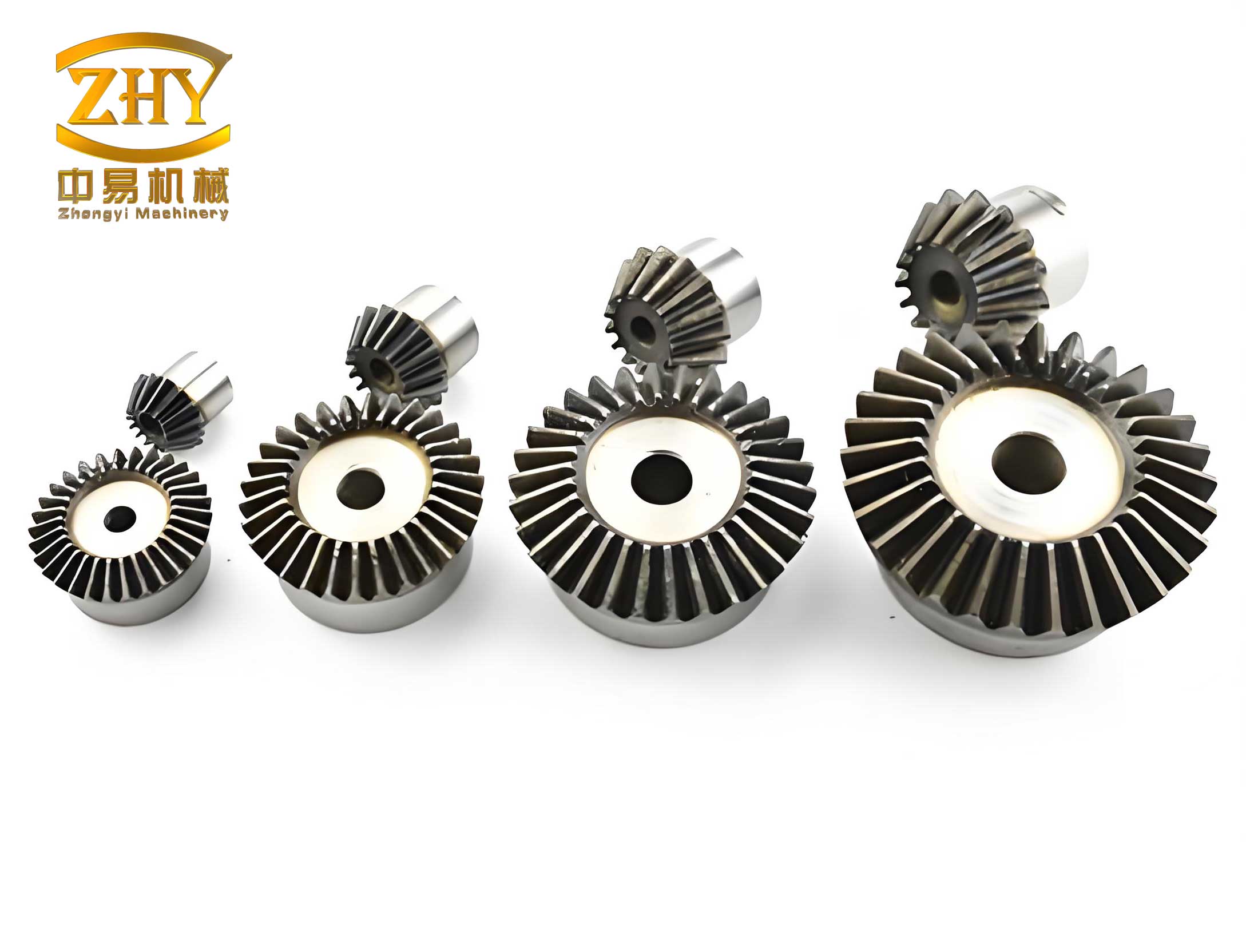
To quantify the benefits, consider the cost per bevel gear. The single-unit cost $C$ can be modeled as:
$$ C = \frac{C_{\text{machine}} + C_{\text{tooling}} + C_{\text{labor}} + C_{\text{material}}}{N} $$
where $N$ is the number of units produced. By reducing cycle times and automating processes, $C_{\text{labor}}$ and $C_{\text{machine}}$ per unit decrease significantly. For high-volume runs, this translates to substantial savings. The table below compares traditional single-spindle machining with twin-spindle technology for bevel gear production, based on hypothetical data to illustrate trends:
| Parameter | Traditional Machining | Twin-Spindle Machining |
|---|---|---|
| Cycle Time per Gear (seconds) | 60 | 25 |
| Loading/Unloading Time (seconds) | 10 | 4.5 |
| Changeover Time (seconds) | 30 | 6 |
| Power Consumption per Gear (kW) | 5 | 4.95 |
| Estimated Cost Reduction | Base | Up to 40% |
This table underscores how twin-spindle solutions enhance productivity for bevel gears. Moreover, the ability to perform operations like drilling central holes in solid materials in one setup further streamlines production. The mathematical relationship for material removal rate $MRR$ during bevel gear machining is crucial:
$$ MRR = f \times d \times v $$
where $f$ is feed rate, $d$ is depth of cut, and $v$ is cutting speed. Optimizing these parameters through advanced machine control ensures efficient machining of bevel gear teeth profiles, which often involve complex geometries. The surface finish of a bevel gear, critical for noise reduction and longevity, can be expressed as:
$$ R_a = k \cdot \frac{f^2}{r} $$
where $R_a$ is average roughness, $k$ is a constant, $f$ is feed, and $r$ is tool radius. Advanced machines allow precise control over $f$ and $r$, yielding superior bevel gear quality.
Beyond machining, the materials used for bevel gears are evolving. Historically, steel alloys dominated, but polymer composites are gaining traction for lightweight applications. This shift aligns with broader industry movements, such as the consolidation in specialty polymers. The merger of global polymer expertise with color masterbatch capabilities has created a powerhouse focused on sustainable solutions. This integration enables the development of advanced materials for bevel gears, enhancing properties like wear resistance and reducing weight. The stress on a bevel gear tooth can be calculated using:
$$ \sigma = \frac{F_t}{A} + \frac{M \cdot c}{I} $$
where $\sigma$ is stress, $F_t$ is tangential force, $A$ is area, $M$ is bending moment, $c$ is distance from neutral axis, and $I$ is moment of inertia. Advanced materials can withstand higher $\sigma$, extending bevel gear life. The table below summarizes material properties relevant to bevel gears:
| Material Type | Density (g/cm³) | Tensile Strength (MPa) | Application in Bevel Gears |
|---|---|---|---|
| Steel Alloy | 7.8 | 600-1000 | High-load differentials |
| Polymer Composite | 1.2-1.5 | 50-200 | Lightweight systems |
| Advanced Polymer Blend | 1.0-1.3 | 100-300 | Experimental prototypes |
Innovation in bevel gear manufacturing is not limited to machining and materials; it also encompasses surface treatments and coatings. Collaborative initiatives, such as global challenges aimed at fostering innovation, play a pivotal role. These programs bring together suppliers, startups, and academic institutions to co-develop breakthrough solutions. For bevel gears, coatings can reduce friction and wear, with the coefficient of friction $\mu$ being a key parameter. The relationship between wear rate $W$ and coating properties is:
$$ W = k \cdot \frac{P \cdot v}{H} $$
where $P$ is pressure, $v$ is sliding velocity, $H$ is hardness, and $k$ is a wear coefficient. Advanced coatings, developed through such collaborations, can optimize $H$ and reduce $k$, thereby enhancing bevel gear durability. The synergy between material scientists and manufacturing engineers is essential; for instance, color masterbatches might incorporate additives that improve the polymer matrix for bevel gears used in non-critical applications.
The economic impact of these advancements on bevel gear production is profound. Let’s model the total cost savings $S$ over a production run of $N$ bevel gears using twin-spindle technology versus traditional methods:
$$ S = N \cdot (C_{\text{traditional}} – C_{\text{twin}}) $$
where $C_{\text{traditional}}$ and $C_{\text{twin}}$ are per-unit costs. Assuming $C_{\text{traditional}} = \$10$ and $C_{\text{twin}} = \$6$, for $N = 1,000,000$ gears, $S = \$4,000,000$. This stark reduction underscores why manufacturers are rapidly adopting such technologies for bevel gear mass production. Furthermore, the integration of robotic units and rotary tables for automated loading enhances reliability. The efficiency $\eta$ of the system can be expressed as:
$$ \eta = \frac{T_{\text{productive}}}{T_{\text{total}}} $$
where $T_{\text{productive}}$ is time spent machining bevel gears, and $T_{\text{total}}$ includes idle times. With automation, $\eta$ approaches 0.9 or higher, minimizing waste.
In the realm of materials, the fusion of specialty polymers and color technologies opens new avenues for bevel gear design. For example, polymer bevel gears can be injection-molded with integrated color codes for part identification, leveraging masterbatch innovations. The viscosity $\eta_{\text{poly}}$ of polymer melts during molding affects bevel gear quality, governed by the power-law model:
$$ \eta_{\text{poly}} = m \cdot \dot{\gamma}^{n-1} $$
where $m$ is consistency index, $\dot{\gamma}$ is shear rate, and $n$ is power-law index. Optimizing these parameters through advanced material formulations ensures precise replication of bevel gear teeth. The sustainability angle is also critical; recycled polymers can be used for bevel gears in low-stress environments, reducing environmental impact. The carbon footprint $F$ of producing a bevel gear can be approximated as:
$$ F = E \cdot e_{\text{carbon}} $$
where $E$ is energy consumed and $e_{\text{carbon}}$ is carbon intensity. Efficient machining and lightweight materials lower $E$, aligning with global sustainability goals.
Collaborative innovation programs further accelerate progress. By engaging a diverse ecosystem, these initiatives foster solutions that address multiple challenges simultaneously. For bevel gears, this might mean developing multifunctional coatings that provide corrosion resistance and noise damping. The adhesion strength $\sigma_{\text{adh}}$ of a coating on a bevel gear surface is vital:
$$ \sigma_{\text{adh}} = \frac{F_{\text{peel}}}{A_{\text{bond}}} $$
where $F_{\text{peel}}$ is peel force and $A_{\text{bond}}$ is bonded area. Joint research efforts can yield coatings with high $\sigma_{\text{adh}}$, ensuring longevity. The table below highlights key areas where collaboration benefits bevel gear technology:
| Collaboration Area | Impact on Bevel Gears | Potential Improvement |
|---|---|---|
| Machining Automation | Reduced cycle times | 30-50% faster production |
| Material Development | Enhanced strength-to-weight ratio | 20% lighter gears |
| Coating Innovations | Lower friction and wear | Extended lifespan by 25% |
| Sustainable Practices | Reduced energy consumption | 15% lower carbon footprint |
Looking ahead, the future of bevel gear manufacturing lies in digital integration and smart factories. Real-time monitoring of machining parameters using IoT sensors can predict tool wear and prevent defects. The tool wear rate $V_B$ can be modeled as:
$$ V_B = C \cdot v^a \cdot f^b \cdot d^c $$
where $C, a, b, c$ are constants specific to the tool-material pair. By analyzing data from bevel gear production lines, manufacturers can optimize $v, f, d$ to minimize $V_B$, reducing downtime and costs. Additive manufacturing also holds promise for prototyping custom bevel gears, with layer-by-layer fabrication allowing complex geometries. The accuracy $\Delta$ of an additively manufactured bevel gear can be expressed as:
$$ \Delta = \sqrt{\sum_{i=1}^{n} \delta_i^2} $$
where $\delta_i$ are errors from each layer. Advances in 3D printing materials and processes are steadily reducing $\Delta$, making additive manufacturing viable for low-volume bevel gear production.
In conclusion, the advancements in bevel gear manufacturing, driven by twin-spindle machining, material science integrations, and collaborative innovation, are transformative. As I reflect on these developments, it’s clear that the relentless focus on efficiency and quality for bevel gears mirrors broader industrial trends. The synergy between mechanical engineering and chemical sciences—from machining centers to polymer blends—creates a holistic ecosystem. For bevel gears, this means not only lower costs but also enhanced performance and sustainability. The ongoing evolution promises even greater strides, solidifying the bevel gear’s role as a cornerstone of modern machinery. Through continued innovation and cooperation, the industry will undoubtedly unlock new potentials, ensuring that bevel gears remain at the forefront of technological progress.