
In my years of experience working with agricultural machinery, I have frequently encountered issues related to the central drive system of tractors, particularly the early damage of bevel gears. These bevel gears, consisting of a small bevel gear and a large bevel gear, are critical components that reduce speed, increase torque, and change the direction of power transmission. When these bevel gears fail prematurely, it leads to operational恶化 such as abnormal noises, overheating, and oil leaks, severely impacting tractor performance. Through careful analysis, I have identified several key factors contributing to the early damage of bevel gears and developed comprehensive prevention strategies. This article delves into these aspects, emphasizing the importance of proper maintenance and operation to extend the lifespan of bevel gears.
The functionality of bevel gears in tractors cannot be overstated. They operate under high loads and varying speeds, making them susceptible to wear and tear. However, premature failure is often due to avoidable factors. I will explore these causes in detail, supported by tables and formulas to summarize key points. The repeated mention of ‘bevel gears’ throughout this discussion underscores their centrality in tractor传动 systems. By understanding and addressing these issues, we can significantly enhance the durability and efficiency of bevel gears.
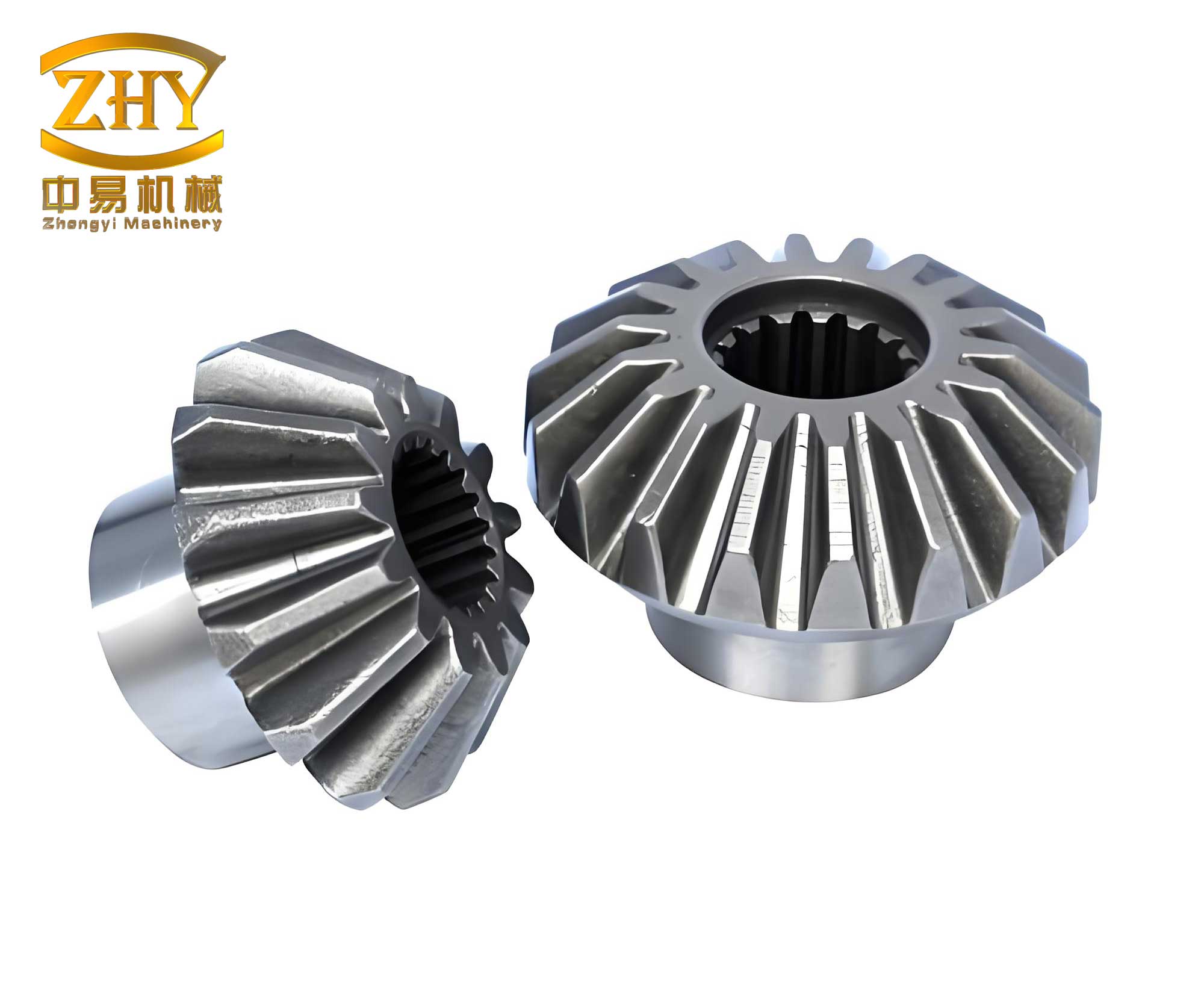
One of the primary causes of early damage in bevel gears is inadequate lubrication. Lubrication is essential for minimizing friction and wear between the gear teeth. When lubrication fails, it results in semi-dry or abrasive friction, accelerating the deterioration of bevel gears. Several sub-factors contribute to this: firstly, the use of不合格 lubricants. Bevel gears require specific gear oils based on operational conditions. The selection depends on gear type, load magnitude, and sliding speed, typically categorized under GL-3, GL-4, or GL-5 standards. Additionally, viscosity grades must align with ambient temperatures; lower temperatures and lighter loads necessitate lower viscosity oils, while higher temperatures and heavier demands require higher viscosity. A summary of recommended lubricants for bevel gears is provided in Table 1.
| Gear Type | Load Condition | Sliding Speed | Recommended Oil Grade | Viscosity Range (cSt at 100°C) |
|---|---|---|---|---|
| Bevel Gears (General) | Moderate | Low to Medium | GL-4 | 10-15 |
| Bevel Gears (Heavy-Duty) | High | Medium to High | GL-5 | 15-20 |
| Bevel Gears (Extreme Conditions) | Very High | High | GL-5 with Additives | 20-25 |
Secondly, contamination of lubricants with dirt or debris introduces abrasive particles that cause磨料磨损. This can be mitigated through rigorous cleaning during assembly and maintenance. Regular oil changes and initial保养 are crucial. The wear rate due to abrasion can be modeled using the following formula, where \( wear\_rate \) is proportional to the concentration of contaminants \( C \) and the hardness of particles \( H \): $$ wear\_rate = k \cdot C \cdot H \cdot load \cdot speed $$ Here, \( k \) is a constant dependent on material properties of the bevel gears. Thirdly, insufficient oil levels lead to starvation and increased friction. Periodic checks of oil levels are essential, and any leaks must be promptly addressed. Common leak sources include loose bolts, damaged seals, and worn阻油圈. A preventive maintenance schedule should include inspections of these components every 200 operating hours for bevel gears systems.
Another significant cause is improper installation and adjustment, which disrupts the normal meshing relationship of bevel gears. The backlash and contact pattern between the small and large bevel gears must be precisely set. Excessive axial play due to worn bearings, such as the 7612 and 7312 bearings, can increase backlash beyond the recommended 0.15 to 0.30 mm. This misalignment leads to localized contact, such as tooth tip or root contact, causing stress concentration and early pitting. The backlash \( B \) can be expressed as a function of axial play \( \Delta_a \) and radial play \( \Delta_r \): $$ B = \sqrt{\Delta_a^2 + \Delta_r^2} $$ For optimal performance, \( B \) should be maintained within manufacturer specifications. Additionally, wear in the变速箱二轴前轴承 shifts the small bevel gear forward, altering the meshing geometry. Similarly, 2712K轴承 wear increases radial play, causing excessive摆动 and misalignment. Regular adjustments are necessary to restore proper meshing. The contact pattern can be evaluated using dye tests, and adjustments should be made to ensure at least 60% contact area on the tooth flanks of bevel gears. Table 2 outlines common adjustment parameters for bevel gears in tractors.
| Parameter | Optimal Range | Measurement Method | Adjustment Frequency |
|---|---|---|---|
| Backlash (齿侧间隙) | 0.15 – 0.30 mm | Dial Indicator | Every 500 hours |
| Axial Play of Rear Axle | 0.10 – 0.25 mm | Feeler Gauge | Every 500 hours |
| Contact Pattern Area | > 60% of tooth flank | Dye Test | After any adjustment |
| Bearing Preload (7312/7612) | Specified by Manufacturer | Torque Wrench | During overhaul |
Operational practices play a crucial role in the longevity of bevel gears. Improper driving habits, such as abrupt clutch engagement and hard braking, impose shock loads on the bevel gears, accelerating fatigue damage. The冲击力 \( F_{shock} \) can be estimated using the equation: $$ F_{shock} = m \cdot a $$ where \( m \) is the effective mass of rotating components and \( a \) is the deceleration or acceleration rate. Minimizing such practices is vital. Furthermore,耕作 patterns affect wear; consistent内翻 operations increase the frequency of右操纵杆 pulls, leading to asymmetric wear on bearings and bevel gears. Alternating between内翻 and外翻 methods can distribute loads evenly. Similarly,偏牵引 operations exacerbate wear on specific bearings, altering the meshing of bevel gears. High-speed operations and frequent turns on small plots also contribute to accelerated wear. Educating operators on proper techniques is essential for protecting bevel gears.
Structural issues in the tractor can indirectly damage bevel gears. Deformation or fracture of the main frame or左右托架 misaligns the entire传动 system, disrupting the meshing of bevel gears. This misalignment increases stress on the gear teeth, leading to premature failure. The stress concentration factor \( K_t \) for misaligned bevel gears can be approximated as: $$ K_t = 1 + \frac{\delta}{t} $$ where \( \delta \) is the misalignment offset and \( t \) is the tooth thickness. Regular inspections of the frame and mounting points are necessary. Loose bolts connecting the变速箱 and后桥壳体 can also cause relative movement, changing the gear alignment. Tightening these bolts to specified torque values during maintenance checks is critical. A torque specification table for critical bolts related to bevel gears housing is provided in Table 3.
| Bolt Location | Bolt Size | Recommended Torque (Nm) | Inspection Interval |
|---|---|---|---|
| Transmission to Rear Casing | M12 | 90-110 | Every 250 hours |
| Rear Axle Bearing Cap | M10 | 50-60 | Every 500 hours |
| Mounting Bracket Bolts | M14 | 120-140 | Every 500 hours |
| Oil Drain Plugs | M16 | 30-40 | Every oil change |
Neglecting adjustments after component replacement is a common oversight. For instance, replacing the 700409轴承 without readjusting the backlash and contact pattern of the bevel gears can lead to misalignment. The small bevel gear may shift rearward, altering the meshing relationship and causing localized stress. After any repair involving bevel gears or associated bearings, a comprehensive adjustment procedure must be followed. This includes checking backlash, axial play, and contact pattern. The adjustment process can be summarized in a step-by-step guide: first, measure the existing backlash using a dial indicator; second, adjust the shims or spacers to achieve the desired value; third, apply marking compound to the teeth and rotate the gears to assess the contact pattern; fourth, fine-tune until the pattern is centered on the tooth flank. This ensures that the bevel gears operate under optimal conditions.
To prevent early damage of bevel gears, a holistic approach encompassing lubrication, adjustment, operation, and structural integrity is required. Implementing a regular maintenance schedule is paramount. This should include daily checks of oil levels, monthly inspections of bolts and seals, and semi-annual adjustments of gear meshing. Using high-quality lubricants tailored to the operating environment can significantly reduce wear. The wear life \( L \) of bevel gears can be estimated using the following empirical formula, which considers multiple factors: $$ L = \frac{C \cdot S_f}{K_l \cdot K_o \cdot K_t} $$ where \( C \) is the material capacity factor, \( S_f \) is the safety factor, \( K_l \) is the lubrication factor, \( K_o \) is the operational factor, and \( K_t \) is the temperature factor. By optimizing these variables, the lifespan of bevel gears can be extended. Additionally, operator training programs should emphasize smooth handling and balanced耕作 techniques to minimize shock loads and asymmetric wear on bevel gears.
In conclusion, the early damage of bevel gears in tractor central drives is a multifaceted issue that stems from lubrication deficiencies, improper adjustments, operational errors, structural problems, and post-repair negligence. Through diligent maintenance, precise adjustments, and educated operation, we can mitigate these risks. The bevel gears are indispensable components, and their protection ensures reliable tractor performance. By adhering to the guidelines outlined here, including the use of recommended lubricants, regular inspections, and proper adjustment protocols, we can enhance the durability of bevel gears and reduce downtime. Remember, proactive care of bevel gears is an investment in the long-term efficiency of agricultural machinery.
Further considerations include the impact of environmental factors such as temperature extremes and dust exposure on bevel gears. In hot climates, lubricants may thin out, reducing their effectiveness, while in cold conditions, they may thicken, increasing drag. Using multi-grade oils with appropriate viscosity indices can help. Dust infiltration accelerates abrasive wear; thus, ensuring密封 integrity is crucial. Regular cleaning of the surrounding areas and using air filters can minimize contamination. Additionally, monitoring vibration and noise levels through sensors can provide early warning signs of bevel gears issues, enabling predictive maintenance. Implementing these advanced strategies further safeguards the bevel gears from premature failure.
Finally, it is worth noting that technological advancements in materials and design are continually improving the resilience of bevel gears. For instance, case-hardened steel alloys and surface treatments like nitriding enhance wear resistance. However, even with superior materials, proper maintenance remains key. I encourage all tractor operators and maintenance personnel to prioritize the care of bevel gears, as they are the heart of the central drive system. By integrating the practices discussed—from lubrication management to operational discipline—we can ensure that bevel gears perform reliably over extended periods, supporting agricultural productivity.