
Bevel gears are critical components in the power transmission systems of mining machinery, such as reducers, where they operate under extreme loads, shock conditions, and in harsh environments. The failure of these bevel gears, particularly through catastrophic cracking, leads to significant operational downtime and economic loss. This article presents a detailed, first-person investigation into the root cause analysis of a specific case involving the circumferential cracking of a mining reducer bevel gear. The analysis integrates macroscopic examination, material characterization, mechanical testing, and microstructural evaluation to pinpoint the failure mechanism and provide actionable recommendations.
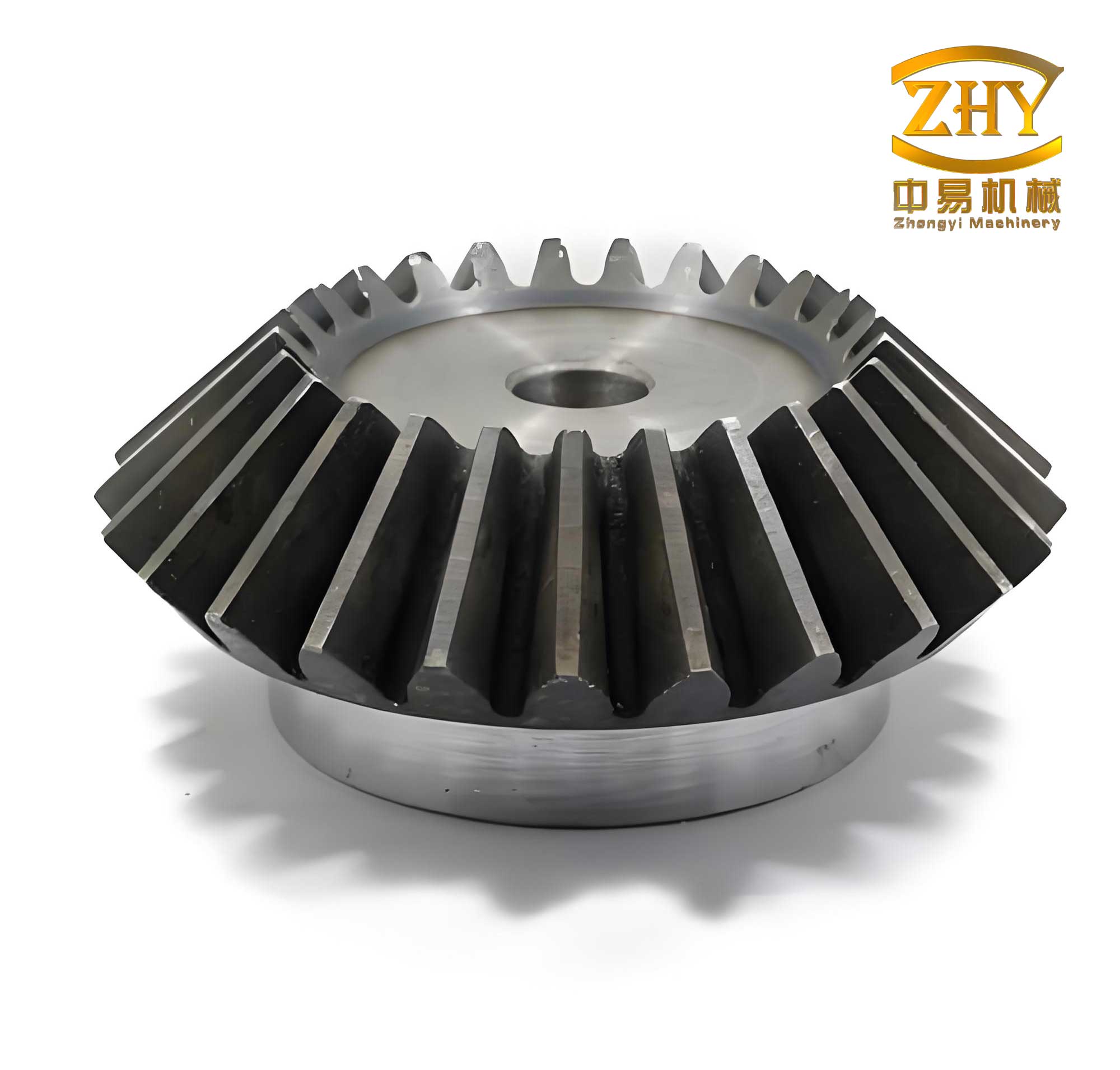
The subject bevel gear, manufactured from 18CrNiMo7-6 low-carbon alloy carburizing steel, exhibited a severe failure during service. The crack manifested as a large, arc-shaped fracture propagating circumferentially around the gear’s outer periphery. Macroscopically, approximately one-third of the crack was located on the upper planar surface near the gear’s hub, while the remaining two-thirds traversed the outer conical face. The crack path appeared relatively straight and sharp, characteristic of quench-induced stress cracking. The depth of the fracture varied, penetrating approximately 30mm inward from depths of 17mm and 45mm from the surface at different locations. This pattern suggested a uniform accumulation of internal stress prior to a sudden, instantaneous release, causing complete failure.
The investigation followed a structured analytical protocol to systematically eliminate potential causes. Samples were extracted from the crack arrest zone (the tip of the crack) using wire electrical discharge machining (EDM) to avoid altering the critical crack initiation site. The methodology encompassed chemical composition analysis, residual gas measurement, hardness profiling, non-destructive testing, and comprehensive metallography.
Experimental Methodology and Initial Findings
A multi-faceted experimental approach was employed to diagnose the failure of the bevel gears. The techniques and their purposes are summarized below:
| Analysis Type | Equipment/Standard | Purpose |
|---|---|---|
| Chemical Composition | SPECTROMAXx Spark OES | Verify material conformity to 18CrNiMo7-6 specification. |
| Residual Gas Analysis | Hon-2000 Gas Analyzer | Measure hydrogen, oxygen, nitrogen content to rule out embrittlement. |
| Hardness Testing | Rockwell C scale, GB/T 230.1 | Profile surface and core hardness against specifications. |
| Non-Destructive Testing | CDX-III Magnetic Particle Inspector, JB/T 5000.15 | Detect surface and near-surface defects like seams or forging cracks. |
| Metallographic Examination | Optical Microscopy (100X-1000X) | Assess non-metallic inclusions, microstructure, crack morphology, and retained austenite. |
Chemical Composition and Material Conformity
The first step was to verify the integrity of the base material. Chemical analysis of a sample from the failed bevel gear was conducted and compared against the original melt certificate and the standard requirements for 18CrNiMo7-6 steel (GB/T 3077-2015). The results are presented in the table below.
| Element | Sample (wt.%) | Melt Record (wt.%) | GB/T 3077-2015 Requirement (wt.%) |
|---|---|---|---|
| C | 0.19 | 0.19 | 0.15-0.21 |
| Si | 0.26 | 0.25 | ≤0.40 |
| Mn | 0.86 | 0.85 | 0.60-0.90 |
| P | 0.016 | 0.018 | ≤0.025 |
| S | 0.001 | 0.001 | ≤0.035 |
| Cr | 1.68 | 1.66 | 1.50-1.80 |
| Ni | 1.60 | 1.65 | 1.40-1.70 |
| Mo | 0.26 | 0.26 | 0.25-0.35 |
| Cu | 0.04 | 0.04 | ≤0.30 |
The composition of the failed bevel gear is fully compliant with the standard. Notably, key alloying elements like Cr, Ni, and Mo, which contribute to hardenability and core strength, are at the mid-to-upper range of the specification. This effectively rules out a gross material mix-up or off-spec chemistry as the primary cause of failure for these bevel gears.
Residual Gas Content and Hardness Profile
To investigate potential embrittlement mechanisms, the content of residual gases, particularly hydrogen which can cause delayed cracking, was measured. The results were compared with factory records.
| Gas | Sample Analysis (ppm) | Production Record (ppm) |
|---|---|---|
| [H] Hydrogen | 1.6 | 1.7 |
| [O] Oxygen | 8 | 7.3 |
| [N] Nitrogen | 82 | 77 |
The gas contents are low and consistent with production records. The hydrogen level is well below typical thresholds (often >5 ppm) associated with hydrogen-induced cracking. Therefore, residual gases are not a contributing factor in the failure of these bevel gears.
Hardness testing was performed on a cross-section, measuring both the surface/case hardness and the core hardness at various points. The specification required a surface hardness of 58-62 HRC and a core hardness of 30-45 HRC for the carburized and hardened bevel gears.
| Location | Specification (HRC) | Measured Values (HRC) | Average (HRC) |
|---|---|---|---|
| Tooth Surface/Case | 58 – 62 | 52, 58, 58, 58 | 58.5* |
| Core (15 points) | 30 – 45 | 44, 39, 38, 39, 39, 39, 35, 36, 38, 35, 34, 34, 33, 31, 35 | 36.5 |
*Note: One low surface reading (52 HRC) may be from an unrepresentative spot or slight decarburization; other points are on target. The core hardness is well within the specified range. The effective case depth was confirmed to be between 1.4-2.0 mm, meeting the requirement. Thus, the basic quenching result for the bevel gears appears nominally correct.
Non-Destructive Testing and Macroscopic Defect Screening
A full 360-degree magnetic particle inspection was performed on the gear surface adjacent to the cracked area. The inspection followed stringent standards for heavy forgings. No relevant indications, such as forging laps, seams, hairline cracks, or flakes (white spots), were detected on or near the surface. This crucial finding eliminates pre-existing material or manufacturing defects in the near-surface region as the origin of the crack in the bevel gear.
Metallographic and Microstructural Analysis
Microscopic examination provided the most critical insights. Samples from the crack tip region and the unaffected base metal were prepared and analyzed.
1. Non-Metallic Inclusions: The microstructure of the base metal and the area immediately adjacent to the crack was examined at 100x magnification per GB/T 10561-2005. The inclusion rating was exceptionally clean:
- Type A (Sulfide): 0.5
- Type B (Alumina): 0.5
- Type C (Silicate): 0.5
- Type D (Globular Oxide): 0.5
- Type Ds (Single, large): None
Furthermore, the crack path showed no association with clusters of inclusions. There was no evidence of decarburization along the crack flanks, indicating the crack formed after the final heat treatment and was not present during forging or prior processing stages of the bevel gears.
2. Microstructure: The microstructure of the base material away from the crack consisted of tempered martensite in the case and a mixture of low-carbon martensite and bainite in the core, which is typical and acceptable for carburized 18CrNiMo7-6 bevel gears. No network or abnormal agglomeration of carbides was observed.
3. Retained Austenite (RA): A pivotal discovery was made when examining the microstructure at higher magnifications. Both the failed bevel gear sample and a witness coupon from the same heat treatment batch revealed a significant amount of retained austenite in the case region. Quantitative analysis according to relevant standards rated the retained austenite content as Level 6, indicating an excessively high volume fraction. Retained austenite is a soft, metastable phase. Its presence in large quantities negatively impacts surface hardness, reduces contact fatigue strength, and can lead to dimensional instability. More critically for stress analysis, the transformation of retained austenite to martensite over time or under stress can induce significant secondary tensile stresses.
The key microstructural findings are summarized below:
| Microstructural Feature | Observation | Implication for Bevel Gears |
|---|---|---|
| Inclusion Content | Very low, all types ≤0.5 | Rules out inclusion-initiated fracture. Material cleanness is good. |
| Crack Path Decarb | Absent | Crack occurred post-final heat treatment, not during forging. |
| Base Microstructure | Normal tempered martensite (case) & martensite/bainite (core) | General heat treatment response is normal. |
| Retained Austenite (RA) | Excessive (Level 6) | Lowers surface strength, creates instability, source of transformation stress. |
Heat Treatment Process Review and Operational Discrepancies
An audit of the production heat treatment records uncovered significant procedural issues that correlate directly with the metallurgical findings. The bevel gears in question were processed according to a carburizing and direct quenching cycle. The records revealed two major anomalies:
- Mixed-Load Furnace Charge: The 18CrNiMo7-6 bevel gears were carburized in the same furnace load with components made from 20CrMnTi steel. The furnace cycle parameters (temperature, carbon potential, time) were set primarily for 20CrMnTi, which has different alloy content and hardenability characteristics compared to 18CrNiMo7-6. This non-optimal cycle for the nickel-chromium-molybdenum bevel gears likely contributed to the excessive retention of austenite.
- Post-Quench Handling Delays: The specified procedure after quenching required a brief period of furnace cooling for oil drainage (<10 minutes), followed by transfer to a washing machine for a 45-minute clean in 65°C warm water, and finally immediate tempering. The records showed the oil drainage step lasted for 4553 seconds (over 75 minutes), significantly exceeding the guideline. Furthermore, the time lag between the end of washing and the start of the tempering cycle was calculated to exceed two hours.
These operational errors created a perfect storm for failure. The sub-optimal carburizing/quenching cycle for 18CrNiMo7-6 led to high levels of unstable retained austenite in the case of the bevel gears. The prolonged delays before tempering allowed for two detrimental processes: (a) the relaxation of beneficial compressive quenching stresses, and (b) the possible gradual or stress-induced transformation of some retained austenite to untempered martensite. This transformation is accompanied by a volume expansion, generating localized tensile stresses.
The combined effect can be described by considering the superposition of stresses. The primary quenching stresses $sigma_{quench}$ are often tensile in the core and compressive at the surface. The transformation stress from retained austenite change $sigma_{trans}$ is locally tensile. The total stress $sigma_{total}$ at a potential flaw or stress concentrator can be modeled as:
$$sigma_{total} = sigma_{quench} + sigma_{trans} + K_t cdot sigma_{applied}$$
where $K_t$ is the stress concentration factor at a geometric or microstructural feature, and $sigma_{applied}$ is the operational stress. The delayed tempering allowed $sigma_{quench}$ to relax and $sigma_{trans}$ to develop, potentially shifting the local stress state to a critical tensile level.
The crack initiation likely started at a micro-scale stress concentrator—potentially a grinding mark, a slight microstructural inhomogeneity, or a region of particularly high retained austenite. Once initiated, the high internal tensile stress stored in the bevel gear drove an unstable, rapid crack propagation, resulting in the observed catastrophic circumferential fracture. The crack’s straight, non-branching path is classic for a single-event, high-stress overload fracture as opposed to a progressive fatigue failure.
Conclusion and Recommendations for Bevel Gear Manufacturing
Based on the comprehensive multi-technique analysis, the root cause of the mining reducer bevel gear cracking is conclusively determined not to be a base material defect. The chemical composition, gas content, inclusion rating, and core microstructure were all within acceptable limits. The failure was primarily induced by deficiencies in the heat treatment process and subsequent handling.
Root Cause Summary: The bevel gears were subjected to a non-optimal carburizing/quenching cycle (due to mixed loading), resulting in an excessively high and unstable level of retained austenite in the case. Compounding this, protracted delays in the post-quench washing and, critically, before the tempering operation, allowed for the detrimental relaxation of quenching stresses and the potential for transformation-induced stresses. This created a state of high internal tensile stress. A localized stress concentractor acted as an initiation site, and the accumulated energy was released instantaneously, causing a rapid, brittle fracture through the bevel gear’s cross-section.
Technical Recommendations: To prevent recurrence of such failures in critical bevel gears, the following measures are strongly recommended:
- Implement Sub-Zero (Cryogenic) Treatment: For high-alloy steels like 18CrNiMo7-6 used in demanding bevel gear applications, incorporate a deep cryogenic treatment immediately after quenching and before tempering. This process promotes the near-complete transformation of retained austenite to martensite, thereby stabilizing dimensions, increasing surface hardness, and eliminating a major source of transformation stress. The transformation during cryo-treatment is more controlled than unstable post-quench transformation.
- Optimize Furnace Loading Policy: Strictly enforce furnace loads containing components of identical or very similar material grades and hardenability. Develop and validate separate heat treatment recipes for 18CrNiMo7-6 bevel gears versus 20CrMnTi components to ensure both achieve their respective optimal microstructures (minimized RA, proper case depth).
- Standardize and Control Post-Quench Procedures: Establish and rigorously adhere to precise time limits for all steps between quenching and tempering. The “chain” from quench tank to tempering furnace must be as short and controlled as possible, ideally within one hour, to prevent undesirable stress relaxation and microstructural changes. Automate timing controls where feasible.
- Enhance Process Monitoring and Training: Implement real-time data logging for all heat treatment steps (temperatures, times, carbon potential). Provide targeted training for furnace operators on the critical importance of timing, load segregation, and the specific requirements of high-performance bevel gear steels like 18CrNiMo7-6.
By addressing these process control issues, the manufacturing integrity and service reliability of mining reducer bevel gears can be significantly enhanced, reducing the risk of costly in-service failures.