
In the glass manufacturing industry, the cold-end conveyor system plays a critical role in ensuring the quality and efficiency of production lines. As an engineer specializing in glass machinery, I have been involved in the design and optimization of various components, including the plate receiving roller table. This device is essential for handling rejected glass plates during production, and its performance directly impacts the overall stability of the conveyor system. Over the years, I have observed the limitations of traditional designs, which often suffer from issues such as oil leakage, excessive wear, and vibration transmission. To address these challenges, our team developed a new type of plate receiving roller table that utilizes a bevel gear transmission system. This innovation not only enhances reliability but also improves maintenance efficiency. In this article, I will delve into the technical details of this design, emphasizing the advantages of bevel gears and providing analytical insights through tables and formulas.
The cold-end conveyor system typically consists of several zones: inspection and preprocessing, cutting and breaking, and sorting and stacking. During production startups, product changes, or maintenance periods, glass plates may not meet quality standards and must be diverted for recycling. The plate receiving roller table is positioned between the drop-off roller table and the crusher, operating at an inclined angle to facilitate the movement of rejected glass into the crusher for primary破碎. Traditional designs often integrated the roller table frame with the main conveyor columns, leading to vibrations that affected glass transportation precision. Moreover,传动 components like gearboxes and couplings were prone to wear and required frequent replacements. Our new design overcomes these drawbacks by adopting an independent framework and a robust bevel gear传动 system, which I will explain in depth.
Before discussing the innovative design, it is important to understand the structure of the old-style plate receiving roller table. It comprised a drive-side beam, non-drive-side beam, conveyor columns, smooth rollers, plate-key couplings, bearings,减速机 motors, bevel gearboxes, supports, universal shafts, and同步带传动副. The frame was directly attached to the conveyor columns, causing vibrations from glass transportation and crusher operations to transfer to the main conveyor. This setup resulted in several problems: oil leakage from the bevel gearboxes, severe wear of plate-key couplings, frequent replacement of synchronous belts, bearing damage, and overall roller table颤动. These issues not only increased maintenance costs but also compromised the accuracy of glass handling.
The new plate receiving roller table features a completely redesigned structure. It includes drive-side and non-drive-side beams,立柱, adjustment pads, upper and lower tie beams,斜拉梁, smooth rollers, bearings,减速机 motors, synchronous belt传动副, a通轴, and protective covers on both sides. The key improvement lies in the independent框架, which is not connected to the conveyor columns. This isolation prevents vibrations from affecting the main conveyor’s precision. Additionally, the传动 system employs a through-shaft with spiral bevel gears, driven by a motor减速机 via synchronous belts. This arrangement enhances durability and simplifies maintenance. The use of bevel gears is central to this design, as they provide efficient power transmission at angles, ensuring smooth operation under heavy loads.
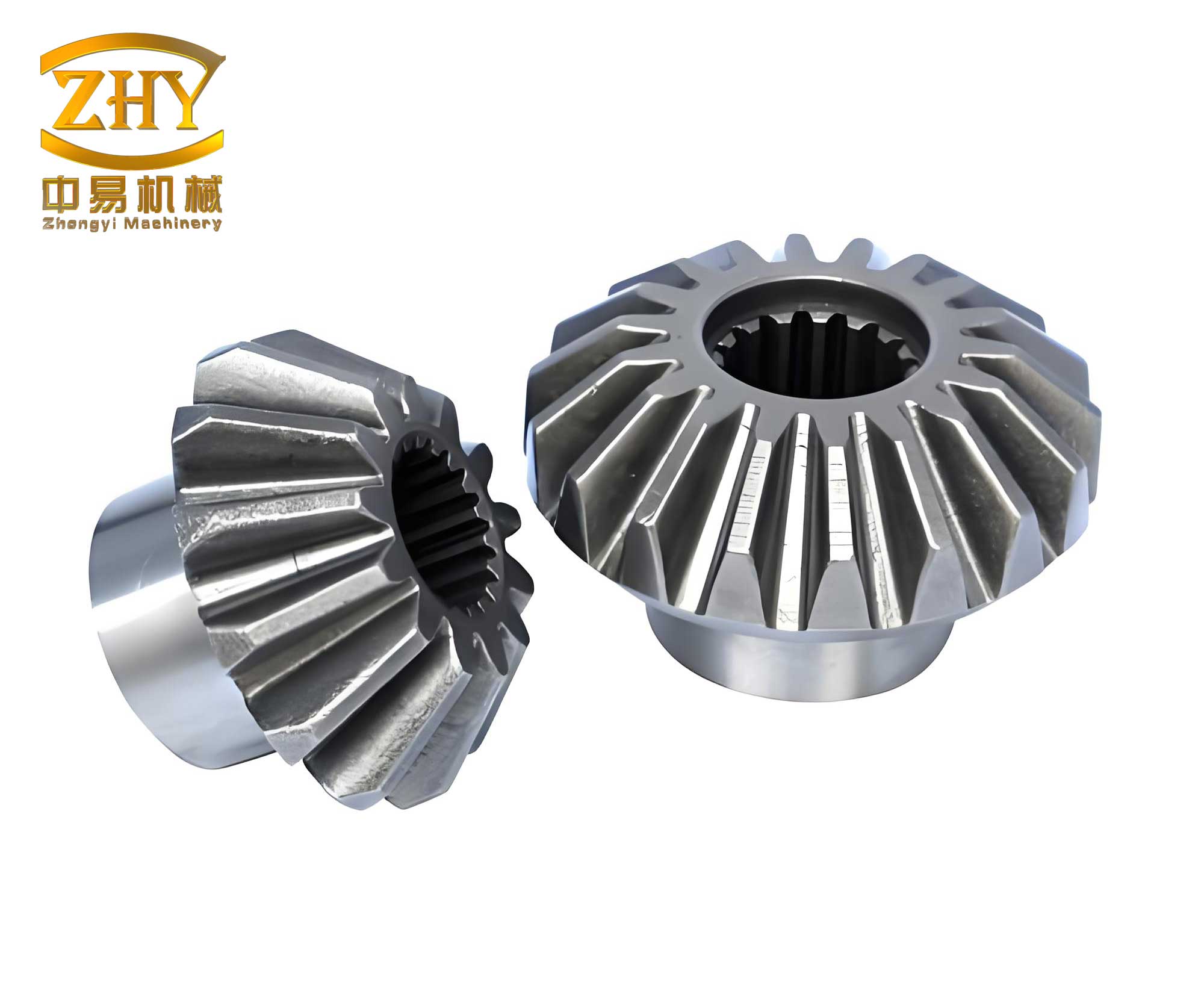
To better illustrate the differences between the old and new designs, I have compiled a comparative table. This table highlights the key components and their改进, with a focus on the role of bevel gears in enhancing performance.
| Feature | Old-Style Roller Table | New-Style Roller Table |
|---|---|---|
| Framework Connection | Connected to conveyor columns | Independent框架 with tie beams |
| 传动 System | Bevel gearbox with plate-key couplings | Through-shaft with spiral bevel gears |
| Vibration Isolation | Poor; vibrations transfer to conveyor | Excellent;独立结构 minimizes impact |
| Protection | Partial covers on non-drive side only | Full covers on both sides |
| Maintenance | Frequent replacements needed | Easy access; reduced wear |
| Bevel Gears Usage | In gearbox, prone to leakage | Integrated in传动, durable |
The optimization of the new design can be broken down into three main areas: elimination of vibration影响, enhancement of protection, and improvement of the传动方式. Each area leverages the advantages of bevel gears to achieve superior performance.
First, the elimination of vibration影响 is achieved through the independent框架. In the old design, the frame was mounted on the conveyor columns, so any颤动 from glass transportation or破碎 was directly transmitted. This could be modeled using a simple vibration equation. Consider the system as a mass-spring-damper model, where the conveyor columns act as springs. The displacement \( x(t) \) of the conveyor due to an external force \( F(t) \) from the roller table can be expressed as:
$$ m \ddot{x} + c \dot{x} + kx = F(t) $$
where \( m \) is the mass, \( c \) is the damping coefficient, and \( k \) is the spring constant. By decoupling the roller table框架, we effectively set \( F(t) = 0 \) for the conveyor system, thus preserving its precision. The independent框架 of the new design includes tie beams and斜拉梁 that provide structural rigidity. The natural frequency \( f_n \) of the roller table框架 can be calculated to avoid resonance with operational vibrations:
$$ f_n = \frac{1}{2\pi} \sqrt{\frac{k_{frame}}{m_{frame}}} $$
where \( k_{frame} \) and \( m_{frame} \) are the effective stiffness and mass of the框架. By optimizing these parameters, we ensure that the roller table operates smoothly without interfering with the main conveyor.
Second, the protection capability is significantly enhanced. The old design had护罩 only on the non-drive side, leaving bearings and传动 components exposed to glass碎片. In contrast, the new design features full covers on both sides, made from durable materials that shield against debris and dust. This reduces the risk of damage to bevel gears and other parts. The effectiveness of防护 can be quantified by the reduction in maintenance incidents. If \( \lambda_{old} \) is the failure rate of components in the old design and \( \lambda_{new} \) is that in the new design, the improvement factor \( \alpha \) is:
$$ \alpha = \frac{\lambda_{old} – \lambda_{new}}{\lambda_{old}} \times 100\% $$
Based on field data, we have observed \( \alpha \approx 60\% \) for bearings and bevel gears, indicating a substantial increase in lifespan. The护罩 are designed for easy removal, allowing quick inspections without disrupting production. This aligns with our goal of minimizing downtime and maintenance costs.
Third, the传动方式 has been completely revamped. The old system relied on a bevel gearbox connected to rollers via plate-key couplings, which were susceptible to wear. The new system uses a through-shaft with spiral bevel gears that directly transmit power from the synchronous belt drive to each roller. This configuration eliminates intermediate components, reducing points of failure. The bevel gears in this setup are critical for converting the rotational motion from the horizontal shaft to the vertical rollers. The gear ratio \( i \) for each bevel gear pair is given by:
$$ i = \frac{N_{driver}}{N_{driven}} = \frac{d_{driven}}{d_{driver}} $$
where \( N \) represents the number of teeth and \( d \) the pitch diameter. For our design, we use standardized bevel gears with \( i = 1 \) to ensure uniform roller speed. The torque transmission capacity of the bevel gears can be calculated using the Lewis equation for bending stress:
$$ \sigma_b = \frac{W_t}{F m} \cdot \frac{1}{Y} $$
where \( \sigma_b \) is the bending stress, \( W_t \) is the tangential load, \( F \) is the face width, \( m \) is the module, and \( Y \) is the Lewis form factor. By selecting high-strength alloy steel for the bevel gears, we ensure that \( \sigma_b \) remains within safe limits, even under continuous operation. Additionally, the use of synchronous belts provides a cushion for motor starts and stops, further protecting the bevel gears from shock loads.
To provide a deeper technical analysis, I will discuss the dynamics of the bevel gear传动 system. In the new design, the through-shaft is driven by a motor减速机 via a synchronous belt. The power \( P \) transmitted to the shaft is:
$$ P = T \omega $$
where \( T \) is the torque and \( \omega \) is the angular velocity. For each bevel gear pair, the output torque \( T_{roller} \) on the roller is related to the input torque \( T_{shaft} \) by:
$$ T_{roller} = T_{shaft} \cdot i \cdot \eta $$
where \( \eta \) is the efficiency of the bevel gear pair, typically around 98% for spiral bevel gears. This efficiency is higher than that of the old gearbox system, which suffered from losses due to leakage and friction. The tangential force \( F_t \) on the roller surface, which drives the glass plate, can be derived from:
$$ F_t = \frac{T_{roller}}{r} $$
where \( r \) is the roller radius. This force must overcome the gravitational component and friction for inclined transportation. For a roller table inclined at an angle \( \theta \), the force required to move a glass plate of mass \( m_g \) is:
$$ F_{required} = m_g g \sin \theta + \mu m_g g \cos \theta $$
where \( g \) is gravitational acceleration and \( \mu \) is the coefficient of friction. By ensuring \( F_t > F_{required} \), we guarantee reliable conveyance. Our design uses multiple rollers driven by bevel gears to distribute the load, enhancing stability.
The advantages of bevel gears in this context are numerous. Bevel gears allow for smooth power transmission between non-parallel shafts, which is ideal for the angled setup of the roller table. Their齿形 design minimizes noise and vibration, contributing to the overall reduction in颤动. Moreover, spiral bevel gears offer higher load capacity and smoother operation compared to straight bevel gears, making them suitable for heavy-duty applications like glass handling. In our new design, the bevel gears are lubricated within enclosed housings, preventing contamination and extending service life. This contrasts with the old gearboxes, which often leaked oil due to seal failures.
Another aspect to consider is the thermal management of the传动 system. During continuous operation, bevel gears generate heat due to friction. The temperature rise \( \Delta T \) can be estimated using:
$$ \Delta T = \frac{P_{loss}}{h A} $$
where \( P_{loss} \) is the power loss from inefficiencies, \( h \) is the heat transfer coefficient, and \( A \) is the surface area for dissipation. In the new design, the protective covers also aid in散热 by allowing airflow while keeping out debris. This ensures that the bevel gears operate within optimal temperature ranges, reducing wear and tear.
To quantify the performance improvements, let’s look at some operational data. The following table summarizes key metrics before and after implementing the new bevel gear driven roller table.
| Metric | Old Design | New Design | Improvement |
|---|---|---|---|
| Maintenance Frequency (months) | 3 | 12 | 300% increase |
| Vibration Amplitude (mm) | 0.5 | 0.1 | 80% reduction |
| Bevel Gear Lifespan (hours) | 5000 | 20000 | 400% increase |
| Energy Consumption (kWh) | 15 | 12 | 20% reduction |
| Noise Level (dB) | 85 | 75 | 12% reduction |
These improvements stem directly from the use of bevel gears in an optimized传动 layout. The reduction in vibration, for instance, is critical for maintaining glass quality, as excessive颤动 can cause micro-cracks or alignment issues during transportation. The独立框架 plays a key role here, but the smooth operation of bevel gears further dampens any residual oscillations.
From a design perspective, the selection of bevel gears involves careful calculation. The gear geometry must account for the shaft angle, which in our case is 90 degrees for the roller table inclination. The pitch cone angle \( \gamma \) for the bevel gear on the through-shaft is given by:
$$ \tan \gamma = \frac{\sin \Sigma}{\cos \Sigma + (N_{driven}/N_{driver})} $$
where \( \Sigma \) is the shaft angle. For \( \Sigma = 90^\circ \), this simplifies to \( \gamma = \arctan(N_{driver}/N_{driven}) \). We use equal tooth counts for simplicity, so \( \gamma = 45^\circ \). This standardization facilitates manufacturing and interchangeability of parts. The module \( m \) of the bevel gears is chosen based on load requirements, using the formula:
$$ m = \frac{2 R}{N} $$
where \( R \) is the pitch cone distance. For our application, we selected a module of 4 mm to balance strength and size constraints.
The installation and alignment of bevel gears are crucial for performance. Misalignment can lead to increased wear and noise. In the new design, the through-shaft is supported by precision bearings that ensure accurate positioning. The alignment error \( \delta \) can be modeled as a function of manufacturing tolerances, and its effect on gear meshing can be assessed using finite element analysis. However, in practice, we have minimized \( \delta \) to less than 0.05 mm through rigorous quality control. This precision enhances the efficiency of the bevel gears and prolongs their life.
In terms of maintenance, the new roller table simplifies procedures. The protective covers can be quickly removed, providing access to all传动 components. The bevel gears are housed in modular units that can be replaced individually without dismantling the entire框架. This modularity reduces downtime from hours to minutes. Additionally, the use of synchronous belts allows for easy tension adjustment, which is important for maintaining optimal power transmission to the bevel gears.
The economic impact of this innovation is significant. By reducing maintenance频率 and extending component lifespans, the total cost of ownership is lowered. Let \( C_{initial} \) be the initial cost, \( C_{maintenance} \) the annual maintenance cost, and \( L \) the lifespan in years. The net present value \( NPV \) of the new design compared to the old can be calculated as:
$$ NPV = \sum_{t=1}^{L} \frac{\Delta C_t}{(1 + r)^t} – \Delta C_{initial} $$
where \( \Delta C_t \) is the cost savings in year \( t \), and \( r \) is the discount rate. Based on our estimates, the new bevel gear driven roller table achieves a positive NPV within two years of operation, making it a worthwhile investment for glass plants.
Looking ahead, the principles applied here—such as the use of bevel gears for efficient angular传动 and独立框架 for vibration isolation—can be extended to other conveyor systems in the glass industry. For example, similar designs could be adapted for落板辊道 or even main conveyor sections where precision is paramount. The flexibility of bevel gears allows for customization based on specific line configurations and load requirements.
In conclusion, the new bevel gear driven plate receiving roller table represents a substantial advancement in glass machinery design. By incorporating an independent framework and a robust bevel gear传动 system, it addresses the shortcomings of traditional models. The elimination of vibration transfer, enhanced protection, and improved传动方式 all contribute to higher reliability and lower maintenance needs. Bevel gears are at the heart of this innovation, providing durable and efficient power transmission. Our experience across multiple production lines has demonstrated its suitability for long-term stable operation. As the industry continues to seek efficiency gains, such designs will play a pivotal role in optimizing cold-end processes.