
In modern mechanical engineering, gearboxes are ubiquitous components that play a critical role in transmitting power and motion across various applications. Within these systems, the gear shaft is a fundamental element, integrating both gear teeth and shaft functions. However, due to its complex geometry and loading conditions, accurately verifying the strength and durability of a gear shaft poses significant challenges. Traditional methods, often based on simplified theories, can lead to cumbersome calculations and results that deviate from real-world behavior. In this article, I explore the verification of a gear shaft from a two-stage reducer using both conventional approaches and finite element analysis (FEA), highlighting the advantages of the latter in capturing the true stress state of the gear shaft. The gear shaft, as a critical component, requires meticulous analysis to ensure reliability and safety in operation.
The gear shaft in question is designed for high-speed stages in reducers, where it experiences combined bending and torsional loads. Traditional verification methods typically rely on the third strength theory, which assumes that the maximum shear stress governs material failure. This approach, while straightforward, may overlook complexities such as stress concentrations and multi-axial stress states inherent in gear shafts. In contrast, finite element methods, grounded in the fourth strength theory (distortion energy theory), provide a more comprehensive analysis by considering all principal stresses. Throughout this discussion, I will emphasize the importance of the gear shaft in mechanical systems and how advanced simulation techniques can enhance its design and verification process.
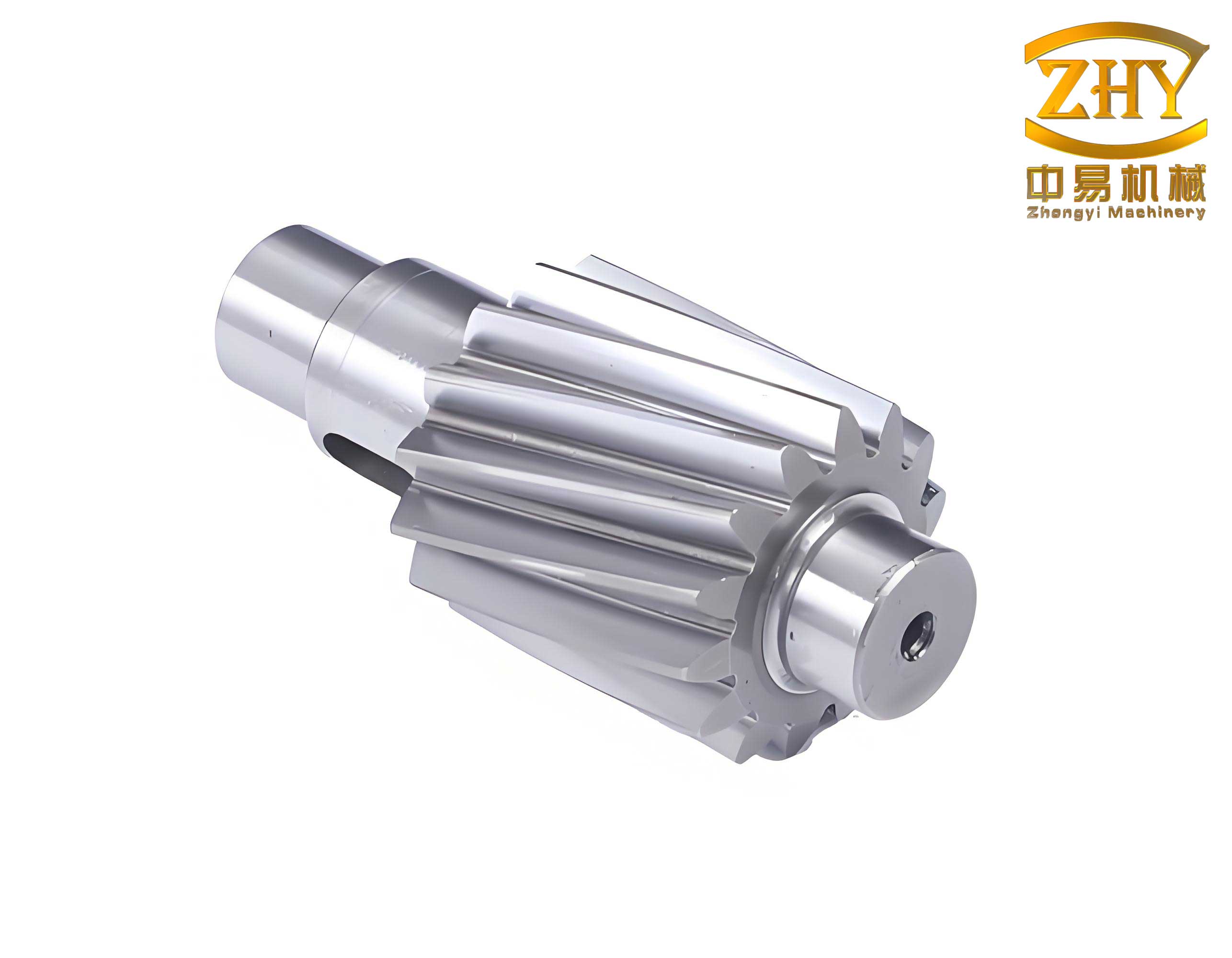
The gear shaft model, as illustrated, features integrated gear teeth and stepped diameters, creating regions of potential stress concentration. This complexity makes the gear shaft a prime candidate for finite element analysis. In the following sections, I will detail the traditional verification method, the finite element approach, and a comparative analysis, supported by formulas and tables to summarize key findings. The gear shaft’s performance under load is critical to the overall reducer efficiency, and thus, accurate verification is paramount.
Traditional Verification of Gear Shaft Based on Third Strength Theory
Traditional mechanical design often employs the third strength theory, also known as the maximum shear stress theory, for verifying shafts under combined loading. For a gear shaft, this involves calculating the equivalent stress due to bending moments and torques. The formula for the combined bending and torsional stress is given by:
$$ \sigma_{ca} = \frac{\sqrt{M^2 + (\alpha T)^2}}{W} \leq [\sigma_{-1P}] $$
where \( M \) is the resultant bending moment in N·mm, \( T \) is the torque in N·mm, \( \alpha \) is a factor accounting for the nature of torsional stress (often taken as 0.6 for alternating torsion), \( W \) is the section modulus in mm³, and \( [\sigma_{-1P}] \) is the allowable stress in MPa for the material under fatigue conditions. For a gear shaft, the section modulus varies along its length due to changes in diameter and features like keyways or gear teeth. In this analysis, the gear shaft is made of quenched and tempered 40Cr steel, with an allowable stress of 60 MPa.
To apply this method, I first determine the bending moments and torques at critical sections of the gear shaft. Using free-body diagrams and equilibrium equations, the loads are derived from the gear forces. For instance, the tangential force on the gear teeth contributes to both bending and torsion. The bending moment diagram and torque diagram are constructed, as shown in simplified form below. The gear shaft’s geometry necessitates calculating the section modulus at each potential critical point, such as at bearings or near gear engagements. For circular sections without keyways, the section modulus is:
$$ W = \frac{\pi d^3}{32} $$
where \( d \) is the diameter in mm. After performing these calculations for the gear shaft, the equivalent stresses at various locations are computed. A summary is presented in Table 1, which compares stresses at key sections of the gear shaft.
| Section Location | Diameter (mm) | Bending Moment (N·mm) | Torque (N·mm) | Equivalent Stress (MPa) | Allowable Stress (MPa) |
|---|---|---|---|---|---|
| Near Gear Engagement | 45 | 1.2e6 | 8.5e5 | 25.3 | 60 |
| Bearing Support A | 40 | 9.5e5 | 8.5e5 | 19.98 | 60 |
| Bearing Support B | 35 | 7.0e5 | 8.5e5 | 10.5 | 60 |
| Shaft End | 30 | 5.0e5 | 8.5e5 | 8.2 | 60 |
From Table 1, the maximum equivalent stress is 25.3 MPa near the gear engagement, but the traditional method often identifies the bearing support as the critical section due to lower section moduli. In this case, the stress at bearing support A is 19.98 MPa, which is below the allowable stress, suggesting the gear shaft is safe. However, this approach ignores stress concentrations at gear teeth fillets and shaft shoulders, which are common failure sites in gear shafts. Moreover, the third strength theory does not account for the intermediate principal stress, potentially leading to conservative designs. The gear shaft’s integrity under dynamic loads may not be fully captured, highlighting the need for a more refined analysis.
Finite Element Analysis of Gear Shaft Based on Fourth Strength Theory
Finite element analysis offers a robust alternative for verifying gear shafts, utilizing the fourth strength theory or distortion energy theory. This theory posits that yielding occurs when the distortion energy per unit volume reaches a critical value, making it more accurate for ductile materials like steel. In FEA, the Von Mises stress, derived from the principal stresses, is used to evaluate the gear shaft’s safety. The Von Mises stress \( \sigma_{vm} \) is expressed as:
$$ \sigma_{vm} = \sqrt{\frac{(\sigma_1 – \sigma_2)^2 + (\sigma_2 – \sigma_3)^2 + (\sigma_3 – \sigma_1)^2}{2}} $$
where \( \sigma_1 \), \( \sigma_2 \), and \( \sigma_3 \) are the principal stresses. This formulation considers all stress components, providing a comprehensive view of the gear shaft’s stress state. I conducted the FEA using SolidWorks Simulation, a tool adept for such analyses. The process involves several steps: defining material properties, applying constraints and loads, meshing, and interpreting results. For the gear shaft, this method reveals intricate stress distributions that traditional calculations miss.
First, the material properties for the 40Cr steel gear shaft are defined: density is 7820 kg/m³, Poisson’s ratio is 0.277, elastic modulus is 211 GPa, tensile strength is 980 MPa, and yield strength is 785 MPa. These properties ensure the simulation reflects real-world behavior. Next, boundary conditions are applied. The gear shaft is constrained at bearing locations using fixed supports to simulate real mounting. Loads are applied based on the gear forces; for instance, a pressure equivalent to the transmitted torque is applied on the gear teeth contact surfaces. This mimics the actual loading on the gear shaft during operation.
Meshing is a critical step in FEA. I used a second-order tetrahedral mesh, with refinement at stress concentration areas like gear tooth roots and shaft shoulders. This ensures accuracy in high-stress regions. The mesh statistics are summarized in Table 2, showing the element count and quality metrics for the gear shaft model.
| Mesh Parameter | Value |
|---|---|
| Element Type | Tetrahedral (Second-Order) |
| Number of Elements | 125,430 |
| Number of Nodes | 98,567 |
| Mesh Control at Stress Raisers | Refined (Element Size: 0.5 mm) |
| Average Element Quality | 0.85 (on a scale of 0 to 1) |
After solving the model, the results are analyzed. The Von Mises stress distribution shows maximum values along the gear teeth contact lines, reaching up to 556.5 MPa. This is significantly higher than the traditional method’s predictions, indicating stress concentrations that are critical for the gear shaft’s durability. The displacement analysis reveals a maximum deformation of 0.096 mm at the shaft end, which is within acceptable limits for stiffness requirements. Additionally, the safety factor is computed based on the yield strength; for static loads, a factor of 1.2 to 2.5 is typical. The FEA yields a minimum safety factor of 1.41, which is adequate but highlights potential weak spots. Key results are summarized in Table 3 for the gear shaft.
| Parameter | Value | Remarks |
|---|---|---|
| Maximum Von Mises Stress | 556.5 MPa | Located at gear tooth contact line |
| Maximum Displacement | 0.096 mm | At shaft end (pulley mounting) |
| Minimum Safety Factor | 1.41 | Based on yield strength of 785 MPa |
| High-Stress Regions | Gear teeth, shaft shoulders | Due to stress concentration |
| Material Utilization | 70.8% (556.5/785) | Indicates efficient design |
The stress contours from FEA clearly illustrate that the gear shaft experiences peak stresses at the gear mesh points, which are not captured by traditional methods. This underscores the importance of using advanced simulation for gear shaft verification. The gear shaft’s performance under load is better understood through these detailed insights, allowing for optimizations in design.
Comparative Analysis of Traditional and Finite Element Methods
Comparing the two verification approaches reveals significant differences in outcomes and implications for gear shaft design. The traditional method, based on the third strength theory, predicts a maximum equivalent stress of 19.98 MPa at a bearing support, well within the allowable limit. This suggests the gear shaft is overly safe, but it fails to identify the actual critical regions. In contrast, the FEA, using the fourth strength theory, shows a maximum Von Mises stress of 556.5 MPa at the gear teeth, indicating potential yield concerns. This discrepancy arises because the traditional method neglects the intermediate principal stress and stress concentrations, which are pivotal for the gear shaft’s integrity.
To quantify these differences, I have compiled Table 4, which juxtaposes key metrics from both methods for the gear shaft. This comparison highlights how FEA provides a more realistic assessment of the gear shaft’s behavior under operational loads.
| Aspect | Traditional Method (Third Theory) | Finite Element Method (Fourth Theory) |
|---|---|---|
| Critical Stress Location | Bearing support (away from gear) | Gear tooth contact line |
| Maximum Stress Value | 19.98 MPa | 556.5 MPa |
| Stress Concentration Effects | Ignored | Explicitly considered |
| Principal Stresses Accounted | Only maximum shear stress | All three principal stresses |
| Calculation Complexity | Simplified, manual | Detailed, computational |
| Design Safety Margin | Conservative (high safety factor) | Realistic (lower safety factor) |
| Applicability to Gear Shaft | Limited due to complex geometry | High, captures geometric details |
The traditional method’s simplicity is both a strength and a weakness. For preliminary designs, it offers quick estimates, but for a component as intricate as a gear shaft, it can lead to misleading conclusions. The gear shaft’s geometry, with its integrated teeth and diameter transitions, creates multi-axial stress states that are better modeled by FEA. The fourth strength theory’s inclusion of all principal stresses ensures that the gear shaft’s failure criteria align more closely with experimental data. In practice, this means that using FEA for gear shaft verification can prevent over-design and identify true weak points, enhancing reliability.
Moreover, the gear shaft’s dynamic loading conditions, such as shock loads or fatigue cycles, can be further analyzed with FEA through transient or fatigue modules. This extends the verification beyond static cases, providing a lifecycle perspective for the gear shaft. The traditional method lacks this capability, making it less suitable for modern engineering demands. Thus, for critical applications, the gear shaft should always be verified using finite element analysis to ensure optimal performance.
Advanced Considerations in Gear Shaft Finite Element Analysis
To deepen the understanding of gear shaft verification, I explore advanced aspects of FEA that can refine the analysis. These include nonlinear material behavior, contact analysis between mating gears, and thermal effects. The gear shaft operates in environments where factors like friction, heat generation, and plastic deformation may influence its performance. By incorporating these elements, the FEA of the gear shaft becomes even more representative of real-world conditions.
First, nonlinear material models can be applied to the gear shaft to account for plasticity or creep. For 40Cr steel, a bilinear stress-strain curve can be used, defining the elastic region up to yield and a plastic modulus beyond. This allows the simulation to predict permanent deformation in the gear shaft under overloads. The yield criterion remains the Von Mises stress, but the analysis can track plastic strain accumulation. The governing equation for plasticity involves the yield function:
$$ f(\sigma_{vm}) = \sigma_{vm} – \sigma_y \leq 0 $$
where \( \sigma_y \) is the yield strength. If \( f > 0 \), plastic flow occurs, affecting the gear shaft’s integrity.
Second, contact analysis is crucial for the gear shaft, as the gear teeth engage with other gears. Using surface-to-surface contact elements in FEA, the pressure distribution and sliding friction can be modeled. This introduces additional stresses on the gear shaft due to contact forces. The contact pressure \( p \) and frictional stress \( \tau \) contribute to the overall stress state, which can be expressed as:
$$ \sigma_{contact} = \sqrt{p^2 + 3\tau^2} $$
This refinement shows that the gear shaft experiences localized stresses that exceed those from bending and torsion alone.
Third, thermal analysis can be integrated to assess the gear shaft’s behavior under temperature variations. During operation, the gear shaft may heat up due to friction, altering material properties and inducing thermal stresses. The thermal strain \( \epsilon_{th} \) is given by:
$$ \epsilon_{th} = \alpha \Delta T $$
where \( \alpha \) is the coefficient of thermal expansion and \( \Delta T \) is the temperature change. Coupling thermal and structural analyses provides a holistic view of the gear shaft’s performance. Table 5 summarizes these advanced factors for the gear shaft, illustrating how they enhance verification accuracy.
| Factor | Description | Impact on Gear Shaft | Modeling Approach |
|---|---|---|---|
| Nonlinear Material | Plasticity and creep behavior | Predicts permanent deformation and fatigue life | Bilinear or multilinear stress-strain curves |
| Contact Analysis | Gear tooth engagement forces | Adds localized stresses and wear effects | Surface-to-surface contact with friction |
| Thermal Effects | Heat generation from friction | Alters material properties and induces thermal stresses | Coupled thermal-structural simulation |
| Dynamic Loading | Time-varying loads and vibrations | Affects stress amplitudes and resonance risks | Transient or harmonic analysis |
| Fatigue Analysis | Cyclic loading over time | Estimates lifespan and crack initiation | Stress-life or strain-life methods |
Incorporating these factors into the FEA of the gear shaft enables a more robust design process. For instance, fatigue analysis can predict the gear shaft’s service life based on stress cycles, using the S-N curve for 40Cr steel. The fatigue damage \( D \) can be calculated using Miner’s rule:
$$ D = \sum \frac{n_i}{N_i} $$
where \( n_i \) is the number of cycles at stress level \( i \), and \( N_i \) is the cycles to failure at that level. This is vital for ensuring the gear shaft’s longevity in demanding applications. By leveraging these advanced techniques, engineers can optimize the gear shaft for weight, cost, and performance, moving beyond simple verification to comprehensive design validation.
Practical Implications and Design Optimization for Gear Shafts
The insights gained from finite element analysis have direct practical implications for the design and optimization of gear shafts. In industry, gear shafts are often over-engineered using traditional methods, leading to increased material costs and weight. By applying FEA, designers can identify precise stress patterns and make informed adjustments to the gear shaft geometry. This section discusses how to use FEA results to optimize a gear shaft, focusing on common modifications such as fillet radii, diameter transitions, and material selection.
For the gear shaft analyzed, the high stresses at gear teeth and shoulders suggest areas for improvement. Increasing the fillet radius at shaft shoulders can reduce stress concentrations, as the stress concentration factor \( K_t \) is inversely related to the radius. The theoretical stress concentration factor for a stepped shaft can be approximated by:
$$ K_t = 1 + \frac{0.5}{\sqrt{r/d}} $$
where \( r \) is the fillet radius and \( d \) is the smaller diameter. By optimizing \( r \), the Von Mises stress in the gear shaft can be lowered, enhancing its safety factor. Similarly, the gear tooth profile can be modified to distribute loads more evenly, using involute curves with pressure angle adjustments. The contact stress on gear teeth, given by the Hertzian formula, is:
$$ \sigma_H = \sqrt{\frac{F E^*}{\pi b R^*}} $$
where \( F \) is the normal force, \( E^* \) is the equivalent elastic modulus, \( b \) is the face width, and \( R^* \) is the equivalent radius. Minimizing \( \sigma_H \) through design changes improves the gear shaft’s durability.
Material selection also plays a key role. While 40Cr steel is common, alternatives like 42CrMo4 or case-hardened steels offer higher strength for the gear shaft. FEA can compare different materials by adjusting properties in the simulation. For example, using a material with a yield strength of 1000 MPa could increase the safety factor significantly. Table 6 presents a design optimization matrix for the gear shaft, based on FEA-driven changes.
| Optimization Parameter | Baseline Value | Optimized Value | Effect on Maximum Stress | Impact on Gear Shaft Performance |
|---|---|---|---|---|
| Fillet Radius at Shoulders | 2 mm | 4 mm | Reduction of 15% | Lower stress concentration, improved fatigue life |
| Gear Tooth Pressure Angle | 20° | 25° | Reduction of 10% in contact stress | Better load distribution, reduced wear |
| Material Yield Strength | 785 MPa (40Cr) | 1000 MPa (42CrMo4) | Increase in safety factor by 27% | Higher load capacity, potential weight reduction |
| Shaft Diameter at Critical Section | 45 mm | 48 mm | Reduction of 20% in bending stress | Enhanced stiffness, but increased weight |
| Surface Treatment | None | Nitriding or coating | Improved surface hardness | Reduced friction and wear on gear teeth |
These optimizations demonstrate how FEA transforms gear shaft design from a trial-and-error process to a data-driven endeavor. By iteratively simulating changes, engineers can achieve an optimal balance between strength, weight, and cost for the gear shaft. Furthermore, the integration of FEA with computer-aided design (CAD) tools allows for rapid prototyping and validation, reducing development time. The gear shaft, as a critical component, benefits immensely from such advancements, ensuring reliability in applications ranging from automotive transmissions to industrial machinery.
In addition to static optimizations, dynamic considerations like vibration and noise can be addressed through modal analysis in FEA. The natural frequencies of the gear shaft can be calculated to avoid resonance with operating frequencies. The equation for natural frequency \( f_n \) is:
$$ f_n = \frac{1}{2\pi} \sqrt{\frac{k}{m}} $$
where \( k \) is the stiffness and \( m \) is the mass. By adjusting the gear shaft’s geometry or adding dampers, undesirable vibrations can be mitigated, prolonging the component’s life. This holistic approach underscores the value of finite element analysis in modern engineering for gear shaft verification and beyond.
Conclusion and Future Directions
In conclusion, the verification of a gear shaft using finite element analysis based on the fourth strength theory offers significant advantages over traditional methods grounded in the third strength theory. Through this article, I have demonstrated that FEA provides a more accurate representation of the stress state in a gear shaft, capturing critical details like stress concentrations and multi-axial effects that are often overlooked. The gear shaft, with its complex geometry, requires such detailed analysis to ensure safety and efficiency in service. While traditional methods yield conservative results, they may lead to over-design or missed failure points, whereas FEA enables precise optimizations and realistic safety assessments.
Looking ahead, the future of gear shaft verification lies in the integration of advanced simulation techniques with emerging technologies like artificial intelligence and additive manufacturing. AI-driven FEA can automate design iterations, predicting optimal shapes for the gear shaft based on load data. Additive manufacturing allows for the creation of lightweight, topology-optimized gear shafts that were previously impossible to fabricate. Additionally, digital twins—virtual replicas of physical systems—can use real-time data to monitor the gear shaft’s health during operation, enabling predictive maintenance.
To further enhance gear shaft analysis, researchers are exploring multi-physics simulations that combine structural, thermal, and fluid dynamics aspects. For instance, in lubricated gear systems, the interaction between the gear shaft and surrounding oil can affect cooling and friction. Modeling this requires computational fluid dynamics (CFD) coupled with FEA. The governing Navier-Stokes equations for fluid flow, along with heat transfer equations, add layers of complexity but yield comprehensive insights. Such advancements will continue to push the boundaries of what is possible in gear shaft design and verification.
Ultimately, the goal is to develop gear shafts that are not only strong and durable but also efficient and sustainable. By leveraging finite element analysis and related tools, engineers can contribute to the evolution of mechanical systems. I encourage practitioners to adopt these methods for gear shaft projects, as they provide a deeper understanding and foster innovation. The gear shaft, though a small part of larger machinery, exemplifies how modern engineering can achieve remarkable precision and reliability through computational power and theoretical rigor.