
During vehicle motion, the cross-type planetary gear shaft within a bevel gear differential is subjected to significant mechanical demands. A prevalent failure mode is fracture at the root of the cross shaft. This fracture, typically resulting from a combination of torsional deformation and bending stress at the shaft neck’s fillet, leads to differential failure and impaired vehicle operation. To address this critical reliability issue, a detailed mechanical analysis is essential. This article systematically examines the gear shaft’s behavior under load, develops a robust analytical model, and proposes a validated optimization strategy to enhance its durability.
The core of the problem lies in the complex stress state within the gear shaft. Traditional analysis might treat it as a monolithic component, but this overlooks key stress concentrators and interaction effects. Therefore, based on its functional geometry and load path, the planetary gear shaft is conceptually decomposed into three interconnected segments for analysis: the internal spline hollow shaft section, the central cross-shaped stepped shaft, and the external involute spline section. This tripartite model allows for a more precise investigation of stress distribution and failure initiation points.
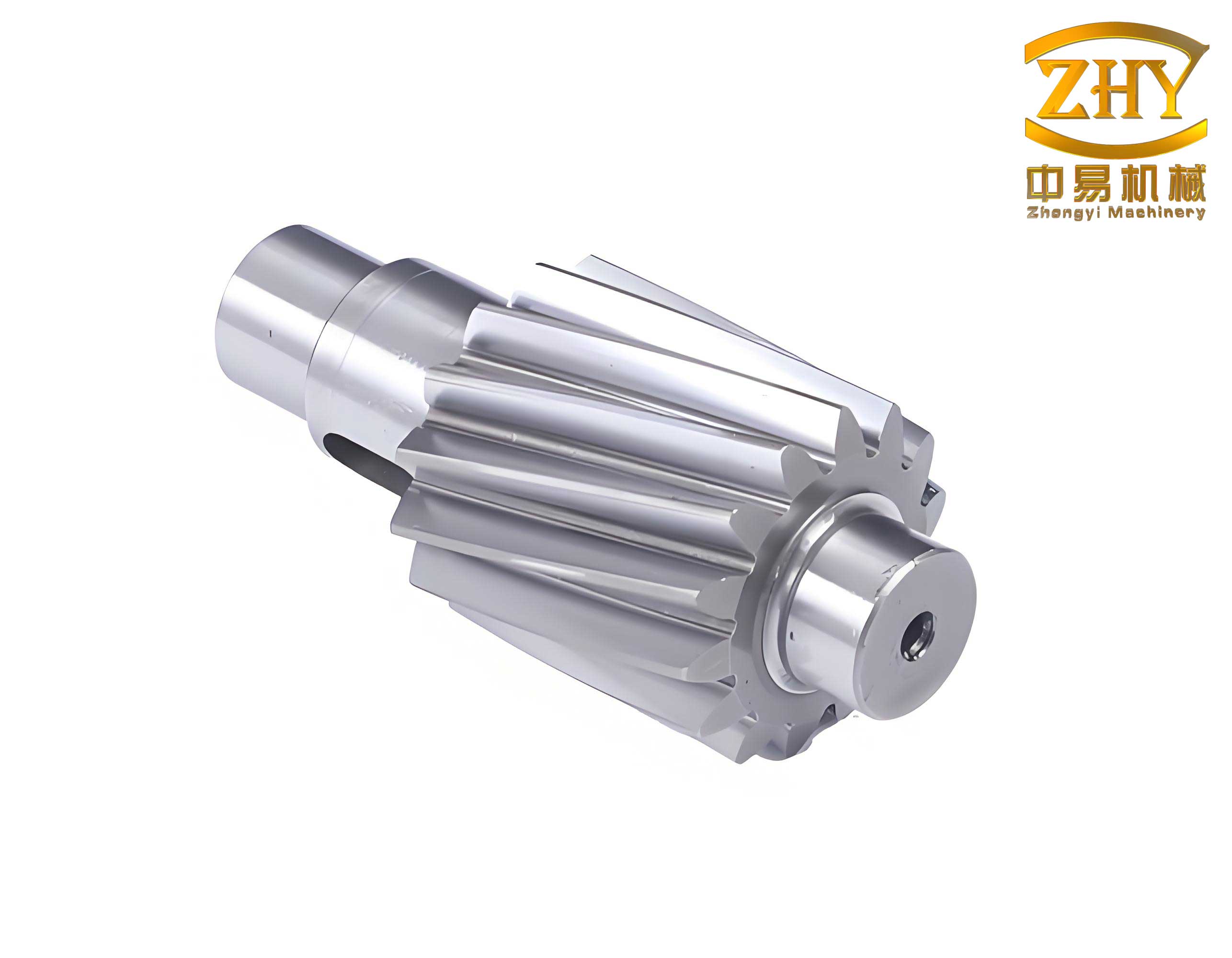
The primary function of the planetary gear shaft is to transmit torque from the differential case to the planetary gears. Consequently, torsional strength is a fundamental requirement. The internal spline hollow shaft segment is particularly critical for this function. Its analysis draws from the theory of torsion in hollow circular shafts. Under pure torsion, and assuming the planar hypothesis holds, cross-sections rotate as rigid planes about the axis. Since the distance between adjacent sections remains constant, no significant normal stress (σ) arises on the cross-section. However, the relative angular displacement between sections induces shear deformation, resulting in shear stress (τ) across the plane.
The shear stress at any point within the hollow shaft’s wall is not uniform. It varies linearly with the radial distance (ρ) from the center, reaching a maximum at the outer surface. The maximum shear stress, τ_max, in a hollow shaft with outer diameter D and inner diameter d, subjected to a torque T, is given by the torsion formula:
$$
\tau_{\text{max}} = \frac{T \cdot (D/2)}{J} = \frac{T \cdot (D/2)}{\frac{\pi}{32}(D^4 – d^4)}
$$
Where J is the polar moment of inertia of the hollow circular cross-section. For the gear shaft in question, the relevant diameters are the outer diameter of the hollow splined section (d₁) and the inner diameter (d_f₂). The transmitted torque T is related to engine power P and rotational speed n by:
$$
T = \frac{9.55 \times 10^6 \cdot P}{n} \quad \text{N·mm}
$$
Substituting, the condition for safe torque transmission in the internal spline hollow section of the gear shaft is:
$$
\tau_{p} = \frac{ \frac{9.55 \times 10^6 P}{n} \cdot \frac{d_1}{2} }{ \frac{\pi}{32}(d_1^4 – d_{f2}^4) } = \frac{4.864 \times 10^7 P}{n} \cdot \frac{d_1}{(d_1^4 – d_{f2}^4)} \leq [\tau]
$$
Where [τ] is the allowable shear stress of the material (e.g., 20CrMnTi). This equation highlights four key factors influencing torsional performance: transmitted power (P), rotational speed (n), outer wall diameter (d₁), and inner bore diameter (d_f₂). For a vehicle manufacturer, P and n are operational parameters defined by the drivetrain. The inner diameter d_f₂ is often constrained by the need to house other components or by the spline standard. Therefore, the most direct geometric parameter available for design optimization is the outer wall diameter d₁, which is intrinsically linked to the wall thickness (h) of the hollow section. Increasing h (and thus d₁, provided d₁ remains less than the adjoining shoulder diameter d₂) directly increases the polar moment of inertia J, thereby reducing the maximum shear stress for a given torque.
However, strengthening the hollow section against torsion is only one facet of the problem. The gear shaft experiences significant bending loads at the journals of the cross shaft, where the planetary gears apply force. The cross-shaped stepped shaft segment is therefore analyzed for bending strength, analogous to the design of a十字轴 in a universal joint. The critical section for bending is almost invariably the fillet or root at the base of the cross journal (denoted as point k in our model).
The force (F) applied by each planetary gear on the journal can be related to the transmitted torque. Assuming the torque is evenly distributed among the journals and acts at a pitch radius (r) from the differential axis, the force per journal is:
$$
F = \frac{T}{4r}
$$
This force acts as a cantilever load on the journal, creating a bending moment at its root. The maximum bending stress (σ_b) at the root of a journal with neck diameter d_v and an effective moment arm (t) is calculated by:
$$
\sigma_b = \frac{M_b}{Z} = \frac{F \cdot t}{\frac{\pi}{32} d_v^3}
$$
Where Z is the section modulus. The diameter d_v at the critical root section requires careful consideration, especially if the journal has a stepped or profiled shape. An effective diameter (d_eff) can be used for calculation, often derived from the geometry of the journal’s loaded portion. A more general form considering a tapered or stepped journal profile involves integrating the bending moment over the journal’s length or using an equivalent diameter based on the profile’s moment of inertia.
For a stepped journal with two cylindrical sections of diameters d₃ and d₄’ and lengths l₃ and l₄ respectively, an approximate effective diameter (d_eff) for stress calculation at the transition can be expressed based on the average section properties. The bending stress formula then becomes:
$$
\sigma = \frac{32 \cdot F \cdot t}{\pi \cdot d_{\text{eff}}^3} = \frac{32 \cdot \left( \frac{9.55 \times 10^6 P}{4 n r} \right) \cdot t}{\pi \cdot \left( \frac{d_3 l_3 + d’_4 l_4}{l_3 + l_4} \right)^3} = \frac{2.399 \times 10^8 P}{n} \cdot \frac{t}{r \cdot \left( \frac{d_3 l_3 + d’_4 l_4}{l_3 + l_4} \right)^3}
$$
The third segment, the external involute spline, primarily transmits torque to the planetary gear. Its failure modes typically involve shear at the spline teeth or surface wear. While critical for overall function, its stress analysis is more standardized and often the spline is designed with a significant safety factor relative to the core shaft’s bending and torsional limits. For this gear shaft analysis, the primary failure driver is the bending-torsion interaction at the cross root, making the spline section a less likely initiation point for the observed fracture.
The interconnection between the three segments is crucial. An optimization that changes the wall thickness (h) of the hollow section (Segment 1) to improve torsional resistance will alter the stiffness of the entire gear shaft. This change could theoretically slightly shift the load distribution and stress concentration at the cross root (Segment 2). Therefore, a holistic view is necessary.
To quantify the impact of design changes, let’s define a baseline and an optimized scenario for the gear shaft. The primary proposed optimization is a modest increase in the wall thickness h of the internal spline hollow section. This translates to an increase in its outer diameter d₁, while keeping all other major functional diameters and the adjoining shoulder diameter d₂ constant.
| Parameter | Symbol | Baseline Design | Optimized Design | Unit | Notes |
|---|---|---|---|---|---|
| Internal Spline Wall Thickness | h | ~ (d₁ – d_f₂)/2 | h + Δh | mm | Δh is the design increment. |
| Hollow Section Outer Diameter | d₁ | 44 ±0.05 | 45 ±0.05 | mm | Example: Δh = 1mm results in d₁ increasing from 44mm to 45mm. |
| Hollow Section Inner Diameter | d_f₂ | Constant | Constant | mm | Assumed unchanged to maintain internal compatibility. |
| Adjacent Shoulder Diameter | d₂ | Constant (> d₁) | Constant (> d₁’) | mm | d₁’ must remain less than d₂. |
Now, we evaluate the effect of this change on the two key stress measures. For the torsional stress in the hollow section, using the formula derived earlier and assuming nominal values for P and n as scaling factors:
Baseline Torsional Stress:
$$
\tau_{p(\text{base})} \approx K_T \cdot \frac{P}{n} \cdot \frac{d_{1,\text{base}}}{(d_{1,\text{base}}^4 – d_{f2}^4)} \quad \text{where } K_T = 4.864 \times 10^7
$$
With d₁,base_min = 43.95 mm and d₁,base_max = 44.05 mm, the stress range is:
$$
\tau_{p(\text{base})} \approx (118.33 \text{ to } 123.43) \times \frac{P}{n} \quad \text{MPa}
$$
Optimized Torsional Stress:
With d₁,opt_min = 44.95 mm and d₁,opt_max = 45.05 mm:
$$
\tau’_{p(\text{opt})} \approx (105.28 \text{ to } 107.96) \times \frac{P}{n} \quad \text{MPa}
$$
This represents a significant reduction in maximum shear stress, approximately **10-14%**, directly enhancing the torsional strength of the gear shaft’s hollow section.
For the bending stress at the cross root, the analysis is slightly more complex. The primary geometrical change (increasing d₁) does not directly alter the journal’s root diameter d_v or the force arm t in a first-order approximation. The force F remains unchanged for the same torque T and radius r. Therefore, the bending stress formula σ ∝ F ⋅ t / d_v³ suggests no direct change. However, a more nuanced view considers potential secondary effects: a stiffer hollow section (due to increased h) might marginally change the load distribution or the effective constraint at the base of the cross, potentially altering the stress concentration factor. But based on the fundamental bending formula for the journal geometry, the calculated nominal bending stress remains largely unaffected by the hollow section’s wall thickness.
Using the given formula with an effective diameter calculation:
Baseline Bending Stress:
$$
\sigma_{(\text{base})} \approx K_B \cdot \frac{P}{n} \cdot \frac{t}{r \cdot d_{\text{eff, base}}^3} \quad \text{where } K_B = 2.399 \times 10^8
$$
Resulting in:
$$
\sigma_{(\text{base})} \approx (647.68 \text{ to } 689.93) \times \frac{P}{n} \quad \text{MPa}
$$
Optimized Bending Stress:
Assuming d_eff remains virtually constant:
$$
\sigma’_{(\text{opt})} \approx (643.1 \text{ to } 683.1) \times \frac{P}{n} \quad \text{MPa}
$$
The change is minimal, showing a decrease of only about **0.7% to 1.0%**. This confirms that the optimization primarily targets torsional stress without compromising the bending strength of the cross root, which was already the governing failure mode. In fact, by reducing the overall stress ratio (τ/[τ]), the gear shaft’s margin of safety increases.
The implementation of this solution has a minor ripple effect on adjacent components. The primary consequence is that the planetary gear which mates with the cross journals must have its internal width correspondingly reduced by Δh to accommodate the slightly wider hub of the optimized gear shaft without interference. This is a straightforward and acceptable trade-off in manufacturing and assembly.
The analysis can be extended by considering combined stress states. At the critical root of the cross journal, a material element experiences both bending stress (σ) and torsional shear stress (τ). Using a failure theory appropriate for ductile materials like 20CrMnTi, such as the Von Mises yield criterion, the equivalent stress (σ_vm) is:
$$
\sigma_{\text{vm}} = \sqrt{\sigma_b^2 + 3\tau^2}
$$
While τ at the cross root is not the same as τ_p in the hollow section, a local shear stress exists. The optimization reduces the dominant bending stress slightly and may reduce local shear, thereby lowering the overall von Mises stress and improving fatigue life.
| Aspect | Baseline Gear Shaft | Optimized Gear Shaft (Δh = +1mm) | Impact |
|---|---|---|---|
| Torsional Shear Stress (τ_p) | $$ \tau_p \propto 118.33-123.43 $$ | $$ \tau’_p \propto 105.28-107.96 $$ | Significant reduction (~10-14%). Major gain in torsional strength. |
| Bending Stress at Cross Root (σ) | $$ \sigma \propto 647.68-689.93 $$ | $$ \sigma’ \propto 643.1-683.1 $$ | Negligible reduction (~0.7-1.0%). Bending strength essentially maintained. |
| Combined Stress State | Higher equivalent stress. | Lower equivalent stress. | Improved overall safety factor and fatigue resistance. |
| Gear Shaft Stiffness | Lower torsional stiffness. | Higher torsional stiffness. | Reduced angular deflection under load. |
| Assembly Consideration | Standard planetary gear width. | Planetary gear width must be reduced by ~Δh. | Minor, manageable design change. |
In conclusion, the fracture of the bevel gear differential planetary gear shaft at the cross root is a direct consequence of high cyclic bending stresses, exacerbated by a stress concentration at the fillet. Through a structured mechanical analysis decomposing the gear shaft into three functional segments—internal spline hollow shaft, cross stepped shaft, and external spline—the key influencing factors are identified. While the bending stress at the root is the primary failure driver, the overall integrity is interconnected. The proposed and validated optimization of increasing the wall thickness (h) of the internal spline hollow section, thereby increasing its outer diameter d₁ (while ensuring d₁ < d₂), delivers a highly effective solution. This modification produces a substantial increase in the gear shaft’s torsional strength with a negligible impact on its critical bending stress capacity. The resultant reduction in the global stress state significantly mitigates the risk of fatigue fracture at the cross root. This approach resolves the field failure problem without necessitating major alterations to the overall differential architecture, requiring only a complementary minor adjustment to the planetary gear’s width. The methodology underscores the importance of a holistic, segment-based stress analysis in designing robust and reliable drivetrain components like the planetary gear shaft.