
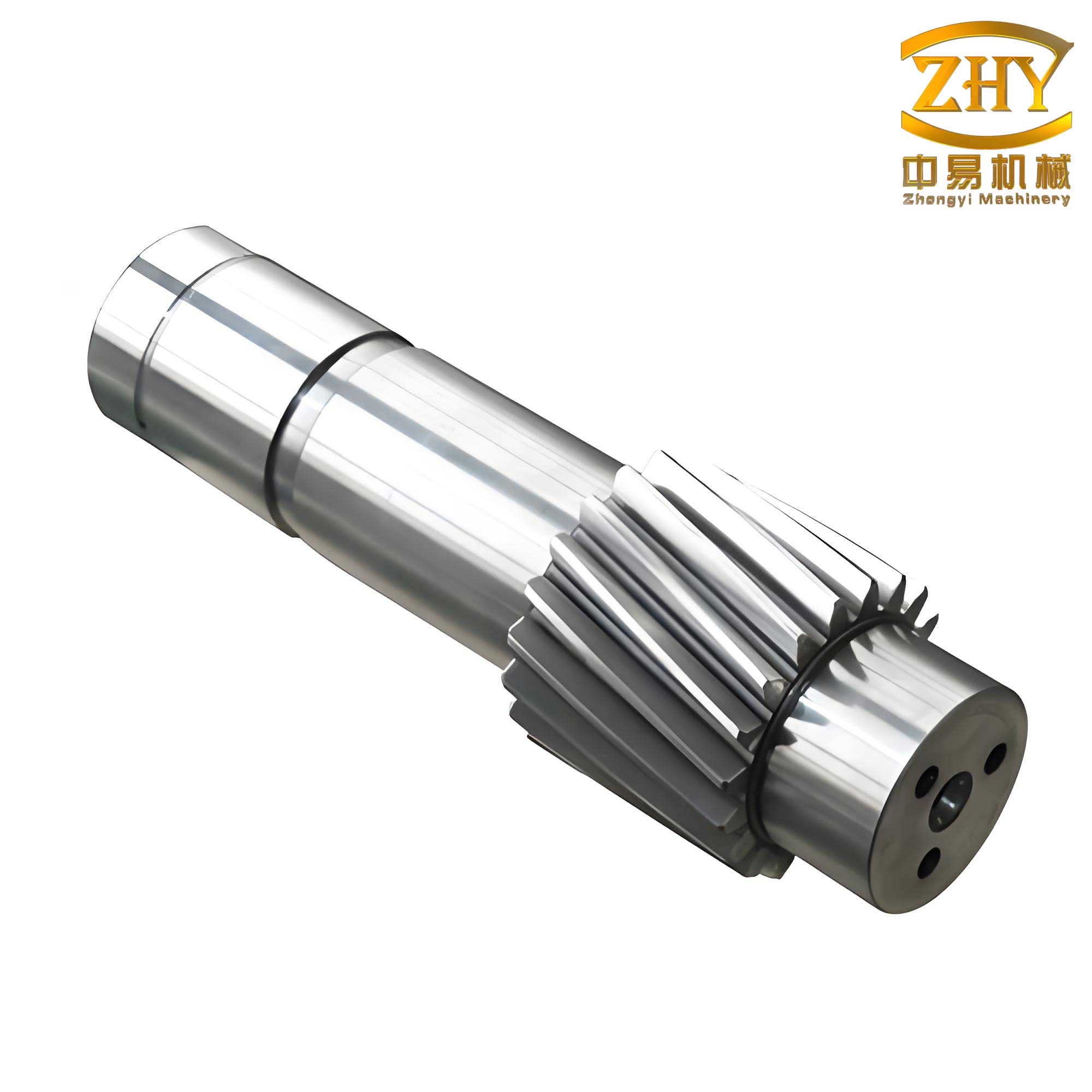
In the precision machining of power transmission components, the bevel gear shaft stands as a critical element, demanding exceptional accuracy in its tooth geometry to ensure smooth, efficient, and quiet operation within final assemblies. For decades, the manufacturing of these complex parts has been constrained not only by machine tool capabilities but also by the fixturing solutions used to hold them during the critical gear cutting operation. The fixture is the indispensable interface between the machine tool and the workpiece; its design directly dictates achievable precision, production cycle time, and operational ergonomics. The evolution of machine tools towards high-efficiency, precision, and intelligent control has, in turn, propelled fixture technology towards parallel goals of high precision, modularity, combinability, and superior cost-effectiveness. In high-volume or high-mix production environments, the strategic use of dedicated, yet reconfigurable, fixtures becomes paramount for realizing both high productivity and guaranteed part quality. This narrative details my first-hand experience and the analytical journey in transitioning from a traditional, labor-intensive fixturing method to a sophisticated, hydraulically-actuated modular fixture centered on a tapered elastic collet, specifically designed for the machining of medium to large bevel gear shafts.
1. Legacy Fixturing and Its Inherent Challenges
Our historical capability for machining Klingelnberg-type spiral bevel gear sets was limited by our machine tools to a maximum module of 10, a maximum gear shaft diameter of φ150 mm, and a maximum tooth flank outer diameter of φ630 mm. The corresponding fixture, appropriate for this smaller machine envelope, was a drawbar-type assembly. Its operation was conceptually straightforward: a locating mandrel was mounted to the machine spindle. The gear shaft workpiece was then placed onto this mandrel. A drawbar connector was screwed into a pre-machined threaded hole at the tail end of the gear shaft. This connector was linked to a long drawbar, which passed through the machine spindle, and a nut was tightened on the opposite end. A hydraulic system then pulled the drawbar, clamping the gear shaft between the connector and the locating mandrel face. A key and keyway machined into the shaft and mandrel prevented rotation.
While functional, this system presented several significant drawbacks that severely impacted efficiency and part integrity:
- Prolonged Auxiliary Time: Every single gear shaft required the manual tightening and subsequent loosening of the locking nut and the disassembly/assembly of the drawbar linkage. This non-value-added time accumulated rapidly in batch production.
- Part Weakening: The necessity for an anti-rotation keyway on the gear shaft diameter created a stress concentration point, potentially compromising the shaft’s fatigue strength—a critical property for a rotating power component. This also added an extra, non-value-added machining step.
- Alignment Difficulty: Achieving coaxial alignment between the long drawbar and the threaded hole in the gear shaft was challenging and time-consuming. The longer the drawbar and smaller the thread, the more pronounced this issue became, risking cross-threading or inducing unwanted bending moments during clamping.
The limitations of this fixturing method became starkly apparent with the acquisition of a new, advanced CNC gear cutting machine. This machine offered superior precision, automated setup via sophisticated software, and dramatically reduced cutting cycle times. Consequently, the fixturing process, now the primary bottleneck, demanded a revolutionary redesign to match the machine’s potential. The new fixture needed to be highly precise, allow for rapid loading/unloading (ideally under 60 seconds), and provide unwavering clamping rigidity and repeatability.
2. Design of the Tapered Collet Modular Fixture System
The new CNC gear cutting machine was equipped with an integrated hydraulic clamping cylinder within its workpiece spindle. This eliminated the need to design a primary power source, allowing focus solely on the intermediate force transmission mechanism and the final clamping element—the heart of any fixture. A modular fixture system was conceptualized based on this machine interface, consisting of the following core components:
| Component | Role in Fixture System | Description |
|---|---|---|
| Locating Mandrel | Positioning Element | Provides the precise axial and radial datum for the gear shaft. It is custom-designed for specific shaft diameters. |
| Support Sleeve | Multi-functional Core | Acts as a) a secondary radial support, b) the reaction body for the collet’s taper, and c) the main structural connection to the machine spindle. |
| Tapered Elastic Collet | Clamping Element | The key active component. Its internal bore clamps onto the gear shaft OD when axially pulled, generating immense radial force via its tapered external surface. |
| Threaded Adapter, Pull Rod, Connecting Sleeve | Force Transmission Mechanism | This assembly connects the machine’s hydraulic piston to the collet, transmitting the axial clamping force reliably. |
The operational sequence is elegantly simple and fast:
- The gear shaft is manually inserted through the bore of the Support Sleeve and seated against the face of the Locating Mandrel.
- The machine’s hydraulic clamping cycle is initiated.
- Hydraulic pressure drives the piston, pulling the Connecting Sleeve, Pull Rod, and Threaded Adapter assembly.
- The Threaded Adapter, connected to the rear of the Tapered Elastic Collet, applies a direct axial pull force.
- As the collet is pulled into the matching internal taper of the Support Sleeve, its slotted body is forced to contract elastically inward.
- This contraction creates a uniform, high-pressure grip on the cylindrical surface of the gear shaft, immobilizing it completely against both rotation and axial movement.
The entire clamping action is achieved in seconds with the push of a button. Releasing the gear shaft is equally swift upon cycle completion. The fixture’s modularity lies in the fact that for a different family of gear shafts, only the Locating Mandrel and the Tapered Elastic Collet (with a different bore) need to be swapped. The Support Sleeve and force transmission assembly remain universal.
3. Mechanical Analysis and Force Validation
To ensure the fixture’s reliability, a rigorous static analysis was performed. The fundamental requirement is that the frictional torque generated at the interface between the collet and the gear shaft must exceed the maximum cutting torque encountered during the gear milling process. The core of this analysis is the free-body diagram of the Tapered Elastic Collet during clamping.
3.1 Force Analysis of the Tapered Collet
The collet is subjected to an axial pull force $F_a$ from the machine. It reacts against the tapered surface of the Support Sleeve and contacts the gear shaft. We analyze the forces on one segment of the collet (assuming symmetry). The equilibrium equations in the axial (X) and radial (Y) directions are:
$$ \sum F_x = 0: W_1 \sin\theta_1 + W_2 \sin(\theta_2 + \alpha) – F_{a\text{ (per segment)}} = 0 \tag{1} $$
$$ \sum F_y = 0: W_1 \cos\theta_1 + W_2 \cos(\theta_2 + \alpha) = 0 \tag{2} $$
Where:
$W_1$ = Total reaction force from the gear shaft on the collet segment.
$W_2$ = Total reaction force from the support sleeve taper on the collet segment.
$\theta_1$ = Angle of friction at the collet/gear shaft interface ($\tan^{-1}\mu_1$).
$\theta_2$ = Angle of friction at the collet/sleeve taper interface ($\tan^{-1}\mu_2$).
$\alpha$ = Half-angle of the collet’s external taper.
Solving this system of equations for $W_1$, the normal clamping force $N_1$ exerted by the collet segment onto the gear shaft is derived from $W_1$’s radial component. For the full collet, the total normal force is the sum of all segments. The relationship simplifies to a function of the applied axial force, taper angle, and friction coefficients:
$$ N_1 = \frac{F_a}{\mu_1 \cos\alpha + \sin\alpha} \quad \text{(A simplified form assuming small angles and negligible radial friction component on taper)} \tag{3} $$
A more precise calculation considers the friction on both interfaces. The pressure $p$ on the gear shaft surface can be expressed as:
$$ p = \frac{2 F_a \tan(\alpha + \varphi_2)}{\pi d_0 l_c (\mu_1 + \tan(\alpha + \varphi_2))} \tag{4} $$
Where:
$d_0$ = Nominal diameter of the gear shaft clamping area (mm).
$l_c$ = Effective clamping length of the collet (mm).
$\varphi_2 = \tan^{-1}\mu_2$.
The total frictional torque $M_f$ that can be transmitted is:
$$ M_f = \frac{1}{2} \mu_1 p \pi d_0^2 l_c \times 10^{-3} \quad \text{(N·m)} \tag{5} $$
Substituting (4) into (5) yields the final relationship:
$$ M_f = \frac{ \mu_1 F_a d_0 \tan(\alpha + \varphi_2) }{ 2000 (\mu_1 + \tan(\alpha + \varphi_2)) } \quad \text{(N·m)} \tag{6} $$
3.2 Calculation of Milling Torque
Gear cutting on this machine is a discontinuous face milling process. The most demanding condition often occurs during the initial roughing cuts. The tangential cutting force $P_z$ and resulting torque $M_c$ must be estimated. The power at the cutter $N_c$ can be calculated using empirical relations for face milling:
$$ N_c = C_N \cdot 10^{-5} \cdot D^{g} \cdot t^{x} \cdot S_z^{y} \cdot B^{u} \cdot Z \cdot n \cdot K_{MN} \quad \text{(kW)} \tag{7} $$
| Parameter | Symbol | Value | Unit/Note |
|---|---|---|---|
| Workpiece Material | – | 20CrMnTi | Tensile Strength σb = 1100 MPa |
| Material Constant | $C_N$ | 2.0 | – |
| Cutter Diameter | $D$ | 210 | |
| Depth of Cut | $t$ | 3.0 | |
| Feed per Tooth | $S_z$ | 0.1 | |
| Cutting Width | $B$ | 100 | |
| Number of Teeth | $Z$ | 10 | (5 groups of 2) |
| Spindle Speed | $n$ | ~152 | |
| Exponents | $g, x, y, u$ | 0.14, 0.86, 0.72, 1.0 | – |
Calculating with these values gives $N_c ≈ 3.53 \text{ kW}$. The tangential cutting force is:
$$ P_z = \frac{60 \times 10^3 \cdot N_c}{\pi D n} \quad \text{(N)} \tag{8} $$
This yields $P_z ≈ 2.12 \text{ kN}$. However, this must be multiplied by a comprehensive safety factor $K$ accounting for dynamic effects, tool wear, and material variations:
$$ K = K_0 \cdot K_1 \cdot K_2 \cdot K_3 \cdot K_4 \tag{9} $$
| Factor | Description | Selected Value |
|---|---|---|
| $K_0$ | Basic Safety Factor | 1.5 |
| $K_1$ | Accounting for Cutting Nature | 1.2 |
| $K_2$ | Tool Bluntness Factor | 1.2 |
| $K_3$ | Intermittent Cutting | 1.2 |
| $K_4$ | Clamping Force Stability | 1.3 |
$$ K_{total} = 1.5 \times 1.2 \times 1.2 \times 1.2 \times 1.3 ≈ 3.37 $$
Thus, the design tangential force $P = P_z \cdot K ≈ 7.14 \text{ kN}$. The maximum cutting torque $M_c$ on the gear shaft, assuming the force acts at the mean diameter $d_m$ of the cut, is:
$$ M_c = P \cdot \frac{d_m}{2} \times 10^{-3} \quad \text{(N·m)} \tag{10} $$
For a typical cut, $M_c$ was calculated to be approximately 85 N·m under worst-case, two-tooth engagement conditions.
3.3 Safety Margin Verification
Using equation (6) with the fixture’s design parameters: $F_a = 30 \text{ kN}$ (machine hydraulic force), $d_0 = 140 \text{ mm}$, $\alpha = 8^\circ$, $\mu_1 = \mu_2 = 0.12$, we calculate the fixture’s available frictional torque:
$$ M_f = \frac{ 0.12 \times 30000 \times 140 \times \tan(8^\circ + 6.84^\circ) }{ 2000 \times (0.12 + \tan(8^\circ + 6.84^\circ)) } $$
$$ M_f ≈ \frac{504000 \times 0.267}{2000 \times (0.12 + 0.267)} ≈ \frac{134568}{774} ≈ 174 \text{ N·m} $$
The resulting safety factor for clamping is $SF_{clamp} = M_f / M_c = 174 / 85 ≈ 2.05$. This confirms that the tapered collet fixture provides more than double the required torque resistance, ensuring absolute security during the machining of the bevel gear shaft, even accounting for fluctuations in cutting conditions.
4. Advantages and Economic Implications
The implementation of this modular, collet-based fixture system has revolutionized the production flow for bevel gear shafts. The advantages are multifaceted and significant:
- Dramatically Reduced Auxiliary Time: The single-action hydraulic clamping has cut workpiece changeover time by over 80% compared to the manual drawbar system. This directly increases machine utilization and throughput.
- Enhanced Part Quality and Strength: Eliminating the need for a keyway on the gear shaft not only removes a machining step but, more importantly, preserves the integrity of the shaft’s cross-section, leading to a component with higher potential fatigue life.
- Superior Clamping Precision and Repeatability: The collet provides concentric, uniform clamping pressure, minimizing any potential distortion of the gear shaft during cutting. This contributes directly to achieving the high tooth geometry accuracy promised by the modern CNC gear cutter.
- Inherent Safety and Ergonomics: The process is now largely automated and free from the manual handling of heavy drawbars and nuts, reducing physical strain and associated risks for the operator.
- Excellent Economy through Modularity: This is arguably the most significant strategic benefit. The initial investment in the high-precision Support Sleeve and force transmission assembly is amortized over the entire family of gear shafts. For each new gear shaft variant, only two relatively simple components—the Locating Mandrel and the Tapered Elastic Collet—need to be manufactured. This makes the system incredibly adaptable and cost-effective for both high-volume production and smaller, customized batches of different bevel gear shafts.
5. Conclusion and Future Perspectives
The transition from a traditional, dedicated drawbar fixture to an advanced modular system underscores a critical principle in modern manufacturing: to fully leverage the capabilities of high-performance machine tools, supporting technologies—especially workholding—must evolve in tandem. The designed tapered elastic collet fixture successfully addresses the core requirements of high precision, rapid actuation, and operational safety for bevel gear shaft machining. Its success is rooted in a sound mechanical design validated by rigorous static force and torque analysis, ensuring reliability under dynamic cutting conditions. The modular architecture future-proofs the investment, enabling quick adaptation to new product lines by changing minimal components. Looking forward, the integration of such modular fixturing with automated loading systems and plant-wide data networks for predictive maintenance and tool management represents the next logical step towards a fully integrated, intelligent, and highly efficient manufacturing cell dedicated to producing critical power transmission components like the bevel gear shaft.