
The manufacturing of critical aerospace components, such as high-performance gear shafts, demands materials that offer an exceptional combination of strength, toughness, and dimensional stability. Among the advanced alloys developed for this purpose, C250 maraging steel stands out. As a member of the maraging steel family, C250 derives its strength not from carbon but from the precipitation of intermetallic compounds within a low-carbon martensitic matrix. This paper, based on extensive process development, details the heat treatment strategy, analyzes the inherent dimensional changes during aging, and presents a robust methodology for achieving precise final dimensions in C250 steel gear shafts. The core challenge addressed is the predictable yet significant dimensional contraction that occurs during the final aging step, which, if unaccounted for, renders precision-machined components like gear shafts unusable.
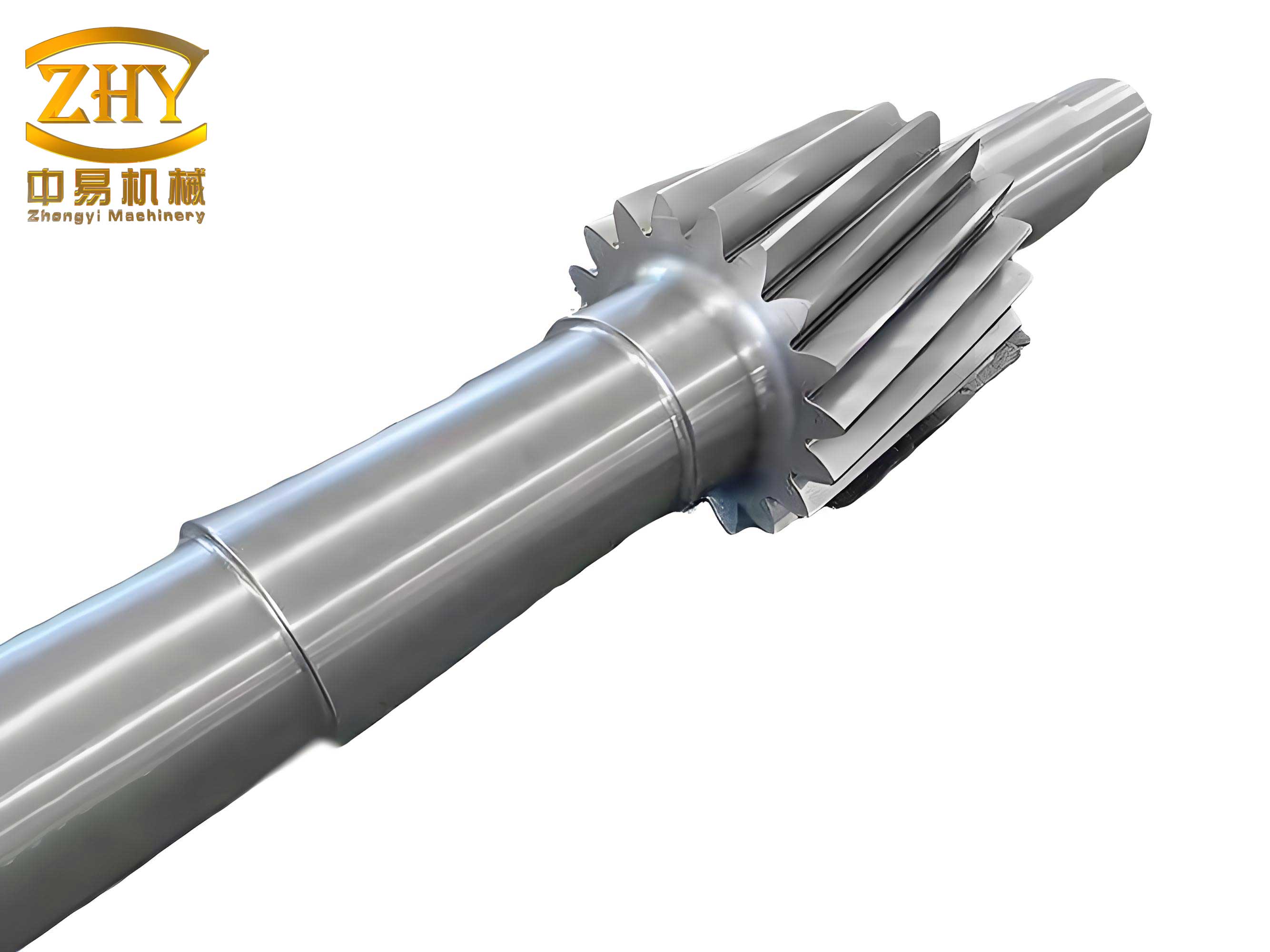
The foundational step in working with C250 steel is understanding its unique metallurgical characteristics. Unlike conventional quenched and tempered steels, its hardening mechanism is fundamentally different, leading to distinct processing requirements and material behavior, especially relevant for the manufacture of complex components like gear shafts.
1. Material Characteristics of C250 Maraging Steel
C250 is a nickel-cobalt-molybdenum maraging steel characterized by its very low carbon content. The nominal chemical composition, which is critical for achieving the desired transformation sequence and precipitation hardening response, is summarized in Table 1.
| Element | C | Si | Mn | Ni | Co | Mo | Ti | Al | S | P |
|---|---|---|---|---|---|---|---|---|---|---|
| Content | ≤ 0.03 | ≤ 0.12 | ≤ 0.20 | 17.5-18.5 | 7.00-8.00 | 4.75-5.25 | 0.30-0.50 | ≤ 0.15 | ≤ 0.01 | ≤ 0.01 |
The high nickel content ensures that the steel is fully austenitic at the solution annealing temperature. Upon cooling to room temperature, this austenite transforms to a soft, lath martensite without the need for rapid quenching, significantly reducing thermal stresses and distortion compared to conventional hardening. This soft martensite, with a typical hardness below 34 HRC, provides excellent machinability for intermediate processing stages of gear shafts. The ultimate high strength is achieved subsequently by aging at moderate temperatures (around 480°C), where elements like Ni, Ti, Mo, and Al form coherent intermetallic precipitates (e.g., Ni3(Ti,Al), Fe2Mo) within the martensitic matrix. This precipitation strengthening mechanism yields the remarkable mechanical properties outlined in Table 2.
| Property | Symbol | Minimum Value | Unit |
|---|---|---|---|
| Tensile Strength | $\sigma_b$ | 1758 | MPa |
| Yield Strength (0.2% Offset) | $\sigma_{0.2}$ | 1724 | MPa |
| Elongation (Gauge Length 5D) | $\delta_5$ | 6 | % |
| Reduction of Area | $\psi$ | 45 | % |
| Fracture Toughness | $K_{IC}$ | 78 | MPa√m |
The combination of ultra-high strength and good fracture toughness is precisely what makes C250 steel an ideal candidate for highly stressed, safety-critical aerospace gear shafts where weight savings and reliability are paramount.
2. Standard Heat Treatment and Machining Sequence for Gear Shafts
The conventional processing route for C250 steel gear shafts is logically structured to leverage the material’s phases: a soft, machinable state for shaping and a hard, strong state for service. The standard sequence is as follows:
- Rough Machining: The forged or bar stock is machined to a shape close to the final dimensions, leaving significant excess material for subsequent operations.
- Solution Annealing (Solidus Treatment): The part is heated to approximately 820°C (±14°C), held for 1.5 to 2 hours to dissolve all alloying elements into a homogeneous austenitic solid solution, and then air-cooled. The resulting microstructure is soft, low-carbon martensite.
$$ \text{Austenite (820°C)} \xrightarrow[\text{Cooling}]{\text{Air}} \text{Soft Martensite} \quad (\text{Hardness} \leq 34 \text{ HRC}) $$ - Intermediate (Semi-Finish) Machining: The soft martensitic condition allows for relatively easy machining to dimensions very near the final blueprint specifications.
- Aging (Precipitation Hardening): The nearly-finished component is heated to 480°C (±5°C), held for 4 hours, and then cooled. This step precipitates intermetallic compounds, drastically increasing strength and hardness.
$$ \text{Soft Martensite} + \text{Super-saturated Solid Solution} \xrightarrow[\text{Holding}]{\text{480°C, 4h}} \text{Hard Martensite} + (\text{Ni,Fe})_3(\text{Ti,Al}) \text{ Precipitates} \quad (\text{Hardness} \geq 48 \text{ HRC}) $$
This sequence presents a fundamental dilemma for finishing gear shafts. The aging step, which is essential for developing the required mechanical properties, must be the final thermal operation. Performing any significant machining after aging is exceedingly difficult and costly due to the high hardness (≥48 HRC). Consequently, the part must be machined to its final dimensions before aging. This practice immediately leads to the core problem: dimensional instability during the aging transformation.
3. Analysis of Dimensional Contraction During Aging
Initial production trials following the standard sequence revealed unacceptable dimensional changes in C250 steel gear shafts after aging. Components exhibited a uniform, isotropic contraction. For instance, a shaft’s overall length might shrink by 0.35 mm, while diameters and features like undercut grooves also reduced proportionally. This rendered the parts out of tolerance and unfit for assembly.
To isolate the cause, controlled experiments were conducted. A test specimen was measured before and after solution annealing and again after aging. The results were conclusive:
- Solution Annealing: No measurable dimensional change.
- Aging: Significant and consistent contraction in all directions (axial and radial).
This ruled out causes such as stress relief from prior machining or elastic strain recovery. The contraction is an intrinsic, predictable consequence of the martensitic crystal lattice evolution during precipitation hardening. The formation of coherent Ni3(Ti,Al) and other precipitates within the martensite matrix alters the local atomic arrangement and creates strain fields. On a macroscopic scale, this manifests as a net volumetric contraction. The magnitude of this contraction is a material property of C250 steel and is typically reported in the range of 0.03% to 0.05% linearly.
This can be conceptualized with a simplified model. The linear strain $\epsilon$ due to aging is:
$$ \epsilon_{\text{aging}} = \frac{\Delta L}{L_0} $$
where $\Delta L$ is the change in length (negative for contraction) and $L_0$ is the initial length. The empirical observation is that for C250 steel:
$$ \epsilon_{\text{aging}} \approx – (0.0003 \text{ to } 0.0005) $$
This strain, while seemingly small, is critically significant for precision gear shafts. For a 500 mm long shaft, a 0.04% contraction translates to a length reduction of 0.20 mm, far exceeding typical aerospace tolerances for gear mesh alignment and bearing fits.
4. Compensatory Machining Strategy: The Proactive Solution
Since the aging contraction is intrinsic and predictable, it cannot be prevented but must be compensated for during the machining process. The solution is to intentionally leave a specific amount of excess material on the gear shafts prior to the aging treatment. This excess, or “shrinkage allowance,” is precisely calculated so that the part contracts to its intended final dimensions after aging.
The revised and validated manufacturing sequence for C250 steel gear shafts is therefore:
- Rough Machine & Solution Anneal: As before.
- Intermediate Machine with Shrinkage Allowance: Machine the part, but instead of targeting the final blueprint dimensions, target an intermediate “pre-aged” size. This pre-aged size is the final dimension plus the calculated shrinkage compensation. Based on the observed contraction range of 0.03-0.05%, a conservative and effective compensation factor is applied. For critical dimensions, a single-sided allowance of 0.4 mm (on diameters) has proven highly effective. The required oversize dimension $D_{\text{pre}}$ is calculated from the final dimension $D_{\text{final}}$ and the estimated contraction strain $\epsilon_{\text{est}}$:
$$ D_{\text{pre}} = \frac{D_{\text{final}}}{(1 + \epsilon_{\text{est}})} \approx D_{\text{final}} \times (1 + |\epsilon_{\text{est}}|) \quad \text{(for small $\epsilon$)} $$
For example, targeting a final diameter of 50.000 mm with an estimated $\epsilon_{\text{est}} = -0.0004$:
$$ D_{\text{pre}} \approx 50.000 \times (1 + 0.0004) = 50.020 \text{ mm} $$
Thus, the part is machined to approximately 50.020 mm before aging, expecting it to contract to 50.000 mm afterward. - Aging (Precipitation Hardening): The part undergoes the standard aging cycle (e.g., 480°C for 4 hours in vacuum to prevent oxidation). During this step, the anticipated contraction occurs.
- Verification & Final Finishing: After aging, the part is inspected. The primary dimensions should now be at or very near the final specification. Only minimal finishing operations, such as precision grinding of bearing journals or honing of gear teeth, are performed if necessary to achieve the tightest tolerances. The bulk of the material has already been removed in the softer condition.
This strategy successfully decouples the problem of machining a very hard material from the problem of dimensional stability. The majority of machining is done in the soft, tractable condition, and the predictable material behavior during aging is used as a final “sizing” step.
5. Process Control and Quality Assurance Considerations
Implementing this strategy robustly requires careful process control. Key considerations include:
- Material Certification and Consistency: The contraction behavior must be consistent from batch to batch. Chemical composition and prior processing history (forging, etc.) must be tightly controlled to ensure the precipitation kinetics and resultant strain are reproducible for all gear shafts.
- Heat Treatment Uniformity: The aging furnace must have excellent temperature uniformity (±5°C or better) to ensure the entire component, especially long gear shafts, contracts homogeneously without inducing stress or distortion.
- Validation via Coupons: As noted in the initial findings, it is a critical best practice to heat-treat material coupons alongside the production gear shafts. A coupon from the same lot is aged first and tested for mechanical properties (tensile, hardness, toughness). Only upon confirmation that the properties meet specifications should the actual component be released for its final aging cycle. This prevents the irreversible aging of an out-of-spec component.
- Dimensional Data Collection: Statistical process control should be applied by meticulously measuring critical dimensions before and after aging on multiple production parts. This data refines the empirical shrinkage factor $\epsilon_{\text{est}}$ for ever more precise compensation.
The heat treatment parameters for both critical stages are consolidated in Table 3 for clarity.
| Process Stage | Temperature | Atmosphere / Cooling | Key Outcome | Typical Hardness |
|---|---|---|---|---|
| Solution Annealing | $820 \pm 14\,^{\circ}\mathrm{C}$ | Air Furnace / Air Cool | Soft, Machinable Martensite | ≤ 34 HRC |
| Aging (Precipitation) | $480 \pm 5\,^{\circ}\mathrm{C}$ | Vacuum (< $1.3 \times 10^{-1}$ Pa) / Gas Quench to 200°C, then Air Cool | High-Strength Aged Martensite + Precipitates | ≥ 48 HRC |
Conclusion
The manufacture of precision gear shafts from ultra-high-strength C250 maraging steel presents a specific challenge rooted in the material’s physical metallurgy. The indispensable aging treatment that confers the required mechanical properties inevitably causes a volumetric contraction on the order of 0.03-0.05%. For components where final dimensions are established prior to this last thermal step, this contraction leads to out-of-tolerance conditions. The proven and effective solution is to integrate this predictable behavior into the machining process plan. By deliberately machining the gear shafts to an oversized “pre-aged” dimension, calculated based on the material’s characteristic shrinkage factor, the subsequent aging contraction becomes a precise final sizing operation. This compensatory machining strategy, combined with rigorous control of heat treatment parameters and validation testing, transforms a potential source of scrap into a controlled and reliable step. It ensures that C250 steel gear shafts can be consistently produced to meet the stringent dimensional and mechanical property requirements of advanced aerospace applications, fully leveraging the alloy’s exceptional strength-to-weight ratio and toughness.