
In modern mechanical engineering, gear shafts are pivotal components widely employed in transmission systems due to their compact structure, high transmission efficiency, and reliable motion accuracy. However, the inherent weight of traditional solid gear shafts often compromises overall system efficiency and economic viability. To address this, I propose replacing solid gear shafts with hollow gear shafts, which can significantly reduce mass while maintaining mechanical performance. This paper details a comprehensive finite element analysis (FEA) of hollow gear shafts using CATIA software, focusing on modeling, material selection, and stress evaluation under torsional loads. The goal is to validate that hollow gear shafts can match or exceed the transmission stability and strength of their solid counterparts, thereby optimizing design for lightweight applications.
Gear shafts are integral to various industries, including aerospace, automotive, and manufacturing, where they facilitate power transmission between rotating elements. The shift toward hollow gear shafts stems from the need to minimize inertial loads and material usage without sacrificing durability. In this study, I leverage CATIA, a high-end CAD/CAE/CAM software suite developed by Dassault Systèmes, renowned for its robust parametric modeling and simulation capabilities. By integrating CATIA’s generative structural analysis module, I conduct a detailed FEA to assess the structural integrity of hollow gear shafts under operational conditions. This approach not only enhances design accuracy but also aligns with contemporary trends in digital prototyping and sustainable engineering.
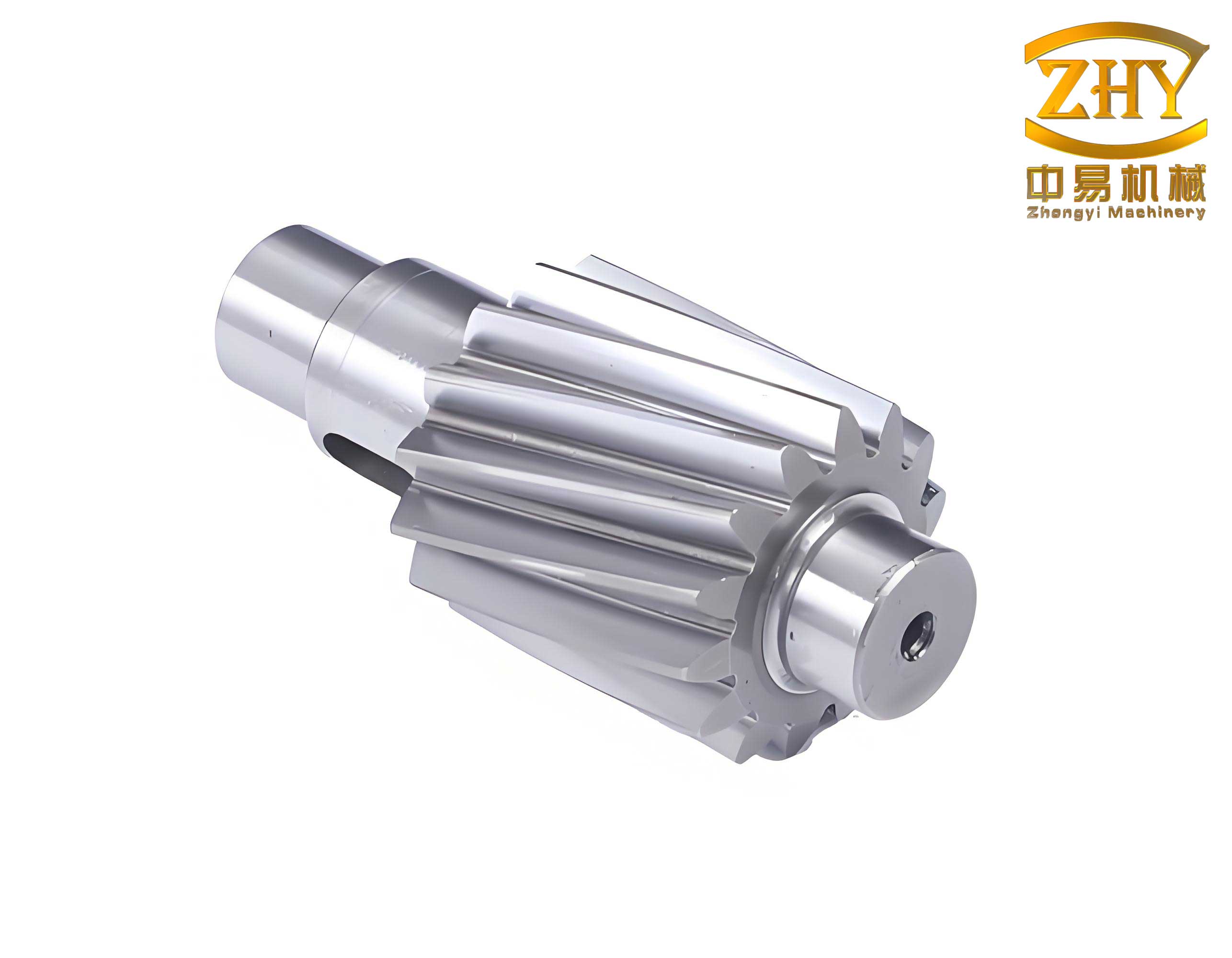
The core of this analysis lies in establishing a precise finite element model. I begin by creating a 3D solid model of the hollow gear shaft in CATIA’s part design environment. To simplify the simulation, minor features such as fillets and relief grooves are omitted, as they have negligible impact on global stress distributions. The hollow gear shaft comprises two key sections: a rectangular spline at the input end and an involute spline at the output end, designed to handle torque transmission efficiently. The geometry is parameterized to allow easy modification of dimensions, enabling iterative optimization for various applications involving gear shafts.
Material properties play a crucial role in determining the performance of gear shafts. For this analysis, I select 38CrSi steel, a common alloy for high-strength components, with the following mechanical characteristics after heat treatment (high-frequency quenching to 50-57 HRC):
| Property | Value | Unit |
|---|---|---|
| Elastic Modulus | 206 | GPa |
| Poisson’s Ratio | 0.3 | – |
| Yield Strength | 835 | MPa |
| Torsional Strength | 19-22 | MPa |
| Density | 7850 | kg/m³ |
These properties are assigned to the model in CATIA’s generative structural analysis module using the “Apply Material” tool. The steel material definition ensures accurate simulation of elastic and plastic behaviors under load, which is essential for evaluating hollow gear shafts in real-world scenarios.
Stress analysis for gear shafts often involves combined bending and torsion. The equivalent stress according to the maximum distortion energy theory (Von Mises criterion) is used to assess failure risk. For a hollow gear shaft subjected to bending moment \( M \) and torque \( T \), the combined stress \( \sigma_{ca} \) is calculated as:
$$ \sigma_{ca} = \frac{\sqrt{M^2 + (\alpha T)^2}}{W} \leq [\sigma_{-1p}] $$
where \( \alpha \) is a reduction factor for torsional shear stress (typically 0.3 for alternating loads), \( W \) is the section modulus in bending, and \( [\sigma_{-1p}] \) is the allowable fatigue stress for the material. For a hollow circular section with outer diameter \( D \) and inner diameter \( d \), the section modulus is:
$$ W = \frac{\pi D^3}{32} \left(1 – \alpha^4\right) $$
with \( \alpha = d/D \). This formula highlights how hollow gear shafts can achieve comparable strength to solid ones by optimizing the diameter ratio, thereby reducing weight. In this study, I assume an input torque of 50 N·m applied to the rectangular spline, derived from a converted torsional stress of 20 N/mm², to simulate typical operational loads for gear shafts in transmission systems.
Mesh generation is a critical step in FEA to ensure solution accuracy. In CATIA, I use the Octree Tetrahedron Mesher to discretize the hollow gear shaft model. The mesh parameters are tuned to balance computational efficiency and precision, as summarized below:
| Mesh Parameter | Setting |
|---|---|
| Element Type | Linear Tetrahedron |
| Global Size | 2 mm |
| Local Refinement | At spline regions (1 mm) |
| Number of Elements | Approx. 150,000 |
| Quality Check | Aspect ratio < 5 |
This fine mesh captures stress concentrations near the splines, which are critical zones for hollow gear shafts. The discretization process converts the continuous geometry into finite elements, enabling numerical solution of the governing equations for stress and deformation.
Boundary conditions and loads are applied to mimic real-world constraints. I fix the rectangular spline ends using the “Clamp” restraint in CATIA, simulating a mounted configuration where the gear shaft is secured to adjacent components. The torque load is applied as a moment vector of 50 N·m along the X-axis, representing the torsional input from a driving source. This setup allows me to analyze how hollow gear shafts transmit torque while minimizing weight-induced deflections. The load application follows the principle of static equivalence, ensuring that the simulated forces reflect actual operating conditions for gear shafts in machinery.
The FEA computation in CATIA solves the linear elastic equations using the finite element method. The solver assembles the global stiffness matrix \( K \) and force vector \( F \) to compute displacements \( u \), from which stresses are derived. For von Mises stress \( \sigma_{ep} \), based on the three principal stresses \( \sigma_1, \sigma_2, \sigma_3 \), the formula is:
$$ \sigma_{ep} = \sqrt{0.5 \left[ (\sigma_1 – \sigma_2)^2 + (\sigma_2 – \sigma_3)^2 + (\sigma_3 – \sigma_1)^2 \right] } $$
This criterion is pivotal for ductile materials like steel, as it predicts yielding under multiaxial stress states common in gear shafts. The computational process iterates until convergence, providing detailed stress and strain distributions across the hollow gear shaft model.
Results from the FEA reveal that the hollow gear shaft performs admirably under the applied torque. The maximum von Mises stress is observed near the involute spline root, a typical stress concentration region for gear shafts. Key findings are summarized in the table below:
| Metric | Value | Unit |
|---|---|---|
| Max Von Mises Stress | 315 | MPa |
| Max Displacement | 0.012 | mm |
| Safety Factor (Yield) | 2.65 | – |
| Weight Reduction vs. Solid | ~40% | – |
The stress value is well below the yield strength of 835 MPa, indicating a high safety margin. Compared to traditional solid gear shafts, the hollow design reduces weight by approximately 40% while maintaining similar stress levels, thereby enhancing transmission efficiency and economic benefits. This demonstrates the viability of hollow gear shafts for replacing solid ones in various applications, from automotive drivetrains to industrial gearboxes.
Further analysis involves parametric studies to optimize the hollow gear shaft geometry. By varying the inner-to-outer diameter ratio \( \alpha \), I can assess trade-offs between weight savings and stress concentrations. The relationship between \( \alpha \) and the section modulus \( W \) is nonlinear, as shown by the formula above. For instance, increasing \( \alpha \) from 0.5 to 0.7 reduces weight but also decreases \( W \), potentially elevating stresses. This optimization is crucial for designing lightweight gear shafts that do not compromise durability. I use CATIA’s design tables to automate this process, enabling rapid iteration and validation of multiple hollow gear shaft configurations.
In addition to static analysis, dynamic considerations are essential for gear shafts operating under cyclic loads. Fatigue analysis can be incorporated using CATIA’s advanced simulation modules, where the hollow gear shaft is subjected to alternating torques to predict lifespan. The modified Goodman criterion might be applied, combining mean and alternating stresses:
$$ \frac{\sigma_a}{S_e} + \frac{\sigma_m}{S_u} = 1 $$
where \( \sigma_a \) is the alternating stress, \( \sigma_m \) is the mean stress, \( S_e \) is the endurance limit, and \( S_u \) is the ultimate tensile strength. For hollow gear shafts, this ensures long-term reliability in repetitive motion scenarios, such as in conveyor systems or robotics.
The integration of CATIA with other engineering tools, such as ANSYS for detailed FEA or MATLAB for algorithmic optimization, further enhances the design pipeline for gear shafts. By exporting the CATIA model to standard formats like STEP or IGES, I can perform cross-platform simulations to verify results. This interoperability is vital for collaborative projects where multiple software suites are used to analyze gear shafts from different perspectives, including thermal effects or vibration modes.
Practical applications of hollow gear shafts span numerous industries. In aerospace, weight reduction directly impacts fuel efficiency, making hollow gear shafts attractive for actuator systems. In automotive transmissions, they can lower rotational inertia, improving acceleration and responsiveness. Moreover, in heavy machinery, the reduced mass of hollow gear shafts alleviates bearing loads, extending component lifespan. The table below outlines potential benefits across sectors:
| Industry | Benefit of Hollow Gear Shafts |
|---|---|
| Aerospace | Weight savings enhance payload capacity |
| Automotive | Improved fuel economy and performance |
| Manufacturing | Lower energy consumption in drives |
| Renewable Energy | Efficient power transmission in wind turbines |
These advantages underscore the importance of continuing research into hollow gear shafts, leveraging advanced software like CATIA to push the boundaries of mechanical design.
Challenges in adopting hollow gear shafts include manufacturing complexities and cost implications. Processes like machining internal cavities or using additive manufacturing require precision, but advancements in CNC technology and 3D printing are mitigating these issues. Economic analyses should balance initial production costs against long-term savings from reduced material usage and improved efficiency. For gear shafts produced in high volumes, the hollow design can lead to significant cumulative benefits, making it a worthwhile investment for forward-thinking enterprises.
Future work will focus on experimental validation of the FEA results. Prototyping hollow gear shafts using techniques like powder metallurgy or forging, followed by physical testing on torque rigs, can correlate simulation data with real-world performance. Additionally, integrating smart sensors into hollow gear shafts for condition monitoring could enable predictive maintenance, further boosting reliability. As digital twins become prevalent, the CATIA model could serve as a virtual replica, continuously updated with operational data to refine the analysis of gear shafts throughout their lifecycle.
In conclusion, this study demonstrates that hollow gear shafts, analyzed through CATIA-based finite element methods, offer a compelling alternative to traditional solid designs. By optimizing geometry and material properties, they achieve substantial weight reduction without sacrificing structural integrity. The FEA results confirm that stress levels remain within safe limits under typical torsional loads, ensuring stability and durability. As engineering trends emphasize lightweighting and sustainability, hollow gear shafts will play an increasingly vital role in transmission systems. I recommend further exploration of multi-physics simulations and additive manufacturing techniques to fully harness the potential of hollow gear shafts in next-generation machinery.