
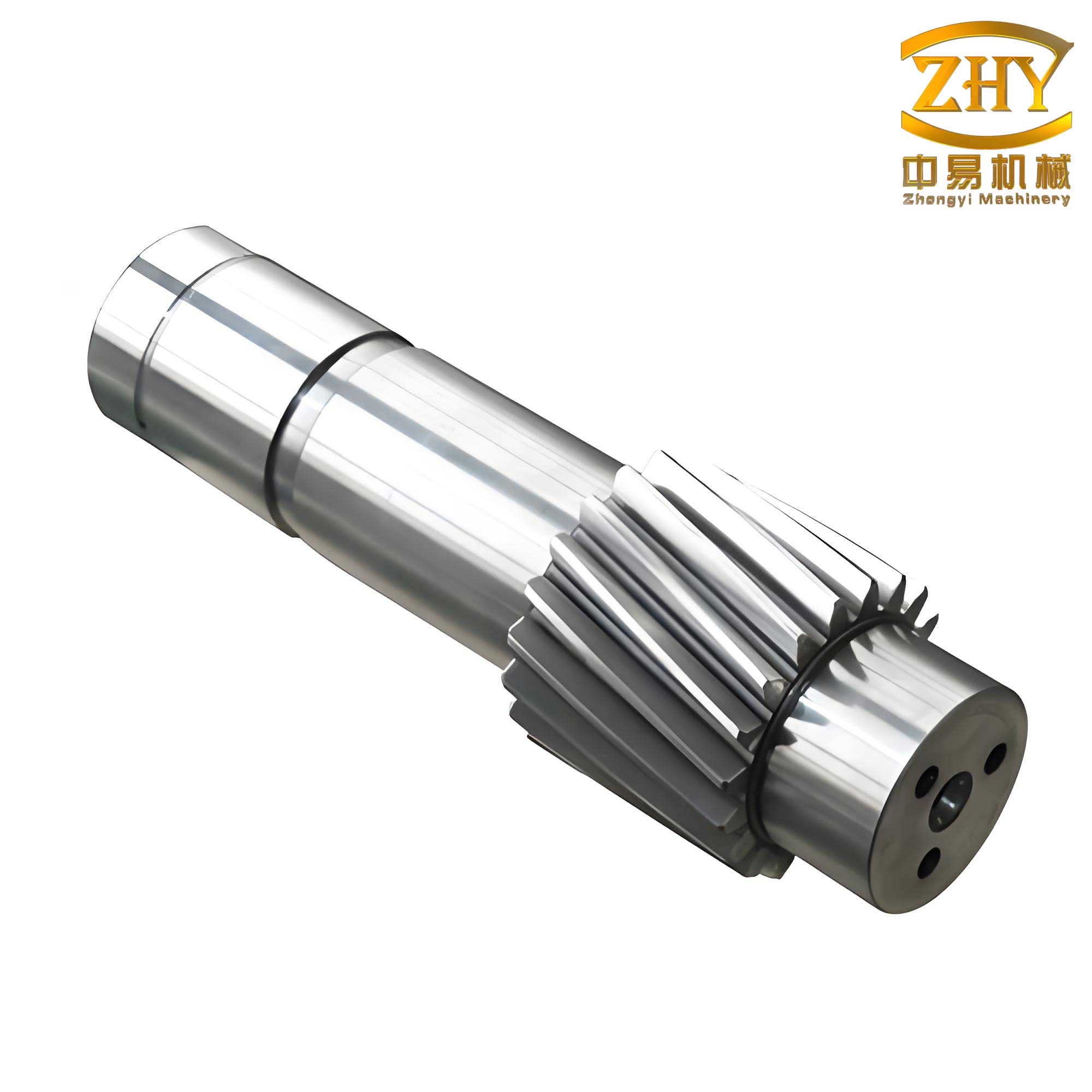
In my extensive experience with mechanical equipment maintenance, I have consistently observed that gear shafts are pivotal components, often subjected to severe wear, corrosion, and surface damage such as scoring or dimensional loss. Traditional repair methods, including machining to undersize, adhesive bonding, thermal spraying, or welding, present significant limitations. Machining weakens the shaft, adhesives offer limited durability, and thermal spray coatings are challenging to control. Consequently, I turned to Fe brush plating as a promising alternative due to its excellent corrosion resistance, high hardness, simplicity, and rapid deposition rates. This study details my personal investigation into optimizing Fe brush plating for repairing gear shafts, focusing on process parameters, layer quality, and performance metrics.
The core of my approach involved developing a stable brush plating solution and defining precise operational conditions. I utilized a portable inverter-based brush plating power supply, with a pure iron anode (substituted with 10# carbon steel) shaped into a flat plate. The anode was wrapped with one to two layers of polyester cotton sleeve, avoiding medical cotton to ensure adequate electrolyte supply. For substrate preparation, I used 45# steel specimens measuring 50 mm × 25 mm × 4 mm, simulating typical gear shaft material. To maintain electrolyte flow during high-current operations and prevent dry spots or oxidation, I implemented a liquid pump for continuous feed. Characterization equipment included an S-250 scanning electron microscope (SEM) for surface morphology, an OP-160 pH meter, a D32 Hanemann microhardness tester, and an MM-200 wear testing machine for耐磨性 evaluation.
My brush plating solution formulation was meticulously crafted based on preliminary trials and literature review. The composition is summarized in Table 1.
| Component | Role | Concentration Range |
|---|---|---|
| Ferrous Chloride (FeCl₂) | Main Salt | 400 – 450 g/L |
| Lactic Acid (C₃H₆O₃) | Complexing Agent | ~30 g/L |
| Potassium Chloride (KCl) | Buffer Agent | 20 – 25 g/L |
| Potassium Iodide (KI) | Antioxidant | Trace amount |
The solution pH was maintained between 1.5 and 2.5, and the operating temperature (θ) was controlled at 30 – 45°C. The electrochemical equivalent for deposition was approximately 0.09 Ah/(dm²·μm). The process workflow I adhered to was: degreasing → water rinse → electrochemical cleaning (using TGY-2 solution, workpiece as cathode, voltage U = 10–13 V) → water rinse → activation (using THY-1 solution, workpiece as anode, U = 8–12 V, time t = 30–60 s) → water rinse → brush plating of the Fe working layer → immersion in NaOH or Na₂CO₃ solution → water rinse → drying. For the Fe deposition, I initiated at a low voltage of 5 V, gradually increasing to 12–14 V, with a relative brush speed of 8–10 m/min. Post-plating, specimens were immersed in 5–10% NaOH solution for 1–2 hours for neutralization.
A critical metric in brush plating is the deposition rate, which I calculated using the formula:
$$ v = \frac{\delta}{t} $$
where \( v \) is the deposition rate in μm/h, \( \delta \) is the layer thickness in μm, and \( t \) is the plating time in hours. This formula was essential for evaluating process efficiency under various conditions.
Examining the surface morphology of the Fe brush plating layer on gear shaft specimens revealed distinctive features. SEM analysis showed that the coating crystallites grew in a胞状 pattern perpendicular to the substrate surface. These cell-like protrusions varied in size, creating a cauliflower-like appearance typical of rapid electrodeposition. The high deposition rate inhibited grain growth, resulting in fine, dense crystals with high dislocation density and severe lattice distortion. This microstructure contributes to enhanced hardness due to impeded slip deformation. Some minor孔隙 and small nodules were observed between cells, attributed to non-uniform deposition speeds, but overall, the layer appeared compact and suitable for gear shaft repair applications.
I systematically investigated the influence of key process parameters on coating quality, particularly for gear shafts. First, the concentration of the main salt, ferrous chloride, profoundly affected deposition dynamics. The relationship between concentration and deposition rate is shown in Figure 2 (conceptual). The solution’s electrical conductivity (κ) initially increases with concentration due to higher ion availability, but beyond a critical point, interionic attraction reduces mobility, decreasing conductivity. This directly impacts deposition speed. Empirically, I found that while a concentration around 600 g/L yielded maximum speed, it often led to poor adhesion, micro-cracks, and nodulation. For robust gear shaft repair, I optimized the concentration to 400–450 g/L, balancing speed and quality.
The role of additives was crucial. Lactic acid, as a complexing agent, stabilizes the solution by chelating Fe²⁺ ions, allowing operation at higher pH ranges and slowing pH drop during plating. The effect of lactic acid concentration on deposition rate followed a saturation curve. At concentrations below 30 g/L, the rate increased with added lactic acid due to enhanced surface activation and current efficiency. Beyond 30 g/L, the rate declined as complexation became excessive, hindering ion reduction. Thus, I fixed the lactic acid concentration at approximately 30 g/L. Potassium chloride acted as a buffer, maintaining solution stability with a缓冲值 of 1.0–1.3; concentrations above 25 g/L induced brittleness. Importantly, potassium iodide served as an antioxidant, suppressing the oxidation of Fe²⁺ to Fe³⁺. Fe³⁺ ions can hydrolyze at low acidity, forming Fe(OH)₃ colloidal particles that incorporate into the coating as detrimental impurities. Controlling Fe³⁺ generation was vital for achieving high-quality Fe brush plating layers on gear shafts.
Solution pH was another pivotal factor. The pH affects both electrochemical efficiency and coating integrity. As shown in Figure 4 (conceptual), deposition rate peaks within a specific pH range. At pH > 2.5, Fe²⁺ oxidation to Fe³⁺ accelerates, leading to hydrolysis products that contaminate the layer. At pH < 1.5, excessive hydrogen evolution occurs, causing pinholes and reducing current efficiency. My experiments confirmed that maintaining pH between 1.5 and 2.5 optimized deposition speed and minimized defects, essential for durable gear shaft coatings.
Operating voltage directly influences deposition kinetics and layer morphology. I used a step-wise voltage application: starting at 5 V to promote nucleation, then ramping to 12–14 V for bulk growth. High voltages increase current density, accelerating deposition but risking粗糙ness if not coupled with adequate electrolyte flow. The optimized range of 12–14 V ensured uniform, adherent layers suitable for gear shaft repair.
The performance of the Fe brush plating layer is paramount for gear shaft applications. I evaluated microhardness at eight random points on coated specimens; results are averaged in Table 2.
| Measurement Point | 1 | 2 | 3 | 4 | 5 | 6 | 7 | 8 | Average |
|---|---|---|---|---|---|---|---|---|---|
| Hardness (HV) | 554 | 548 | 551 | 552 | 550 | 549 | 547 | 552 | 550 |
The average hardness of approximately HV 550 corresponds to about HRC 52, significantly higher than the substrate. This high hardness stems from the fine-grained, strained microstructure, which resists plastic deformation.耐磨性 testing under lubricated conditions (400 rpm, 49 N load,机油 lubrication) demonstrated that the Fe brush plating layer outperformed quenched and tempered 45# steel, as illustrated in Figure 5 (conceptual). The coating’s porosity aids in oil retention, enhancing lubricity and reducing wear rates—a critical advantage for rotating gear shafts in machinery.
Adhesion strength was assessed via cross-cut testing. Using a 30°硬质钢划刀, I created a grid pattern on coated specimens, ensuring cuts reached the substrate. Examination under 5× magnification revealed no peeling or lifting at intersections, confirming excellent bonding. This strong adhesion ensures that repaired gear shafts can withstand operational stresses without delamination.
To provide a comprehensive understanding, I delved into the electrochemical principles underlying Fe brush plating. The deposition process involves reduction of Fe²⁺ ions at the cathode (workpiece):
$$ \text{Fe}^{2+} + 2e^- \rightarrow \text{Fe} $$
The current efficiency (η) can be expressed as:
$$ \eta = \frac{m_{\text{actual}}}{m_{\text{theoretical}}} \times 100\% $$
where \( m_{\text{actual}} \) is the actual mass deposited and \( m_{\text{theoretical}} \) is calculated from Faraday’s law: \( m_{\text{theoretical}} = \frac{I t M}{n F} \), with \( I \) as current, \( t \) time, \( M \) molar mass of Fe, \( n \) number of electrons (2), and \( F \) Faraday’s constant. Additives like lactic acid modify the double-layer structure, affecting polarization and nucleation rates. The buffer capacity (β) of KCl helps stabilize pH:
$$ \beta = \frac{dC_b}{d(\text{pH})} $$
where \( dC_b \) is the amount of strong base added. For gear shafts, consistent pH control prevents localized corrosion and ensures uniform deposition across complex geometries.
Comparing Fe brush plating with other gear shaft repair techniques highlights its advantages. Table 3 summarizes key aspects.
| Technique | Advantages | Disadvantages | Suitability for Gear Shafts |
|---|---|---|---|
| Machining (Undersizing) | Precise dimensions | Reduces shaft strength, material loss | Limited to minor wear |
| Thermal Spraying | Thick coatings possible | High porosity, poor adhesion, heat distortion | Moderate, requires post-machining |
| Welding/堆焊 | High deposition rate | Heat-affected zone, residual stresses, distortion | Risky for precision shafts |
| Adhesive Bonding | Simple, no heat | Low durability, poor load-bearing | Unsuitable for high-stress areas |
| Fe Brush Plating | Room temperature, good adhesion, high hardness, precise control | Limited thickness, requires surface prep | Excellent for localized wear repair |
For gear shafts, which often experience localized wear on journals or splines, Fe brush plating offers targeted repair without compromising the bulk material. The process can be applied in-situ with portable equipment, minimizing downtime—a significant benefit for industrial maintenance.
In practical applications, I have successfully repaired numerous gear shafts using this optimized process. For instance, a worn gear shaft from a conveyor system with a diameter loss of 0.3 mm was restored to nominal dimensions. The procedure involved thorough cleaning, activation, and brush plating at 13 V for approximately 90 minutes to achieve a 300 μm layer. Post-plating, the shaft was ground and polished to required tolerances. Performance tests showed no signs of wear after 500 hours of operation, validating the method’s efficacy. Such case studies underscore the reliability of Fe brush plating for gear shaft rehabilitation.
Future work could explore alloy brush plating (e.g., Fe-Ni or Fe-Co) to further enhance properties like wear resistance or toughness for extreme-duty gear shafts. Additionally, advanced monitoring techniques, such as in-situ pH and temperature sensors, could automate process control. The environmental aspect is also crucial; my formulation uses relatively benign chemicals, but recycling of spent electrolytes warrants investigation to align with green manufacturing trends.
In conclusion, my first-person investigation confirms that Fe brush plating is a highly effective method for repairing gear shafts. The optimal parameters I established are: ferrous chloride concentration of 400–450 g/L, pH 1.5–2.5, operating voltage 12–14 V, with lactic acid at 30 g/L and potassium iodide as an antioxidant. These conditions yield a coating with high hardness (≈HV 550), excellent耐磨性 under lubrication, and strong adhesion. The process addresses limitations of traditional methods, offering a rapid, controllable, and durable solution for restoring gear shafts to service. By integrating electrochemical principles with practical adjustments, this technique promises significant cost savings and extended lifespan for critical machinery components. I recommend widespread adoption of this Fe brush plating protocol for gear shaft maintenance across various industries, from automotive to heavy equipment, ensuring operational reliability and efficiency.