
In the vast and intricate world of power transmission systems, the screw gear mechanism, more commonly known as the worm and worm gear drive, occupies a unique and vital niche. Its ability to provide high reduction ratios within compact envelopes, its inherent self-locking potential in certain configurations, and its capacity for smooth, quiet operation make it indispensable in applications ranging from conveyor systems and material handling equipment to precision machine tools and automotive steering mechanisms. However, the performance pedigree of a screw gear set is not a given; it is meticulously forged in the crucible of design precision and manufacturing excellence. Among the multitude of factors that determine the ultimate quality of the drive—encompassing housing rigidity, bearing alignment, and lubrication adequacy—the accuracy of the tooth form stands preeminent. The geometric fidelity of the interacting helicoid surfaces of the worm and the conjugate profiles of the worm gear teeth is the fundamental determinant of transmission quality. Inaccuracies here are the primary progenitors of elevated friction, excessive heat generation, objectionable noise, vibrational instability, and reduced mechanical efficiency. This treatise will delve into a comprehensive analysis of screw gear tooth geometry, its profound influence on operational dynamics, and the advanced manufacturing strategies employed to perfect it.
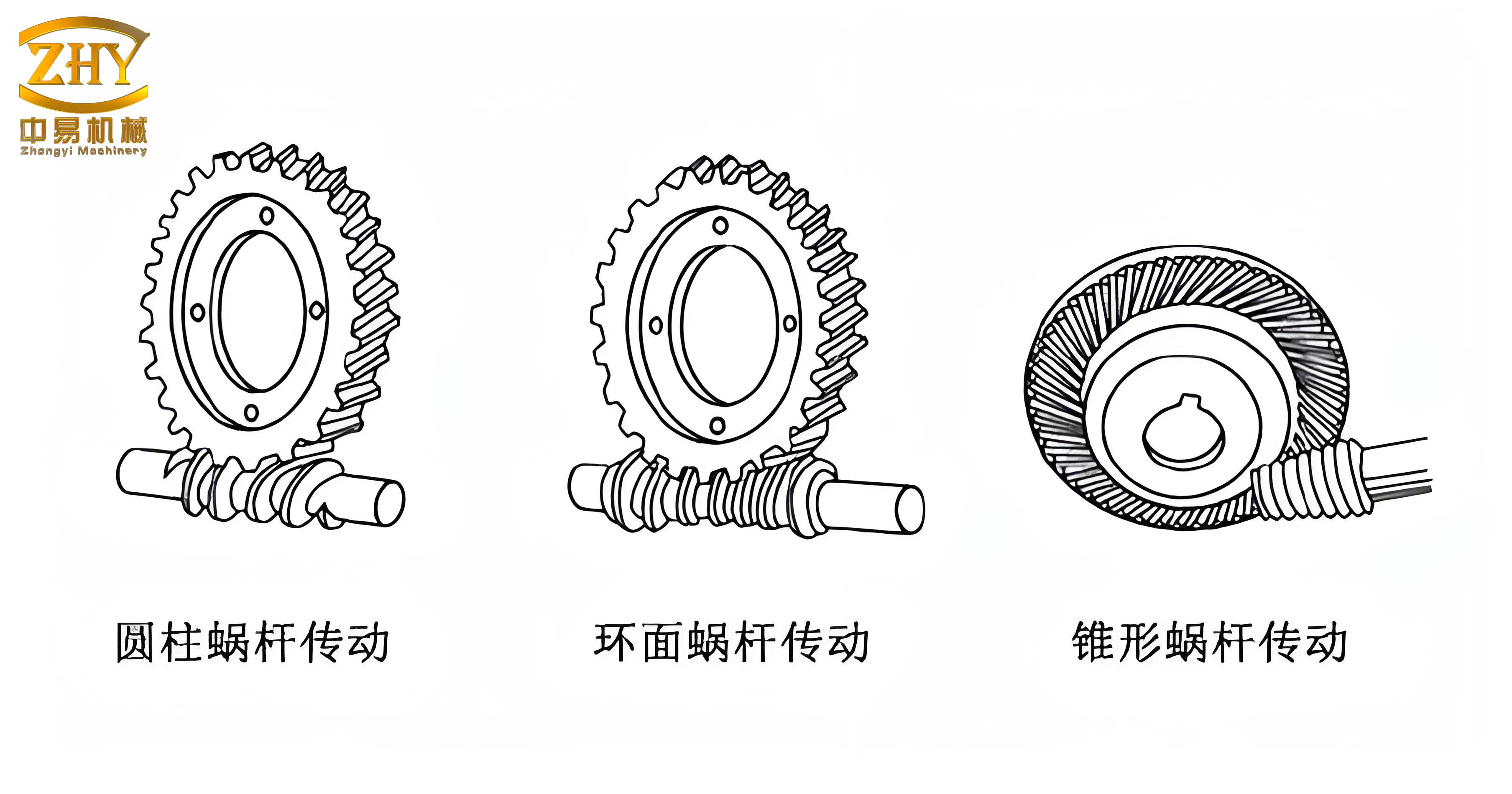
The essence of a screw gear drive is a kinematic pair where motion and power are transferred between non-parallel, non-intersecting shafts, typically at a 90-degree angle. The driving member, the worm, is essentially a screw thread, while the driven member, the worm gear, is a special helical gear whose teeth are curved to envelop the worm, increasing the contact area. The fundamental motion relationship is defined by the ratio of the number of threads (starts) on the worm, $Z_1$, to the number of teeth on the worm gear, $Z_2$, giving the gear ratio, $i$:
$$ i = \frac{Z_2}{Z_1} $$
For a single-start worm ($Z_1=1$) mating with a 40-tooth gear, a 40:1 reduction is achieved. The lead of the worm, $p_z$, which is the axial distance the thread advances in one complete revolution, and the axial module, $m_x$, are key defining parameters:
$$ p_z = \pi m_x Z_1 $$
The lead angle of the worm, $\gamma$, a critical parameter influencing efficiency and self-locking tendency, is given by:
$$ \tan \gamma = \frac{p_z}{\pi d_1} = \frac{m_x Z_1}{d_1} $$
where $d_1$ is the reference diameter of the worm. The performance envelope of a screw gear set is heavily constrained by this geometry.
The performance characteristics of a screw gear set—its efficiency, load capacity, wear resistance, and acoustic signature—are direct consequences of its tooth geometry. The contact between the worm thread and the worm gear tooth is theoretically a line contact that, under load, expands into an elliptical area. The shape, size, and motion of this contact zone are wholly governed by the mathematical definition of the tooth forms. An ideal, conjugate pair ensures that contact occurs along a theoretically perfect line, promoting even load distribution, minimizing sliding friction, and ensuring smooth motion transfer. Deviations from this ideal geometry, however, lead to edge loading, concentrated stress, increased sliding velocities, and ultimately, the failure modes previously mentioned. Therefore, the pursuit of tooth form accuracy is not merely a quest for dimensional compliance; it is the central endeavor in unlocking high efficiency, low noise, and thermal stability in screw gear drives.
Deconstructing Screw Gear Tooth Geometry: The ZA and ZN Forms
The international standard ISO 1122-1 recognizes several basic types of worm tooth profiles, differentiated by the method of generation or the section in which they possess a straight-line profile. The two most prevalent in industrial applications, particularly for power transmission reducers, are the ZA (Archimedes) type and the ZN (Straight-Sided Normal) type. The choice between them represents a classic engineering trade-off between manufacturing ease and performance potential.
The ZA-type screw gear, characterized as having an axial straight-line profile, is arguably the most common. In any axial section (a plane containing the worm axis), the thread flanks appear as straight lines inclined at the pressure angle, $\alpha_x$. This profile is a ruled surface generated by a straight cutting edge (like a lathe tool) moving along a helical path with its edge contained in the axial plane. The mathematical definition is straightforward: the axial profile coordinates $(x, y)$ for one flank can be described relative to the worm axis, satisfying a linear equation. This simplicity is its primary manufacturing virtue. It can be readily produced on a standard lathe with a trapezoidal-form tool, making it economical and accessible. The corresponding ZA-type worm gear is generated using a hob whose axial tooth profile mirrors that of the worm, which is also relatively straightforward to manufacture. This symbiotic manufacturing ease is why many reducer manufacturers default to the ZA-type screw gear system. However, this ease comes at a cost. The ZA profile is not involute and presents significant challenges for precision finishing via grinding. As we will explore, this limitation directly impacts the ultimate surface quality and accuracy attainable for the worm.
The ZN-type screw gear, in contrast, is defined by a normal straight-line profile. In the normal section (a plane perpendicular to the thread helix at the pitch point), the thread flanks are straight lines. It is further subdivided into tooth-profile-straight (ZN1) and space-profile-straight (ZN2) types, depending on which part of the tool profile is aligned normally. The ZN profile is a closer relative to the involute helicoid and offers superior kinematic properties. More importantly, it is inherently more amenable to precision grinding. A grinding wheel, whose generating line is straight, can be easily aligned to the normal plane of the worm thread, allowing for precise and efficient generation of the ZN profile. This enables the production of worms with exceptional surface finish, accuracy, and hardness (through case-hardening and grinding). The significant drawback lies in the conjugate worm gear. The hob required to generate a ZN-type worm gear must have a complex, non-linear profile in its axial section to create the correct normal straight-line profile on the worm gear tooth. Manufacturing such a hob with high precision is considerably more difficult and expensive than manufacturing a ZA hob. This often results in a mismatch: a high-precision, ground ZN worm paired with a worm gear whose tooth form has compromised accuracy due to hob limitations, undermining the potential benefits.
The following table summarizes the key characteristics and trade-offs of these two primary screw gear types:
| Feature | ZA-Type (Archimedes) | ZN-Type (Straight-Sided Normal) |
|---|---|---|
| Defining Section | Straight line in Axial section | Straight line in Normal section |
| Worm Manufacturing (Roughing) | Very Easy (Turning) | Moderately Difficult (Special Tool Setup) |
| Worm Manufacturing (Finishing/Grinding) | Very Difficult | Relatively Easy |
| Worm Gear Hob Manufacture | Relatively Easy | Very Difficult & Costly |
| Kinematic Quality | Good | Potentially Excellent |
| Primary Performance Limitation | Worm finishing accuracy | Worm gear generation accuracy |
This dichotomy explains the prevalent industry choice: adopt the ZA system to guarantee a reasonably accurate worm gear via a simpler hob, and then confront the challenge of how to precision-finish the ZA worm to a level that matches or complements the gear’s accuracy. The core problem, therefore, shifts to the manufacturing process of the ZA worm thread, particularly its grinding.
The Manufacturing Conundrum: Grinding the ZA-Profile Worm
To achieve high load capacity and long life, worm threads are often case-hardened (e.g., nitrided, induction hardened) after rough machining. Grinding is then necessary to correct distortion from heat treatment and to achieve the final, precise geometry and superb surface finish required for efficient meshing. Herein lies the fundamental problem for the ZA-type screw gear.
The theoretical requirement for grinding a ZA worm is to generate its axial straight-line profile. On a universal worm grinding machine, the grinding wheel is dressed to a specific profile and then oriented relative to the workpiece. To prevent interference between the grinding wheel and the opposing flank of the helical thread, the axis of the grinding wheel must be swiveled to match the lead angle, $\gamma$, of the worm. This alignment is shown in the figure below conceptually: the wheel axis is tilted so that it lies in the normal plane (N-N) relative to the worm thread at the pitch point.
When this tilt is applied, a critical geometric shift occurs. The grinding wheel, now operating in the worm’s normal section, is no longer generating the desired axial straight-line profile. Instead, it is generating a profile in the normal section. For a straight-sided grinding wheel, the resulting worm profile becomes a ZN-type (specifically, a ZN2 or “space-profile-straight” type) in the normal section. When this ground worm is then sectioned axially, its profile is not straight but curved. The relationship between the ground normal profile and the resulting axial profile is governed by the worm’s helical geometry. If the wheel profile is a straight line in the normal plane defined by angle $\theta$ relative to the worm axis normal, the corresponding coordinates in the axial plane become a function of the lead angle $\gamma$:
$$ x_{axial} = f( y_{normal}, \theta, \gamma ) $$
This function results in a non-linear, curved profile in the axial section.
Therefore, the straightforward method of grinding a ZA worm by simply tilting a straight-profile wheel produces a worm with a ZN-type geometry. When this “ZN-by-grinding” worm is meshed with a true ZA-type worm gear (generated by a ZA hob), a geometric mismatch ensues. The contact pattern deviates severely from the ideal line contact. It becomes a concentrated point or a very short, misaligned area, leading to dramatically increased contact pressure. The consequences are quantifiable and severe:
- Reduced Efficiency: Increased sliding friction due to poor conformity raises the friction coefficient, $\mu$. The basic efficiency formula for a screw gear, ignoring other losses, is:
$$ \eta = \frac{\tan \gamma}{\tan(\gamma + \rho’)} $$
where $\rho’ = \arctan(\mu / \cos \alpha_n)$ is the equivalent friction angle. Poor contact increases $\mu$, thereby reducing $\eta$ significantly. - Elevated Noise and Vibration: The mismatch causes discontinuous engagement and disengagement of teeth, generating excitation forces at the meshing frequency and its harmonics. The sound pressure level, $L_p$, can be correlated to vibrational acceleration, which is a function of the error in the transmission function, $\Delta \phi(\theta)$.
- Excessive Heat Generation: The power loss, $P_{loss}$, due to friction is concentrated in a small area:
$$ P_{loss} \approx T_1 \omega_1 (1 – \eta) $$
where $T_1$ and $\omega_1$ are the worm’s torque and angular velocity. This concentrated loss causes localized high temperatures, risking thermal breakdown of the lubricant and scoring of the surfaces.
Traditional workarounds, such as using a template-based dresser to shape the grinding wheel into a curved profile that theoretically produces a straight axial profile, are fraught with practical limitations. Template wear, alignment errors, and the inflexibility of the dresser mechanism lead to inconsistent and often inaccurate wheel profiles. The result is a ZA worm of unreliable quality, perpetuating the performance issues the grinding was meant to solve.
The Path to Precision: CNC Wheel Dressing for True ZA Form Grinding
The definitive solution to this manufacturing impasse lies in advanced, computer-controlled wheel dressing technology. The objective is clear: to dress the grinding wheel to a precise, non-linear profile such that, when the wheel is tilted to the worm’s lead angle and traversed along it, the resulting ground worm thread exhibits a perfect straight-line profile in its axial section. This requires the wheel’s active surface to be a sophisticated, calculated surface of revolution.
A modern CNC wheel dresser, typically implemented as a two-axis ($X$, $Z$) linear servo system carrying a single-point diamond tool, provides the necessary capability. The dressing system is mounted on the grinding machine, independent of the workpiece spindle. The required wheel profile is no longer a simple shape stored in a physical template but a digital dataset—a series of coordinates calculated from the exact worm design parameters: axial module ($m_x$), pressure angle ($\alpha_x$), lead angle ($\gamma$), and reference diameter ($d_1$).
The mathematical foundation involves solving the inverse problem: given the desired axial straight-line worm profile, what is the corresponding wheel profile in the normal section defined by the swivel angle $\gamma$? This is a problem of coordinate transformation between the axial section (A) of the worm and the normal section (N) of the grinding wheel. For a point on the desired axial worm flank defined by coordinates $(x_a, y_a)$, its location in the wheel’s coordinate system $(x_w, z_w)$ must be calculated, accounting for the wheel’s tilt and its relative motion along the worm helix. The governing transformations involve rotations by the lead angle $\gamma$ and the pressure angle $\alpha_x$. The resulting wheel profile is not a standard curve but a unique, high-order polynomial or spline function.
The CNC system executes this profile by synchronously moving the $X$ and $Z$ axes of the dresser during the dressing pass, tracing the calculated path with the diamond point against the rotating grinding wheel. This creates the exact inverse form on the wheel. The following table contrasts the traditional and CNC-based approaches:
| Aspect | Traditional Template Dressing | CNC Wheel Dressing |
|---|---|---|
| Profile Generation | Physical template (prone to wear, error) | Digital data (exact, repeatable) |
| Flexibility | Fixed for one worm design | Instantly reprogrammable for any design |
| Accuracy | Limited (>= ±0.005 mm profile error) | High (≤ ±0.001 mm profile error) |
| Setup Time for New Part | Long (new template needed) | Short (program upload) |
| Compensation for Wheel Wear | Manual, approximate | Automatic, precise via tool offset |
The practical implementation on a machine such as a modernized S7525 worm grinder involves integrating this CNC dresser with the machine’s existing axes. The lead angle $\gamma$ is still set using the machine’s mechanical swivel (or a CNC rotary axis). The grinding cycle—synchronized rotation of the worm (C-axis) with the axial traverse of the wheelhead (Z-axis)—remains. The breakthrough is that the wheel now has the correct, digitally-defined profile. When grinding, the wheel’s specially-dressed surface contacts the worm in the normal plane, yet it precisely generates the coveted ZA axial straight-line profile on the workpiece. The worm’s axial profile error, $\delta_{axial}$, is minimized, ensuring perfect conjugacy with its ZA worm gear mate.
The benefits cascade through the entire screw gear system performance. With accurate form grinding, the following improvements are empirically observed and can be modeled:
- Contact Pattern Optimization: The theoretical line contact is approached. The half-width, $b$, of the Hertzian contact ellipse under load, $F_n$, for the corrected geometry is maximized, reducing contact stress, $\sigma_H$:
$$ \sigma_H \propto \sqrt{ \frac{F_n E^*}{b \rho^*} } $$
where $E^*$ is the equivalent elastic modulus and $\rho^*$ is the equivalent radius of curvature. A larger $b$ and optimized $\rho^*$ lower $\sigma_H$. - Efficiency Gains: The reduction in localized friction can improve full-load efficiency by 2-5%, a significant gain in high-power applications.
- Thermal Management: The even heat flux distribution, $q”$, across the tooth flank prevents hot spots. The maximum steady-state temperature rise, $\Delta T_{max}$, can be estimated and shown to be lower for the accurate form.
$$ \Delta T_{max} \approx \frac{P_{loss,friction}}{A_{eff} \, h} $$
where $A_{eff}$ is the effective contact area and $h$ is the heat transfer coefficient. A larger, uniform $A_{eff}$ from good contact lowers $\Delta T_{max}$.
Comprehensive System Optimization: Beyond the Worm Grind
While precision grinding of the ZA worm is the cornerstone of improvement, it represents one element in a holistic system optimization strategy for superior screw gear performance. To fully exploit the potential of a high-accuracy worm, complementary actions on the worm gear and the system assembly are essential.
Worm Gear Finishing: Even with a perfect worm, if the worm gear tooth form has errors from hobbing (such as profile deviation, pitch error, or poor surface finish), the benefits are diluted. Post-hobbing finishing processes are highly beneficial:
– Gear Shaving or Honing: A finishing process using a cutter that meshes with the gear under crossed-axes conditions to remove small amounts of material, correcting minor errors and improving surface finish. It refines the tooth flanks to better conjugate with the ground worm.
– Increased Hob Diameter and Number of Gashes: Using a larger diameter hob with more gashes (cutting teeth) reduces the theoretical generating error (kinematic error per revolution) and produces a smoother tooth surface. The effective radius of the hob, $r_{hob}$, influences the curvature of the generated surface on the worm gear. A larger $r_{hob}$ can produce a form closer to the ideal conjugate of the worm, especially in the root and tip regions.
Assembly and Alignment Precision: The perfect screw gear pair must be mounted perfectly. Critical assembly parameters include:
– Center Distance Accuracy ($a$): Any deviation, $\Delta a$, from the design center distance alters the operating pressure angles and backlash, affecting contact pattern and stress.
– Axial Alignment and Squareness: The worm axis must be precisely square to the worm gear axis and correctly positioned axially so the active profile of the worm aligns with the full face width of the gear. Misalignment, $\delta_{align}$, causes one-sided contact and edge loading.
– Controlled Backlash ($j$): Proper backlash is essential to accommodate thermal expansion and ensure smooth, non-binding operation. It is typically set via precise adjustment of the center distance or the worm gear’s axial position.
The synergistic effect of combining a CNC-ground ZA worm with a finished worm gear and precise assembly can be summarized in a final performance comparison:
| Performance Metric | Conventional ZA Manufacturing | Optimized ZA System (CNC Ground + Finished) |
|---|---|---|
| Transmission Efficiency (η) at rated load | 85% – 92% | 90% – 95%+ |
| Noise Level (dB(A)) at 1440 rpm input | 70 – 78 dB(A) | 64 – 70 dB(A) |
| Temperature Rise (ΔT) above ambient | 40°C – 60°C | 25°C – 40°C |
| Expected Service Life (L10) | Base Reference (1.0x) | 1.5x – 2.5x |
| Contact Pattern at Assembly | Centered but narrow, possibly patchy | Full, centered, covering 60-80% of active flank |
In conclusion, the quest for excellence in screw gear transmission is fundamentally a quest for geometric perfection. The analysis unequivocally establishes that tooth form accuracy, particularly of the worm, is the primary lever controlling efficiency, noise, thermal behavior, and longevity. The manufacturing conundrum of the popular ZA-type screw gear—its easy generation but difficult precision finishing—has been definitively solved by the advent of CNC grinding wheel dressing technology. This technology enables the economic production of ZA worms with axial straight-line profiles of the highest fidelity. When this capability is integrated into a comprehensive manufacturing philosophy that also embraces worm gear finishing and meticulous assembly, the result is a screw gear drive of exceptional quality. The benefits are tangible: reduced energy consumption, quieter operation, greater reliability, and extended service life. For engineers and manufacturers dedicated to advancing the state of the art in power transmission, mastering the science and technology of screw gear tooth form is not merely an option; it is an imperative.