
In my experience working with automotive steering systems, I have encountered numerous challenges related to noise, vibration, and harshness (NVH). One persistent issue is friction noise in the screw gear assemblies of column-type electric power steering (C-EPS) systems. These systems rely directly on an electric motor for assistance, and their integrated components are complex. During operation, abnormal noises can severely compromise driving comfort. Among these, friction noise originating from the screw gear interaction is particularly difficult to resolve due to its multifaceted influencing factors. This article, drawing from product development insights, outlines fundamental approaches and methods to address screw gear friction noise, aiming to provide valuable reference for vehicle design and development.
Friction noise in screw gears is not merely an acoustic nuisance; it is a symptom of underlying mechanical interactions that affect system reliability and user perception. Through systematic investigation, I have identified that controlling this noise requires a holistic strategy encompassing dimensional precision, material science, lubrication engineering, and assembly rigor. The following sections delve into these aspects, employing tables and formulas to summarize key concepts and data, while consistently emphasizing the role of the screw gear in steering performance.
Classification and Characteristics of Steering System Noise
From a vibrational perspective, abnormal noises in electric power steering systems can be categorized into three types: rotational, bump-induced, and impact-related. Rotational noise occurs during continuous steering wheel rotation and includes contributions from motor operation and mechanical elements like the screw gear. Bump-induced noise arises when driving on rough roads, where small clearances between parts lead to impact vibrations. Impact noise is generated when the steering wheel is fixed at a position and then repeatedly turned back and forth around that point; the change in force direction causes collisions between components.
Specifically, screw gear friction noise falls under rotational noise. In vehicles, it manifests in two primary phenomena. First, during slow steering maneuvers such as startup or parking, a “creaking” sound can emerge from the screw gear mesh, indicative of friction and sticking. Second, across various speed ranges, especially during steering reversals, a high-pitched “squealing” noise may occur, often exacerbated under low-temperature conditions. Both phenomena stem from unstable interactions within the screw gear assembly.
Mechanism of Friction Noise Generation
The core mechanism behind friction noise in screw gears is stick-slip motion. This occurs when the contact surfaces between the screw and gear experience alternating static and kinetic friction, leading to unstable vibrations. Mathematically, stick-slip can be modeled using a simplified system with a mass, spring, and friction interface. The friction force $F_f$ is often described as:
$$ F_f = \mu F_n $$
where $\mu$ is the coefficient of friction and $F_n$ is the normal force. When static friction $\mu_s$ exceeds kinetic friction $\mu_k$, and the system has elasticity, stick-slip oscillations arise. The condition for stick-slip is:
$$ \mu_s > \mu_k $$
During the stick phase, friction builds up until it overcomes the static threshold, causing a sudden slip. This results in resistance fluctuations and, often, high-frequency acoustic emissions. For screw gears, this can be exacerbated by geometric imperfections or material inconsistencies. The stick-slip frequency $f_{ss}$ can be approximated by:
$$ f_{ss} = \frac{1}{2\pi} \sqrt{\frac{k}{m}} $$
where $k$ is the system stiffness and $m$ is the effective mass. However, in practice, the dynamics are more complex due to multi-degree-of-freedom interactions in the screw gear assembly.
Fundamental Approach to Mitigating Screw Gear Friction Noise
Based on the stick-slip mechanism, my approach to controlling screw gear friction noise focuses on four pillars: dimensional control and optimization of the screw gear, material selection for the gear, lubrication formulation, and precision assembly processes. Each pillar aims to minimize friction coefficient variations, ensure stable contact, and reduce susceptibility to environmental factors like temperature and humidity. The interplay between these factors is critical; for instance, an optimal lubricant must complement the chosen screw gear material to maintain performance across operating conditions.
Dimensional Control and Optimization of Screw Gears
In one product development case, inspection of noisy screw gear assemblies revealed wear marks on the gear edges and mating surfaces, as well as scoring on the screw thread. This indicated interference during motion, leading to noise. Dimensional analysis showed significant deviations in gear geometry, particularly in face runout, which caused uneven contact pressure and frictional spikes. Additionally, the screw thread exhibited sharp edges with high roughness, further aggravating surface damage.
To address this, I implemented stringent controls on key screw gear dimensions. First, for the gear (often manufactured via injection molding), the molding process was revised from a 4-gate to a 6-gate system, improving dimensional accuracy and reducing runout. The table below summarizes typical tolerance improvements:
| Parameter | Before Optimization | After Optimization |
|---|---|---|
| Gear Face Runout | ≤ 0.15 mm | ≤ 0.05 mm |
| Gear Outer Diameter Tolerance | ± 0.1 mm | ± 0.05 mm |
| Screw Thread Roughness (Ra) | 0.8 µm | 0.4 µm |
Second, the screw thread design was optimized by introducing a radius at the tooth crest to eliminate sharp edges. This reduces stress concentrations and prevents mechanical jamming. The surface finish was enhanced through grinding processes, controlled to a roughness average $R_a \leq 0.4 \mu m$. The geometry of the screw gear mesh can be described by the center distance $a$, which for a screw gear pair is given by:
$$ a = \frac{d_1 + d_2}{2} $$
where $d_1$ is the screw pitch diameter and $d_2$ is the gear pitch diameter. Maintaining tight tolerances on $a$ is crucial to minimize backlash and ensure smooth engagement. In practice, I use statistical process control to monitor these parameters, ensuring each screw gear component meets specifications.
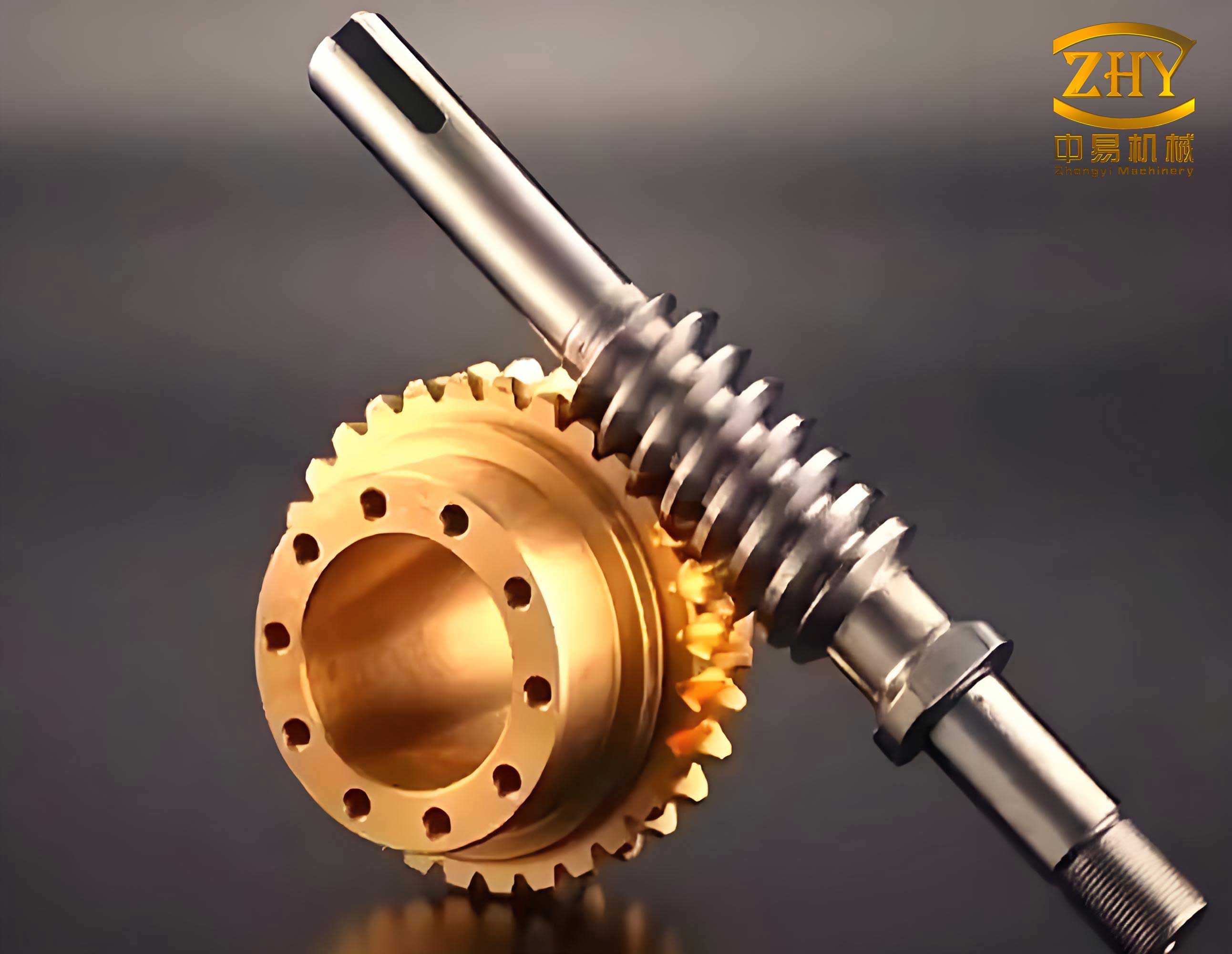
This image illustrates a typical screw gear assembly, highlighting the intricate mesh between the screw and gear. Proper dimensional harmony here is essential to prevent friction noise.
Material Selection for Screw Gears
The material of the screw gear (specifically the gear component, often made from polymer) plays a pivotal role in friction noise. Key properties include hardness, water absorption, wear resistance, dimensional stability under temperature fluctuations, and permanent deformation characteristics. My evaluation criteria for screw gear materials encompass three aspects: low friction coefficient and wear rate, dimensional stability across humidity and temperature ranges, and strong weathering and aging resistance.
Common materials for screw gears are polyamides (e.g., PA66, PA66G). I conducted comparative tests to assess their performance, as summarized in the table below:
| Material Property | PA66 | PA66G (Glass-filled) | POM | PPA |
|---|---|---|---|---|
| Hardness (Rockwell M) | 90 | 100 | 80 | 95 |
| Water Absorption (%) | 2.5 | 1.8 | 0.2 | 1.0 |
| Friction Coefficient vs. Steel | 0.25 | 0.20 | 0.30 | 0.22 |
| Wear Rate (mm³/N·m) | 5 × 10⁻⁶ | 3 × 10⁻⁶ | 8 × 10⁻⁶ | 4 × 10⁻⁶ |
| Dimensional Change at -40°C (%) | -0.3 | -0.2 | -0.5 | -0.25 |
| Dimensional Change at +120°C (%) | +0.4 | +0.3 | +1.0 | +0.35 |
| Permanent Deformation after Heat Aging | Low | Very Low | Moderate | Low |
From this, PA66 and PA66G exhibit balanced properties. The friction coefficient $\mu$ is critical; a lower value reduces the stick-slip propensity. Wear rate affects long-term clearance; minimizing it helps maintain screw gear mesh integrity. Dimensional stability is vital because temperature-induced changes alter the center distance $a$, potentially leading to noise. For instance, the change in gear diameter $\Delta d_2$ due to thermal expansion can be expressed as:
$$ \Delta d_2 = d_2 \cdot \alpha \cdot \Delta T $$
where $\alpha$ is the coefficient of linear expansion and $\Delta T$ is the temperature change. Materials with low $\alpha$ are preferred for screw gears to minimize such variations.
Additionally, I perform bench tests to validate material compatibility. Multiple screw gear sets are subjected to endurance cycles under varying loads and temperatures, assessing noise generation and wear patterns. This empirical approach complements material data, ensuring the selected screw gear material performs reliably in real-world conditions.
Lubrication Formulation for Screw Gears
Lubrication is paramount in mitigating screw gear friction noise. The lubricant must form a stable film between contacting surfaces, reducing metal-to-polymer friction and dampening vibrations. Key factors influencing lubricant efficacy include quantity, compatibility with materials, and formulation characteristics.
Firstly, insufficient lubricant quantity fails to coat the screw gear mesh adequately, leading to dry spots and friction coefficient spikes. Based on my testing, a minimum grease mass of 16 grams is required for typical C-EPS screw gear assemblies. The coverage area $A_c$ can be estimated by:
$$ A_c = \pi \cdot d_2 \cdot w $$
where $w$ is the gear face width. Ensuring uniform distribution across $A_c$ is essential.
Secondly, compatibility with screw gear materials and other substances (e.g., rust preventives, machining oils) must be assessed. Incompatible mixtures can increase friction. I evaluate this by measuring the friction torque $T_f$ before and after contamination:
$$ T_f = F_f \cdot r $$
where $r$ is the effective radius. A significant rise in $T_f$ indicates poor compatibility.
Thirdly, the lubricant’s formulation—its base oil, thickener, and additives—affects performance across temperatures. Ideal screw gear greases maintain consistent viscosity $\eta$ over a broad range. The Stribeck curve illustrates the lubrication regime; for screw gears, we aim for hydrodynamic or elastohydrodynamic conditions to avoid boundary lubrication where friction is high. The dimensionless Sommerfeld number $S$ is relevant:
$$ S = \frac{\eta \cdot N}{P} $$
where $N$ is the rotational speed and $P$ is the load per unit area. Higher $S$ indicates better film formation. I select greases with high viscosity index and anti-wear additives. The table below compares typical grease properties:
| Grease Property | Type A (Lithium-based) | Type B (Polyurea) | Type C (Synthetic PAO) |
|---|---|---|---|
| Base Oil Viscosity at 40°C (cSt) | 120 | 150 | 100 |
| Dropping Point (°C) | 180 | 250 | 220 |
| Worked Penetration (0.1 mm) | 280 | 260 | 270 |
| Friction Coefficient with PA66 | 0.10 | 0.08 | 0.09 |
| Low-Temperature Torque (-40°C, N·m) | 0.5 | 0.3 | 0.4 |
Type B often shows superior performance in screw gear applications due to its low friction and high-temperature stability. However, comprehensive testing is necessary to match the grease with the specific screw gear material and operating envelope.
Assembly Process for Screw Gears
Precision assembly is the final step in ensuring screw gear performance. Due to manufacturing variances, housings, screws, and gears must be selectively matched to control mesh clearance, reduce free play, and minimize noise. My approach involves grouping components based on critical dimensions and assembling them in matched sets.
The housing bore center distance $a_h$ is 100% measured and grouped into categories (e.g., Group H1, H2). Similarly, the gear pitch diameter $d_2$ is measured and grouped (Group G1, G2). The screw thread is manufactured to a nominal “zero” condition, with its pitch diameter $d_1$ tightly controlled. The assembly rule is to pair housing and gear from the same group, then install the zero-condition screw. This minimizes the effective clearance $c$:
$$ c = a_h – \frac{d_1 + d_2}{2} $$
By keeping $c$ within a narrow band, typically ±0.02 mm, I reduce the likelihood of impact and friction noise. The table below illustrates a grouping scheme:
| Component | Group 1 | Group 2 | Group 3 |
|---|---|---|---|
| Housing Center Distance (mm) | 25.000 – 25.005 | 25.005 – 25.010 | 25.010 – 25.015 |
| Gear Pitch Diameter (mm) | 24.990 – 24.995 | 24.995 – 25.000 | 25.000 – 25.005 |
| Screw Pitch Diameter (mm) | Nominal 24.995 (Zero Group) | ||
This modular grouping ensures that each screw gear assembly has consistent engagement, lowering the risk of stick-slip. Additionally, I verify assembly quality through torque and noise tests on a dedicated bench, measuring parameters like starting torque $T_s$ and rotational noise level in decibels. The process capability index $C_{pk}$ is monitored to ensure long-term stability:
$$ C_{pk} = \min\left( \frac{USL – \mu}{3\sigma}, \frac{\mu – LSL}{3\sigma} \right) $$
where $USL$ and $LSL$ are specification limits for noise or torque, $\mu$ is the mean, and $\sigma$ is the standard deviation. A $C_{pk} \geq 1.33$ is targeted for critical screw gear assemblies.
Conclusions and Future Directions
In summary, addressing friction noise in screw gear assemblies demands a multifaceted strategy. By controlling screw gear dimensions, selecting appropriate materials, optimizing lubrication, and implementing precision assembly, I have successfully reduced noise incidents in C-EPS systems. The core principle is to maintain stable mesh conditions and minimize friction coefficient variations, thereby suppressing stick-slip motion.
Looking ahead, I recommend two focal areas for further research. First, deeper investigation into the tribological compatibility between lubricants, screw gear materials, and steel screws. Systematic studies could explore novel lubricant additives or surface treatments for the screw gear to enhance film strength and reduce wear. Second, developing comprehensive bench and vehicle test protocols that simulate real-world conditions more accurately. By creating accelerated aging tests, temperature-humidity cycles, and road load simulations, we can better validate screw gear performance early in development, reducing late-stage issues.
Ultimately, the screw gear remains a critical component in electric power steering, and its quiet operation is essential for vehicle NVH refinement. Through continued innovation in materials, processes, and testing, we can further elevate the driving experience while ensuring reliability. The insights shared here, grounded in practical experience, aim to guide engineers in tackling similar challenges, emphasizing that a proactive, integrated approach is key to mastering screw gear friction noise.