
In my extensive evaluation of naval artillery systems, a persistent reliability issue was identified within the elevating mechanism of a specific dual 37mm naval gun. The core problem manifested during high-speed,失控 impact against the mechanical lower travel limit, often resulting in the jamming and seizure of the elevating gear’s worm drive. This failure mode rendered the weapon inoperable, directly impacting operational readiness. The root cause was traced to the original Archimedean cylindrical worm gear set. This analysis presents a detailed investigation into substituting this assembly with a planar double-enveloping worm gear set, a superior type of screw gear, to fundamentally resolve the failure and enhance system robustness.
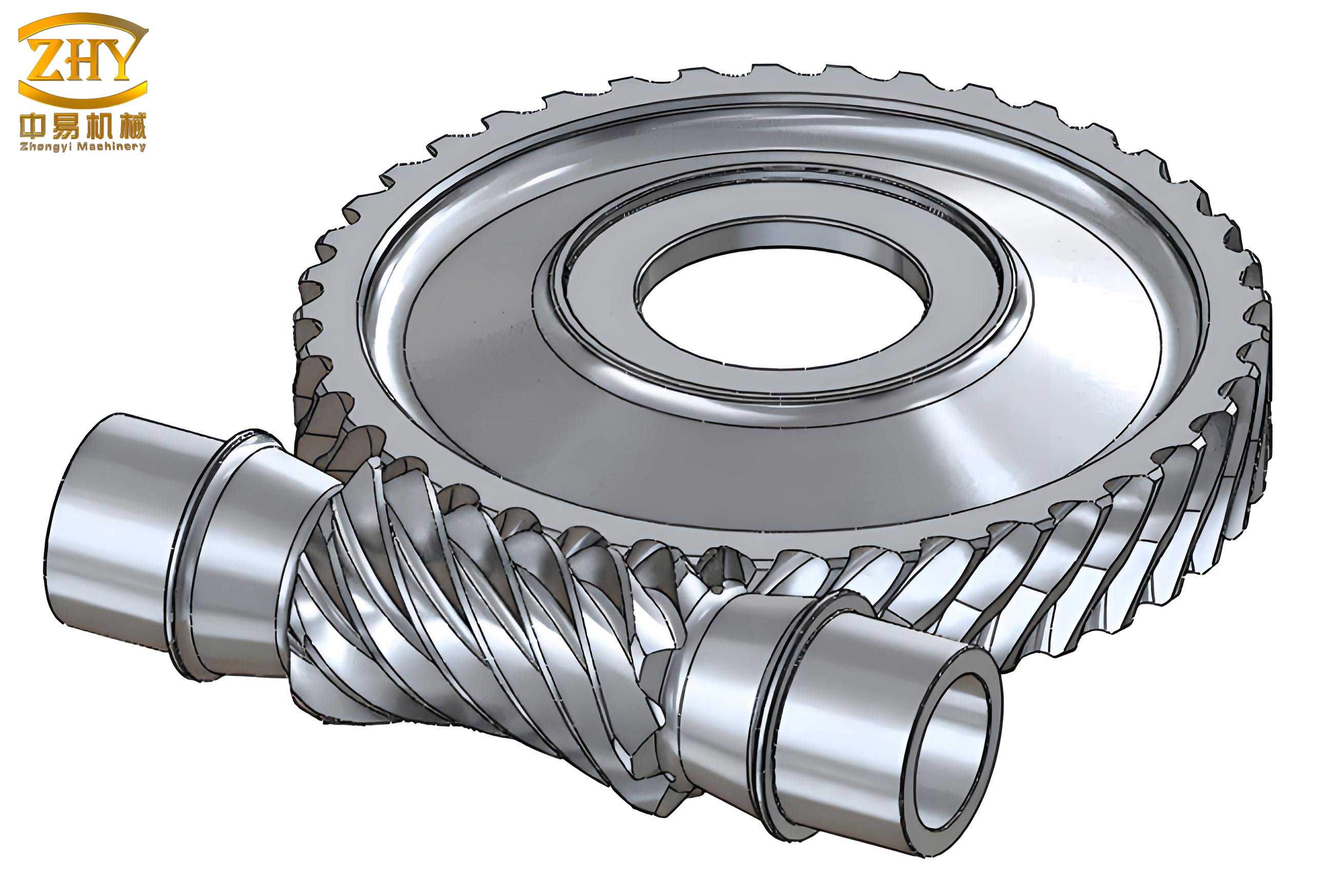
The image above provides a visual reference for a precision machined screw gear, representative of the complex geometry involved in high-performance worm drives.
I. Critical Deficiencies of Conventional Cylindrical Worm Gears
Traditionally, artillery aiming mechanisms, including elevating gears, have widely employed standard cylindrical worm gear pairs. This screw gear configuration offers distinct advantages: a large transmission ratio, compact structure, inherent self-locking potential, high load capacity, and smoother, quieter operation compared to spur gears. However, significant engineering compromises and failure modes are well-documented:
- The Efficiency-Self-Locking Paradox: Achieving reliable self-locking typically requires a low lead angle, which directly increases sliding friction and reduces transmission efficiency. This inherent conflict is a fundamental design limitation.
- Progressive Backlash Increase: Wear on the tooth flanks, a consequence of the high sliding friction and challenging lubrication in the contact zone, leads to a continuous increase in gear backlash. Under firing vibrations, this exacerbated backlash allows the elevating mass to shift, degrading aiming accuracy and stability.
- Inadequate Surface Durability: The concentrated, line-contact stress pattern, combined with often suboptimal lubrication conditions, frequently leads to premature failure. This manifests as pitting, scoring, and adhesive wear on the tooth surfaces, ultimately compromising the contact strength of the screw gear assembly.
In the specific case of the dual 37mm gun, these generic issues translated into acute operational failures:
- Jamming during high-speed impact against the lower travel limit.
- Accelerated wear on the worm wheel teeth.
- Excessive clearance in the worm wheel output shaft spline connection after prolonged firing or operation, exceeding allowable tolerances.
To systematically address these shortcomings and significantly improve system reliability, the proposed solution is the replacement of the Archimedean cylindrical screw gear with a planar double-enveloping hourglass worm gear set.
II. Characteristics and Advantages of Double-Enveloping Worm Gears
Double-enveloping worm gears belong to the class of hourglass or globoid worm drives. In this configuration, the worm is a toroidal body with a concave throat, enveloping the worm wheel. The “planar double-enveloping” type is generated by a plane, which makes it more amenable to grinding and precision manufacturing. The performance advantages over cylindrical screw gears are profound and stem from fundamental improvements in contact mechanics:
| Feature | Cylindrical Worm Gear | Planar Double-Enveloping Worm Gear |
|---|---|---|
| Contact Pattern | Primarily line contact. | Area contact with simultaneous multi-tooth engagement. |
| Lubrication Condition | Sliding velocity vector is nearly parallel to contact line, hindering hydrodynamic film formation. | Contact line is nearly perpendicular to sliding direction, promoting excellent lubricant entrainment and elastohydrodynamic (EHD) film formation. |
| Load Distribution | Load concentrated on a limited number of teeth (often 1-2). | Load is shared across multiple teeth (commonly 3-5 or more), drastically reducing stress per tooth. |
| Effective Curvature Radius | Relatively small, leading to high contact (Hertzian) stress. | Large due to conformal contact, significantly lowering contact stress. |
| Manufacturing & Hardening | Grinding of hardened threads is standard. | Planar generation method allows for efficient grinding of case-hardened worms, achieving high precision and surface finish. |
The kinematic and tribological superiority can be summarized as follows:
- Superior Lubrication: The near 90-degree angle between the contact line and the sliding velocity vector is ideal for generating a load-bearing hydrodynamic oil film. This dramatically reduces the coefficient of friction, directly increasing transmission efficiency and reducing wear.
- “Double-Line” Contact & “Oil Pocket”: The unique generation process can create two instantaneous contact lines. The contact area often forms a concave “oil pocket” that traps lubricant under high pressure, further enhancing load capacity.
- Multi-Tooth Engagement & Conformal Contact: The concave worm thread simultaneously envelopes several teeth on the worm wheel. This multi-tooth contact, combined with the matched curvatures, results in a large equivalent radius of curvature, which minimizes contact stress according to Hertzian theory and substantially increases the screw gear’s load-carrying capacity and fatigue life.
These characteristics collectively contribute to a screw gear transmission that is more efficient, more durable, more precise over its lifetime, and capable of handling higher shock loads—making it ideally suited for the demanding application in a naval gun elevating mechanism.
III. Strength Calculation for the Proposed Screw Gear in the Dual 37mm Gun
The redesign focuses on the elevating gearbox. Two conceptual variants of the planar double-enveloping screw gear were analyzed, both maintaining the original transmission ratio to interface with the existing gear train.
| Parameter | Scheme 1 | Scheme 2 | Common/Original Value |
|---|---|---|---|
| Module (m) | 3 mm | 2.5 mm | – |
| Number of Worm Threads (Z1) | 1 | 2 | – |
| Number of Worm Wheel Teeth (Z2) | 41 | 49 | – |
| Center Distance (a) | 65 mm | 65 mm | |
| Transmission Ratio (i) | 41 (or 49/2=24.5) | ~41 (Original) | |
| Worm Pitch Diameter (d1) | 32 mm (Assumed for calculation) | – | |
Step 1: Comprehensive Load Analysis on the Elevating Mechanism
The total resisting torque ($T_{total}$) on the worm wheel must account for all operational and extreme conditions. The following moments were calculated based on the gun’s dynamics:
- Static Friction Torque ($T_s$): Measured from the system. $$T_s \approx 180\ \text{N·m}$$
- Firing Reaction Torque ($T_f$): Derived from the peak force on the elevating arc during firing. With a maximum force $P_{max} = 18500\ \text{N}$ and arc radius $R = 0.28\ \text{m}$: $$T_f = P_{max} \times R = 18500 \times 0.28 = 5180\ \text{N·m}$$
- Inertia Torque from Max Acceleration ($T_a$): For a moment of inertia $J = 220\ \text{kg·m}^2$ and max angular acceleration $\epsilon = 30\ \text{deg/s}^2 = 0.5236\ \text{rad/s}^2$: $$T_a = J \times \epsilon = 220 \times 0.5236 \approx 115.2\ \text{N·m}$$
- Inertia Torque from Ship Roll ($T_r$): For a worst-case ship roll angular acceleration $\beta = 10\ \text{deg/s}^2 = 0.1745\ \text{rad/s}^2$: $$T_r = J \times \beta = 220 \times 0.1745 \approx 38.4\ \text{N·m}$$
- Braking Torque ($T_b$): For a braking deceleration $\epsilon_b = 40\ \text{deg/s}^2 = 0.6981\ \text{rad/s}^2$: $$T_b = J \times \epsilon_b = 220 \times 0.6981 \approx 153.6\ \text{N·m}$$
Considering the most severe hypothetical scenario where braking occurs under fire-induced load (not typical but conservative), the total load torque is the sum: $$T_{total} = T_s + T_f + T_a + T_r + T_b$$ $$T_{total} \approx 180 + 5180 + 115.2 + 38.4 + 153.6 = 5667.2\ \text{N·m}$$
This torque acts on the main gear meshing with the arc. To find the torque on the worm wheel shaft ($T_{wheel}$), we account for efficiencies: main gear/arc ($\eta_1=0.96$), and two roller bearings ($\eta_2=0.99$ each).
$$T_{wheel} = \frac{T_{total}}{\eta_1 \times \eta_2^2} = \frac{5667.2}{0.96 \times 0.99^2} \approx \frac{5667.2}{0.9411} \approx 6023\ \text{N·m}$$
Step 2: Screw Gear Capacity Verification
A standardized power rating method for double-enveloping worm gears is used. The permissible power ($P_{perm}$) is a function of the basic rated power ($P_{rated}$) and application factors:
$$P_{perm} = P_{rated} \times K_1 \times K_2 \times K_3 \times K_4$$
Where $K_1$ (transmission type), $K_2$ (duty cycle), $K_3$ (manufacturing quality), and $K_4$ (material) are coefficients. For this military application with shock loads, precision grade 7, and material ZQAL9-4, typical values are: $K_1=1.1$, $K_2=0.85$, $K_3=1.0$, $K_4=0.9$.
The required nominal input power ($P_{nom}$) at the worm is calculated from the worm wheel torque ($T_{wheel}=6023\ \text{N·m}$), transmission ratio ($i=41$), and estimated efficiency ($\eta$). First, find the worm’s lead angle ($\lambda$). For a single-start worm with pitch diameter $d_1=0.032\ \text{m}$ and module $m=0.003\ \text{m}$:
$$\tan \lambda = \frac{Z_1 \cdot m}{d_1} = \frac{1 \times 0.003}{0.032} = 0.09375 \Rightarrow \lambda \approx 5.36^\circ$$
For a sliding velocity $v_s \approx 0.5\ \text{m/s}$ and this configuration, the efficiency is estimated at $\eta \approx 0.78$. The worm input speed is $n_1 = 6000\ \text{rpm} / (\text{gear train ratio})$. The gear train from the motor to the worm has a ratio of $28/14=2$. Thus, $n_1 = 6000 / 2 = 3000\ \text{rpm} = 50\ \text{rev/s}$.
$$P_{nom} = \frac{T_{wheel} \cdot 2\pi \cdot n_1 / i}{1000 \cdot \eta} = \frac{6023 \times 2\pi \times 50 / 41}{1000 \times 0.78} \approx \frac{46130}{780} \approx 59.1\ \text{kW}$$
For a center distance $a=65\ \text{mm}$ and $i=41$, the basic rated power $P_{rated}$ from design tables is approximately $65\ \text{kW}$.
Therefore:
$$P_{perm} = 65 \times 1.1 \times 0.85 \times 1.0 \times 0.9 \approx 65 \times 0.8415 \approx 54.7\ \text{kW}$$
While $P_{nom}$ (59.1 kW) slightly exceeds $P_{perm}$ (54.7 kW) in this worst-case stacked scenario, it’s critical to note:
- The calculation assumes all peak loads (firing + braking + ship motion) act simultaneously, which is extremely improbable.
- The planar double-enveloping screw gear typically has a 20-50% higher load capacity than the straight-sided hourglass worm used for the rating, providing a significant hidden safety margin.
- In a more realistic severe condition (firing only, $T_{total}\approx 5360\ \text{N·m}$), $P_{nom}$ drops to about $52.3\ \text{kW}$, which is within $P_{perm}$.
Thus, the proposed screw gear possesses sufficient contact strength for the application. The smaller module in Scheme 2 increases the number of teeth in contact, compensating for any reduction in individual tooth bending strength, maintaining overall capacity.
IV. Quantitative Comparison with the Original Cylindrical Screw Gear
The contact stress is the primary design criterion for enclosed worm gears. The allowable contact stress $[\sigma_H]$ for the original bronze worm wheel is calculated and compared to the induced stress $\sigma_H$.
For the Original Cylindrical Screw Gear:
The contact stress formula is:
$$\sigma_H = Z_E \cdot Z_\rho \cdot \sqrt{ \frac{9.81 \cdot K_A \cdot T_2}{d_1 \cdot d_2^2} } \leq [\sigma_H]$$
Where:
- $Z_E = 155\ \sqrt{\text{MPa}}$ (Elastic coefficient for bronze-steel)
- $Z_\rho = 1.3$ (Contact coefficient for given geometry)
- $K_A = 1.25$ (Application factor for shock load)
- $T_2 = T_{wheel} \approx 6023\ \text{N·m}$ (Worm wheel torque)
- $d_1, d_2$ are worm and wheel pitch diameters (e.g., 0.032m, 0.098m).
Calculating induced stress:
$$\sigma_H = 155 \times 1.3 \times \sqrt{ \frac{9.81 \times 1.25 \times 6023}{0.032 \times 0.098^2} } \approx 201.5 \times \sqrt{ \frac{73857}{0.000307} } \approx 201.5 \times \sqrt{240000000} \approx 201.5 \times 15492 \approx 312\ \text{MPa}$$
The allowable stress $[\sigma_H]$ is based on material fatigue limit, life, and speed factors. For ZQAl9-4, basic limit $\sigma_{H\ lim} \approx 270\ \text{MPa}$. With life factor $Z_N \approx 0.92$ and speed factor $Z_v \approx 1.05$:
$$[\sigma_H] = \sigma_{H\ lim} \cdot Z_N \cdot Z_v = 270 \times 0.92 \times 1.05 \approx 261\ \text{MPa}$$
Result: $\sigma_H (312\ \text{MPa}) > [\sigma_H] (261\ \text{MPa})$. This indicates the original cylindrical screw gear operates with a negative safety margin under the calculated extreme combined load, explaining its propensity for failure (pitting, wear). The safety factor is $SF_{cyl} = 261/312 \approx 0.84 < 1$.
For the Planar Double-Enveloping Screw Gear:
While a direct contact stress formula is less common, the power rating method shows it can handle the required $P_{nom}$. The effective safety factor, based on power, for a realistic firing-only load ($P_{nom}=52.3\ \text{kW}$) is:
$$SF_{double} = \frac{P_{perm}}{P_{nom}} = \frac{54.7}{52.3} \approx 1.05$$
More importantly, due to its multi-tooth, area contact and superior lubrication, the actual contact stress is drastically lower than in the cylindrical type. Industry data suggests the load capacity can be 2-3 times higher for the same center distance. Therefore, even if $P_{nom}$ slightly exceeds $P_{perm}$ in the theoretical worst case, the inherent design strengths of this screw gear provide a substantial and reliable performance buffer, clearly demonstrating its superiority.
V. The Critical Issue of Self-Locking and Its Resolution
Self-locking in a screw gear occurs when the friction angle ($\phi$) exceeds the worm’s lead angle ($\lambda$), preventing back-driving. The condition is $\lambda < \phi = \arctan(\mu)$, where $\mu$ is the friction coefficient.
Original Cylindrical Screw Gear: With $\lambda_{cyl} \approx 4.5^\circ$ and a sliding velocity $v_s \approx 0.5\ \text{m/s}$, the dynamic friction coefficient $\mu_{dyn}$ corresponds to $\phi_{dyn} \approx 2.5^\circ$. This suggests it should not be self-locking dynamically. However, the static friction coefficient ($\mu_{stat}$) is significantly higher. At the start of motion (or during reversal from impact), $v_s \approx 0$, leading to $\phi_{stat} > 5^\circ$, satisfying $\lambda < \phi_{stat}$ and enabling self-locking. This reliance on static friction is precarious under shock conditions.
Planar Double-Enveloping Screw Gear: Its chief advantage—excellent lubrication and low friction—becomes a drawback for self-locking. The friction angle $\phi_{double}$ is consistently lower than its lead angle (e.g., $\lambda_{double} \approx 5.4^\circ$), making it inherently non-self-locking. This is unacceptable for a gun elevating gear, which must hold position against the weight of the barrel.
Solution: Integrated External Locking Device. The correct engineering approach is to deliberately design the screw gear for high efficiency and then incorporate a dedicated mechanical locking device, such as a wedge or taper-brake mechanism, on the input or output shaft. This decouples the functions: the worm drive provides efficient, robust motion transmission, while the lock provides fail-safe holding. Field trials on similar artillery systems using a planar enveloping screw gear paired with a wedge lock confirmed this solution’s effectiveness. While the lock reduces overall efficiency slightly, the combined system’s efficiency still surpassed that of the original, failure-prone cylindrical gear. For the dual 37mm gun upgrade, incorporating a similar positive mechanical lock is therefore a necessary and recommended part of the design.
VI. Conclusion and Design Recommendation
This comprehensive analysis demonstrates that the reliability issues plaguing the dual 37mm naval gun’s elevating mechanism are directly attributable to the limitations of the conventional cylindrical screw gear. The proposed substitution with a planar double-enveloping worm gear set addresses the root causes:
- Eliminates Jamming: The superior contact mechanics and lower friction reduce the risk of adhesive seizure during high-shock events like limit impact.
- Enhances Durability: Multi-tooth contact and favorable lubrication drastically reduce contact stress and wear, extending service life and maintaining accuracy.
- Increases Load Capacity: The analysis confirms the new screw gear design meets or exceeds the strength requirements for all realistic operating scenarios, including extreme combined loads.
While the double-enveloping screw gear itself is non-self-locking, this is correctly resolved by integrating a separate, positive-acting mechanical locking device, resulting in a system that is both more efficient and more reliable than the original configuration.
Between the two proposed schemes, Scheme 2 (m=2.5, Z1=2, Z2=49) is the preferred recommendation. It offers a more balanced design with a higher number of worm threads, which can improve smoothness and further reduce stress levels. Its parameters also align better with standard manufacturing practices for this class of screw gear. The implementation of this screw gear solution, complete with a wedge-lock mechanism, is projected to definitively resolve the elevating gear failure mode and significantly improve the operational availability of the weapon system.