
In the realm of mechanical transmission systems, screw gears, encompassing worms and worm wheels, hold a position of critical importance due to their unique ability to provide high reduction ratios and self-locking characteristics within compact spatial configurations. The manufacturing process for screw gears is notably complex, with the quality of the final product being profoundly influenced by the precision and appropriateness of the formulated process plan. Traditional manual methods for developing these process plans are not only tedious and time-consuming but also prone to inconsistencies and errors, which can directly impact the performance and longevity of the screw gear pair. To address these challenges, the development and implementation of Computer-Aided Process Planning (CAPP) systems present a compelling solution. A fundamental and persistent challenge in realizing effective CAPP, however, lies in the method of part information input and the internal computer representation of the part. This challenge essentially revolves around defining a rational data structure or part model capable of comprehensively describing all relevant part information.
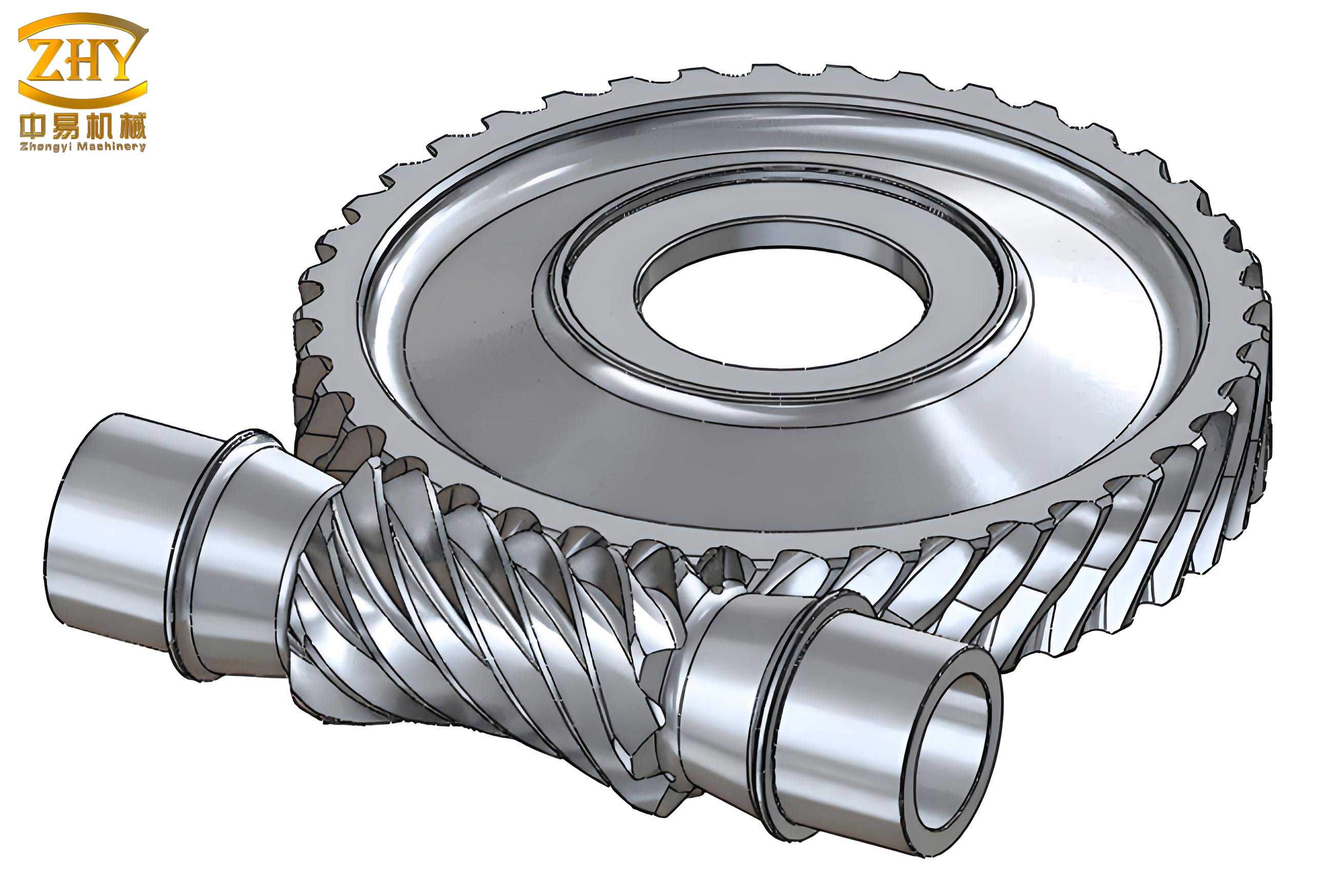
Part Information Description and the Feature-Based Approach
Considering the current state of many manufacturing enterprises, where full integration with 3D CAD models or sophisticated feature-based design systems is not always feasible, there exists a need for a pragmatic part information input methodology. This article explores and proposes a hybrid approach centered on feature-based description, coupled with graphical input via scanning technology, specifically applied to the domain of screw gear CAPP. For a screw gear component, a ‘feature’ can be defined as an information set representing a specific portion of the part’s shape and its associated attributes. This encompasses geometric primitives like holes, threads, grooves, and shafts, as well as non-geometric data such as material specifications, tolerances, and surface finish requirements. Features provide a convenient and semantically rich way to describe the geometry of a screw gear, offering information that is both necessary and sufficient for downstream engineering applications like machining, analysis, and assembly planning.
However, relying solely on low-level geometric entities (points, lines, surfaces) fails to capture the higher-level engineering intent and non-geometric information. To bridge this gap, the concept of a ‘Feature Unit’ (FU) is introduced. A Feature Unit is an encapsulated collection of features. It can integrate several primary (main) features, auxiliary features, datum features, and transitional features (like fillets and chamfers). Depending on the granularity required for manufacturing, inspection, and production scheduling, a Feature Unit may consist of a single basic shape feature or may encompass all features of an entire screw gear part. Typically, a complete screw gear part is decomposed into multiple Feature Units, which can be represented as:
$$ \text{Part Features} = FU_1 + FU_2 + \ldots + FU_n = \sum_{i=1}^{n} FU_i $$
This modular representation facilitates efficient information handling and retrieval within the CAPP system for screw gears.
Shape Feature Characterization of Screw Gears
The geometric definition of a screw gear pair is governed by a specific set of parameters. Distinguishing between the worm and the worm wheel, as well as between different variants within each type, is essential for accurate process planning.
Worm Shaft Features: The primary geometric features defining a worm shaft include:
- Number of Threads (Starts), $z_1$ (typically ranging from 1 to 4)
- Lead Angle at the Pitch Cylinder, $\gamma$
- Thread Profile Angle (or working half-angle), $\alpha_h$
- Length of the Threaded Portion, $L$
- Tip Diameter (Outside Diameter), $d_{a1}$
- Root Diameter, $d_{f1}$
- Pitch Diameter, $d_{1}$
- Aspect of the Tip: Whether it is cylindrical or arc-shaped (hollowed).
Worm Wheel Features: The primary features for a worm wheel include:
- Number of Teeth, $z_2$ (typically ranging from 27 to 80)
- Transverse Module, $m_t$
- Tip Diameter (Outside Diameter), $d_{a2}$
- Throat Diameter, $d_{g}$
- Face Width, $b_2$.
These parameters, whether extracted as numerical values or identified as pixel patterns, exhibit significant differences between a worm and a worm wheel, making their initial classification straightforward within the recognition system. For finer categorization among different worm types, a feature matrix can be constructed based on primary shape characteristics. Similarly, worm wheels can be distinguished using their own defining feature set.
We can define a feature vector for classification. For a worm, a simplified but effective feature vector $F_w$ could be:
$$ F_w = [z_1, \quad d_{a1}, \quad T_{\text{type}}, \quad L] $$
Where $T_{\text{type}}$ is a binary code for the tip shape (e.g., 1 for cylindrical, 0 for arc-shaped).
For a worm wheel, a feature vector $F_{ww}$ can be:
$$ F_{ww} = [z_2, \quad d_{a2}] $$
To systematize the identification for CAPP retrieval, we can assign a six-bit feature code to categorize screw gear parts broadly. The correspondence between this feature code and the detailed shape feature matrix for different screw gear part types can be summarized in the following table:
| Feature Code | Worm Shape Feature Matrix ($F_w$) | Worm Wheel Shape Feature Matrix ($F_{ww}$) |
|---|---|---|
| 100000 | $(z_1, d_{a1}, 1, L)$ | – |
| 010000 | $(z_1, d_{a1}, 0, L)$ | – |
| 001000 | $(z_1, d_{a1}, 0, L)$ (for a different variant) | – |
| 000100 | – | $(z_2, d_{a2})$ |
| 000010 | – | $(z_2, d_{a2})$ (for a different variant) |
| 000001 | – | $(z_2, d_{a2})$ (for yet another variant) |
Image Scanning and Feature Recognition Methodology
The proposed input method begins with a 2D engineering drawing of the screw gear part. This drawing is scanned and digitized. The core of the methodology lies in the subsequent pattern recognition process to extract the predefined feature vectors from this raster image. The steps involve:
- Image Pre-processing: This includes noise reduction, binarization (converting the image to black and white), and thinning or skeletonization to clarify lines and contours relevant to the screw gear drawing.
- Primitive Extraction: Algorithms identify basic graphical primitives such as line segments, circles, arcs, and hatch patterns which correspond to center lines, outlines, cross-sectional views, and dimension lines of the screw gear.
- Feature Vector Formation: Based on the extracted primitives and their relational geometry (e.g., concentric circles for diameters, parallel lines for lengths, symbols for tolerances), the system constructs the numerical and categorical components of the feature vector ($F_w$ or $F_{ww}$). For instance, the number of teeth ($z_1$ or $z_2$) might be counted from a sectional view, and diameters are interpreted from dimension lines or scaled measurements against a known drawing scale.
- Neural Network Training and Classification: The extracted feature vectors serve as input to an Artificial Neural Network (ANN). The ANN is pre-trained on a large dataset of known screw gear drawings and their corresponding, validated feature codes and vectors. The network learns the complex, non-linear mapping from the raw feature data (which may include pixel-level patterns from specific views) to the standardized feature code and the precise parameter values. This learning process enhances the system’s robustness in handling variations in drawing styles and minor imperfections in the scanned image. The output of the neural network is a definitive classification (e.g., feature code ‘100000’) and a quantified feature vector ready for the CAPP retrieval module.
Implementation of a Retrieval-Based CAPP System for Screw Gears
The core philosophy of the developed screw gear CAPP system is based on the principle of part similarity: similar screw gear parts possess similar process plans. Therefore, the process plan for a new screw gear is generated by retrieving and intelligently modifying the standard process plan of the most similar existing part stored in the system database. The implementation involves several structured phases:
- Part Family Formation: Existing screw gear parts are grouped into families based on their feature codes and similarity in feature matrices. This grouping considers not just the binary code but also the proximity of numerical parameters (e.g., similar diameters, same number of starts).
- Standard Process Plan Derivation: For each established screw gear part family, a standardized, optimized process plan is created by synthesizing and generalizing the best practices from historical process files of family members. This standard plan is stored as a template in the CAPP database.
- New Part Processing Workflow:
- Input & Classification: The feature vector extracted via scanning and neural network recognition for the new screw gear is input into the CAPP system. The system first compares the feature code to classify the part as a worm or worm wheel and assign it to a primary family.
- Similarity Matching & Retrieval: Within the assigned family, a more refined similarity matching is performed. This involves comparing the detailed feature matrix of the new screw gear against those of the standard plans. A similarity metric $S$ can be calculated, for example, as a weighted Euclidean distance:
$$ S = \sqrt{w_1(z_{\text{new}} – z_{\text{std}})^2 + w_2(d_{\text{new}} – d_{\text{std}})^2 + \ldots} $$
where $w_i$ are weights assigned based on the process-criticality of each feature. The standard plan with the highest similarity (smallest distance) is retrieved. - Interactive Editing & Finalization: The retrieved standard process plan is presented to the process planner via a user interface. The planner can review and modify operations, sequencing, machine tools, cutting parameters, or fixtures to tailor the plan precisely to the new screw gear’s requirements and current shop floor conditions.
- Storage & Output: The finalized, validated process plan is saved as a new instance in the database for future reference and can be printed or exported to manufacturing execution systems.
The overall workflow of the screw gear retrieval-based CAPP system is illustrated in the following flowchart, which summarizes the integration of scanning, recognition, classification, retrieval, and editing modules into a cohesive system designed specifically for the manufacturing of screw gears.
| Operation No. | Operation Description | Machine Tool / Fixture | Inspection Gauge |
|---|---|---|---|
| 10 | Casting: separate core and rim | – | – |
| 20 | Aging treatment, Inspection | – | – |
| 30 | Machine core and rim separately (pre-machining) | Lathe | Calipers |
| 40 | Assemble core and rim, fasten with bolts | Assembly Station | Torque Wrench |
| 50 | Finish turning outer diameter to $\varnothing 345_{-0.1}$ | C630 Lathe, Special Fixture | Micrometer |
| 60 | Semi-finish boring inner hole to $\varnothing 90$ (+0.05mm allowance), chamfer | Boring Mill | Plug Gauge |
| 70 | Rough hob teeth, control center distance $65_{-0.1}$ from reference face, leave stock for finish hobbing | Hobbing Machine | Gear Rolling Tester |
| 80 | Broach / Mill keyway $25_{-0.026}$ | Broaching Machine / Mill | Keyway Gauge |
| 90 | Finish bore inner hole to $\varnothing 90^{+0.035}_{-0}$ | Precision Boring Machine | Full-form Plug Gauge |
| 100 | Finish hob teeth, control center distance $210 \pm 0.02$ mm | Hobbing Machine | Special Gear Measurement Fixture | 110 | Deburr and final chamfering | Bench Work | Visual |
Conclusion
The feature-based CAPP system for screw gears presented herein offers a complete and pragmatic solution tailored to the specific needs of manufacturing enterprises. By leveraging a hybrid approach that combines feature-based information modeling with accessible scanning technology and intelligent pattern recognition, the system effectively addresses the critical part information input bottleneck. The utilization of neural networks for feature extraction enhances adaptability and recognition accuracy from 2D drawings. The subsequent retrieval-based CAPP mechanism, founded on the solid principle of part family similarity, enables the rapid generation of standardized, high-quality process plans for both worms and worm wheels. Compared to manual planning methods, this system dramatically increases the speed and consistency of process plan generation for screw gears. Furthermore, it promotes standardization and best practice adherence across the production floor. Future enhancements could focus on tighter integration with 3D CAD models for direct feature extraction, expansion of the feature set to include more detailed thermal treatment and inspection operations specific to screw gears, and the incorporation of generative AI techniques for dynamic, optimized process sequence generation within each screw gear family.