
In the realm of mechanical transmission systems, screw gear mechanisms, commonly referred to as worm gear systems, hold a pivotal role due to their ability to provide high reduction ratios, smooth operation, and compact design. As an engineer specializing in computer-aided design, I have extensively explored the integration of parametric modeling techniques to enhance the efficiency and accuracy of designing these complex components. This article delves into the comprehensive process of parametric design and motion simulation for screw gear systems within the Pro/ENGINEER environment. By leveraging parametric principles, we can create adaptable three-dimensional models that respond dynamically to input variables, thereby streamlining the design workflow and facilitating advanced analyses such as virtual assembly and motion simulation. The significance of this approach lies in its potential to reduce design iteration times, improve manufacturing preparedness, and foster innovation in screw gear applications across industries.
The engineering rationale for parameterizing screw gear systems stems from the intricate geometry of worm gears and worms. Traditional design methods often involve laborious manual recalculations and remodeling for each variation in specifications, leading to inefficiencies. Parametric design, however, embeds intelligence into the model by defining relationships between dimensions and features. This allows for rapid regeneration of the screw gear geometry simply by altering key parameters. In this context, the screw gear assembly comprises two main components: the worm (the screw) and the worm gear (the driven gear). My focus is on developing a robust parametric framework that captures the essential mathematical relationships governing these parts, enabling seamless adaptation to diverse design requirements.
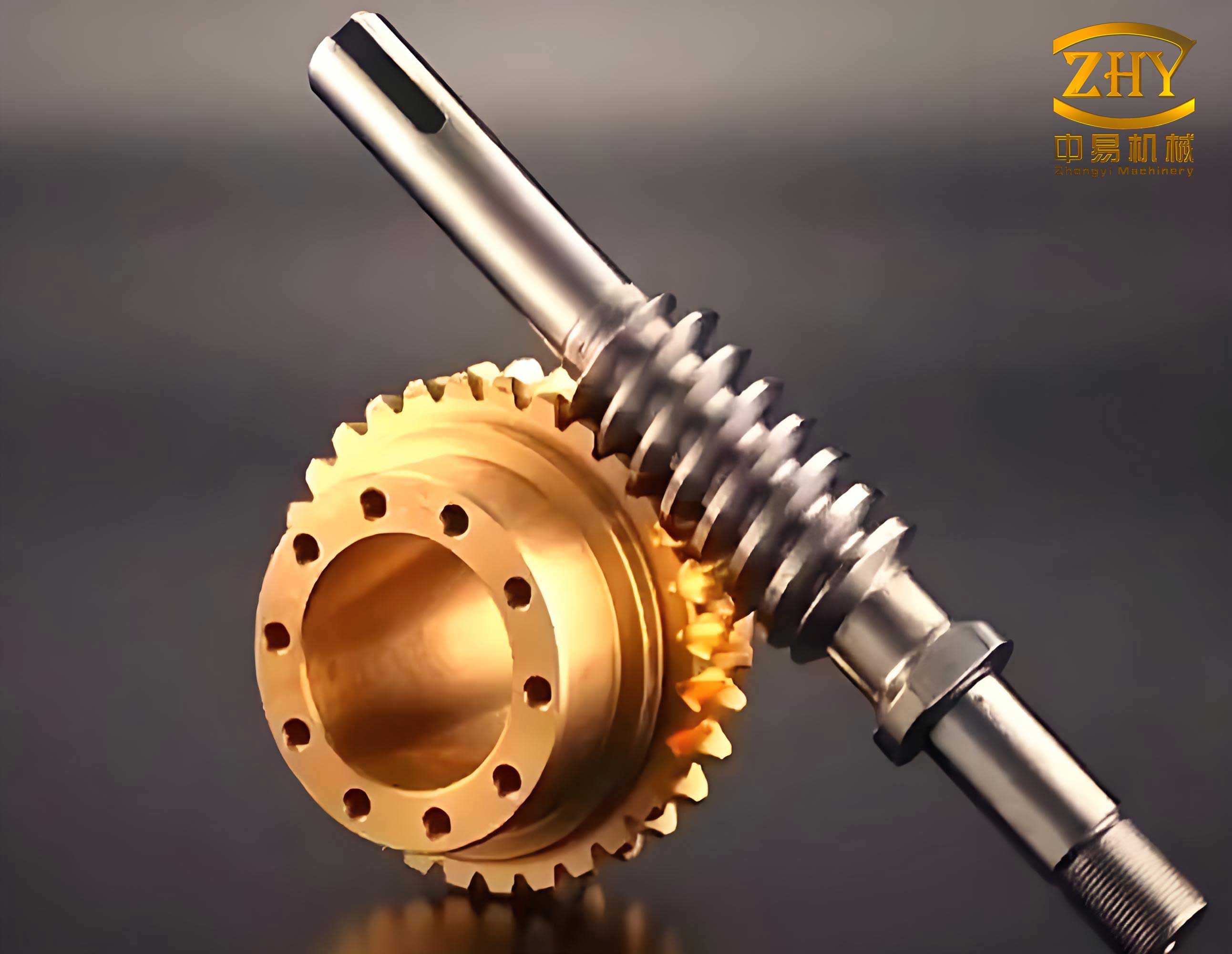
To establish a foundation for parametric design, it is crucial to understand the fundamental geometric parameters of a screw gear system. These parameters dictate the form and function of the components. Below is a table summarizing the primary variables involved in the design of a standard screw gear pair. This table serves as a reference for the parametric relationships that will be elaborated in subsequent sections.
| Parameter Symbol | Description | Typical Units |
|---|---|---|
| $$ m $$ | Module | mm |
| $$ z_1 $$ | Number of starts on the worm | Dimensionless |
| $$ z_2 $$ | Number of teeth on the worm gear | Dimensionless |
| $$ q $$ | Diameter quotient of the worm | Dimensionless |
| $$ \alpha $$ | Pressure angle (normal) | Degrees |
| $$ \gamma $$ | Lead angle of the worm | Degrees |
| $$ d_1 $$ | Reference diameter of the worm | mm |
| $$ d_2 $$ | Reference diameter of the worm gear | mm |
| $$ b $$ | Face width of the worm gear | mm |
| $$ x_2 $$ | Profile shift coefficient for the worm gear | Dimensionless |
The parametric design process for the worm gear begins with defining the variable parameters that will drive the model. In my implementation, key variables such as the module, number of teeth, pressure angle, and face width are designated as inputs. These parameters are not isolated; they are interconnected through a series of geometric relationships derived from screw gear theory. For instance, the lead angle of the worm is calculated from the number of starts and the diameter quotient: $$ \gamma = \arctan\left(\frac{z_1}{q}\right) $$. Similarly, the transverse pressure angle, which is critical for tooth profile generation, is given by: $$ \alpha_t = \arctan\left(\frac{\tan \alpha}{\cos \beta}\right) $$, where $$ \beta $$ is the helix angle, often equal to $$ \gamma $$ for screw gears. These equations are embedded into the model using Pro/ENGINEER’s relation editor, ensuring that any change in input parameters automatically updates all dependent dimensions.
Creating the three-dimensional solid model of the worm gear involves a stepwise approach that integrates parametric curves. The tooth profile of a screw gear is typically based on an involute curve. To generate this curve parametrically, I use a set of parametric equations that define the involute in space. In Pro/ENGINEER, this is accomplished by defining a datum curve through an equation. The equations for the involute curve in a cylindrical coordinate system can be expressed as follows:
$$ r = \frac{d_5}{2} $$
$$ \theta = t \times 45 $$
$$ x = r \cos \theta + r \sin \theta \times \theta \times \frac{\pi}{180} $$
$$ y = r \sin \theta – r \cos \theta \times \theta \times \frac{\pi}{180} $$
$$ z = \frac{m \times q}{2} $$
Here, $$ t $$ is a parameter ranging from 0 to 1, and $$ d_5 $$ is a reference diameter derived from other parameters. This curve represents one side of a tooth space. By mirroring this curve and using sketching tools to connect endpoints, a closed loop for a single tooth gap is formed. This loop is then used to cut an extrusion on a cylindrical blank, creating one tooth gap. The pattern of teeth around the gear is achieved using a circular pattern feature, where the number of instances is driven by the parameter $$ z_2 $$. The entire process is governed by a program written in Pro/ENGINEER’s relation language, which includes conditional statements to handle design variations. For example, the addendum diameter may change based on the number of starts:
IF $$ z_1 \leq 1 $$
$$ d_{21} = d_{20} + 2m $$
ENDIF
IF $$ z_1 > 1 $$ AND $$ z_1 \leq 3 $$
$$ d_{21} = d_{20} + 1.5m $$
ENDIF
IF $$ z_1 > 3 $$
$$ d_{21} = d_{20} + m $$
ENDIF
This programmatic approach ensures that the screw gear model adapts correctly to different design scenarios. Once the worm gear model is fully parameterized, a dialog box is generated through Pro/ENGINEER’s interface tools, allowing users to input desired values for key parameters. Upon entering new values, the model regenerates almost instantaneously, producing a new three-dimensional solid that conforms to the inputs. This capability is invaluable for exploring design alternatives and optimizing the screw gear for specific applications.
Turning to the worm component, the parametric design follows a similar philosophy but addresses the unique geometry of a screw thread. The worm is essentially a helical gear with one or more starts. Its design hinges on the helical path described by the tooth flank. The parametric equations for the worm’s helical curve are fundamental. In a Cartesian system, the helix on a cylinder can be defined as:
$$ x = r_w \cos(\phi) $$
$$ y = r_w \sin(\phi) $$
$$ z = \frac{p \cdot \phi}{2\pi} $$
where $$ r_w $$ is the pitch radius of the worm, $$ \phi $$ is the angular parameter, and $$ p $$ is the lead, calculated as $$ p = \pi m z_1 $$. This helical curve serves as a trajectory for sweeping a tooth profile, which is typically an involute shape oriented normally to the helix. The creation process involves defining this curve as a datum, then using a sweep operation with a parametric sketch for the tooth cross-section. The cross-section dimensions, such as addendum and dedendum, are linked to the module and other primary parameters through relations. Additionally, the worm’s length and end features are parameterized to accommodate different assembly requirements. The worm’s parametric program integrates equations for critical dimensions, such as the root diameter and lead angle, ensuring consistency with the worm gear design. The seamless interaction between the worm and worm gear parameters is crucial for a functional screw gear system.
To illustrate the interdependence of parameters in a screw gear system, the following table consolidates key formulas that relate the worm and worm gear geometries. These formulas are embedded in the parametric models to maintain design integrity.
| Relationship | Formula |
|---|---|
| Worm reference diameter | $$ d_1 = m q $$ |
| Worm gear reference diameter | $$ d_2 = m z_2 $$ |
| Center distance | $$ a = \frac{m(q + z_2 + 2x_2)}{2} $$ |
| Lead angle of worm | $$ \gamma = \arctan\left(\frac{z_1}{q}\right) $$ |
| Transverse pressure angle | $$ \alpha_t = \arctan\left(\frac{\tan \alpha}{\cos \gamma}\right) $$ |
| Circular pitch | $$ p = \pi m $$ |
| Lead of worm | $$ L = \pi m z_1 $$ |
With both the worm and worm gear individually parameterized, the next step is virtual assembly. In Pro/ENGINEER, assembly constraints are applied to mate the components accurately. For a screw gear pair, typical constraints include aligning the axes of the worm and worm gear, and setting the correct offset distance based on the calculated center distance. Since the components are parametric, the assembly adapts automatically when part dimensions change. This dynamic assembly capability is a cornerstone of digital prototyping, allowing designers to verify fits and clearances under various parameter sets without manual rework. The assembly serves as the foundation for subsequent motion simulation, enabling a holistic evaluation of the screw gear system’s performance.
Motion simulation is a powerful tool to analyze the kinematic behavior of the screw gear assembly. In Pro/ENGINEER’s Mechanism module, I define the assembly as a mechanism by applying suitable connections. The worm is typically connected to the ground via a revolute joint, while the worm gear is connected to another revolute joint with its axis perpendicular to that of the worm. A gear pair connection is then established between these two joints, with the gear ratio defined by the number of starts and teeth: $$ \text{Ratio} = \frac{z_2}{z_1} $$. To drive the simulation, a servo motor is applied to the worm’s joint, providing rotational motion. The motor’s profile can be defined to simulate constant speed, acceleration, or complex motions. After setting up the mechanism, I run a kinematic analysis to observe the motion. The simulation outputs data on position, velocity, and acceleration over time, which can be graphed and analyzed. This virtual testing helps identify potential issues such as interference or irregular motion before physical prototyping. The integration of parametric design with motion simulation creates a closed-loop design validation process, significantly enhancing the reliability of screw gear systems.
The benefits of this parametric and simulation-driven approach are manifold. Firstly, it drastically reduces the time required for design iterations. A designer can explore dozens of screw gear configurations in a fraction of the time needed for manual modeling. Secondly, it ensures geometric consistency and adherence to design standards, as all dimensions are controlled by validated mathematical relationships. Thirdly, it facilitates customization; for instance, adapting a screw gear for high-torque applications simply involves adjusting the module or face width parameters. Moreover, the parameterized models serve as a knowledge base, capturing design intent and best practices. They can be reused across projects or shared within an organization, promoting standardization. Finally, the motion simulation capability provides insights into dynamic performance, enabling optimization for smoothness and efficiency. This is particularly important for screw gears used in precision instruments or heavy machinery.
Looking ahead, the parametric design framework for screw gear systems can be extended in several directions. One avenue is integration with finite element analysis (FEA) tools. By exporting the parameterized solid models to FEA software, engineers can perform stress and deformation analyses under load. The parameters can be varied to study their effect on structural integrity, leading to weight reduction or strength improvement. Another direction is the development of a dedicated user interface or application programming interface (API) that simplifies parameter input for non-experts. This could include dropdown menus for standard screw gear types, automated calculation of derived parameters, and real-time preview of the model. Furthermore, incorporating manufacturing considerations, such as tool paths for CNC machining, would bridge the gap between design and production. The ultimate goal is to create a comprehensive digital twin of the screw gear system that encompasses design, simulation, and manufacturing preparation.
In conclusion, the parametric design and motion simulation of screw gear systems represent a significant advancement in mechanical engineering design methodology. By embedding parametric intelligence into three-dimensional models, we achieve unprecedented flexibility and efficiency in designing these complex components. The process, as detailed in this article, involves defining key parameters, establishing geometric relationships through formulas, and implementing them in a CAD environment like Pro/ENGINEER. The resulting models are not static; they are dynamic entities that respond to changes, enabling rapid prototyping and virtual testing. The motion simulation adds a layer of validation, ensuring that the screw gear assembly functions as intended kinematically. This integrated approach lays a robust foundation for further research and development, including optimization algorithms, advanced material studies, and smart manufacturing integration. As industries continue to demand higher performance and customization, parametric design will remain an indispensable tool for innovation in screw gear technology and beyond.
To further elucidate the parametric relationships, consider the following extended set of equations that govern the tooth geometry and meshing of screw gears. These equations are essential for ensuring proper engagement and load distribution in the screw gear system.
The base circle radius for the worm gear involute is given by: $$ r_b = \frac{d_2 \cos \alpha_t}{2} $$.
The tooth thickness on the pitch circle can be expressed as: $$ s = \frac{\pi m}{2} + 2m x_2 \tan \alpha $$.
The contact ratio, which affects smoothness of operation, is approximated by: $$ \epsilon = \frac{\sqrt{(r_{a2}^2 – r_{b2}^2)} + \sqrt{(r_{a1}^2 – r_{b1}^2)} – a \sin \alpha_t}{p \cos \alpha_t} $$, where $$ r_a $$ and $$ r_b $$ are addendum and base radii for worm (1) and worm gear (2).
These formulas highlight the intricate interdependencies in screw gear design. By codifying them in the parametric model, we ensure that any design modification automatically respects these fundamental principles, resulting in a functional and efficient screw gear pair.
In summary, the journey from a concept to a virtual prototype of a screw gear system is greatly accelerated through parametric design. The ability to quickly iterate and simulate not only saves time and resources but also empowers engineers to explore innovative configurations that might be impractical with traditional methods. As I continue to refine these techniques, I am convinced that parametric design will play a central role in the future of mechanical design, particularly for complex systems like screw gears. The synergy between mathematical modeling, CAD tools, and simulation software creates a powerful ecosystem for engineering excellence, driving progress in transmission technology and beyond.