
In the operation of screw pump wells, the rod string is subjected to torque, leading to elastic deformation and the storage of elastic potential energy. Upon shutdown, the release of this energy causes the rod string to reverse rotate. Additionally, under the pressure difference between the oil and casing, the liquid column drives the screw pump rotor to reverse, resulting in continuous backspin. Uncontrolled reverse rotation in screw pump systems can lead to rod detachment, bending of polished rods, damage to ground drive components, and even pose safety risks to operators. Currently, common horizontal screw pump drive devices often employ ratchet-and-pawl braking systems. However, these systems have low safety factors, cannot automatically release reverse torque, require manual intervention, increase labor intensity, and present significant safety hazards.
To address these issues, I designed a braking system that leverages the self-locking特性 of screw gears, combined with an overrunning clutch. This system is installed on the main shaft of the screw pump drive device. During normal operation, the braking system remains inactive. When the system shuts down and the rod string reverses, the braking system engages to provide reverse braking. A release motor then activates, driving the worm to rotate slowly, allowing the main shaft and rod string to reverse gradually under the constraint of the worm wheel until the elastic and liquid column potential energies are fully dissipated.
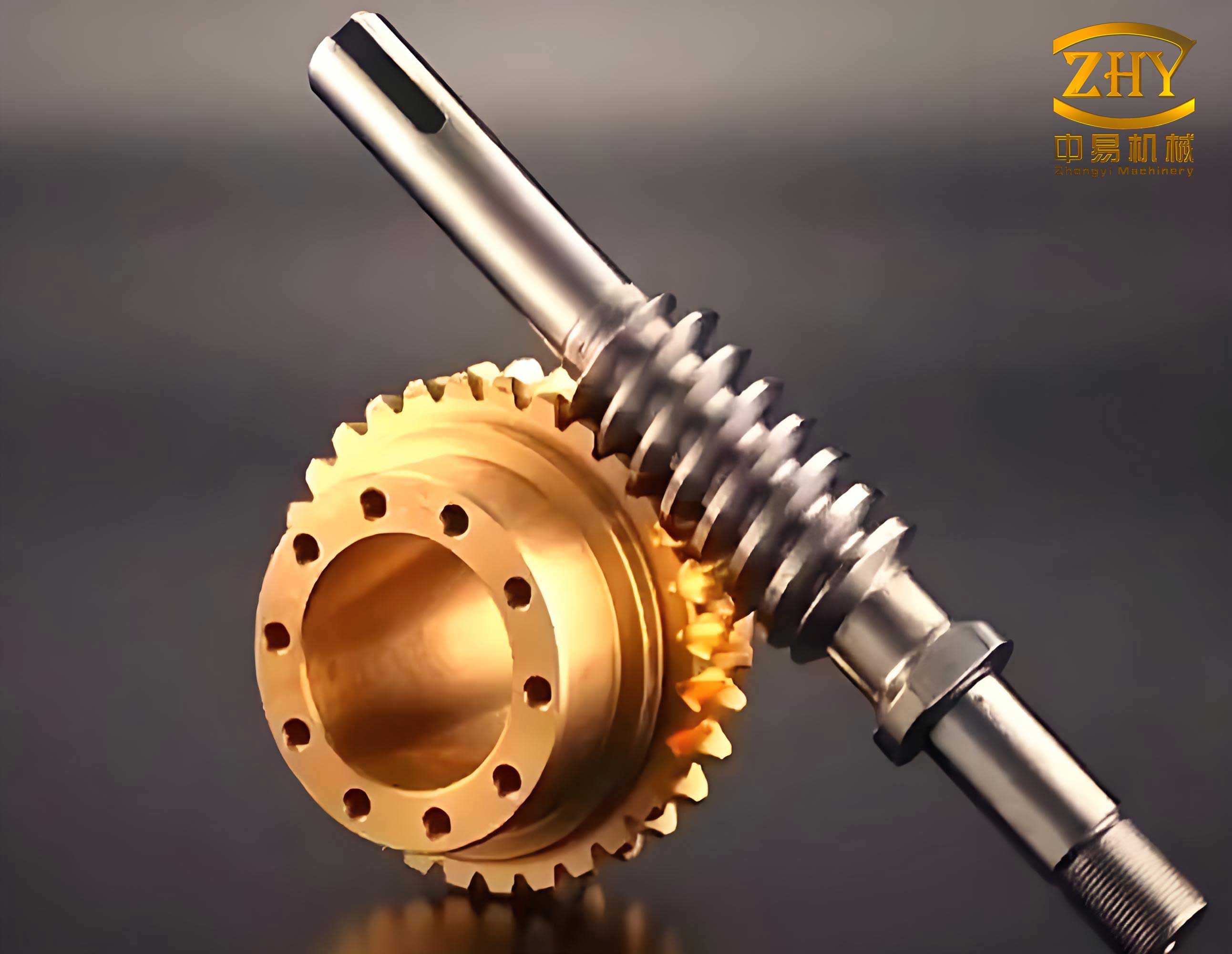
The internal structure of the screw gear braking device primarily consists of the worm and wheel (screw gears), an overrunning clutch, and a gearbox housing. The outer race of the clutch is integrated with the worm wheel, while the gearbox housing is fixed to the减速箱体 of the screw pump drive device via bolts. The inner race of the clutch is connected to the drive device’s main shaft using a parallel key. This compact design ensures efficient integration into existing drive systems.
The working principle of this braking system revolves around the interaction between the overrunning clutch and the screw gears. During normal operation, when the main shaft rotates forward, the overrunning clutch is in an overrunning state, meaning the inner race rotates independently of the outer race. Thus, the screw gears do not engage. Upon system shutdown, if the main shaft begins to reverse, the inner race reverses, causing the clutch to engage as the inner race moves relative to the outer race. Since the worm wheel and worm are self-locking due to the screw gear design, the system locks, preventing further reverse rotation. This braking action is instantaneous and reliable.
To release the stored reverse energy, an auxiliary motor is employed. When the main drive motor stops, the screw gear braking system activates and locks the main shaft. The release motor then operates, driving the worm to rotate. At this point, the overrunning clutch is in a分离 state because the inner race moves relative to the outer race. If the main shaft has no reverse tendency, the inner race remains stationary. However, due to the existing reverse tendency, the inner race reverses but at a speed not exceeding that of the outer race. This controlled release ensures safe dissipation of energy.
The control circuit for the auxiliary motor enhances safety. Power is supplied via an external source connected to the normally closed contact of the main motor’s electromagnetic relay. When the main motor starts, the relay opens, cutting power. Upon main motor stop, the normally closed contact closes, and after a time delay of approximately 30 seconds, a current detection controller activates the auxiliary motor. Once the speed controller completes unloading and the worm wheel can no longer drive the inner race, the motor operates under no load, causing the current to drop below a set threshold. This triggers the controller to断开 the circuit, stopping the motor and extinguishing an indicator light. Operators can then verify complete torque release manually before maintenance, significantly reducing labor intensity and improving safety.
The self-locking property of screw gears is fundamental to this braking system. For self-locking to occur, the lead angle of the worm must be less than the equivalent friction angle. Consider a worm gear set where the worm wheel is the driving member. The forces acting on a right-hand worm can be analyzed. Let $F_n$ be the normal force concentrated at the pitch point P, acting in the normal section Pabc. $F_n$ can be decomposed into $F_n’$ and radial force $F_r$. $F_n’$ further decomposes into tangential force $F_t$ and axial force $F_a$. For self-locking, when the worm wheel attempts to drive the worm, the worm must remain stationary. The frictional force $f$ has components in the circumferential ($f_t$) and axial ($f_a$) directions. Equilibrium requires that the maximum circumferential frictional force satisfies:
$$ f_t \geq F_{t1} $$
where $f_t = f \cos \gamma$, $\gamma$ is the lead angle of the worm, $f = \mu F_n = \mu F_n’ / \cos \alpha_n$, $\mu$ is the friction coefficient, $\alpha_n$ is the normal pressure angle. Defining the equivalent friction coefficient $\mu’ = \mu / \cos \alpha_n$, we have $f = \mu’ F_n’$. Let $\mu’ = \tan \psi$, where $\psi$ is the equivalent friction angle. Also, $F_{t1} = F_n’ \sin \gamma$. Substituting, we get:
$$ \tan \psi \geq \tan \gamma $$
Thus, the condition for self-locking in screw gears is:
$$ \psi \geq \gamma $$
This inequality ensures that the worm cannot be driven by the worm wheel, providing reliable braking.
For reverse release, when the screw gears are self-locked, a release torque must be applied to the worm to allow the worm wheel to rotate and dissipate energy. The relationship between the applied torque on the worm ($T_1$) and the torque on the worm wheel ($T_2$) is derived from force平衡. The external force on the worm plus the tangential force must overcome the circumferential frictional force:
$$ F_{\text{ext}} + F_{t1} > f_t $$
where $F_{\text{ext}} = 2T_1 / d_1$, $d_1$ is the pitch diameter of the worm. The axial force on the worm from the worm wheel reversal is related to $T_2$: $F_{a1} = 2T_2 / d_2$, with $d_2$ as the pitch diameter of the worm wheel. After substitutions and simplifications, we obtain:
$$ T_1 > T_2 \times \frac{(\tan \psi – \tan \gamma) \times d_1}{(1 + \tan \psi) \times d_2} $$
Let $K = \frac{(\tan \psi – \tan \gamma) \times d_1}{(1 + \tan \psi) \times d_2}$. Then:
$$ T_1 > T_2 \times K $$
This linear relationship shows that the release torque on the worm is proportional to the load torque on the worm wheel, with $K$ depending on the equivalent friction coefficient, lead angle, and pitch diameters of the screw gears.
To validate this, I conducted laboratory tests on a prototype, measuring the required release torque on the worm under various load torques on the worm wheel. The data are summarized in the table below:
| Load Torque on Worm Wheel, $T_2$ (N·m) | Release Torque on Worm, $T_1$ (N·m) |
|---|---|
| 0 | 1.8 |
| 100 | 2.9 |
| 200 | 4.1 |
| 400 | 6.2 |
| 800 | 10.7 |
| 1500 | 18.5 |
| 2000 | 24.1 |
| 2500 | 29.6 |
| 3500 | 40.9 |
From this data, a linear graph can be plotted, confirming the proportional relationship between $T_1$ and $T_2$. The slope of the line corresponds to the factor $K$, which aligns with theoretical predictions. This实验验证 is crucial for designing screw gear braking systems with predictable release characteristics.
The application of screw gears in screw pump drive systems offers several advantages. The combination of screw gears and an overrunning clutch ensures that during forward rotation, the clutch remains in an overrunning state, minimizing wear. Upon reverse rotation, the clutch engages, and the self-locking screw gears provide immediate braking. The automatic control of the auxiliary motor facilitates safe energy release, reducing manual effort and enhancing operational safety. Furthermore, the self-locking condition of screw gears—where the lead angle is less than the equivalent friction angle—guarantees reliable braking. The release torque required on the worm is linearly related to the load torque on the worm wheel, as demonstrated by both theory and experiment.
In conclusion, the integration of screw gears into screw pump drive braking systems effectively addresses the limitations of traditional ratchet-and-pawl mechanisms. The self-locking特性 of screw gears, when paired with an overrunning clutch, provides a robust solution for preventing uncontrolled reverse rotation. The automated release mechanism powered by an auxiliary motor improves safety and efficiency. This design leverages fundamental principles of screw gear mechanics, such as the self-locking condition and torque relationships, to ensure reliable performance. Future developments could focus on optimizing the screw gear parameters, such as lead angle and material selection, to enhance durability and adaptability for various industrial applications. The use of screw gears in this context underscores their versatility and effectiveness in mechanical braking systems, particularly where safety and automation are paramount.
Throughout this discussion, the term “screw gears” has been emphasized to highlight the central role of these components. Screw gears, with their unique ability to provide high reduction ratios and self-locking, are indispensable in applications requiring precise motion control and safety. In screw pump drives, screw gears not only facilitate braking but also enable controlled energy dissipation, making them a critical innovation. The experimental data further validate the theoretical models, reinforcing the reliability of screw gear-based systems. As technology advances, the application of screw gears is likely to expand, driven by their proven performance in demanding environments. This analysis serves as a foundation for further research into optimizing screw gear designs for enhanced efficiency and safety in various mechanical systems.