
As a researcher deeply immersed in the field of mechanical transmission systems, I have witnessed the evolution of screw gears, particularly the planar double-enveloping hourglass worm gear drive, which stands out for its superior load capacity, efficiency, and longevity compared to cylindrical worm gears. This type of screw gear, often referred to as the “SG-71” worm pair, was pioneered in China and has seen extensive development over the past four decades. In this article, I will delve into the design, manufacturing, and measurement technologies that have shaped these screw gears, highlighting key innovations and future directions. The complexity of screw gears lies in their intricate geometry and demanding precision requirements, which pose challenges in parameter design, accuracy control, and cost-effectiveness. Through this exploration, I aim to synthesize the research achievements and offer insights into advancing these high-performance screw gears.
The essence of planar double-enveloping hourglass worm gear drives lies in their dual-enveloping process: the first enveloping generates the worm from a planar surface, and the second enveloping produces the worm wheel from that worm. This results in multiple-tooth engagement and double-line contact, enhancing the performance of screw gears. However, the journey from theory to practical application involves overcoming significant hurdles in modeling, analysis, and fabrication. In the following sections, I will dissect these aspects, employing tables and formulas to encapsulate critical findings. The term “screw gears” will be frequently used to emphasize the broader context of these transmission elements, as they represent a pivotal category in gear technology.
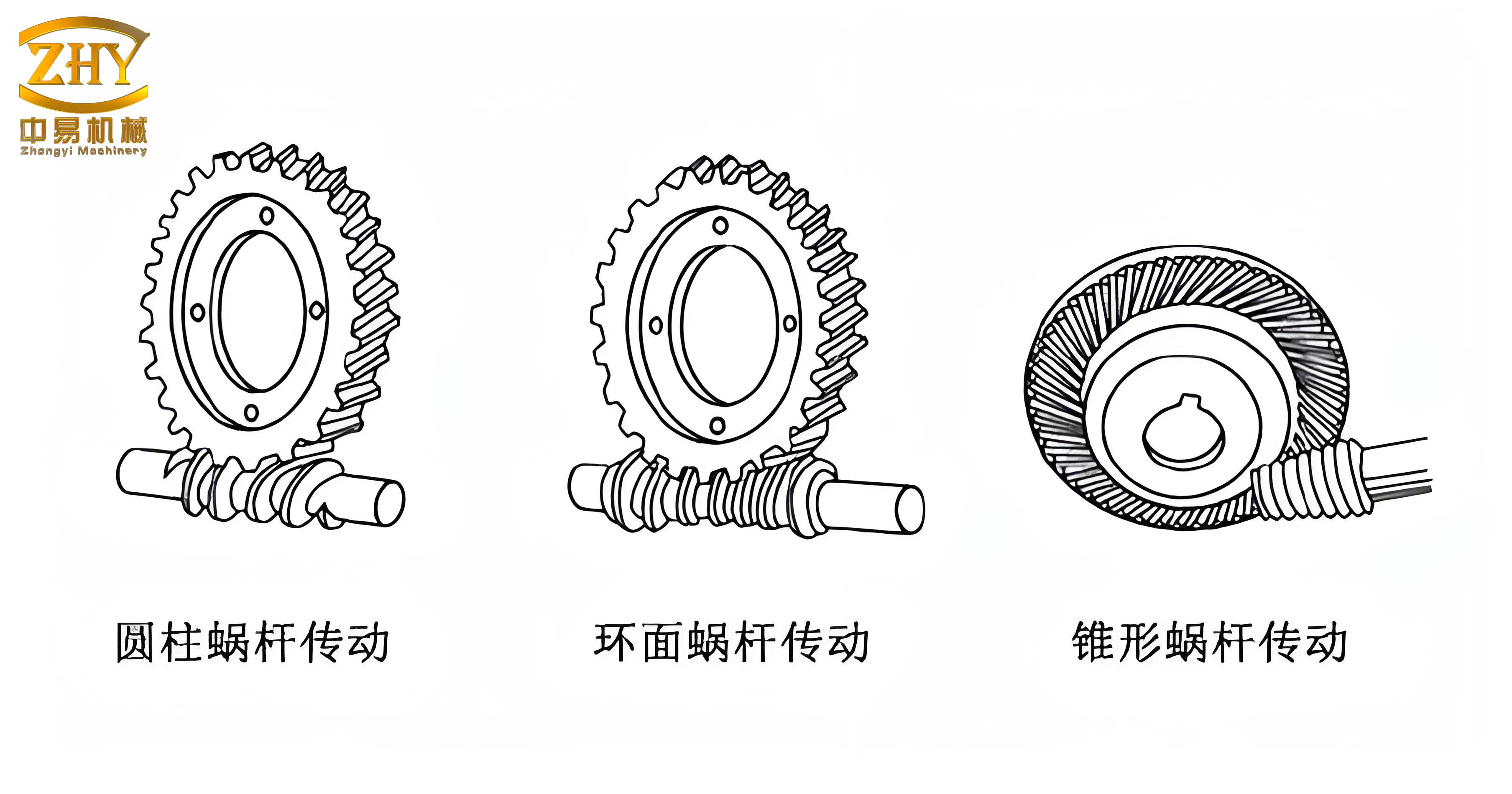
Designing screw gears, especially planar double-enveloping types, begins with accurate three-dimensional modeling. The tooth surfaces are complex spatial curves, and traditional methods rely on solving meshing equations to derive point clouds for surface fitting. For instance, the worm tooth surface can be represented parametrically. Let the position vector of a point on the worm tooth surface be $\mathbf{r}_w(u, \theta)$, where $u$ is a parameter along the tooth profile and $\theta$ is the rotation angle. The meshing condition with the planar tool surface can be expressed as:
$$
f(u, \theta, \phi) = \mathbf{n} \cdot \mathbf{v} = 0
$$
where $\mathbf{n}$ is the normal vector to the tool surface, $\mathbf{v}$ is the relative velocity between the worm and tool, and $\phi$ is the tool rotation angle. This equation must be solved numerically to generate discrete points for CAD modeling. Alternatively, direct digital modeling simulates the machining process through Boolean operations, but it requires careful step-size selection to balance accuracy and computational load. For screw gears, this step is crucial as it influences subsequent finite element analysis and CNC toolpath generation.
Meshing characteristic analysis is fundamental to evaluating screw gears’ performance. Key metrics include instantaneous contact lines, bearing contact patterns, and micro-geometry parameters like induced normal curvature and lubrication angle. Consider an unmodified planar double-enveloping worm gear drive with center distance $a = 125$ mm and transmission ratio $i = 40$. The distribution of contact lines on the worm wheel tooth surface reveals交叉 regions where contact frequency is high, leading to potential pitting. To quantify micro-geometry, the relative entrainment velocity $v_e$ at a contact point is given by:
$$
v_e = \frac{v_1 + v_2}{2}
$$
where $v_1$ and $v_2$ are the surface velocities of the worm and wheel, respectively. The lubrication angle $\gamma$ affects oil film formation and can be derived from the cross product of surface normals. Load distribution studies show that in unmodified screw gears, contact load decreases from the entry to exit side, with stress concentrations at the ends of contact lines. Tooth contact analysis (TCA) and loaded tooth contact analysis (LTCA) have been employed to simulate real conditions, incorporating errors and elastic deformations. For example, LTCA solves the compatibility equation:
$$
\delta_i = \sum_{j=1}^n C_{ij} F_j
$$
where $\delta_i$ is the deformation at contact point $i$, $C_{ij}$ is the compliance matrix, and $F_j$ is the load at point $j$. This helps predict contact stress and load sharing among teeth in screw gears.
Parameter optimization is vital for enhancing screw gears’ performance. Design variables often include the inclination angle of the plane $\alpha$, the main base circle diameter $d_b$, the pitch diameter $d$, and the number of worm threads $z_1$. A multi-objective optimization might aim to maximize transmission efficiency $\eta$, minimize sliding velocity $v_s$, and ensure structural compactness. The efficiency can be estimated using:
$$
\eta = \frac{\tan(\lambda)}{\tan(\lambda + \rho’)}
$$
where $\lambda$ is the lead angle and $\rho’$ is the equivalent friction angle. Constraints include geometric limits (e.g., no undercutting), meshing conditions (e.g., proper working start angle), and strength criteria (e.g., contact and bending stress limits). Table 1 summarizes common optimization approaches for screw gears.
| Design Variables | Objectives | Constraints | Algorithms |
|---|---|---|---|
| $\alpha$, $d_b$, $d$, $z_1$ | Minimize $v_s$, maximize $\eta$, minimize size | No root cutting, contact line distribution | Compound shape method, fuzzy logic |
| Tool tooth count, module | Maximize oil film thickness, minimize cost | Stress limits, geometric boundaries | Multi-objective programming |
Modification design, or “修形” in Chinese context, is another critical aspect for screw gears. Based on meshing principles, modification involves altering relative motion parameters between first and second enveloping, such as center distance $\Delta a$ or transmission ratio $\Delta i$. This yields Type I or Type II drives, distinguished by the presence of boundary curves. For Type II, a small positive $\Delta a$ can eliminate the first boundary curve, improving contact quality. The modification amount can be calculated using conditions derived from meshing theory. For instance, to ensure full contact, the following inequality must hold:
$$
\Delta a > \frac{m z_2}{2} \cdot \epsilon
$$
where $m$ is the module, $z_2$ is the worm wheel teeth number, and $\epsilon$ is a tolerance factor. Mismatch modification, using non-identical tools, introduces point contact to reduce sensitivity to errors. However, improper modification can degrade screw gears’ performance, necessitating careful analysis via TCA.
Manufacturing screw gears has evolved with CNC technology. Traditional methods relied on dedicated machines with rotary tables, but modern techniques include virtual rotary center grinding, five-axis flank milling, and CNC hobbing. For worm grinding, the virtual rotary center technique uses four-axis interpolation to simulate the tool plane motion. The kinematic relationship is:
$$
x = R \cos(\beta), \quad z = R \sin(\beta), \quad \theta = i \beta
$$
where $x$ and $z$ are the worktable coordinates, $R$ is the virtual base circle radius, $\beta$ is the rotary table angle, and $\theta$ is the worm rotation angle. This eliminates the need for physical center distance adjustment, expanding machining range. For worm wheels, hobbing remains cost-effective, but CNC milling is suitable for large or custom screw gears. Tool path generation involves discretizing the tooth surface into Bezier patches. Table 2 compares manufacturing methods for screw gears.
| Process | Advantages | Disadvantages | Application |
|---|---|---|---|
| Virtual Center Grinding | High precision, flexible | High machine cost | Batch production |
| Five-Axis Milling | General machines, accurate | Low efficiency | Prototyping |
| CNC Hobbing | Economical, efficient | Tool complexity | Mass production |
The hob for worm wheel generation requires relief grinding to maintain clearance angles. Due to varying helical angles along the cutting edge, this process is challenging. A four-axis CNC method controls the grinding wheel orientation to ensure constant relief angle $\alpha_r$. The condition for proper grinding is:
$$
\mathbf{n}_g \cdot \mathbf{t}_e = 0
$$
where $\mathbf{n}_g$ is the grinding wheel normal and $\mathbf{t}_e$ is the tangent vector along the cutting edge. This enables precise hob fabrication, crucial for high-quality screw gears.
Measurement technology for screw gears has advanced with coordinate-based systems. Gear measuring centers or dedicated instruments use electronic generating methods to assess errors. For the worm, spiral line error $\Delta F_{\beta}$ can be measured by synchronizing probe movement with rotation. The error is computed as:
$$
\Delta F_{\beta} = \sqrt{(\Delta x)^2 + (\Delta z)^2}
$$
where $\Delta x$ and $\Delta z$ are deviations from the theoretical path. Topological error mapping helps in error溯源, linking manufacturing parameters to deviations. For worm wheel pairs, composite error testing involves recording angular positions via rotary encoders to determine transmission error $\Delta \phi$. A typical setup measures the difference between worm and wheel angles:
$$
\Delta \phi = \phi_1 – \frac{\phi_2}{i}
$$
where $\phi_1$ and $\phi_2$ are the measured rotation angles. This data guides assembly adjustments, such as axial positioning, to optimize contact patterns in screw gears.
Looking ahead, several areas demand further research to propel screw gears forward. First, modification theory needs refinement. Current analyses often focus on instantaneous contact without considering full meshing cycles or load effects. Future work should integrate finite element simulations to study how modification parameters influence contact stress and fatigue life over entire engagements. For instance, dynamic models could incorporate time-varying stiffness:
$$
k(t) = k_0 + \Delta k \sin(\omega t)
$$
where $k_0$ is the nominal stiffness and $\omega$ is the meshing frequency. This will aid in developing robust modification guidelines for screw gears.
Second, manufacturing error correction requires closed-loop systems. By combining design software, CNC machines, and measuring instruments, real-time feedback can be implemented. Error models based on homogeneous transformation matrices can predict tooth surface deviations. For a worm grinding machine, the actual tool position $\mathbf{P}_a$ deviates from theoretical $\mathbf{P}_t$ due to errors $\delta_i$:
$$
\mathbf{P}_a = \prod_{i=1}^n \mathbf{T}_i(\delta_i) \mathbf{P}_t
$$
where $\mathbf{T}_i$ are transformation matrices for each axis. Inverse compensation algorithms can then adjust CNC codes to minimize errors in screw gears.
Third, assembly techniques for worm gear pairs must be systematized. TCA under coupled errors can predict contact斑点 patterns, guiding shimming or alignment. A sensitivity analysis using partial derivatives can rank error sources:
$$
S = \frac{\partial \Delta \phi}{\partial e}
$$
where $e$ is an error like center distance deviation. This will enable precision assembly of screw gears.
Fourth, hob manufacturing technology needs innovation. Interference in relief grinding for hobs with many flutes or large helical angles can be addressed by modifying grinding wheel geometry or using pre-formed inserts. Computational geometry tools can determine optimal wheel profiles to avoid collisions.
Fifth, standardization is essential for screw gears. Current accuracy standards, established decades ago, require updates to reflect modern measurement capabilities. Parameter series and interchangeability standards will facilitate mass production and reduce costs. Industry-wide collaboration is key to developing comprehensive standards for screw gears.
Sixth, industrial software development will codify knowledge. Design tools should integrate optimization, TCA, and 3D modeling, while manufacturing software should generate CNC code and interface with measurement systems. Open-source platforms could accelerate innovation in screw gears.
In conclusion, screw gears, particularly planar double-enveloping hourglass worm drives, represent a high-performance transmission solution with immense potential. Through decades of research, significant progress has been made in design, manufacturing, and measurement. However, challenges remain in modification theory, error correction, assembly, tooling, standardization, and software. By building closed-loop systems and fostering interdisciplinary collaboration, the future of screw gears looks promising, paving the way for more efficient and reliable mechanical systems. As I reflect on this journey, I am optimistic that continued innovation will unlock new applications, from robotics to renewable energy, solidifying the role of screw gears in advanced engineering.
To elaborate further on the design aspects, let’s consider the parametric equations for the worm tooth surface. In a coordinate system attached to the worm, the surface can be derived from the enveloping condition with a plane. Let the plane equation be $\mathbf{r}_p = [u, v, 0]^T$ in its local frame. After transformation through rotation and translation, the worm surface coordinates become:
$$
\mathbf{r}_w = \mathbf{R}(\theta) \mathbf{r}_p + \mathbf{d}(\theta)
$$
where $\mathbf{R}$ is a rotation matrix function of $\theta$ and $\mathbf{d}$ is a translation vector. The meshing equation ensures contact, and solving it yields the explicit form. This mathematical foundation is crucial for CAD and CAE of screw gears.
Regarding manufacturing, the virtual rotary center technique’s kinematics can be extended to multi-axis machines. For five-axis milling of worm wheels, tool orientation is optimized to minimize scallop height. The scallop height $h$ is given by:
$$
h = \frac{f^2}{8R_t}
$$
where $f$ is the feed per tooth and $R_t$ is the tool radius. Adaptive toolpaths can improve surface finish in screw gears.
In measurement, advanced sensors like laser scanners can capture full tooth topography. Data fusion algorithms combine multiple error maps to construct a comprehensive quality assessment for screw gears. Statistical process control can then monitor production trends.
Finally, the integration of IoT and AI into screw gear manufacturing is an emerging trend. Predictive maintenance models use vibration and temperature data to foresee failures, enhancing reliability. Digital twins simulate real-world performance, allowing virtual testing of new designs for screw gears.
Throughout this discussion, the term “screw gears” has been emphasized to underscore the broader applicability of these insights. Whether in heavy industrial machinery or precision instruments, screw gears play a pivotal role, and ongoing research will continue to push the boundaries of what is possible. I encourage fellow engineers and researchers to explore these avenues, contributing to the vibrant ecosystem of screw gears technology.