
In my extensive experience with engineering machinery, I have consistently observed that the performance and reliability of these systems hinge critically on the quality of their components. Among these, gears stand out as indispensable elements, transmitting power and motion with precision. The performance of engineering machinery is, to a large extent, a direct reflection of gear performance. If the gears fail to meet stringent requirements, the entire machinery underperforms, leading to inefficiencies and potential failures. Therefore, ensuring optimal gear performance is paramount. Gears are finished mechanical products, and their final properties are profoundly shaped by the material processing techniques employed. In contemporary manufacturing, pre-heat treatment technology is a prevalent and crucial method for conditioning gear materials. It is instrumental in meeting the escalating demands for higher performance in engineering machinery, enabling these systems to operate at their maximum potential. A significant aspect of this process is the management and avoidance of heat treatment defects, which can severely compromise material integrity if not properly addressed through controlled pre-heat treatment cycles.
My analysis begins with a fundamental understanding of pre-heat treatment. What exactly is pre-heat treatment? In my view, it refers to the thermal processing applied to a workpiece before the final heat treatment that aims to achieve the desired service properties. This preparatory stage is designed to set the stage for subsequent mechanical machining or the final heat treatment itself. By implementing pre-heat treatment, we can tailor the initial material condition to facilitate the attainment of target performance characteristics, thereby significantly enhancing the final workpiece’s capabilities. This practice has gained widespread acceptance and application across the industrial machinery sector. The primary objective is to establish a uniform and refined microstructure that serves as a robust foundation, minimizing the risk of detrimental heat treatment defects such as excessive grain growth or undesirable phase formations during later processing stages.
From the current industrial landscape, I categorize pre-heat treatment into three principal types: annealing, normalizing, and quenching and tempering (often referred to as conditioning or tempering). These collectively form the core of modern pre-heat treatment technology. Each method has distinct protocols and outcomes, influencing the material’s response to final processing and its susceptibility to various heat treatment defects.
| Type | Key Process Parameters | Primary Objectives | Common Associated Heat Treatment Defects if Improperly Executed |
|---|---|---|---|
| Annealing | Slow heating to a specific temperature (e.g., above Ac3 or Ac1), holding for sufficient time, followed by slow cooling (often furnace cooling). | To soften the material, relieve internal stresses, improve machinability, and refine grain structure. | Incomplete recrystallization, excessive grain coarsening, insufficient stress relief leading to distortion. |
| Normalizing | Heating to 30-50°C above Ac3 or Accm, holding, then cooling in still air or controlled atmosphere. | To produce a finer, more uniform pearlitic structure, normalize grain size, and enhance mechanical properties. | Mixed grain sizes, non-uniform hardness, retained stresses causing warping or cracking during quenching. |
| Quenching & Tempering (Conditioning) | Quenching from austenitizing temperature to form martensite/bainite, followed by high-temperature tempering. | To achieve a good combination of strength and toughness (high toughness with considerable strength). | Quench cracks, excessive softness or brittleness from improper tempering, uneven core properties. |
The mathematical relationship governing diffusion-controlled processes like grain growth during annealing or normalizing can be described by the Arrhenius-type equation:
$$ G = G_0 + k \cdot \exp\left(-\frac{Q}{RT}\right) \cdot t^{n} $$
where $G$ is the final grain size, $G_0$ is the initial grain size, $k$ is a material constant, $Q$ is the activation energy for grain growth, $R$ is the universal gas constant, $T$ is the absolute temperature, $t$ is the holding time, and $n$ is a time exponent. Inadequate control of $T$ and $t$ can lead to one of the most common heat treatment defects: abnormal grain growth, severely degrading mechanical properties.
I must emphasize the critical role of pre-heat treatment in mitigating heat treatment defects. Defects such as residual stresses, segregation, and coarse microstructure originating from casting or forging can be alleviated or eliminated through proper pre-heat treatment. For instance, homogenization annealing, a form of annealing, aims to reduce chemical segregation by promoting diffusion, which is governed by Fick’s laws:
$$ J = -D \frac{\partial C}{\partial x} $$
$$ \frac{\partial C}{\partial t} = D \frac{\partial^2 C}{\partial x^2} $$
Here, $J$ is the diffusion flux, $D$ is the diffusion coefficient, $C$ is concentration, $x$ is position, and $t$ is time. Failure to achieve sufficient homogenization can result in localized heat treatment defects like banding or non-uniform hardening during final quenching.
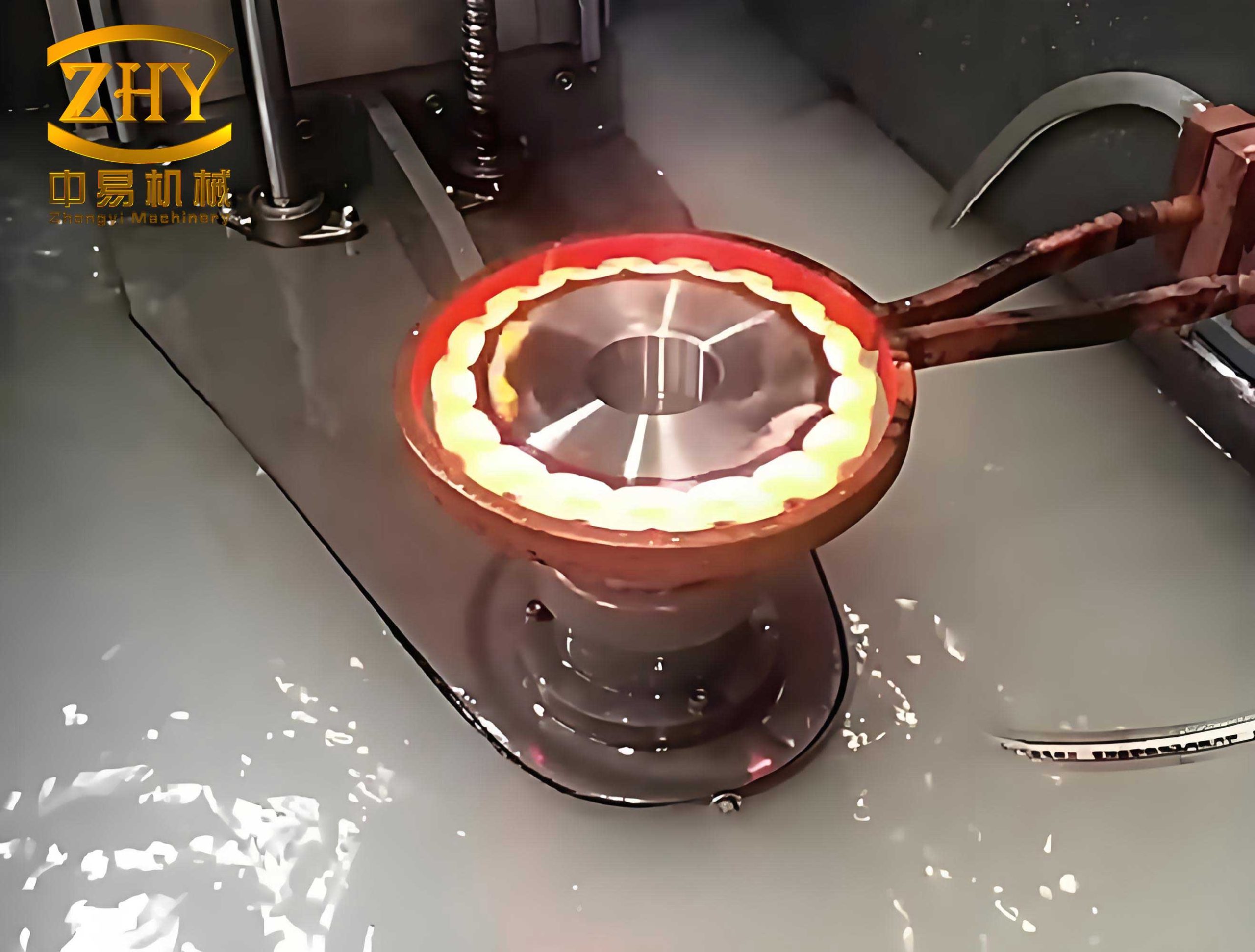
Moving to the specific impact on gear materials, I will consider a case akin to widely used gear steels like 20MnCr5. Pre-heat treatment exerts a profound influence on microstructure, surface hardness, and wear resistance. These properties are interdependent, and deficiencies in pre-heat treatment can propagate heat treatment defects that undermine all subsequent performance metrics.
Microstructural Transformations Induced by Pre-Heat Treatment
The microstructure of gear steel after pre-heat treatment is a decisive factor. When conventional normalizing is applied, the resulting microstructure often consists of relatively coarse, mixed grain structures with blocky ferrite-pearlite aggregates and elongated grains. This inhomogeneity is a precursor to heat treatment defects in the final product, such as uneven response to case hardening. Isothermal normalizing, which involves holding at a temperature just below the austenite transformation range for a controlled time before cooling, typically yields finer grains with reduced blocky constituents, though uniformity may still be suboptimal. The most refined and uniform microstructure is achieved through a combined homogenization and isothermal normalizing process. This sequence effectively minimizes microsegregation and promotes a fine, lamellar pearlitic structure with equiaxed ferrite. The Hall-Petch relationship quantitatively links grain size ($d$) to yield strength ($\sigma_y$):
$$ \sigma_y = \sigma_0 + k_y d^{-1/2} $$
where $\sigma_0$ is the friction stress and $k_y$ is the strengthening coefficient. Finer grains from superior pre-heat treatment directly enhance strength and toughness, reducing the likelihood of heat treatment defects related to low fracture resistance.
| Pre-Heat Treatment Process | Average Prior Austenite Grain Size (µm) | Microstructure Homogeneity Index (Qualitative) | Presence of Coarse Constituents | Potential for Subsequent Heat Treatment Defects |
|---|---|---|---|---|
| Conventional Normalizing | 25-35 | Low | Significant blocky ferrite/pearlite | High risk of non-uniform case depth, distortion. |
| Isothermal Normalizing | 15-22 | Medium | Moderate, reduced blocky areas | Medium risk; improved but may have local variations. |
| Homogenization + Isothermal Normalizing | 8-12 | High | Negligible | Low risk; provides uniform substrate for final HT. |
The kinetics of phase transformation during cooling can be modeled using time-temperature-transformation (TTT) diagrams. The cooling rate ($\dot{T}$) during normalizing determines the transformation products. For a steel with a given composition, the resulting microstructure fraction ($f$) of phases like ferrite ($\alpha$), pearlite ($P$), and bainite ($B$) can be approximated as functions of cooling rate and undercooling:
$$ f_i = 1 – \exp\left(-k_i (T_{A3}-T)^{n_i} t^{m_i}\right) $$
for different phases $i$. Incorrect cooling rates can lead to undesirable phase mixtures, a classic set of heat treatment defects affecting machinability and final properties.
Influence on Surface Hardness and Its Uniformity
Surface hardness is a critical parameter for gear durability. Pre-heat treatment establishes the baseline hardness and its uniformity across the component. In my evaluation, conventional normalizing often results in significant hardness scatter, with differences on the order of 20-24 HB at various locations on a gear blank. This non-uniformity is a direct manifestation of microstructural inhomogeneity—a clear heat treatment defect that can lead to unpredictable wear and contact fatigue. Isothermal normalizing improves hardness uniformity, reducing the maximum hardness deviation to approximately 15-19 HB. The combined homogenization and isothermal normalizing process achieves the best results, with hardness variations confined to about ±2 HB. The relationship between hardness ($H$) and microstructure can be expressed through a composite model considering different phases:
$$ H = H_{\alpha} V_{\alpha} + H_{P} V_{P} + H_{B} V_{B} + \Delta H_{gb} $$
where $H_{\alpha}$, $H_{P}$, $H_{B}$ are hardness contributions from ferrite, pearlite, and bainite respectively, $V$ are their volume fractions, and $\Delta H_{gb}$ is the grain boundary strengthening contribution. Uniform microstructure ensures consistent $V$ values, minimizing hardness scatter. Inadequate pre-heat treatment that leaves segregated regions or mixed grain sizes creates local variations in $V$, directly causing heat treatment defects in the form of soft or hard spots.
| Sample Location | Conventional Normalizing | Isothermal Normalizing | Homogenization + Isothermal Normalizing |
|---|---|---|---|
| 1 (Near surface) | 187 | 192 | 195 |
| 2 (Mid-radius) | 201 | 194 | 196 |
| 3 (Core) | 179 | 188 | 194 |
| 4 (Opposite surface) | 195 | 190 | 195 |
| Range (Max-Min) | 22 | 6 | 2 |
| Standard Deviation | 8.5 | 2.2 | 0.8 |
The statistical measure of hardness uniformity can be related to process parameters. Let $\Delta H$ represent the hardness range. Empirically, it often correlates with the inverse of microstructural homogeneity index ($I_{hom}$) and the standard deviation of grain size ($\sigma_d$):
$$ \Delta H \propto \frac{\sigma_d}{I_{hom}} $$
Processes that minimize $\sigma_d$ and maximize $I_{hom}$—effectively addressing potential heat treatment defects—yield the lowest $\Delta H$.
Effects on Wear Resistance and Associated Mechanisms
Wear resistance is paramount for gear longevity. Pre-heat treatment dictates the substrate’s ability to resist abrasive and adhesive wear. Testing under conditions simulating gear operation (e.g., at room temperature and elevated temperatures like 300°C) reveals stark differences. Conventionally normalized samples exhibit the highest wear volume, with surfaces showing severe pitting, spalling, and deep abrasion grooves. Isothermally normalized samples show improved wear resistance, with reduced pitting severity. Samples subjected to homogenization and isothermal normalizing demonstrate the best wear performance, with minimal surface damage and negligible coarse pits. The Archard wear equation provides a fundamental framework:
$$ V = K \frac{N \cdot s}{H} $$
where $V$ is wear volume, $K$ is a wear coefficient, $N$ is normal load, $s$ is sliding distance, and $H$ is hardness. However, $K$ itself is highly dependent on microstructure. A more comprehensive model incorporates microstructural parameters:
$$ K = K_0 \cdot \left(1 + \beta \cdot d^{1/2} + \gamma \cdot \Delta V_{inhom}\right) $$
Here, $K_0$ is a base wear coefficient, $\beta$ and $\gamma$ are constants, $d$ is grain size, and $\Delta V_{inhom}$ quantifies microstructural inhomogeneity. Coarse grains and inhomogeneity increase $K$, accelerating wear. Thus, pre-heat treatment processes that refine grains and enhance homogeneity directly reduce $K$, combating wear-related heat treatment defects that manifest as premature surface degradation.
| Pre-Heat Treatment | Relative Wear Volume at 25°C (Index) | Relative Wear Volume at 300°C (Index) | Dominant Wear Mechanism | Surface Observations Post-Test (Indicative of Heat Treatment Defects) |
|---|---|---|---|---|
| Conventional Normalizing | 100 | 135 | Abrasive + Severe Pitting | Deep grooves, large pits, spalling (clear defect manifestation). |
| Isothermal Normalizing | 68 | 92 | Moderate Abrasion + Mild Pitting | Shallower grooves, smaller pits. |
| Homogenization + Isothermal Normalizing | 45 | 60 | Mild Abrasion | Smooth wear track, very fine scratches, no major pits. |
The wear coefficient $K$ can be further decomposed to account for specific heat treatment defects. For instance, the presence of non-metallic inclusions or coarse carbides, which can be influenced by pre-heat treatment through dissolution or agglomeration, acts as stress concentrators. The probability of wear particle formation ($P_{part}$) might scale with the density of such defects ($\rho_{def}$):
$$ P_{part} \propto \rho_{def} \cdot \sigma_{local}^{m} $$
where $\sigma_{local}$ is local stress and $m$ is an exponent. Proper pre-heat treatment reduces $\rho_{def}$, thereby lowering $P_{part}$ and wear rate.
Comprehensive Analysis of Process Parameters and Defect Formation
To fully appreciate the impact, one must consider the interplay of all pre-heat treatment parameters. The heating rate ($\alpha_H$), holding temperature ($T_{hold}$), holding time ($t_{hold}$), and cooling rate ($\alpha_C$) form a multidimensional parameter space. Deviations from optimal settings can induce various heat treatment defects. For example, too slow a heating rate through certain temperature ranges can cause undesired phase transformations, while too fast a rate can cause thermal gradients and distortion. A generalized quality function $Q$ for the pre-heat treated state can be conceptualized:
$$ Q = f(T_{hold}, t_{hold}, \alpha_H, \alpha_C, C_i) $$
where $C_i$ represents material composition. The gradient of $Q$ with respect to any parameter indicates sensitivity. Regions where $\nabla Q$ is large correspond to high risk for heat treatment defects.
I often model the tendency for a specific defect, such as quench cracking susceptibility after final hardening, as being influenced by pre-heat treatment through residual stress ($\sigma_{res}$) and grain size. An empirical risk index $R_{crack}$ might be:
$$ R_{crack} = A \cdot \sigma_{res}^2 + B \cdot d + C \cdot \Delta H_{pre} $$
where $A$, $B$, $C$ are constants, and $\Delta H_{pre}$ is the hardness non-uniformity from pre-heat treatment. Optimal pre-heat treatment minimizes $R_{crack}$ by reducing all terms.
Furthermore, the chemical homogeneity achieved during pre-heat treatment affects hardenability. The ideal critical diameter ($D_I$) from Grossmann’s approach can be expressed as a function of alloying elements. Inhomogeneous distribution leads to local variations in $D_I$, causing non-uniform hardening—a severe heat treatment defect. The effective $D_I$ across a section, $D_{I,eff}$, can be related to the standard deviation of composition $\sigma_{[X]}$ for element $X$:
$$ D_{I,eff} = \overline{D_I} – \lambda \cdot \sigma_{[X]} $$
where $\overline{D_I}$ is the mean ideal critical diameter and $\lambda$ is a proportionality constant. Homogenization pre-heat treatment minimizes $\sigma_{[X]}$, maximizing $D_{I,eff}$ uniformity.
Advanced Considerations and Future Directions
In modern practice, computational tools like finite element analysis (FEA) are used to simulate temperature fields and phase transformations during pre-heat treatment. The heat conduction equation with phase transformation latent heat is solved:
$$ \rho c_p \frac{\partial T}{\partial t} = \nabla \cdot (k \nabla T) + \dot{q}_{latent} $$
where $\rho$ is density, $c_p$ is specific heat, $k$ is thermal conductivity, and $\dot{q}_{latent}$ is the latent heat rate due to phase changes. Accurate simulation helps design processes that avoid thermal stresses leading to heat treatment defects like distortion.
Moreover, the integration of non-destructive evaluation (NDE) after pre-heat treatment is crucial for early detection of heat treatment defects. Techniques like ultrasonic testing can detect subsurface inhomogeneities or cracks initiated during improper cooling. The signal amplitude $A$ in such tests often relates to defect size $a$ via relationships like:
$$ A \propto a^{3/2} \cdot \exp(-\mu x) $$
for certain geometries, where $\mu$ is an attenuation coefficient and $x$ is depth. Implementing such quality checks ensures that components with latent heat treatment defects are identified before costly final processing.
The economic impact of heat treatment defects cannot be overstated. Scrap, rework, and in-service failures stemming from inadequate pre-heat treatment incur significant costs. A simple cost model $C_{total}$ includes preventive cost $C_{prevent}$ (for optimized pre-HT) and failure cost $C_{fail}$:
$$ C_{total} = C_{prevent} + P_{fail} \cdot C_{fail} $$
where $P_{fail}$ is the probability of failure. Investing in robust pre-heat treatment reduces $P_{fail}$ dramatically, lowering $C_{total}$.
In conclusion, from my perspective, pre-heat treatment is not merely a preparatory step but a foundational process that dictates the success of all subsequent manufacturing stages for engineering mechanical gears. Its influence on microstructure, hardness uniformity, and wear resistance is profound and quantifiable. By meticulously controlling pre-heat treatment parameters—temperature, time, cooling rates—we can engineer a material state that maximizes performance and, critically, minimizes the occurrence of detrimental heat treatment defects. These defects, whether in the form of coarse grains, hardness variations, or poor wear resistance, are often rooted in inadequate pre-conditioning of the material. Therefore, a deep understanding and precise execution of pre-heat treatment are indispensable for producing high-performance, reliable gears that meet the demanding standards of modern engineering machinery. The integration of theoretical models, empirical data, and advanced process control is the path forward to consistently avoid heat treatment defects and achieve optimal gear material properties.