
As a professional deeply involved in the tractor industry’s material science and engineering sector, I have witnessed firsthand the significant evolution and the persistent challenges in gear manufacturing. The demand for tractor gears has grown exponentially alongside the industry’s expansion. Currently, numerous specialized factories exist, employing a substantial workforce with an annual production capacity reaching millions of pieces, which fundamentally supports domestic tractor production. This analysis will delve into the current state, identify critical gaps compared to international standards, and propose future directions for gear materials and heat treatment processes, with a particular focus on the pervasive issue of heat treatment defects.
1. Current Status of Gear Materials
The materials employed for tractor gears in the domestic market can be broadly categorized into five groups:
- Case-hardening Steels: Such as 20CrMnTi, 20CrMo, 20CrNiMo, and others. These are the most widely used, primarily for transmission gears.
- Quenched and Tempered Steels: Such as 40Cr and 45 steel, typically used for lightly loaded, fixed-transmission gears.
- Low Hardenability Steels: Such as 55TiD and 60TiD, used for manufacturing fixed transmission gears via induction hardening.
- Powder Metallurgy Materials: Primarily used for differential gears.
- Ductile Iron.
Among these, case-hardening steels dominate the market, with 20CrMnTi being the most prevalent due to its historical availability and acceptable performance. However, the application of low hardenability steels, ductile iron, and powder metallurgy remains in the promotion and trial phase. Over the years, collaborative efforts between tractor industry material scientists and metallurgical departments have led to the development of new materials like 20MnVB, 20SiMnVB, 25MnTiBR, and others to better utilize domestic resources. Despite these efforts, the stringent requirements imposed by modern tractor designs and new precision standards (like the GB10095 standard for involute cylindrical gears) have exposed severe shortcomings in material quality, which are intrinsically linked to subsequent heat treatment defects such as excessive distortion and inconsistent hardness profiles.
2. The Gap with International Standards in Materials
The introduction of manufacturing technology from leading global companies (e.g., John Deere, Fiat, Caterpillar) has provided a clear benchmark, revealing significant disparities:
| Aspect | International Practice | Domestic Status | Impact on Heat Treatment |
|---|---|---|---|
| Material Variety & Specification | Extensive series: C-Mn steels, Cr-Ni-Mo steels; categorized by process (carburizing, carbonitriding, induction); controlled-hardenability (CH) steels; fine-grain steels. | Over-reliance on a single grade (20CrMnTi). Incomplete specifications. | Limits optimization for specific gear geometry and loading, leading to suboptimal case depth and core properties, increasing risk of heat treatment defects like cracking or insufficient load capacity. |
| Chemical Composition & Purity | Tight control via secondary refining, continuous casting, electromagnetic stirring. Low inclusion levels (O, S, P). Narrow within-heat composition ranges. | Large compositional fluctuations, high inclusion content, significant segregation. | Inconsistent hardenability and case response. Non-metallic inclusions act as stress concentrators, promoting quench cracking—a critical heat treatment defect. |
| Grain Size & Hardenability Assurance | Fine-grained steel (ASTM 6-8 or finer) is standard. Guaranteed hardenability bands (CH steel) with narrow ranges (e.g., HRC 4-6 points). | Coarse grain is common. Hardenability is generally not guaranteed; controlled bands are expensive. | Coarse grain increases susceptibility to distortion and reduces toughness. Uncontrolled hardenability causes scatter in core hardness and case depth, a major source of inconsistent performance and heat treatment defects related to dimensional instability. |
The fundamental equation for hardenability, as described by the ideal critical diameter $D_I$, highlights the importance of composition control:
$$ D_I = f(C, Mn, Si, Ni, Cr, Mo, …) $$
Uncontrolled variation in these elements leads to a wide distribution of $D_I$ values, making precise heat treatment process design nearly impossible and directly causing heat treatment defects like soft spots or excessive hardening.
3. Future Directions for Gear Materials
Addressing these gaps requires a multi-faceted approach. The immediate priority is to enhance the purity of existing steels, particularly 20CrMnTi, and tighten chemical composition tolerances. The development and widespread adoption of affordable controlled-hardenability (CH) steels is paramount to reduce distortion. Concurrently, promoting new carbonitriding steels like 20CrMnMoH and researching new case-hardening grades are essential. Expanding the application of low-hardenability steels and systematizing material specifications will provide designers with a more reliable and optimized palette of choices, ultimately minimizing the root causes of material-induced heat treatment defects.
4. Current Status of Gear Heat Treatment
The final heat treatment processes for tractor gears primarily fall into three categories:
- Carburizing: Performed either by direct quenching from the carburizing temperature or slow cooling followed by reheating and quenching.
- Carbonitriding: Gaining popularity due to its lower processing temperature, reduced distortion, and good wear resistance.
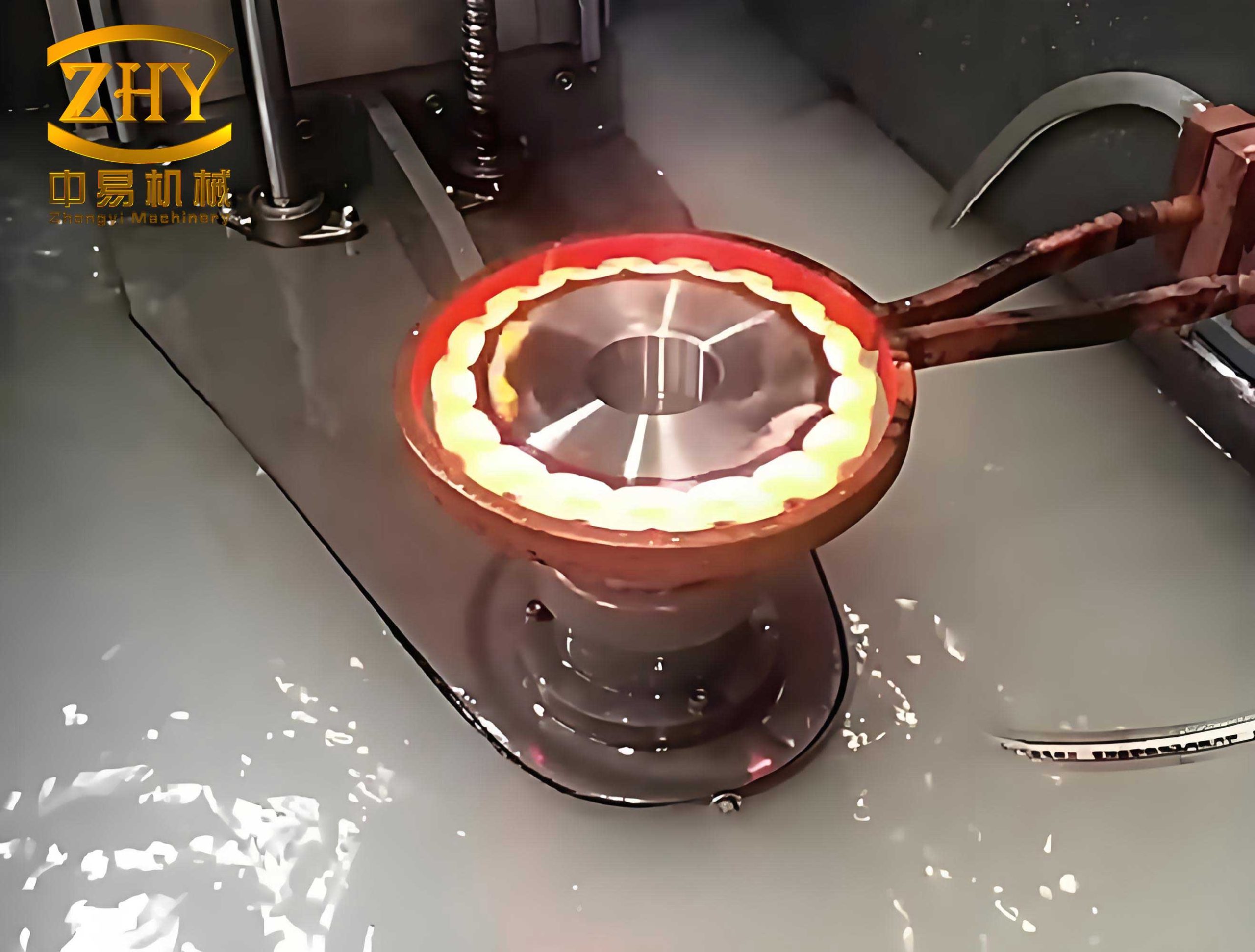
- Induction Hardening: Applied to quenched and tempered steels or low-hardenability steels.
Controlled atmosphere technology is increasingly adopted for carburizing and carbonitriding. Notably, some manufacturers have implemented double-control carbonitriding processes, and the application of Rare Earth (RE) elements in these processes has shown economic benefits. However, the equipment landscape remains largely outdated. The majority of operations rely on pit-type furnaces, which suffer from low productivity, high energy consumption, significant temperature fluctuations ($\pm 15^{\circ}C$ or more), and poor carbon potential control accuracy ($\pm 0.05\%$ C or worse). While a few continuous gas carburizing or carbonitriding lines and imported batch-type multi-purpose furnaces exist, they are not the norm. Furthermore, quality inspection standards require updating, and the widespread use of conventional engine oils as quenchants is suboptimal compared to modern, engineered quenching media.
5. The Gap with International Standards in Heat Treatment
The technological divergence is stark when comparing processes and controls:
- Process Control: Internationally, computerized control systems using infrared analyzers or oxygen probes automatically regulate carbon potential with precision up to $\pm 0.03\%$ C and temperature within $\pm 5^{\circ}C$. This enables consistent “bright hardening” and minimizes heat treatment defects. Domestic control is often manual and imprecise.
- Equipment: Advanced continuous or batch multi-purpose furnaces are standard abroad. Domestic reliance on basic pit furnaces directly contributes to inconsistent case depth, sooting, and increased distortion—all classic heat treatment defects.
- Standards & Metrics: International standards focus on key results: surface hardness (often HRC 58-63 for critical gears), surface carbon content (controlled tightly between 0.70-0.90% C to avoid brittle carbides), and effective case depth measured by the hardness profile method. The common definition for effective case depth (ECD) is the depth from the surface to the point where hardness reaches 550 HV (or HRC 50). This can be modeled for a simple carbon diffusion gradient:
$$ C(x,t) = C_s – (C_s – C_0) \cdot \text{erf}\left( \frac{x}{2\sqrt{Dt}} \right) $$
where $C_s$ is surface carbon, $C_0$ is core carbon, $D$ is diffusion coefficient, and $t$ is time. The depth $x_{550}$ where the corresponding hardness is 550 HV defines the ECD. Domestically, the metallographic method is still prevalent, which is less objective and can lead to interpretation errors, masking true heat treatment defects like shallow or irregular case depth.
6. Future Directions for Gear Heat Treatment
To bridge this gap, the industry must vigorously promote advanced processes like carbonitriding and RE-carbonitriding. Implementing forging residual heat isothermal annealing to replace normalizing for gear blanks can save energy and improve machinability. On the equipment front, there is an urgent need to replace pit furnaces with continuous or sealed quench batch furnaces equipped with precise atmosphere control. Adopting advanced polymer or accelerated quenching oils to replace mechanical oils will improve quenching uniformity and reduce the severity of thermal gradients, thereby mitigating distortion and cracking—two of the most costly heat treatment defects.
7. In-Depth Analysis of Quality Control and Heat Treatment Defects
The core challenge in tractor gear manufacturing lies in controlling and minimizing heat treatment defects. These defects arise from the complex interplay between material inconsistencies, process instability, and thermal/transformation stresses. A primary concern is distortion, including dimensional change (size, shape) and warpage. Distortion is governed by stresses from heating ($\sigma_{th}$), phase transformation volume changes ($\sigma_{tr}$), and quenching ($\sigma_{q}$). The total stress can be approximated as:
$$ \sigma_{total} = \sigma_{th} + \sigma_{tr} + \sigma_{q} $$
Quenching stress, often the dominant factor, is related to the heat transfer coefficient $h$ and the temperature gradient $\nabla T$. Using a simplified model for thermal stress in a plate during quenching:
$$ \sigma_{th} \approx \frac{E \alpha}{1-\nu} (T_{surface} – T_{core}) $$
where $E$ is Young’s modulus, $\alpha$ is the thermal expansion coefficient, and $\nu$ is Poisson’s ratio. Inconsistent material hardenability or non-uniform furnace temperature exacerbates these gradients, leading to unpredictable and often irreparable distortion.
Another critical category of heat treatment defects is related to the hardened case itself. These include:
- Soft Spots: Localized areas of low hardness caused by surface contamination (oil, oxide), inadequate atmosphere circulation, or non-uniform quenchant flow. This directly compromises wear resistance and contact fatigue life.
- Oxidation & Decarburization: Results from insufficient atmosphere protection during heating, depleting the surface of carbon and forming soft ferrite layers, severely reducing fatigue strength and pitting resistance.
- Excessive Retained Austenite (RA): High surface carbon or low quenching pressure/temperature can lead to RA levels above 20-30%. This reduces surface hardness, promotes premature wear, and can later transform to untempered martensite under load, causing dimensional instability and micro-cracking. The volume fraction of RA, $V_{\gamma}$, can be estimated from the Ms (martensite start) temperature, which is lowered by carbon:
$$ M_s (^{\circ}C) \approx 539 – 423C – 30.4Mn – 17.7Ni – 12.1Cr – 7.5Mo $$
Lower $M_s$ leads to higher $V_{\gamma}$. - Grain Coarsening: As identified in the material gap, coarse prior austenite grain boundaries provide easy paths for crack propagation and increase distortion susceptibility.
- Quench Cracking: The most catastrophic heat treatment defect, caused when the tensile stresses during the martensitic transformation exceed the fracture strength of the material. Sharp geometry changes (poor fillet design), material inclusions, and overly severe quenching all contribute. The risk is higher with higher carbon content and faster cooling rates. The Grossmann quench severity factor $H$ is a key parameter here, relating to the heat transfer coefficient of the quenchant.
To systematically address these issues, a Failure Mode and Effects Analysis (FMEA) approach integrated into the production line is crucial. Below is a summary table linking common defects to their root causes and potential mitigation strategies:
| Defect Type | Primary Root Causes | Consequences | Mitigation Strategies |
|---|---|---|---|
| Excessive Distortion/Warpage | Uncontrolled material hardenability; Non-uniform heating/cooling; Residual stresses from machining/forging; Poor part fixturing. | Costly post-heat treatment machining (grinding), assembly issues, noise, reduced gear life. | Implement CH steels; Use press quenching fixtures; Optimize furnace temperature uniformity; Apply stress-relief annealing before final heat treatment. |
| Soft Spots & Low Surface Hardness | Surface contamination; Inadequate atmosphere control ($C_p$ too low); Quenchant agitation failure; Foaming or degraded quenchant. | Accelerated wear, pitting, scuffing, premature gear failure. | Improve pre-cleaning; Maintain precise carbon potential control; Implement quenchant monitoring and filtration; Ensure proper agitation. |
| Oxidation & Decarburization | Air ingress into furnace; Low furnace atmosphere carbon potential; Excessive processing time. | Loss of surface carbon, soft surface layer, drastic reduction in fatigue strength. | Ensure furnace seal integrity; Maintain positive pressure and correct $C_p$; Optimize cycle times. |
| High Retained Austenite | Excessively high surface carbon concentration; Quenching temperature/pressure too high. | Reduced contact fatigue life, dimensional instability, potential for later brittle martensite formation. | Control surface carbon to 0.70-0.90%; Implement deep freezing after quenching; Use higher pressure gas quenching or optimized oil quenching. |
| Quench Cracking | Severe thermal gradients; Material defects (inclusions, seams); Poor gear design (sharp corners); Incorrect quenchant selection for material hardenability. | Catastrophic, irreparable component failure. | Design gears with generous fillets; Use lower severity quenchants (e.g., hot oil, polymers); Ensure material cleanliness; Implement interrupted or martempering processes. |
In conclusion, the path to world-class tractor gear manufacturing requires a holistic and simultaneous upgrade in both materials and heat treatment technology. The fight against heat treatment defects is central to this endeavor. By focusing on material purity, hardenability control, process precision through advanced equipment, and the adoption of modern quality metrics, the industry can significantly improve gear consistency, durability, and performance. This will not only satisfy the demands of modern high-power tractors but also enhance global competitiveness. The integration of computational tools for predicting distortion and stress, along with real-time process monitoring, represents the next frontier in eliminating these costly and performance-limiting heat treatment defects.