
In my years of working on drivetrains for engineering machinery such as vibratory rollers and pavers, I have consistently encountered the critical role played by hyperboloid gears. These gears, specifically the spiral bevel hypoid type, are integral to the rear axle drives, offering advantages in torque transmission and compact design. However, despite their widespread use, challenges in传动质量, service life, and failure rates persist, often falling short of field requirements. While adopting advanced manufacturing systems from abroad is one solution, I believe that enhancing existing design and manufacturing systems through optimization is equally vital. This article details my development of an optimization and selection design system for hyperboloid gears, aimed at improving product structure,传动performance, longevity, and reducing costs and design cycles.
The core of my approach lies in a modular optimization system. I structured it into four interconnected yet independent modules: geometric design, strength calculation, life estimation, and optimization design. Each module addresses specific design aspects, but they share geometric parameters, ensuring consistency. The system is built on a Windows platform using a visual programming language, featuring an intuitive interface with dynamic navigation, automatic chart queries, and report generation. The main interface allows direct access to any module, facilitating a streamlined workflow. For instance, the geometric design module computes over sixty parameters, including gear blank dimensions, positioning data, and machining adjustments based on established methods. The strength calculation module evaluates load capacity using recognized standards for bending fatigue, contact fatigue, static strength, and wear resistance. The life estimation module predicts finite寿命and承载能力, while the optimization design module applies multi-objective optimization to refine key geometric parameters.
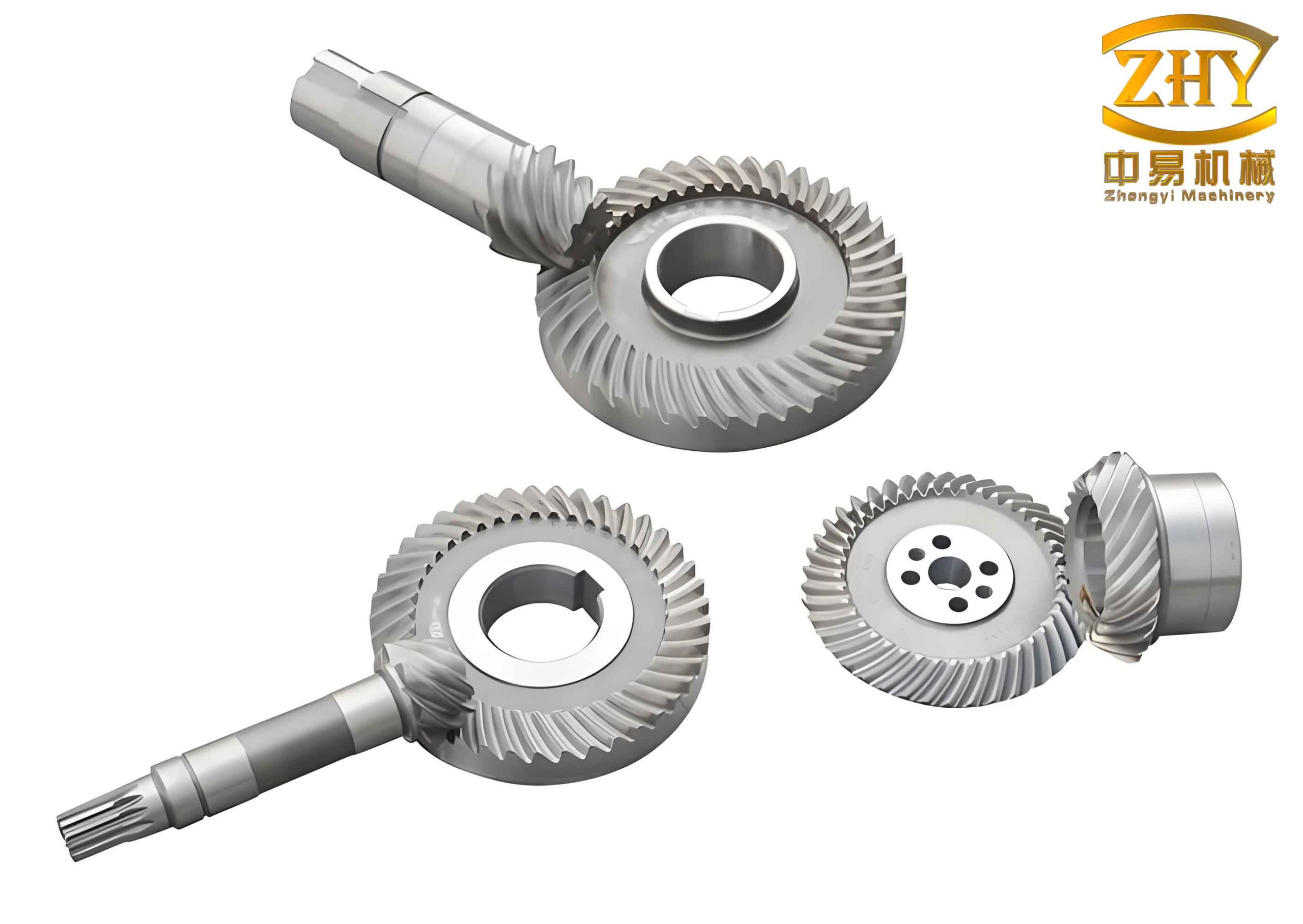
To tackle the optimization problem, I formulated it as a multi-objective design. The primary goal is to determine optimal geometric parameters for the hyperboloid gear pair, balancing minimal volume and maximal load capacity. The design variables I selected are crucial for gear performance:
- Pinion tooth number, $z_1$
- Gear module at the large end, $m_{e2}$
- Gear face width, $b_2$
- Offset distance, $E$
- Pinion spiral angle, $\beta_{m1}$
Thus, the design vector is: $$\mathbf{X} = [z_1, m_{e2}, b_2, E, \beta_{m1}]^T = [x_1, x_2, x_3, x_4, x_5]^T.$$
The first objective function targets minimizing the total volume of the hyperboloid gear pair. The volume is approximated by summing the volumes of the pinion and gear, considering their conical geometry. For the pinion, volume $V_1$ is: $$V_1 = \frac{\pi}{3} \left[ b_1 (d_{e1}^2 + d_{e1} d_{i1} + d_{i1}^2) + h_{f1} (d_{i1}^2 + d_{i1} d_{f1} + d_{f1}^2) \right],$$ where $d_{e1}$ is the pinion outer diameter, $d_{i1}$ is the inner diameter, $d_{f1}$ is the root diameter, $b_1$ is the pinion face width, and $h_{f1}$ is the dedendum height. A similar formula applies to the gear volume $V_2$. The objective is: $$\min f_1(\mathbf{X}) = V_1 + V_2.$$
The second objective function aims to maximize the load capacity, defined as the maximum torque on the pinion that satisfies both bending and contact fatigue strengths. This involves calculating four torque limits: $T_{11}$ and $T_{12}$ for bending based on pinion and gear, and $T_{13}$ and $T_{14}$ for contact based on pinion and gear. The objective is: $$\max f_2(\mathbf{X}) = \frac{1}{\min(T_{11}, T_{12}, T_{13}, T_{14})}.$$ In practice, I often combine these into a single objective using weighting factors, but the system allows multi-objective analysis.
Constraints are essential to ensure practical and manufacturable hyperboloid gears. Based on engineering standards and field experience, I imposed the following constraints:
- Tooth numbers: $6 \leq z_1 \leq 20$, $z_2 \geq 21$, and $40 \leq z_1 + z_2 \leq 60$ for smooth operation.
- Module: $m_{e2} \geq 2$ to ensure adequate bending strength.
- Face width: $b_2 \leq 0.3 \cdot d_{e2}$ to prevent load concentration, where $d_{e2}$ is the gear outer diameter.
- Offset distance: $0.1 \cdot d_{e2} \leq E \leq 0.2 \cdot d_{e2}$ for optimal performance.
- Spiral angle: $30^\circ \leq \beta_{m1} \leq 50^\circ$ to balance axial and radial forces.
- Strength requirements: Bending and contact stresses must not exceed allowable limits for both pinion and gear: $\sigma_{F1} \leq [\sigma_{F1}], \sigma_{F2} \leq [\sigma_{F2}], \sigma_{H1} \leq [\sigma_{H1}], \sigma_{H2} \leq [\sigma_{H2}]$.
These constraints translate into 21 nonlinear inequality functions: $g_j(\mathbf{X}) \leq 0$ for $j=1,2,\dots,21$.
To implement the optimization, I employed the complex method, a direct search algorithm suitable for constrained nonlinear problems. The program integrates the geometric and strength modules to compute objective and constraint functions iteratively. The flowchart below summarizes the process:
| Parameter | Symbol | Range or Condition | Description |
|---|---|---|---|
| Pinion tooth number | $z_1$ | 6–20 | Influences gear ratio and smoothness |
| Gear module | $m_{e2}$ | ≥ 2 mm | Ensures bending strength |
| Gear face width | $b_2$ | ≤ 0.3$d_{e2}$ | Prevents load concentration |
| Offset distance | $E$ | 0.1$d_{e2}$–0.2$d_{e2}$ | Optimizes hyperboloid gear geometry |
| Pinion spiral angle | $\beta_{m1}$ | 30°–50° | Affects axial thrust and efficiency |
| Bending stress | $\sigma_F$ | ≤ allowable $[\sigma_F]$ | Fatigue strength constraint |
| Contact stress | $\sigma_H$ | ≤ allowable $[\sigma_H]$ | Surface durability constraint |
The optimization process begins by initializing a complex of feasible points. For each point, the system calls the geometric design module to compute dimensions like pitch diameters and face widths. For instance, the gear pitch diameter $d_{2}$ is derived from module and tooth count: $$d_{2} = m_{e2} \cdot z_2.$$ The pinion pitch diameter $d_{1}$ relates to the gear ratio $i$: $$d_{1} = \frac{d_{2}}{i}.$$ The offset $E$ influences the hypoid geometry, requiring iterative calculations for spiral angles and contact patterns.
Next, the strength module calculates stresses. Bending stress for the pinion $\sigma_{F1}$ follows: $$\sigma_{F1} = \frac{F_t \cdot K_A \cdot K_V \cdot K_{F\beta} \cdot K_{F\alpha}}{b_1 \cdot m_n \cdot Y_{FS1} \cdot Y_{\epsilon} \cdot Y_{\beta}},$$ where $F_t$ is tangential force, $K_A$ is application factor, $K_V$ is dynamic factor, $K_{F\beta}$ is face load factor, $K_{F\alpha}$ is transverse load factor, $m_n$ is normal module, $Y_{FS1}$ is tooth form factor, $Y_{\epsilon}$ is contact ratio factor, and $Y_{\beta}$ is spiral angle factor. Contact stress $\sigma_{H1}$ is: $$\sigma_{H1} = Z_E \cdot Z_H \cdot Z_{\epsilon} \cdot Z_{\beta} \cdot \sqrt{\frac{F_t \cdot K_A \cdot K_V \cdot K_{H\beta} \cdot K_{H\alpha}}{d_{1} \cdot b_1} \cdot \frac{u+1}{u}},$$ with $Z_E$ as elasticity coefficient, $Z_H$ as zone factor, $Z_{\epsilon}$ as contact ratio factor, $Z_{\beta}$ as spiral angle factor, and $u$ as gear ratio. Allowable stresses $[\sigma_F]$ and $[\sigma_H]$ depend on material properties and寿命requirements, computed via: $$[\sigma_F] = \frac{\sigma_{FE} \cdot Y_{ST} \cdot Y_{NT} \cdot Y_{\delta relT} \cdot Y_{RrelT} \cdot Y_X}{S_F},$$ $$[\sigma_H] = \frac{\sigma_{Hlim} \cdot Z_{NT} \cdot Z_L \cdot Z_V \cdot Z_R \cdot Z_W \cdot Z_X}{S_H},$$ where $\sigma_{FE}$ and $\sigma_{Hlim}$ are endurance limits, $Y$ and $Z$ factors account for various effects, and $S_F$ and $S_H$ are safety factors.
The life estimation module uses stress cycles and material S-N curves to predict service life under variable loads. For bending, the accumulated damage $D_F$ is: $$D_F = \sum_{i=1}^{n} \frac{n_i}{N_{Fi}},$$ where $n_i$ is cycles at stress $\sigma_{Fi}$, and $N_{Fi}$ is cycles to failure at that stress. Similar calculations apply for contact fatigue. The system outputs estimated life in hours or cycles.
In the optimization loop, the complex method evaluates $f_1(\mathbf{X})$ and $f_2(\mathbf{X})$ while checking constraints $g_j(\mathbf{X})$. Points are reflected and contracted until convergence to an optimum. I validated the system with a case study on a vibratory roller drive axle. The initial design had parameters: $z_1=10$, $m_{e2}=5\,\text{mm}$, $b_2=40\,\text{mm}$, $E=30\,\text{mm}$, $\beta_{m1}=35^\circ$. After optimization for minimal volume, results were: $z_1=12$, $m_{e2}=4.5\,\text{mm}$, $b_2=38\,\text{mm}$, $E=28\,\text{mm}$, $\beta_{m1}=40^\circ$. This reduced volume by approximately 15% while maintaining strength. For maximal load capacity, optimization yielded: $z_1=14$, $m_{e2}=5.2\,\text{mm}$, $b_2=42\,\text{mm}$, $E=32\,\text{mm}$, $\beta_{m1}=45^\circ$, increasing permissible torque by over 20% with minimal size change.
| Design Parameter | Initial Design | Optimized for Volume | Optimized for Load Capacity |
|---|---|---|---|
| Pinion tooth number, $z_1$ | 10 | 12 | 14 |
| Gear module, $m_{e2}$ (mm) | 5.0 | 4.5 | 5.2 |
| Gear face width, $b_2$ (mm) | 40 | 38 | 42 |
| Offset distance, $E$ (mm) | 30 | 28 | 32 |
| Pinion spiral angle, $\beta_{m1}$ (°) | 35 | 40 | 45 |
| Total volume (cm³) | 1250 | 1062 | 1285 |
| Max torque (N·m) | 1200 | 1180 | 1450 |
The program’s efficiency stems from its modularity. Each module is coded as a separate function, allowing reuse and independent testing. For example, the geometric design function takes inputs like tooth numbers and module, then outputs pitch diameters, face widths, and spiral angles through iterative solutions of equations like: $$\tan \gamma_1 = \frac{\sin \beta_{m1}}{\cos \beta_{m1} + (E / d_1)},$$ where $\gamma_1$ is the pinion pitch angle. The strength function interfaces with material databases and load spectra, while the optimization driver coordinates evaluations. This structure enables rapid prototyping; I can modify constraints or objectives without overhauling the entire system.
In practice, the hyperboloid gear optimization system has proven valuable for reducing design time and improving performance. For instance, in a paver axle project, using the system cut the design cycle from two weeks to three days by automating parameter selection and validation. The key is the integration of empirical knowledge with numerical optimization. The hyperboloid gear’s unique geometry, characterized by offset axes and curved teeth, demands careful balancing of parameters to avoid edge loading and noise. My system encodes these considerations into constraints, such as limiting face width relative to diameter and ensuring spiral angles within optimal ranges.
Looking forward, I plan to enhance the system by incorporating machine learning for material selection and real-time load data from field sensors. Additionally, extending the optimization to include manufacturing costs and tolerances could further improve economic efficiency. The hyperboloid gear remains a cornerstone of heavy-duty drivetrains, and continuous refinement of design tools is essential for meeting evolving industry demands.
To summarize, my optimization and selection design system for hyperboloid gears addresses critical challenges in engineering machinery. By leveraging multi-objective optimization, modular programming, and rigorous constraint handling, it enables designers to achieve compact, durable, and efficient gear pairs. The use of tables and formulas, as detailed above, facilitates clear communication of parameters and results. This approach not only enhances product quality but also supports rapid response to market needs, underscoring the importance of advanced design methodologies in modern engineering.