
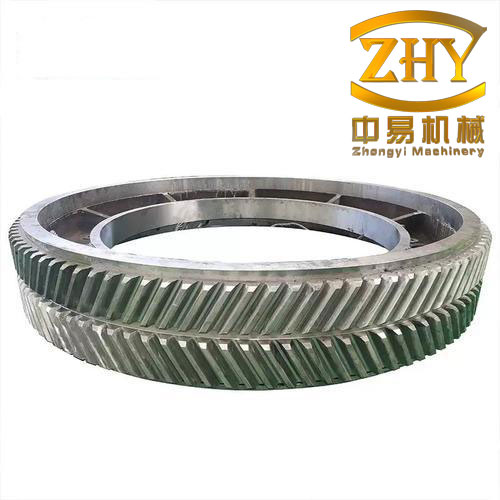
In my years of working with gear transmission systems, I have come to deeply appreciate the unique advantages of herringbone gears. These gears, which are essentially a pair of helical gears with opposite helix angles on a single gear body, offer exceptional performance in terms of load capacity, noise reduction, and smoothness of operation. In this article, I will discuss the formation of involute tooth surfaces, the benefits of herringbone gear transmission, and various manufacturing methods, supported by detailed tables and formulas.
Formation of Involute Tooth Flank Surfaces
The involute profile is one of the most widely used tooth forms in modern gear engineering. I recall that the involute curve is generated by a point on a straight line that rolls without slipping along a circle (the base circle). Extending this concept to three dimensions: when a plane rolls without slipping on a base cylinder, any straight line on that plane traces an involute surface on the cylinder. If the line is parallel to the axis of the base cylinder, we obtain the tooth flank of a spur gear. If the line is at an angle \(\beta\) (the helix angle) to the axis, we obtain a helical gear tooth flank. For herringbone gears, two helical flanks with opposite helix angles are combined on the same gear blank, forming the characteristic “V” or “herringbone” shape.
| Gear Type | Line Orientation on Rolling Plane | Resulting Tooth Surface |
|---|---|---|
| Spur Gear | Parallel to cylinder axis | Involute surface, straight tooth line |
| Helical Gear | At angle \(\beta\) to cylinder axis | Involute helicoid |
| Herringbone Gear | Two opposite angles \(\pm\beta\) | Two mirrored helicoids on one gear |
Advantages of Herringbone Gear Transmission
Herringbone gears are widely recognized for their superior smoothness and ability to transmit high torques. The key advantage lies in their high contact ratio. For a helical gear, the total contact ratio \(\varepsilon_{\gamma}\) is the sum of the transverse contact ratio \(\varepsilon_{\alpha}\) and the overlap (or face) contact ratio \(\varepsilon_{\beta}\):
$$
\varepsilon_{\gamma} = \varepsilon_{\alpha} + \varepsilon_{\beta}
$$
The overlap contact ratio for helical gears is given by:
$$
\varepsilon_{\beta} = \frac{b \cdot \sin\beta}{\pi m_{n}}
$$
where \(b\) is the face width, \(m_{n}\) is the normal module, and \(\beta\) is the helix angle. In herringbone gears, the helix angle can be much larger (typically \(25^{\circ}\) to \(40^{\circ}\)) without causing an axial thrust problem, because the oppositely oriented halves cancel the axial forces internally. This allows \(\varepsilon_{\beta}\) to become very large, leading to extremely smooth and quiet operation.
| Gear Type | Typical Helix Angle \(\beta\) | Typical Overlap Ratio \(\varepsilon_{\beta}\) | Axial Force |
|---|---|---|---|
| Spur Gear | 0° | 0 | None |
| Helical Gear | 8° – 17° | 1.0 – 2.5 | Present |
| Herringbone Gear | 25° – 40° | 2.5 – 6.0+ | Self-cancelling |
From my own design experience, the self-cancelling axial force feature is what makes herringbone gears ideal for high-power, high-speed applications. In many industrial gearboxes, replacing a pair of helical gears with herringbone gears reduces bearing loads significantly, allowing more compact designs. Below I summarize the main advantages:
- High total contact ratio (often \(\varepsilon_{\gamma} > 5\)) ensures continuous tooth engagement.
- Elimination of axial thrust forces, simplifying bearing design.
- Lower noise and vibration compared to spur or single helical gears.
- Increased load capacity due to longer lines of contact.
- Compact gearbox size for given power transmission.
| Parameter | Spur Gear | Helical Gear (\(\beta=15°\)) | Herringbone Gear (\(\beta=30°\)) |
|---|---|---|---|
| Transverse contact ratio \(\varepsilon_{\alpha}\) | 1.6 | 1.6 | 1.6 |
| Overlap ratio \(\varepsilon_{\beta}\) | 0 | 1.65 | 3.18 |
| Total contact ratio \(\varepsilon_{\gamma}\) | 1.6 | 3.25 | 4.78 |
| Axial force factor\(^1\) | 0 | 0.27 | 0 |
| Relative load capacity | 1.0 | 2.0 | 3.0 |
\(^1\) Axial force factor = \(\tan\beta\) for a single helical gear; for herringbone, net zero.
Processing Methods for Herringbone Gears
Manufacturing herringbone gears is inherently more challenging than spur or helical gears due to the requirement of precisely aligning the left‑hand and right‑hand helical sections. The most critical dimension is the herringbone centerline – the intersection line of the two tooth slot extensions along the axial direction. This centerline should ideally lie exactly at the middle of the gear face width to ensure balanced load distribution. I will now discuss the common processing routes, classifying them by the hardness of the gear tooth flanks.
Soft Tooth Surface Herringbone Gears (Hardness < 350 HB)
For gears that are not heat‑treated to a high hardness (typically used in lower‑power applications or as pre‑hobbing blanks), two primary methods are employed:
1. Form Milling with a Finger Cutter
Using a CNC machining center with a finger‑shaped milling cutter, the tooth spaces can be cut one by one. This method is often termed form milling because the cutter shape matches the tooth space profile. The accuracy heavily depends on the cutter geometry and the machine’s positioning precision. Typically, this yields a precision around DIN 8 or lower. The herringbone centerline can be controlled accurately by the CNC program, but the overall productivity is low.
| Aspect | Details |
|---|---|
| Machine type | 5‑axis CNC machining center |
| Cutter | Finger‑shaped form cutter (custom ground) |
| Accuracy | DIN 8 or lower |
| Productivity | Low (single‑tooth indexing) |
| Centerline accuracy | Good (CNC controlled) |
| Typical application | Prototype or small batch |
2. Hobbing (Generating Method)
Hobbing is the most common generating method for soft‑surface gears. For herringbone gears, the process is more complex than for simple helical gears. Modern CNC hobbers often include a special herringbone gear cutting cycle. The machine first cuts the right‑hand helix for one half of the face width, then the left‑hand helix for the other half. The transition point (centerline) is defined by the gear blank’s axial positioning. If the machine controller does not have this dedicated cycle, manual scribing and careful alignment are needed. The resulting accuracy can reach DIN 7, and productivity is moderate to high.
| Aspect | Details |
|---|---|
| Machine type | CNC gear hobbing machine with helical capability |
| Cutter | Single‑start or multi‑start hob |
| Accuracy | DIN 7 (with proper machine) |
| Productivity | High (continuous indexing) |
| Centerline control | Dedicated cycle: automatic; Manual: depends on scribing |
| Typical application | Medium to large batch production |
Hard Tooth Surface Herringbone Gears (Surface Hardness ≈ 60 HRC)
After heat treatment such as carburizing or nitriding, the gear teeth must be finish‑ground to achieve the required hardness, accuracy, and surface finish. Two common pre‑grinding processes exist:
- Carburizing: The gear is first soft‑cut (usually by hobbing or milling), then carburized and hardened. After hardening, the teeth are ground to final geometry.
- Nitriding: The gear is completely machined to final dimensions in the soft state, then nitrided. No subsequent grinding is needed; however, nitriding causes less distortion.
For carburized gears, gear grinding is the mainstream method. Grinding can correct some errors introduced during previous operations, but the stock allowance is limited (typically 0.1–0.3 mm per flank). The herringbone centerline is therefore largely determined by the pre‑heat treatment machining accuracy. Grinding can achieve DIN 5 or better. Only a few specialized companies possess the capability to grind herringbone gears because of the need for dual‑helix wheel dressing and synchronized axial movements.
| Method | Pre‑Treatment Cutting | Heat Treatment | Final Operation | Achievable Accuracy |
|---|---|---|---|---|
| Case‑harden + grind | Hobbing/milling (soft) | Carburize + quench | Gear grinding | DIN 5 or higher |
| Nitriding | Hobbing/milling (finish) | Nitriding | None (as‑nitrided) | DIN 6–7 |
Centerline Alignment Challenges
The herringbone centerline is the axial position where the two helical sections meet. In manufacturing, it must be controlled within a few hundredths of a millimeter to avoid uneven load distribution. In hobbing, the centerline is set by the axial location of the hob relative to the gear blank. If the machine uses a mechanical differential, the operator must manually shift the hob or the worktable to create the V‑gap. For CNC machines with a dedicated herringbone cycle, the control system automatically computes the necessary axial slide movements. In grinding, the wheel must also be dressed with two oppositely angled helices, and the axial feed must precisely synchronize. I have summarized the typical centerline deviation sources in the table below.
| Process Step | Possible Error Source | Impact on Centerline |
|---|---|---|
| Hobbing (soft) | Incorrect mounting height | Shift of V‑point |
| Manual scribing | Marking accuracy | Offset up to ±0.5 mm |
| Heat treatment | Distortion | Asymmetric deformation |
| Grinding | Wheel dressing error | Mismatch of left/right flanks |
Mathematical Model for Herringbone Gear Contact
To better understand the advantages of herringbone gears, I often use the following formulas for load distribution. The total tangential load \(F_t\) acts on the gear teeth. The axial force components from each half cancel, so the net axial force is zero:
$$
F_{a,left} = F_t \cdot \tan\beta, \quad F_{a,right} = -F_t \cdot \tan\beta \quad \Rightarrow \quad F_{a,total} = 0
$$
The bending stress at the root of a herringbone tooth can be approximated using the Lewis formula but with a modified form factor for the oblique contact. The contact stress is governed by the Hertzian theory, with the radius of curvature varying along the tooth. Given the high overlap ratio, the load per unit length is significantly reduced compared to spur gears.
| Parameter | Formula | Symbol Definition |
|---|---|---|
| Overlap ratio | \(\displaystyle \varepsilon_{\beta} = \frac{b \sin\beta}{\pi m_n}\) | \(b\) – face width; \(\beta\) – helix angle; \(m_n\) – normal module |
| Total contact ratio | \(\varepsilon_{\gamma} = \varepsilon_{\alpha} + \varepsilon_{\beta}\) | \(\varepsilon_{\alpha}\) – transverse ratio (from standard involute) |
| Net axial force | \(F_a = F_t (\tan\beta – \tan\beta) = 0\) | \(F_t\) – tangential force |
| Minimum face width for no axial gap | \(b_{\min} \ge \frac{\pi m_n}{\sin\beta}\) | To ensure continuous tooth overlap |
Future Developments in Herringbone Gear Manufacturing
I believe the future of herringbone gears lies in advanced CNC technologies, additive manufacturing for near‑net shape, and improved simulation software. Modern 5‑axis gear grinding machines now allow the production of herringbone gears with profile and lead modifications, achieving even higher load capacities and quieter operation. In addition, the use of high‑strength alloys and optimized tooth micro‑geometry continues to push the limits of power density. The table below outlines some emerging trends.
| Trend | Description | Benefit |
|---|---|---|
| Topological grinding | Grinding with 3D‑controlled wheel paths | Customized tooth flank modifications |
| Additive manufacturing | 3D printing of gear blanks with complex internal features | Weight reduction, integrated cooling channels |
| Condition monitoring | Real‑time vibration and temperature analysis | Predictive maintenance, longer service life |
| High‑precision CNC gear centers | Multi‑axis machines with in‑process measurement | Accuracy up to DIN 2–3 |
Conclusion
Throughout my career, I have seen herringbone gears evolve from a niche product to a mainstream solution for high‑performance gearboxes. Their self‑cancelling axial force and exceptionally high contact ratio make them ideal for applications requiring smooth, quiet, and reliable power transmission at high loads. The manufacturing challenges—especially controlling the herringbone centerline—have been progressively overcome by modern CNC technology and grinding processes. As the demand for more compact and efficient drivetrains grows, herringbone gears will undoubtedly play a key role. I hope this article provides a comprehensive reference for engineers and machinists working with these fascinating components.