
In the realm of mechanical engineering, gear transmission systems are indispensable for power transfer across rotating shafts. However, the inherent meshing of gear teeth often leads to vibration and noise, primarily due to continuous impacts and friction at the contact interfaces. This acoustic emission not only affects operational performance but also compromises product quality, especially in high-precision applications. With the rapid expansion of infrastructure, such as highways, and the growing demand for high-speed transportation, the need for quiet and efficient gear systems has intensified. In many regions, hyperboloid gears—commonly used in automotive differentials—are imported for luxury vehicles, indicating persistent challenges in mitigating noise during high-speed operation. Consequently, extensive research has been conducted globally to address noise reduction in hyperboloid gears, involving diverse perspectives from academia and industry. This article, based on experimental studies and synthesis of existing knowledge, explores effective control methods for hyperboloid gear noise, emphasizing tooth profile modifications and overlap coefficients. The findings aim to provide practical insights for designers and manufacturers striving to enhance gear performance.
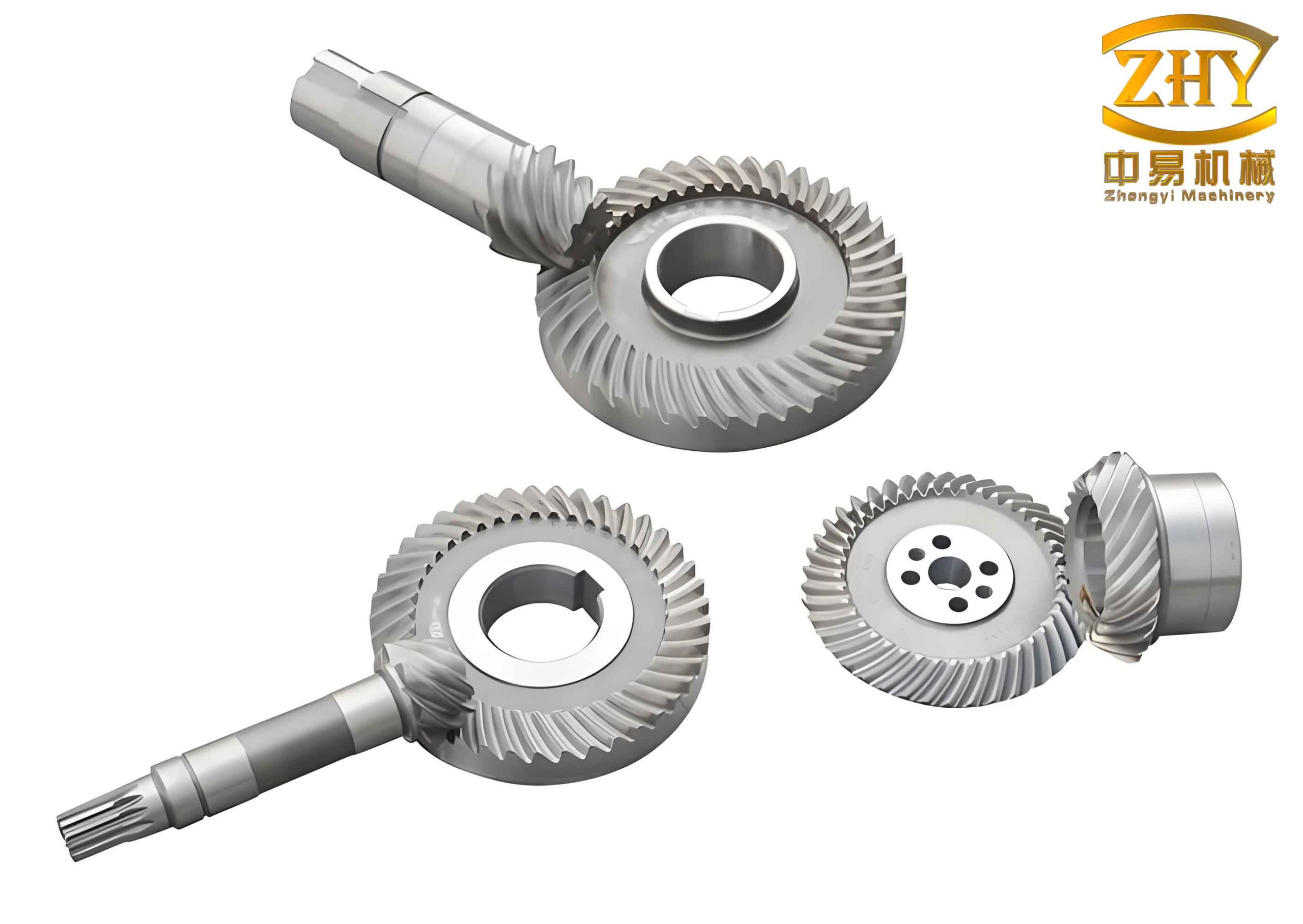
The image above illustrates the complex geometry of hyperboloid gears, highlighting their curved tooth surfaces that contribute to unique meshing dynamics and noise generation. Understanding this geometry is crucial for developing effective noise control strategies.
Fundamentals of Gear Noise in Hyperboloid Gears
Gear noise originates from dynamic forces during tooth engagement, where alternating loads cause deflections and vibrations that radiate as sound. For hyperboloid gears, the noise mechanism is particularly intricate due to their three-dimensional geometry, which involves both rolling and sliding motions. Key factors influencing noise include tooth stiffness variation, transmission error, friction, and contact patterns. The sound pressure level \(L_p\) can be expressed as:
$$L_p = 10 \log_{10}\left(\frac{p^2}{p_0^2}\right) \text{ dB}$$
where \(p\) is the sound pressure and \(p_0\) is the reference pressure (typically \(20 \mu\text{Pa}\)). The dynamic force \(F\) during meshing excites vibrations, with acceleration \(a\) given by:
$$a = \frac{F}{m} \sin(\omega t + \phi)$$
Here, \(m\) represents the effective mass, \(\omega\) is the angular frequency (related to meshing frequency), and \(\phi\) is the phase angle. For hyperboloid gears, these parameters are influenced by design variables such as pressure angle, spiral angle, and tooth dimensions. A critical parameter is the total overlap coefficient \(\epsilon\), which indicates the average number of tooth pairs in contact simultaneously. It is the sum of the overlap coefficient in the tooth length direction \(\epsilon_l\) and the tooth height direction \(\epsilon_h\):
$$\epsilon = \epsilon_l + \epsilon_h$$
In hyperboloid gears, \(\epsilon_h\) is generally small, so \(\epsilon \approx \epsilon_l\). A higher \(\epsilon\) promotes smoother power transmission and reduces noise by minimizing impact forces. The overlap coefficient in the tooth length direction is calculated as:
$$\epsilon_l = \frac{L_c}{p_b}$$
where \(L_c\) is the effective contact length along the tooth, and \(p_b\) is the base pitch, defined as \(p_b = \pi m_n \cos \alpha\), with \(m_n\) being the normal module and \(\alpha\) the pressure angle. Optimizing \(\epsilon_l\) is essential for noise control, as it directly affects the continuity of meshing.
Current Research Status on Noise Reduction in Hyperboloid Gears
Numerous studies have proposed various approaches to reduce noise in hyperboloid gears. These can be categorized into design modifications, analytical methods, and manufacturing techniques. The following table summarizes the key viewpoints from different research streams:
| Category | Specific Approach | Key Principles | Representative Advocates |
|---|---|---|---|
| Design Modifications | Non-zero displacement design | Increase tooth height, reduce pressure angle to enhance \(\epsilon_h\) and lower noise through improved tooth contact. | Academic researchers focusing on gear geometry |
| Tooth profile optimization | Use custom profiles, such as higher tooth height than standard Gleason gears, with tip relief on the large gear to eliminate meshing-in noise. | Automotive manufacturers like Toyota | |
| Analytical Methods | Harmonic analysis | Decompose noise into harmonics (fundamental, second, third) and correlate amplitudes with contact pattern dimensions. Emphasize \(\epsilon_l\) must exceed 1.5 for noise reduction. | Gleason Company, USA |
| Motion curve optimization | Optimize gear motion under load to achieve low noise, rather than focusing on light-load conditions. Stress process optimization for grinding or lapping. | Oerlikon Company, Switzerland | |
| Manufacturing Techniques | Process optimization (grinding/lapping) | Adjust grinding parameters to improve surface finish and contact pattern, thereby reducing noise and contact stress. | Various gear manufacturers |
From these perspectives, it is evident that noise reduction in hyperboloid gears requires a multi-faceted approach. The harmonic analysis method, for instance, provides a systematic way to diagnose noise sources: the fundamental harmonic (first harmonic) is linked to the length and width of the contact area—if too short or narrow, fundamental noise dominates; if too long or wide, second harmonic noise becomes prominent. The third harmonic is associated with surface roughness or interference, underscoring the importance of manufacturing quality. Additionally, the emphasis on \(\epsilon_l\) is consistent across studies, with recommendations that it should be as large as possible, preferably above 1.5, to ensure continuous meshing and minimize dynamic excitations. This aligns with general gear theory, where a higher overlap coefficient reduces transmission error, a primary driver of noise.
Control Methods for Hyperboloid Gear Noise
Based on experimental validation, two primary control methods have been identified for effective noise reduction in hyperboloid gears: tooth tip relief and maximizing the overlap coefficient in the tooth length direction. These methods address the root causes of noise, namely impact forces during meshing entry and discontinuous contact.
Tooth Tip Relief
Tooth tip relief involves modifying the tooth profile near the tip to reduce the sharp impact when teeth engage. In hyperboloid gears, this is often achieved by increasing the tooth height, but the essence is to provide extra material for relief on the large gear’s tip. During meshing, the tip of the driven gear can collide with the root of the driving gear, causing a sudden force transition that excites vibrations, particularly at the second harmonic. By relieving the tip, this impact is softened, thereby lowering meshing-in noise. Experimental studies on hyperboloid gears for small vehicles have shown that grinding the pinion surfaces results in root relief on the pinion, which functionally serves as tip relief on the mating gear. This was confirmed by comparing noise perception before and after grinding both concave and convex surfaces; the contact pattern remained unchanged, indicating that noise reduction was due to profile modification rather than mere tooth height increase.
The amount of tip relief \(\delta_t\) can be determined empirically or through calculations. A common formula is:
$$\delta_t = k \cdot m_n$$
where \(m_n\) is the normal module and \(k\) is a coefficient typically ranging from 0.01 to 0.05. For hyperboloid gears, due to significant sliding action, \(\delta_t\) may require adjustment based on operating conditions. Experimental data suggest that a relief of 0.02 mm to 0.1 mm effectively reduces noise without compromising tooth strength. The theoretical justification lies in the minimal contribution of \(\epsilon_h\) to the total overlap coefficient; thus, modifications in tooth height direction have limited impact, making tip relief a more direct solution.
Increasing Overlap Coefficient in Tooth Length Direction
The overlap coefficient in the tooth length direction, \(\epsilon_l\), is crucial for ensuring smooth power transmission and minimizing noise. It is defined as the ratio of the contact length along the tooth to the base pitch, as previously mentioned. To achieve \(\epsilon_l > 1.5\), the contact pattern must be optimized in terms of length, width, and position. From noise reduction trials, the following guidelines have been established:
| Parameter | Optimal Condition | Rationale |
|---|---|---|
| Contact length | Sufficient to avoid fundamental noise but not excessive to prevent second harmonic noise | Balances load distribution and dynamic excitation; typically 60-80% of tooth length |
| Contact width | Moderate to avoid stress concentration while minimizing noise | Wide contact reduces stress but may increase harmonic noise; width should be 20-40% of face width |
| Contact position | Biased towards small end for load capacity, but adjusted for spiral angle variation | Ensures even wear and stable \(\epsilon_l\) across the tooth; position offset often 0.1-0.3 mm from center |
In practice, optimizing \(\epsilon_l\) involves iterative adjustments during grinding. For example, changing the grinding wheel diameter or its position alters the contact pattern dimensions. Our experiments on hyperboloid gears demonstrated that reducing the grinding wheel diameter by 0.1 mm shortened the contact length, which affected \(\epsilon_l\) and noise perception. The relationship between contact pattern dimensions and \(\epsilon_l\) can be modeled using gear geometry equations. For a hyperboloid gear pair with given parameters, the effective contact length \(L_c\) can be approximated as:
$$L_c = \frac{F_w \cdot \cos \beta}{\sin \gamma}$$
where \(F_w\) is the face width, \(\beta\) is the spiral angle, and \(\gamma\) is the shaft angle. By adjusting these parameters during design or manufacturing, \(\epsilon_l\) can be controlled to meet noise targets.
Experimental Study and Results
To validate the proposed control methods, a series of experiments were conducted on hyperboloid gears used in small vehicle applications. The gears were manufactured using precision grinding processes, and noise tests were performed on a gear checking machine under light load conditions. The experimental setup included a hyperboloid gear pair (pinion and gear), a grinding machine with a dresser for profile modification, a checking machine for contact pattern visualization, and sound measurement equipment. The procedure involved grinding the pinion concave surface first, recording the contact pattern and noise, then grinding the convex surface and comparing results. Noise was evaluated subjectively by trained operators and objectively using sound level meters and harmonic analysis.
The results from different调试 stages are summarized in the following table, which includes contact pattern dimensions, calculated \(\epsilon_l\), and noise levels:
| Stage | Grinding Adjustment | Contact Length \(L_c\) (mm) | Contact Width (mm) | Position (from small end, mm) | \(\epsilon_l\) (approx.) | Noise Level (dB) | Noise Perception |
|---|---|---|---|---|---|---|---|
| 1 | Initial grinding, default settings | 8.0 | 3.0 | 4.0 | 1.54 | 75 | Moderate hiss, no distinct harmonics |
| 2 | Reduced grinding wheel diameter by 0.1 mm | 6.5 | 2.8 | 4.0 | 1.25 | 72 | Slightly reduced hiss, acceptable |
| 3 | Shifted contact pattern towards small end by 0.1 mm | 6.5 | 2.8 | 3.9 | 1.25 | 70 | Mild fundamental hum noticeable |
| 4 | Applied tip relief of 0.05 mm on gear | 6.5 | 2.8 | 3.9 | 1.25 | 68 | Quiet, minimal noise |
In these experiments, the base pitch \(p_b\) was approximately 5.2 mm, derived from gear parameters: normal module \(m_n = 5 \text{ mm}\), pressure angle \(\alpha = 20^\circ\), so \(p_b = \pi \times 5 \times \cos 20^\circ \approx 5.2 \text{ mm}\). The overlap coefficient \(\epsilon_l\) was calculated using \(\epsilon_l = L_c / p_b\). Stage 1, with a longer contact pattern, yielded \(\epsilon_l = 1.54\), which is above the recommended threshold of 1.5, and noise was moderate. In Stage 2, reducing the contact length decreased \(\epsilon_l\) to 1.25, but noise reduced slightly due to diminished second harmonic excitation. Stage 3, with a positional shift, introduced mild fundamental noise, indicating that contact pattern position influences harmonic content. Stage 4, with added tip relief, achieved the lowest noise level (68 dB) despite \(\epsilon_l\) remaining at 1.25, demonstrating that tip relief can compensate for suboptimal \(\epsilon_l\).
Harmonic analysis of the noise signals further elucidated these trends. The sound pressure levels for key harmonics are tabulated below:
| Stage | Fundamental Harmonic (dB) | Second Harmonic (dB) | Third Harmonic (dB) | Total Noise (dB) |
|---|---|---|---|---|
| 1 | 65 | 70 | 60 | 75 |
| 2 | 62 | 68 | 58 | 72 |
| 3 | 68 | 65 | 57 | 70 |
| 4 | 60 | 62 | 55 | 68 |
In Stage 3, the increase in fundamental harmonic (68 dB) correlates with the contact pattern shift towards the small end, confirming that position affects fundamental noise. Stage 4 shows reductions across all harmonics due to tip relief, highlighting its effectiveness in mitigating both impact and friction-related noise. These results underscore the importance of combining \(\epsilon_l\) optimization with profile modifications for comprehensive noise control in hyperboloid gears.
Discussion
The experimental findings align with and extend existing research on hyperboloid gear noise reduction. The effectiveness of tooth tip relief supports viewpoints from automotive manufacturers like Toyota, who emphasize profile modifications to eliminate meshing-in noise. Similarly, the critical role of \(\epsilon_l\) resonates with Gleason’s harmonic analysis approach, which stresses that overlap coefficient in the tooth length direction must be sufficiently large to ensure smooth meshing. However, our results indicate that \(\epsilon_l\) does not need to be excessively high; a value around 1.5, when combined with tip relief, can yield excellent noise performance. This balances the need for continuous contact with avoidance of harmonic excitations.
Compared to non-zero displacement design, which aims to increase \(\epsilon_h\), our experiments show that \(\epsilon_h\) has minimal impact on noise for hyperboloid gears. This is because the tooth height direction contributes little to the total overlap coefficient, making modifications in this direction less effective. Therefore, resources should focus on optimizing \(\epsilon_l\) and implementing precise profile corrections. From a manufacturing perspective, the grinding process is pivotal. The dresser’s ability to create root relief on the pinion effectively implements tip relief on the gear, reducing meshing impact without requiring major design changes. This underscores the need for advanced machine tools and process optimization, as advocated by Oerlikon.
In practical applications, hyperboloid gears operate under varying loads, and noise behavior may differ from light-load testing conditions. Future studies should include loaded tests to validate the motion curve optimization suggested by Oerlikon, which emphasizes achieving low noise under operational loads rather than at idle. Additionally, the interaction between contact pattern dimensions and gear misalignment warrants investigation, as assembly errors can alter contact patterns and noise characteristics.
Conclusions and Future Work
Through comprehensive analysis and experimental research, we conclude that noise reduction in hyperboloid gears can be effectively achieved by integrating tooth tip relief and optimizing the overlap coefficient in the tooth length direction. Key insights include:
- Tooth tip relief, often realized through increased tooth height or grinding-induced profile modifications, reduces meshing-in noise by softening impact forces, particularly at the second harmonic.
- The overlap coefficient \(\epsilon_l\) should be maintained above 1.5 to ensure smooth meshing, but it must be balanced with contact pattern dimensions to avoid exciting fundamental or second harmonic noise.
- Contact pattern optimization—in terms of length, width, and position—is essential for minimizing noise, with guidelines derived from experimental trials.
- Manufacturing processes, especially grinding with proper dresser settings, are critical for implementing these noise control methods, highlighting the interplay between design and production.
For future work, several areas require further investigation to advance hyperboloid gear technology:
- Design Methodology: Develop standardized procedures for hyperboloid gear design that incorporate increased tooth height and tip relief, potentially using non-zero displacement algorithms to optimize geometry without compromising strength.
- Pressure Angle Optimization: Study the minimum tool pressure angle to prevent undercutting on the gear concave surface, ensuring that reductions in average pressure angle do not cause excessive differences between tooth surfaces, which could lead to noise.
- Tip Relief Principles: Establish design guidelines for tip relief amount and profile based on gear parameters (e.g., module, pressure angle), material properties, and operating conditions (e.g., speed, load).
- Overlap Coefficient Calculation: Derive accurate formulas for \(\epsilon_l\) that account for contact pattern variations due to manufacturing tolerances and alignment errors. Determine the minimum contact pattern dimensions that avoid fundamental noise, potentially using finite element analysis or dynamic simulation.
- Grinding Machine Modeling: Create mathematical models for grinding machine dressers to predict and control tooth root relief effects. This could involve parametric equations relating dresser settings to profile modifications, enabling precise noise reduction during manufacturing.
- Load-Dependent Noise Analysis: Extend experiments to include loaded conditions using dynamometers or actual vehicle tests, to validate noise reduction under realistic operating environments and inform design adjustments.
- Material and Lubrication Effects: Investigate how different materials and lubricants influence noise in hyperboloid gears, as these factors can dampen vibrations and alter contact dynamics.
In summary, hyperboloid gear noise control is a multidisciplinary challenge that integrates design, manufacturing, and testing. By focusing on the identified methods—tooth tip relief and overlap coefficient optimization—manufacturers can significantly improve gear performance and meet the demands of high-speed applications. Continued research and collaboration across industries will further advance the state of the art, ultimately leading to quieter and more efficient hyperboloid gears for various mechanical systems.