
In the field of mechanical engineering, the design of hyperboloid gears presents significant challenges due to the complex interactions among numerous parameters and the inherent fuzziness in various influencing factors. Traditional design methods often rely on handbook recommendations and charts, which may not adequately account for the fuzzy nature of these factors. This article explores the application of fuzzy optimization design to hyperboloid gears, aiming to minimize the volume of the gear transmission system while considering fuzzy constraints. The approach demonstrates superior results compared to conventional and ordinary optimization methods, with potential volume reductions exceeding 30% in practical applications. The integration of fuzzy set theory into the optimization process allows for a more realistic representation of design uncertainties, leading to more efficient and reliable hyperboloid gear systems.
Hyperboloid gears, also known as hypoid gears, are widely used in automotive and industrial machinery for transmitting motion between non-intersecting shafts. Their design involves over 150 calculation formulas, with at least 47 requiring iterative solutions, making parameter selection critical. The fuzzy optimization design method introduced here addresses the vagueness in factors such as material properties, manufacturing tolerances, and operational conditions. By modeling these as fuzzy sets, we can achieve designs that are both economical and robust. The primary objective is to minimize the overall volume of the hyperboloid gear pair, which directly impacts weight and space requirements in applications like the KZ32-19 pneumatic steel bundling machine, where compactness is essential.
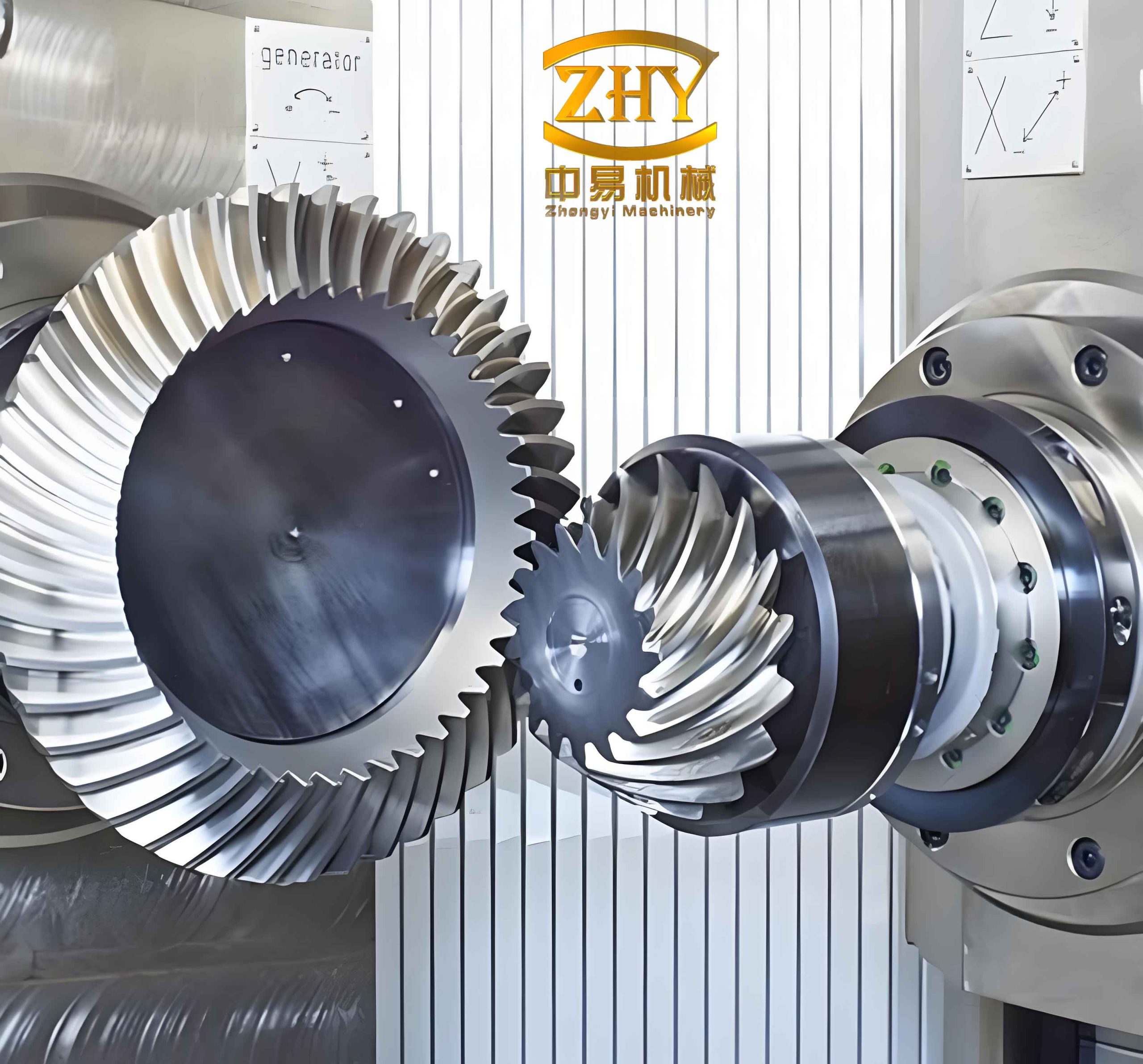
The fuzzy optimization model for hyperboloid gears begins with defining the objective function. We aim to minimize the total volume of the gear pair, calculated as the sum of the volumes of the small and large hyperboloid gears, approximated as truncated cones. The volume function is expressed as:
$$
F(\mathbf{x}) = f_1(\mathbf{x}) + f_2(\mathbf{x}) = \frac{\pi}{3} b \cos \delta_1 \left[ \left( \frac{m_e Z_1}{2} \right)^2 + \left( \frac{m_e Z_1}{2} \cdot \frac{R – b}{R} \right)^2 + \left( \frac{m_e Z_1}{2} \right) \left( \frac{m_e Z_1}{2} \cdot \frac{R – b}{R} \right) \right] + \frac{\pi}{3} b \cos \delta_2 \left[ \left( \frac{m_e Z_2}{2} \right)^2 + \left( \frac{m_e Z_2}{2} \cdot \frac{R – b}{R} \right)^2 + \left( \frac{m_e Z_2}{2} \right) \left( \frac{m_e Z_2}{2} \cdot \frac{R – b}{R} \right) \right]
$$
where \(\mathbf{x}\) is the design variable vector, \(b\) is the face width, \(m_e\) is the module at the large gear pitch circle, \(Z_1\) and \(Z_2\) are the numbers of teeth for the small and large hyperboloid gears, respectively, \(R\) is the pitch cone distance, and \(\delta_1\) and \(\delta_2\) are the pitch angles. This formulation captures the geometric essence of hyperboloid gears, enabling volume reduction through parameter optimization.
The design variables selected for optimization include key parameters that influence the performance and size of hyperboloid gears. These variables are:
- Large gear pitch diameter (module \(m_e\)): Affects contact area and stress; increasing it enhances strength but may increase volume.
- Face width \(b\): Impacts contact area and manufacturing feasibility; excessive width can lead to weak teeth at the small end.
- Spiral angle \(\beta_m\): Influences overlap ratio, efficiency, and smoothness; optimal values balance strength and noise.
- Small gear tooth number \(Z_1\): Affects gear size and meshing quality; fewer teeth reduce volume but may increase noise.
- Midpoint tooth height coefficient \(K\): Determines meshing depth and contact area; higher values improve strength.
- Tangential displacement coefficient \(x_t\): Allows tooth thickness adjustment for equalizing fatigue life between gears.
These variables form the vector \(\mathbf{x} = [m_e, b, \beta_m, Z_1, K, x_t]^T\), which is optimized subject to fuzzy constraints.
Fuzzy constraints are established to account for the imprecision in performance limits and geometric boundaries. For hyperboloid gears, constraints include contact stress, bending stress, module limits, face width bounds, spiral angle range, tooth number sum, midpoint tooth height coefficient, and tooth thickness coefficient. Each constraint is treated as a fuzzy subset with a transition from fully allowable to fully unallowable. The constraints are summarized below:
| Constraint Type | Mathematical Expression | Description |
|---|---|---|
| Contact Stress | \(\sigma_H = Z_H Z_E Z_\varepsilon Z_\beta Z_K \cdot \sqrt{\frac{K_A K_V K_{H\alpha} K_{H\beta} F_{mt}}{d_{m1} \cdot b_{eH}} \cdot \frac{u^2 + 1}{u}} \leq \tilde{\sigma}_{HP}\) | Ensures surface durability of hyperboloid gears. |
| Bending Stress | \(\sigma_F = \frac{F_{mt}}{b_{eF} \cdot m_{mn}} \cdot Y_{F\alpha} Y_{s\alpha} Y_\varepsilon Y_\beta Y_K \cdot K_A K_V K_{F\alpha} K_{F\beta} \leq \tilde{\sigma}_{FP}\) | Prevents tooth breakage in hyperboloid gears. |
| Module | \(m_e \geq \tilde{3}\) | Maintains minimum size for strength. |
| Face Width | \(\tilde{4} m_e \leq b \leq \tilde{10} m_e\), \(b \leq \tilde{\frac{1}{3}} R_e\) | Limits width for manufacturing and assembly. |
| Spiral Angle | \(\tilde{35}^\circ \leq \beta_m \leq \tilde{50}^\circ\) | Controls meshing and efficiency in hyperboloid gears. |
| Tooth Number Sum | \(\tilde{40} \leq Z_1 + Z_2 \leq \tilde{60}\) | Affects smoothness and volume of hyperboloid gears. |
| Midpoint Coefficient | \(\tilde{3.5} \leq K \leq \tilde{4}\) | Optimizes contact area for hyperboloid gears. |
| Tooth Thickness | \(\tilde{X}_t \leq x_t \leq \tilde{X}_t\) | Balances strength between hyperboloid gear pairs. |
The tilde (\(\sim\)) denotes fuzzy boundaries, reflecting uncertainties from design standards, manufacturing quality, and operational conditions. These fuzzy constraints are crucial for realistic optimization of hyperboloid gears.
To handle fuzzy constraints, membership functions define the degree of satisfaction for each constraint. Linear membership functions are commonly used due to their simplicity and effectiveness. For performance constraints like stress limits, the membership function \(\mu_\sigma\) is defined as:
$$
\mu_\sigma =
\begin{cases}
1 & \text{if } 0 \leq \sigma \leq \bar{\sigma}_L \\
\frac{\bar{\sigma}_U – \sigma}{\bar{\sigma}_U – \bar{\sigma}_L} & \text{if } \bar{\sigma}_L \leq \sigma \leq \bar{\sigma}_U \\
0 & \text{otherwise}
\end{cases}
$$
where \(\bar{\sigma}_L\) and \(\bar{\sigma}_U\) are the lower and upper bounds of the fuzzy allowable stress. For geometric and variable constraints, the membership function \(\mu_x\) is given by:
$$
\mu_x =
\begin{cases}
1 & \text{if } \bar{X}_U \leq X \leq \bar{X}_L \\
\frac{\bar{X}_U – X}{\bar{X}_U – \bar{X}_L} & \text{if } \bar{X}_L \leq X \leq \bar{X}_U \\
\frac{X – \bar{X}_L}{\bar{X}_U – \bar{X}_L} & \text{if } \bar{X}_L \leq X \leq \bar{X}_U \\
0 & \text{otherwise}
\end{cases}
$$
Here, \(\bar{X}_L\) and \(\bar{X}_U\) represent the fuzzy limits for design variables. These functions quantify the transition from fully acceptable to unacceptable values, enabling fuzzy optimization of hyperboloid gears.
The fuzzy optimization model is transformed into a non-fuzzy equivalent using the optimal level cut-set method. By introducing a level parameter \(\lambda \in [0,1]\), fuzzy sets are converted into crisp sets. The optimal level \(\lambda^*\) is determined via a two-level fuzzy comprehensive evaluation, considering factors like design expertise and application criticality. The resulting non-fuzzy optimization model for hyperboloid gears is:
$$
\begin{aligned}
\text{Find: } & \mathbf{x} = [x_1, x_2, x_3, x_4, x_5, x_6]^T \\
\text{Minimize: } & F(\mathbf{x}) \\
\text{Subject to: } & \sigma_i(\mathbf{x}) \leq \bar{\sigma}_{U_i} – \lambda^* (\bar{\sigma}_{U_i} – \bar{\sigma}_{L_i}), \quad i = H, F1, F2 \\
& \bar{H}_{L_j} + \lambda^* (\bar{H}_{U_j} – \bar{H}_{L_j}) \leq H_j(\mathbf{x}) \leq \bar{H}_{U_j} – \lambda^* (\bar{H}_{U_j} – \bar{H}_{L_j}), \quad j = 1,2 \\
& \bar{X}_{L_k} + \lambda^* (\bar{X}_{U_k} – \bar{X}_{L_k}) \leq X_k \leq \bar{X}_{U_k} – \lambda^* (\bar{X}_{U_k} – \bar{X}_{L_k}), \quad k = 1,2,\ldots,6
\end{aligned}
$$
This model allows solving the fuzzy optimization problem using standard algorithms, such as the complex method or penalty function methods, tailored for hyperboloid gears.
An example application demonstrates the effectiveness of fuzzy optimization for hyperboloid gears. Starting from an initial design based on conventional parameters, optimization was performed with \(\lambda = 1\) (ordinary optimization) and \(\lambda^* = 0.526\) (fuzzy optimization), obtained from fuzzy evaluation. The results are summarized in the table below, showing design variables and volume for different scenarios.
| Parameter | Original Design | Ordinary Optimization (\(\lambda=1\)) | Fuzzy Optimization (\(\lambda^*=0.526\)) | Fuzzy Optimization (Rounded) |
|---|---|---|---|---|
| \(m_e\) (mm) | 4.000 | 3.812 | 3.706 | 3.750 |
| \(b\) (mm) | 30.000 | 32.074 | 32.781 | 32.800 |
| \(\beta_m\) (°) | 45.000 | 41.368 | 38.139 | 38.000 |
| \(Z_1\) | 12 | 11.468 | 11.104 | 11.000 |
| \(K\) | 3.700 | 3.807 | 3.892 | 3.900 |
| \(x_t\) | 0.000 | 0.263 | 0.241 | 0.241 |
| \(F(\mathbf{x})\) (mm³) | 107187.179 | 86642.190 | 74284.915 | 74877.408 |
The volume reductions are calculated as follows:
- Ordinary optimization reduces volume by: \(\frac{107187.179 – 86642.190}{107187.179} \times 100\% \approx 19.2\%\)
- Fuzzy optimization reduces volume by: \(\frac{107187.179 – 74284.915}{107187.179} \times 100\% \approx 30.6\%\)
- Fuzzy optimization versus ordinary optimization: \(\frac{86642.190 – 74284.915}{86642.190} \times 100\% \approx 14.2\%\)
After rounding continuous variables to practical values for hyperboloid gears, the volume reduction remains significant at 30.1%, highlighting the robustness of fuzzy optimization.
The analysis reveals that fuzzy optimization for hyperboloid gears outperforms both conventional and ordinary optimization by incorporating fuzzy factors like design experience and manufacturing variability. The optimal design achieves a balance between reliability and economy, with volume savings exceeding 30% in some cases. This approach is particularly beneficial for applications where weight and space are critical, such as in aerospace or compact machinery. Furthermore, the fuzzy optimization model can be adapted for other objectives, such as minimizing noise or maximizing efficiency in hyperboloid gear systems.
In conclusion, fuzzy optimization design offers a powerful methodology for enhancing the performance of hyperboloid gears. By accounting for the fuzzy nature of constraints and variables, it yields more realistic and efficient designs compared to traditional methods. The mathematical framework, involving membership functions and optimal level cut-sets, provides a systematic way to handle uncertainties. Future work could extend this approach to dynamic analysis or multi-objective optimization for hyperboloid gears, further advancing their application in modern engineering. The integration of fuzzy logic not only improves design outcomes but also contributes to the broader field of mechanical system optimization, ensuring that hyperboloid gears meet evolving industrial demands.