
In the field of power transmission, particularly for automotive rear axle drives, hyperboloid gears (often referred to as hypoid gears) are paramount. Their ability to transmit motion between non-intersecting, non-parallel axes makes them ideal for this application. However, the demands for higher performance, including increased load capacity, smoother operation, and reduced noise, are ever-growing. One promising approach to meet these demands is the implementation of a high-tooth design, which increases the working depth of the gear teeth. This article presents a comprehensive methodology for the optimal design of such high-tooth hyperboloid gears using a Genetic Algorithm (GA), a powerful global optimization technique inspired by natural evolution.
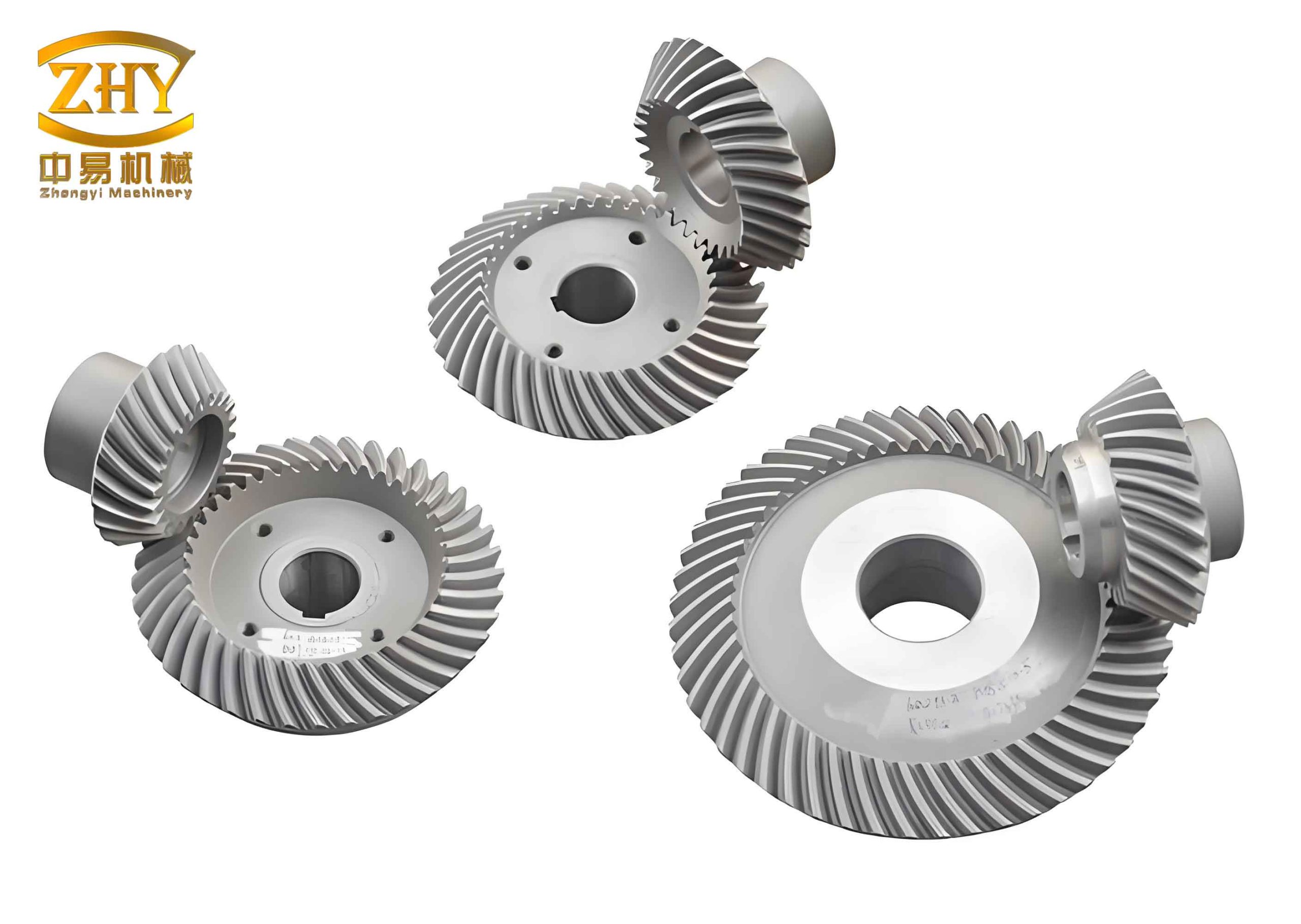
The primary motivation for increasing the working tooth height in hyperboloid gears is to enhance the total contact ratio. The contact ratio is a critical parameter defining the average number of tooth pairs in contact during meshing. A higher contact ratio leads to a more uniform load distribution across the teeth, reduced dynamic loads, lower transmission error, and consequently, lower noise and vibration. While a high-tooth design slightly reduces the single-tooth mesh stiffness, the overall mesh stiffness increases due to the greater number of teeth in contact simultaneously. This is especially beneficial under high-speed, light-load conditions common in vehicle operation, where transmission error and noise are most critical. Under heavy loads, the increased effective tooth height mitigates the risk of edge contact, preventing localized stress concentrations and potential failure.
Traditional design methods for hyperboloid gears, such as the Gleason system, prescribe fixed addendum and dedendum coefficients based on the pinion tooth count. While reliable, this approach does not seek to maximize performance metrics like contact ratio. Conventional optimization techniques (e.g., penalty function methods) applied to this multi-variable, non-linear, and constrained problem often struggle with convergence and are prone to becoming trapped in local optima. This is where the Genetic Algorithm offers a distinct advantage.
Fundamentals of the Genetic Algorithm
The Genetic Algorithm is a search heuristic that mimics the process of natural selection. It operates on a population of candidate solutions, each represented as a string of parameters (a chromosome). The core principle is the survival and reproduction of the fittest individuals. The key operations in a GA are:
- Encoding: Design variables are encoded into a chromosome, typically as a binary or real-valued string. In our case, the variables are the addendum coefficient \( h_a^* \) and the working depth coefficient \( h^* \).
- Initialization: A random population of chromosomes is generated.
- Fitness Evaluation: Each chromosome is decoded, and its corresponding gear design is analyzed. A fitness function \( F \) is calculated to quantify how “good” that solution is. For our objective of maximizing contact ratio \( \varepsilon_{\gamma} \), the fitness function must also incorporate penalties for violating constraints (e.g., undercutting, pointed teeth).
- Selection: Chromosomes are selected for reproduction based on their fitness. Fitterness individuals have a higher probability of being selected.
- Crossover: Selected parent chromosomes are combined (crossed over) to produce offspring, exchanging genetic material. This explores new regions of the solution space.
- Mutation: Random changes are introduced into the offspring’s chromosomes with a small probability. This maintains genetic diversity and helps avoid premature convergence to local optima.
- Replacement: A new population is formed from the parents and offspring, and the process iterates from step 3 until a termination criterion (e.g., maximum generations) is met.
The GA’s strength lies in its ability to handle discontinuous, non-convex, and complex design spaces using only the value of the fitness function, without requiring derivative information. This makes it exceptionally well-suited for the intricate design problem of hyperboloid gears.
High-Tooth Hyperboloid Gear Design Optimization Model
Objective Function
The goal is to maximize the total contact ratio \( \varepsilon_{\gamma} \) of the hyperboloid gear pair. The total contact ratio is the sum of the transverse (face) contact ratio \( \varepsilon_{\alpha} \) and the axial (overlap) contact ratio \( \varepsilon_{\beta} \).
$$ \text{Maximize: } F_{obj} = \varepsilon_{\gamma} = \varepsilon_{\alpha} + \varepsilon_{\beta} $$
Where the transverse contact ratio for the gear pair is calculated at the mean cone distance. A simplified representation for the transverse contact ratio involves the path of contact and the base pitch. The axial contact ratio is a function of the face width and the spiral angle.
Design Variables
The optimization seeks the optimal values for two key coefficients that define the tooth proportions:
- Working Depth Coefficient, \( h^* \): Defines the total working depth of the tooth from addendum to dedendum.
- Addendum Coefficient for the Pinion, \( h_{a1}^* \): Defines the addendum height of the pinion. The gear addendum is derived from \( h^* \) and \( h_{a1}^* \).
Thus, the design variable vector is: \( \mathbf{X} = [h^*, h_{a1}^*]^T \).
Constraint Formulation
Increasing the tooth height introduces several potential manufacturing and performance issues. The optimization must satisfy the following constraints to ensure a practical, producible gear set.
1. Tooth Top Land Thickness Constraint: The tooth must not become pointed. The top land thickness \( s_a \) at the mean cone distance must exceed a minimum allowable value, typically a fraction \( k \) of the module \( m_n \). The constraint for the pinion (i=1) and gear (i=2), on both concave and convex sides, is:
$$ g_1(\mathbf{X}) = k \cdot m_n – s_{ai} \leq 0 $$
The top land thickness is calculated as:
$$ s_{ai} = r_{ai} \left( \frac{s_i}{r_i} + inv\alpha_t – inv\alpha_{tai} \right) $$
where \( r_a \) is tip radius, \( r \) is pitch radius, \( s \) is circular tooth thickness, \( \alpha_t \) is transverse pressure angle, and \( \alpha_{ta} \) is tip transverse pressure angle.
2. Tooling Condition Constraints: The designed hyperboloid gears must be manufacturable using standard tooling available on existing machines (e.g., Gleason Phoenix machines). This imposes limits on the calculated tool settings.
- Gear Finish Blade Point Width (Gear Crowning Tool Point Width): The theoretical point width \( W_{g2} \) for the gear finishing is calculated based on tooth geometry. The actual used value is this rounded up to the nearest standard increment. The constraint ensures it does not fall below the minimum standard value \( W_{g2}^{min} \):
$$ g_2(\mathbf{X}) = W_{g2}^{min} – W_{g2} \leq 0 $$
$$ W_{g2} = \frac{\pi m_n}{2} – (h + c – \Delta_{g2}) \tan\alpha_n $$
where \( h \) is working depth, \( c \) is clearance, \( \Delta_{g2} \) is gear finish stock. - Pinion Roughing Blade Point Width: Similarly, the point width for pinion roughing \( W_{g1r} \) must be greater than a minimum standard value \( W_{g1r}^{min} \):
$$ g_3(\mathbf{X}) = W_{g1r}^{min} – W_{g1r} \leq 0 $$
$$ W_{g1r} \approx \frac{h_t – \Delta_{g1}}{ \sin(\beta_{m1}) } \cdot \frac{z_1}{z_2} \cdot \frac{R_{e1} – 0.5b_2}{R_{m1}} + \frac{\delta_2}{\cos(\beta_{m1})} $$
where \( h_t \) is whole depth, \( \Delta_{g1} \) is pinion finish stock, \( \beta_m \) is mean spiral angle, \( z \) is tooth number, \( R_e \) is outer cone distance, \( R_m \) is mean cone distance, \( b_2 \) is gear face width, \( \delta_2 \) is gear root angle.
3. Undercut (Root Interference) Constraint: The pinion, with a low tooth count, is susceptible to undercutting, especially at the toe end where the effective tooth number is lowest. The actual root height \( h_{f1}^{toe} \) at the pinion toe must be less than the limiting root height \( h_{f1 lim}^{toe} \) to avoid undercut:
$$ g_4(\mathbf{X}) = h_{f1}^{toe} – h_{f1 lim}^{toe} \leq 0 $$
The limiting root height is determined by the geometry of the generating gear (cutter head).
Fitness Function for the Genetic Algorithm
The GA requires a single scalar fitness value to drive the selection process. We construct a fitness function \( F \) that combines the objective (maximize contact ratio) with penalty terms for constraint violations. A common approach is the exterior penalty function method:
$$ F(\mathbf{X}) = \varepsilon_{\gamma}(\mathbf{X}) – P \cdot \sum_{j=1}^{4} \left[ \max(0, \, g_j(\mathbf{X})) \right]^2 $$
where \( P \) is a large positive penalty factor. This function rewards high contact ratios but severely penalizes any constraint violation. The GA will naturally evolve solutions that maximize \( F \), which inherently means maximizing \( \varepsilon_{\gamma} \) while satisfying all constraints \( g_j(\mathbf{X}) \leq 0 \).
Optimization Procedure and Results
The optimization workflow follows the GA cycle outlined earlier. A population size of 50-100 individuals is typical. Real-valued encoding is used for the design variables \( h^* \) and \( h_{a1}^* \). Selection is performed using tournament selection or roulette wheel selection based on the fitness \( F \). Simulated binary crossover (SBX) and polynomial mutation are common operators for real-coded GAs. The process runs for several hundred generations.
To demonstrate the effectiveness of the GA-based high-tooth design, an example hyperboloid gear pair for an automotive rear axle is optimized. The basic parameters are:
| Parameter | Symbol | Value |
|---|---|---|
| Pinion Teeth | \( z_1 \) | 11 |
| Gear Teeth | \( z_2 \) | 41 |
| Gear Face Width | \( b_2 \) | 38 mm |
| Offset | \( E \) | 45 mm |
| Gear Outer Pitch Diameter | \( d_{e2} \) | 236 mm |
| Cutter Radius | \( r_{c0} \) | 114.3 mm |
| Pinion Mean Spiral Angle | \( \beta_{m1} \) | 50° |
The GA was run with the following bounds on design variables: \( 1.8 \leq h^* \leq 2.4 \) and \( 0.25 \leq h_{a1}^* \leq 0.45 \). The results, comparing the traditional design with the GA-optimized high-tooth design, are summarized below:
| Design Parameter | Traditional Design | GA-Optimized High-Tooth Design | Improvement |
|---|---|---|---|
| Working Depth Coeff. \( h^* \) | 1.700 | 2.156 | +26.8% |
| Pinion Addendum Coeff. \( h_{a1}^* \) | 0.265 | 0.392 | +47.9% |
| Transverse Contact Ratio \( \varepsilon_{\alpha} \) | 1.45 | 1.82 | +25.5% |
| Total Contact Ratio \( \varepsilon_{\gamma} \) | 1.92 | 2.36 | +22.9% |
The results are clear. The Genetic Algorithm successfully found a set of tooth proportion coefficients that significantly increase the working depth and the pinion addendum. This leads to a substantial increase in both the transverse and the total contact ratio. All constraints regarding tooth pointing, tooling, and undercut were verified to be satisfied, meaning this high-tooth hyperboloid gear set is both functional and manufacturable with standard cutter heads. The increase in contact ratio directly translates to a longer potential contact line and a greater average number of teeth in mesh, which is the fundamental mechanism for reducing load per tooth, transmission error, and ultimately, noise and vibration.
The benefit is particularly pronounced under partial load conditions, which are critical for vehicle noise assessment. The increased working depth enlarges the “potential contact area” on the tooth flank. Under light loads, the contact ellipse remains within this enlarged area, ensuring a more stable meshing condition and preventing the contact from shifting to sensitive edges. The figure below conceptually illustrates the expansion of the safe contact zone (green) in a high-tooth design compared to a standard design.
Conclusion
This article has detailed a robust and effective methodology for the optimal design of high-tooth hyperboloid gears using a Genetic Algorithm. The primary objective was to maximize the total contact ratio, a key determinant of meshing smoothness and noise performance. The optimization model correctly formulated the critical practical constraints: preventing tooth pointing, ensuring manufacturability with standard tools, and avoiding root undercut.
The Genetic Algorithm proved to be an excellent tool for this task. Its ability to perform a global search without requiring gradient information or a good initial guess overcomes the limitations of traditional local optimization methods when applied to this complex, constrained engineering problem. The optimization results demonstrated a significant increase (over 22%) in the total contact ratio while guaranteeing a practical design. This confirms that the high-tooth design philosophy, when optimally tailored via GA, is a powerful strategy for enhancing the dynamic performance and quietness of hyperboloid gear drives in automotive and other high-performance applications. The methodology is general and can be extended to include other objectives, such as minimizing stress or maximizing efficiency, by modifying the fitness function accordingly.