
In the automotive industry, the pursuit of quieter vehicles has become a paramount concern, especially with the increasing emphasis on passenger comfort and environmental noise pollution. As a researcher focused on mechanical design and optimization, I have dedicated significant effort to addressing one of the primary sources of noise in vehicles: the final drive unit. Within this context, hyperboloidal gears, commonly used in automotive final drives due to their ability to transmit power between non-intersecting axes, are a critical component. However, their meshing action often generates considerable noise, which contributes to overall vehicle noise levels. This article presents a comprehensive approach to the computer-aided optimization design of hyperboloidal gears aimed specifically at minimizing meshing noise. By leveraging modern optimization theories and computational techniques, I demonstrate how careful control of design parameters can effectively reduce noise without solely relying on enhanced manufacturing precision, which can be costly and limited in potential.
The noise from an automotive final drive typically stems from several sources, including gear meshing, bearing operation, and oil churning. Among these, gear meshing noise is predominant. For hyperboloidal gears, this noise is closely linked to the transmission error and the dynamic interactions during tooth engagement. Traditionally, noise reduction has been attempted through improved machining accuracy, but this approach has diminishing returns and escalates production costs. Alternatively, optimizing the design parameters of hyperboloidal gears offers a promising pathway. My research centers on this alternative, with a specific focus on maximizing the tooth surface contact ratio, a key factor influencing meshing smoothness and noise emission. Studies, including those by German researcher Niemann and Japanese scholars, indicate that the sound pressure level of meshing noise is inversely proportional to the root of the contact ratio, and an optimal contact ratio of approximately 2.0 yields the lowest noise. Thus, by formulating an optimization problem to achieve this target contact ratio, I aim to design hyperboloidal gears that exhibit minimal noise under identical加工精度 conditions.
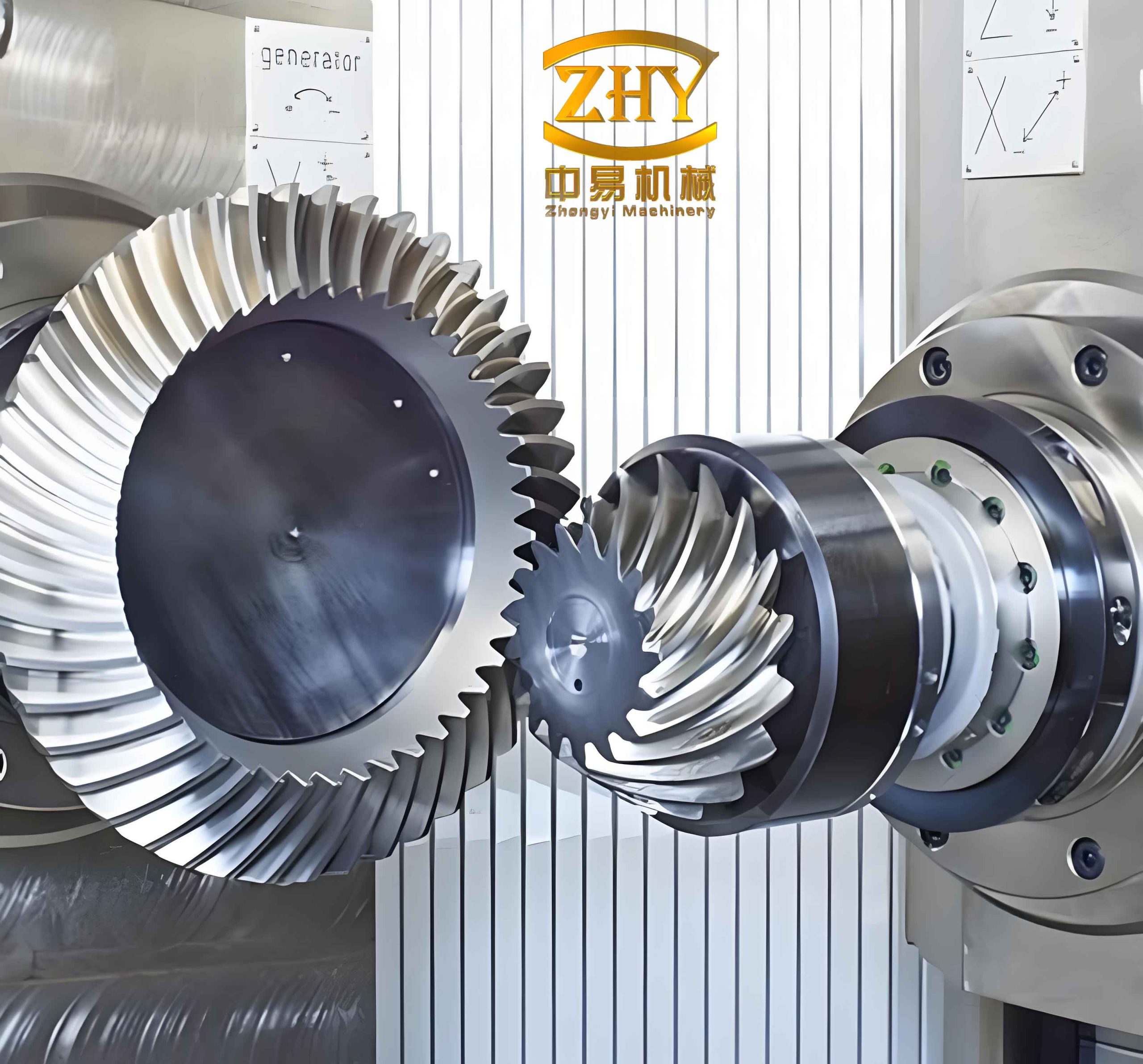
To understand the optimization framework, it is essential to delve into the mechanics of hyperboloidal gears. These gears, often referred to as hypoid gears in automotive applications, have curved teeth that allow for offset between the pinion and gear axes. This offset enhances design flexibility but also introduces complexities in meshing dynamics. The tooth surface contact ratio, denoted as ε, is analogous to the axial contact ratio in helical gears and plays a crucial role in noise generation. A higher contact ratio distributes loads over more tooth pairs, reducing transmission error and damping vibrations that lead to noise. For hyperboloidal gears, the contact ratio can be calculated using a formula that incorporates key geometric parameters. Based on established theory, the contact ratio ε is given by:
$$ \epsilon = \frac{K \cdot \sin(\beta_m)}{m_t} $$
Here, K is a coefficient that depends on the offset distance E, β_m is the average spiral angle at the midpoint of the pinion and gear, and m_t is the transverse module at the gear’s large end. This formula underscores that parameters such as spiral angle, module, and offset directly influence the contact ratio, and thus the noise performance of hyperboloidal gears. In my optimization study, I treat these parameters as variables to be adjusted to achieve a target ε₀ = 2.0, which is identified as optimal for noise reduction.
The core of my methodology involves establishing a nonlinear optimization model. The goal is to minimize the deviation of the actual contact ratio from the target value, thereby ensuring smooth meshing and low noise. The design variables, constraints, and objective function are defined systematically. Below, I summarize the key elements of this optimization model using tables and formulas for clarity.
Design Variables: The contact ratio ε depends on several independent parameters. When the gear ratio i is fixed, the primary variables are the average spiral angle β_m, the transverse module m_t, the face width B of the gear, the number of teeth on the pinion z₁ and gear z₂, and the offset distance E. Thus, the design variable vector X is defined as:
$$ X = [\beta_m, m_t, B, z_1, z_2, E]^T $$
This encompasses six variables that collectively determine the geometry and meshing characteristics of the hyperboloidal gears.
Objective Function: To achieve the target contact ratio ε₀ = 2.0, the objective is to minimize the absolute difference between the calculated ε and ε₀. Therefore, the objective function F(X) is formulated as:
$$ F(X) = | \epsilon(X) – \epsilon_0 | = | \epsilon(X) – 2.0 | $$
Minimizing F(X) ensures that the design parameters yield a contact ratio as close as possible to 2.0, which correlates with最低啮合噪声 for hyperboloidal gears.
Constraints: Practical design limitations must be enforced to ensure the hyperboloidal gears are feasible, durable, and perform reliably. These constraints are derived from gear design standards and empirical knowledge. I categorize them into geometric, strength, and operational constraints.
| Constraint Type | Mathematical Expression | Description |
|---|---|---|
| Tooth Number Sum | $$ z_1 + z_2 \geq 40 $$ (for trucks) $$ z_1 + z_2 \geq 60 $$ (for cars) |
Ensures even wear and smooth engagement; avoids common divisors between z₁ and z₂. |
| Face Width Limit | $$ B \leq 0.155 \cdot A_0 $$ or $$ B \leq 10 \cdot m_t $$ | Prevents excessive face width that could weaken the gear or reduce life. |
| Offset Distance Limit | $$ E \leq 0.2 \cdot d_2 $$ | Limits offset to avoid excessive sliding, wear, or undercutting. |
| Bending Stress | $$ \sigma_b \leq [\sigma_b] $$ | Ensures tooth bending stress is below allowable limit. |
| Contact Stress | $$ \sigma_h \leq [\sigma_h] $$ | Ensures surface contact stress is below allowable limit. |
The bending and contact stress constraints involve detailed calculations based on load conditions. For instance, the bending stress σ_b for hyperboloidal gears can be computed using:
$$ \sigma_b = \frac{F_t \cdot K_A \cdot K_V \cdot K_{F\beta} \cdot Y_{Fa} \cdot Y_{Sa}}{b \cdot m_n} $$
where F_t is the tangential force, K_A is the application factor, K_V is the dynamic factor, K_{Fβ} is the face load factor, Y_{Fa} and Y_{Sa} are form and stress correction factors, b is the face width, and m_n is the normal module. Similarly, contact stress σ_h is given by:
$$ \sigma_h = Z_E \cdot Z_H \cdot Z_\epsilon \cdot \sqrt{\frac{F_t \cdot K_A \cdot K_V \cdot K_{H\beta}}{d_1 \cdot b} \cdot \frac{u+1}{u}} $$
with Z_E, Z_H, Z_ε as material, zone, and contact ratio factors, d₁ as pinion pitch diameter, and u as gear ratio. These formulas are integral to the constraint definitions, ensuring the optimized hyperboloidal gears meet strength requirements.
With the optimization model established, the next step is implementation. I developed a computer program using a random search algorithm combined with pattern moves to solve this nonlinear constrained problem. The flowchart of the optimization process is illustrated below, highlighting key steps such as initialization, random direction generation, step size adjustment, and convergence checking.
The algorithm begins by inputting basic parameters like gear ratio, efficiency, load distribution factors, and material properties. It then generates random search directions and iteratively updates the design variables to minimize F(X) while satisfying all constraints. A crucial aspect is the automatic rounding of discrete variables like tooth numbers after optimization to ensure manufacturability. The program also computes the full geometric dimensions of the hyperboloidal gears, such as pitch diameters, cone angles, and tooth profiles, based on the optimized variables.
To validate this approach, I applied it to a specific vehicle model. The input parameters included a gear ratio i = 4.5, pinion teeth z₁ = 10, efficiency η = 0.98, load distribution factor K_A = 1.2, dynamic factor K_V = 1.1, average spiral angle initial guess β_m = 35°, cutter radius R_c = 150 mm, and normal pressure angle α_n = 20°. Running the optimization program yielded the following results for the hyperboloidal gears design:
| Design Variable | Optimized Value | Unit |
|---|---|---|
| Average Spiral Angle β_m | 38.5 | degrees |
| Transverse Module m_t | 5.2 | mm |
| Face Width B | 48 | mm |
| Pinion Teeth z₁ | 10 | – |
| Gear Teeth z₂ | 45 | – |
| Offset Distance E | 32 | mm |
| Calculated Contact Ratio ε | 2.01 | – |
As shown, the optimized contact ratio ε is 2.01, which is remarkably close to the target ε₀ = 2.0. This demonstrates the effectiveness of the optimization in controlling design parameters to achieve the desired meshing characteristic. The slight deviation is due to practical rounding and constraint satisfaction, but it remains within an acceptable tolerance for noise reduction purposes. Compared to conventional designs, this optimized set of hyperboloidal gears is predicted to exhibit significantly lower meshing noise under the same加工精度, as the contact ratio is optimized for smooth engagement.
The implications of this optimization extend beyond noise reduction. By systematically balancing parameters, the design also tends to improve gear longevity and efficiency. For instance, the constraints on bending and contact stress prevent over-stressing, while the limits on face width and offset ensure stable operation. Moreover, the use of computer-aided optimization allows for rapid exploration of the design space, enabling tailored solutions for different vehicle types, whether for trucks or passenger cars. In practice, this means that manufacturers can adopt this methodology to design hyperboloidal gears that meet specific noise targets without incurring excessive production costs.
In conclusion, my research presents a robust framework for the low-noise optimization of hyperboloidal gears in automotive final drives. Through a carefully constructed数学模型 that incorporates the tooth surface contact ratio as the key performance indicator, I have shown how design variables can be optimized to achieve a target contact ratio of 2.0, thereby minimizing meshing noise. The use of modern optimization algorithms and computer implementation makes this approach practical and scalable. As the automotive industry continues to evolve towards quieter and more efficient vehicles, such optimization techniques will play a vital role in advancing gear design. Future work may involve integrating dynamic simulations or real-world testing to further refine the models, but the foundation laid here offers a significant step forward in the pursuit of silent hyperboloidal gears.
Throughout this article, I have emphasized the importance of hyperboloidal gears in automotive applications and how their noise can be mitigated through intelligent design. The tables and formulas provided summarize the technical details, while the optimization results underscore the practical benefits. By adopting this approach, engineers and designers can create hyperboloidal gears that not only meet functional requirements but also contribute to a quieter driving experience, aligning with broader goals of sustainability and comfort in the automotive sector.